RTD Tea Market Size, Share & Industry Analysis, By Type (Black Tea, Green Tea, Oolong Tea, White Tea, and Others), By Packaging (PET Bottles, Glass Bottles, Cans, Tetra Packs, and Others), By Flavor (Plain/Unflavored and Flavored), By Distribution Channel (Food Service and Retail [Supermarkets & Hypermarkets, Convenience Stores, Online Retail, Specialty Stores, and Others]), and Regional Forecast, 2026-2034
 Download Free Sample
(Offer valid till 30th Sep 2026)

RTD Tea Market Size and Future Outlook
 Listen to Audio Version
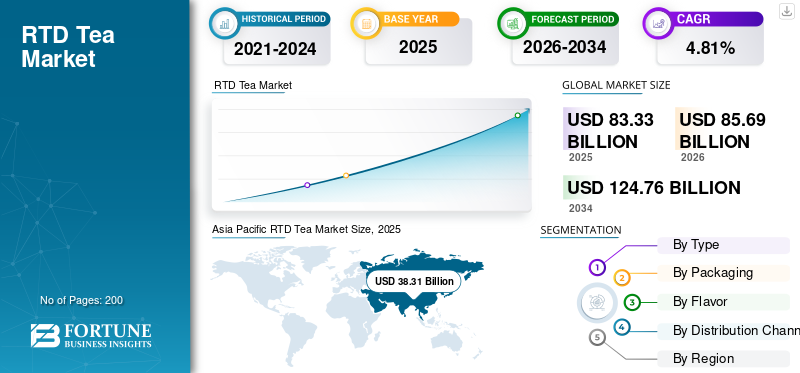
The global RTD tea market size was valued at USD 83.33 billion in 2025. The market is projected to grow from USD 85.69 billion in 2026 to USD 124.76 billion by 2034, exhibiting a CAGR of 4.81% during the forecast period. Asia Pacific dominated the RTD tea market with a market share of 45.97% in 2025.
Ready-to-drink (RTD) tea refers to packaged tea-based beverages that are brewed, blended, flavored, bottled, canned, or packed for direct consumption without additional preparation. The category includes black tea, green tea, oolong tea, white tea, herbal and blended tea formats, and flavored variants sold through retail, convenience, online, and foodservice channels. RTD tea has gained strong relevance in the global beverage industry as consumers shift from carbonated soft drinks toward lighter, refreshing, lower-sugar, antioxidant-positioned, and functional non-alcoholic beverages.
The global market demand is supported by leading beverage companies such as The Coca-Cola Company, PepsiCo, Nestlé S.A., Keurig Dr Pepper Inc., Suntory Holdings Limited, Ito En, Ltd., Unilever PLC, Danone S.A., Arizona Beverage Company, and Ting Hsin International Group. These companies maintain active positions in bottled tea, iced tea, functional beverages, flavored tea drinks, and convenience-led non-alcoholic refreshment platforms.
Download Free sample to learn more about this report.
RTD Tea Market Key Takeaways
 Global Market Size & Forecast
- 2025 Market Size: USD 83.33 billion
- 2026 Market Size: USD 85.69 billion
- 2034 Forecast Market Size: USD 124.76 billion
- CAGR: 4.81% from 2026–2034
 Market Share
- Asia Pacific dominated the RTD tea market with a 45.97% share in 2025.
- Black tea was the leading type segment, valued at USD 39.04 billion in 2025.
- PET bottles led the packaging segment, valued at USD 46.24 billion in 2025.
 Key Regional Highlights
Asia Pacific
Asia Pacific led the market with USD 38.31 billion in 2025 and is projected to reach USD 63.55 billion by 2034 at a 6.00% CAGR.
North America
North America reached USD 21.36 billion in 2025 and is forecast to grow to USD 27.63 billion by 2034.
Europe
Europe was valued at USD 15.03 billion in 2025 and is expected to reach USD 20.04 billion by 2034.
U.S.
The U.S. market was valued at USD 18.15 billion in 2025, leading the North American market.
Japan
Japan's RTD tea market was valued at USD 9.88 billion in 2025, supported by its well-established ready-to-drink tea culture.
Read More

RTD Tea Market Trends
Increasing Demand for Healthier, Low-Sugar, and Functional Refreshment Beverages to Shape Industry Trends
A major trend in the global market is the rising consumer preference for beverages positioned around natural refreshment, lower sugar content, antioxidants, botanicals, and offer functional benefits. Consumers are increasingly replacing carbonated soft drinks and high-sugar juices with tea-based beverages that offer hydration, taste, and perceived wellness benefits in a convenient format. This trend is particularly visible in urban markets, where younger consumers are adopting bottled green tea, fruit-infused iced tea, zero-sugar tea, kombucha-inspired tea drinks, and herbal tea blends as part of daily consumption routines.
Additionally, brands are expanding into premium flavors, cold-brew tea, sparkling tea, unsweetened tea, plant-based functional blends, and clean-label formulations. Packaging innovation is also playing a major role, with PET bottles continuing to dominate mass retail channels while cans and tetra packs gain traction among younger consumers and on-the-go shoppers.
- The International Tea Committee reported that global tea production reached approximately 6.604 million metric tons in 2023, up 2% from 2022 and 26% over the previous decade. Further, supporting a stable raw material base for tea-based beverage manufacturing.
MARKET DYNAMICS
Market Drivers
Download Free sample to learn more about this report.
Rising Consumption of Convenient Non-Alcoholic Beverages to Support Market Growth
The global RTD tea market growth is being significantly supported by the expansion of convenient, packaged, non-alcoholic beverages across retail and foodservice channels. Consumers prefer healthier beverages that combine portability, taste, hydration, and health-oriented positioning. Ready-to-drink tea fits this shift well, as it offers a familiar tea base while allowing brands to innovate with fruit flavors, low-calorie sweeteners, herbal infusions, vitamins, botanicals, and premium brewing claims.
The growth of modern retail, convenience stores, vending formats, quick-service restaurants, cafés, and e-commerce grocery platforms has further improved product availability. In developed markets, ready-to-drink tea is benefiting from demand for unsweetened and zero-sugar beverages. In emerging markets, the category is expanding through affordable PET bottles, locally preferred flavors, and growing cold-chain and distribution infrastructure.
- According to the U.S. Census Bureau and the Tea Association of the U.S.A., tea is found in almost 80% of U.S. households, and more than 159 million Americans drink tea on any given day. Further, showing the depth of consumer familiarity that supports RTD tea adoption.
Market Restraints
Sugar Content Concerns, Raw Tea Price Volatility, and Packaging Sustainability Pressures to Limit Market Expansion
The growth of the market is being constrained by rising scrutiny over sugar content, sweeteners, artificial flavors, and plastic packaging. Many traditional iced tea products contain high levels of added sugar, which can weaken their health positioning compared with unsweetened tea, flavored water, and other functional beverages. As consumers become more label-conscious, manufacturers face pressure to reformulate products without compromising taste, shelf stability, or affordability.
Raw tea supply and pricing also remain important challenges. Tea production is highly sensitive to weather, rainfall, temperature variation, and labor availability in major producing countries such as China, India, Kenya, Sri Lanka, and Vietnam. Climate-related disruptions can affect leaf quality and availability, increasing procurement costs for beverage manufacturers. At the same time, the wide use of PET bottles exposes the category to regulatory and consumer pressure around plastic waste, recyclability, and carbon footprint.
- The World Health Organization (WHO) recommends reducing free sugar intake to less than 10% of total energy intake, with a further conditional recommendation to reduce it to below 5% for additional health benefits.
Market Opportunities
Premiumization and Expansion of Functional Tea Beverages to Unlock Growth Potential
The expansion of premium, functional, and digitally distributed ready-to-drink tea products is expected to create substantial growth opportunities during the global RTD tea market forecast period. Consumers are showing strong interest in beverages that offer more than basic refreshment, including green tea with antioxidants, herbal tea with relaxation claims, energy-support blends, digestive-positioned tea, sparkling tea, cold-brew tea, and reduced-calorie formulations. These formats allow beverage companies to command higher pricing while differentiating from conventional iced tea.
- For instance, in April 2026, Blue Bear, a functional ready-to-drink tea brand, officially launched "Refresh," a caffeine-free functional tea designed to provide immune system and hydration support. This launch marks the brand's expansion into a "full-day wellness" product ecosystem, further solidifying its market position as an "anti-energy drink" alternative.
SEGMENTATION ANALYSIS
By Type
Black Tea Segment Dominated the Market Due to Wide Use in Iced Tea, Sweet Tea, and Mass-Market RTD Formulations
Based on type, the market is segmented into black tea, green tea, oolong tea, white tea, and others.
The black tea segment dominated the global market, valued at USD 39.04 billion in 2025. The growth is owing to its strong use in conventional iced tea, sweet tea, lemon tea, milk tea, and mainstream bottled tea products across North America, Europe, and Asia. Black tea offers a familiar flavor profile, strong brewing base, and compatibility with sugar, fruit flavors, dairy, and functional ingredients.
The oolong tea segment is projected to grow at the fastest CAGR of 7.38% during 2026-2034. Such growth is supported by rising demand for premium Asian tea formats, lightly fermented tea beverages, and differentiated flavor profiles.
To know how our report can help streamline your business, Speak to Analyst
By Packaging
PET Bottles Segment Dominated the Market Due to Affordability, Portability, and Mass Retail Penetration
Based on packaging, the market is segmented into PET bottles, glass bottles, cans, tetra packs, and others.
The PET bottles segment dominated the global RTD tea market share, valued at USD 46.24 billion in 2025. This growth is due to its low cost, lightweight structure, resealability, convenience, and strong suitability for chilled and ambient retail distribution. PET bottles are widely used by leading RTD tea brands for single-serve and family-size formats across supermarkets, convenience stores, vending machines, and foodservice outlets.
The cans segment is projected to grow at the fastest CAGR of 7.13% from 2026 to 2034, supported by increasing demand for premium, sparkling, cold-brew, and functional tea beverages among younger consumers.
By Flavor
Flavored Segment Dominated the Market Due to Strong Consumer Preference for Fruit, Herbal, and Sweetened Iced Tea Variants
Based on flavor, the market is segmented into plain/unflavored and flavored.
The flavored segment dominated the global market and was valued at USD 56.26 billion in 2025. Such dominance is attributed to strong demand for lemon, peach, berry, mango, honey, mint, and other fruit-based tea flavors across mass retail and convenience channels. Flavored ready-to-drink tea benefits from broader taste appeal, especially among younger consumers and occasional tea drinkers who prefer sweeter and more refreshing beverage profiles. The segment is also projected to grow at the fastest CAGR of 4.93% during the forecast period.
The plain/unflavored segment is projected to grow at a moderate CAGR of 6.88% during the forecast period. The growth is supported by rising demand for unsweetened tea, clean-label formulations, zero-sugar beverages, green tea, and premium brewed tea products.
By Distribution Channel
Retail Segment Dominated the Market Due to Strong Supermarket, Convenience Store, and Online Beverage Sales
Based on distribution channel, the market is segmented into food service and retail, with retail further classified into supermarkets & hypermarkets, convenience stores, online retail, specialty stores, and others.
The retail segment dominated the global market, valued at USD 73.83 billion in 2025, as bottled and packaged tea is primarily purchased through supermarkets, hypermarkets, convenience stores, grocery chains, vending formats, and online platforms. Convenience stores and supermarkets remain especially important due to impulse consumption, chilled beverage placement, and wide product availability.
The food service segment is projected to grow at the fastest CAGR of 6.99% during 2026-2034. The growth is supported by higher adoption of iced tea, flavored tea, and premium tea beverages across cafés, restaurants, quick-service outlets, and institutional foodservice.
RTD Tea Market Regional Outlook
Regionally, the market is studied across North America, Europe, Asia Pacific, South America, and the Middle East & Africa.
Asia Pacific
Asia Pacific RTD Tea Market Size, 2025 (USD Billion)
To get more information on the regional analysis of this market, Download Free sample
Asia Pacific dominated the global market, valued at USD 38.31 billion in 2025, and is projected to reach USD 63.55 billion by 2034. Further, the region is growing at the fastest CAGR of 6.00% over the forecast period. Growth is driven by strong tea-drinking cultures, high urban population density, expanding convenience retail, rising disposable incomes, and rapid innovation in green tea, milk tea, fruit tea, and functional tea beverages.
China RTD Tea Market
China dominates the regional market and was valued at approximately USD 15.61 billion in 2025. Such growth is supported by its large tea-consuming population, strong domestic tea production, rapid growth of new-style tea beverages, and extensive convenience store and e-commerce beverage distribution.
Japan RTD Tea Market
Japan was valued at approximately USD 9.88 billion in 2025. It is supported by one of the world’s most developed ready-to-drink tea cultures, strong vending machine penetration, convenience store availability, and high consumption of unsweetened green tea and oolong tea.
North America
North America was valued at USD 21.36 billion in 2025 and is projected to reach USD 27.63 billion by 2034, growing at a CAGR of 3.11% during the forecast period. Growth is driven by high consumption of bottled iced tea, strong convenience store penetration, increasing demand for unsweetened and zero-sugar beverages, and expanding foodservice availability of iced tea.
U.S. RTD Tea Market
The U.S. dominates the North American market, valued at approximately USD 18.15 billion in 2025. The growth is supported by widespread iced tea consumption, strong retail distribution, convenience-led beverage purchases, and high household familiarity with tea.
Europe
Europe was valued at USD 15.03 billion in 2025 and is projected to reach USD 20.04 billion by 2034, growing at a CAGR of 3.46% over the forecast period. Growth is supported by increasing demand for low-sugar beverages, premium iced tea, organic tea formulations, and convenient non-carbonated refreshment products.
Germany RTD Tea Market
Germany was valued at approximately USD 2.72 billion in 2025, supported by strong retail penetration, high consumer preference for flavored iced tea, and increasing demand for organic, reduced-sugar, and functional beverage formats.
U.K. RTD Tea Market
The U.K. market was valued at approximately USD 2.45 billion in 2025. Such growth is due to the country’s deep-rooted tea culture and rising acceptance of chilled, bottled, and flavored tea beverages among younger consumers.
South America and the Middle East & Africa
South America was valued at USD 5.31 billion in 2025 and is projected to reach USD 8.71 billion by 2034, growing at a CAGR of 5.87% over the forecast period. Growth in the region is driven by increasing demand for non-carbonated beverages, expanding modern retail, rising health awareness, and growing availability of flavored iced tea in Brazil, Chile, and Argentina.
The Middle East & Africa market was valued at USD 3.32 billion in 2025 and is projected to reach USD 4.83 billion by 2034, growing at a CAGR of 4.47% over the forecast period. Growth is supported by hot-climate beverage consumption, increasing demand for chilled refreshment products, expansion of supermarkets and convenience stores, and rising availability of packaged tea beverages across the Gulf countries and South Africa.
Brazil RTD Tea Market
Brazil dominates the South American market, valued at approximately USD 2.60 billion in 2025. The dominance is supported by a large urban consumer base, increasing demand for healthier refreshment beverages, and expanding retail availability of flavored iced tea and green tea products.
COMPETITIVE LANDSCAPE
Key Industry Players
Key Players Focus on Low-Sugar Innovation, Premium Tea Blends, Packaging Expansion, and Convenience-Led Distribution to Strengthen Market Position
Key players in the global RTD tea market are focusing on product innovation, flavor diversification, sugar reduction, functional ingredients, and packaging improvements to strengthen their market position. Such players include The Coca-Cola Company, PepsiCo, Nestlé S.A., Suntory Holdings Limited, Ito En, Ltd., Keurig Dr Pepper Inc., Suntory Holdings Limited, Ito En, Ltd., Unilever PLC, Danone S.A., Arizona Beverage Company, and Ting Hsin International Group. Companies are expanding portfolios with green tea, oolong tea, fruit tea, herbal tea, zero-sugar tea, sparkling tea, and premium brewed tea beverages. Strategic partnerships with bottlers, distributors, convenience retailers, cafés, and e-commerce platforms remain central to competitive growth.
Key Players in the Market
|
Rank |
Company Name |
|
1 |
The Coca-Cola Company |
|
2 |
PepsiCo, Inc. |
|
3 |
Nestlé S.A. |
|
4 |
Suntory Holdings Limited |
|
5 |
Ito En, Ltd. |
List of Key RTD Tea Companies Profiled
- The Coca-Cola Company (U.S.)
- PepsiCo, Inc. (U.S.)
- Nestlé S.A. (Switzerland)
- Keurig Dr Pepper Inc. (U.S.)
- Suntory Holdings Limited (Japan)
- Ito En, Ltd. (Japan)
- Unilever PLC (U.K.)
- Danone S.A. (France)
- Arizona Beverage Company (U.S.)
- Ting Hsin International Group (Taiwan)
KEY INDUSTRY DEVELOPMENTS
- April 2026: Pure Leaf launched Pure Leaf Mental Focus, its first functional iced tea line, as a sparkling, real-brewed tea made with naturally occurring caffeine and added L-theanine. The launch was announced and positioned the product around focus and mental clarity.
- March 2026: Lipton has expanded its iced tea portfolio with a new Tropical flavor, adding a mango‑passionfruit blend to its existing flavored lines. The Lipton Ice Tea Tropical variant combines mango and passionfruit to give a tangy, “sunshine‑like” tropical taste. The new flavor is rolling out across U.K. grocery and convenience channels, including chilled‑drink sections.
- March 2026: Spindrift Beverage Co. entered the iced‑tea category with a new line of non‑carbonated ready‑to‑drink teas made with real brewed tea and real squeezed fruit, positioning itself as a “better‑for‑you” alternative to conventional sweetened RTD teas.
- July 2025: Pfanner launched a special‑edition Alpine‑themed Iced Tea in collaboration with Austrian alpine skier Manuel Feller, and this variant is being rolled out exclusively in REWE stores in Germany and Austria.
- April 2022: Jade Forest, an Indian premium non-alcoholic beverage brand launched in 2019, introduced its Premium Iced Teas to target health-conscious consumers seeking low-calorie, antioxidant-rich options.
REPORT COVERAGE
The global industry report analyses the market in depth and highlights crucial aspects such as global market trends, market dynamics, supply chains, prominent companies, investment in research and development, and end-use. Besides this, the report also provides insights into the global RTD tea market analysis and highlights significant industry developments.
Request for Customization to gain extensive market insights.
Report Scope & Segmentation
| ATTRIBUTE | DETAILS |
| Study Period | 2021-2034 |
| Base Year | 2025 |
| Estimated Year | 2026 |
| Forecast Period | 2026-2034 |
| Historical Period | 2021-2024 |
| Growth Rate | CAGR of 4.81% from 2026 to 2034 |
| Unit | Value (USD Billion) |
|
Segmentation |
By Type
|
|
By Packaging
|
|
|
By Flavor
|
|
|
By Distribution Channel
|
|
|
By Region
|
Frequently Asked Questions
Fortune Business Insights says that the global market was valued at USD 83.33 billion in 2025 and is anticipated to reach USD 124.76 billion by 2034.
At a CAGR of 4.81%, the global market will exhibit steady growth over the forecast period.
By flavor, the flavored segment led the market.
Asia Pacific held the largest market share in 2025.
Rising consumption of convenient non-alcoholic beverages to support market growth.
The Coca-Cola Company, PepsiCo, Nestlé S.A., Keurig Dr Pepper Inc., Suntory Holdings Limited, Ito En, Ltd., Unilever PLC, Danone S.A., Arizona Beverage Company, and Ting Hsin International Group are the leading players in the market.
Increasing demand for healthier, low-sugar, and functional refreshment beverages to shape industry trends.



- 2021-2034
- 2025
- 2021-2024
- 200
-
(Offer valid till 30th Sep 2026)
Get 30-60 hrs Free Customization
Expand Regional and Country Coverage, Segments Analysis, Company Profiles, Competitive Benchmarking, and End-user Insights.




















Related Reports
-
US +1 833 909 2966 ( Toll Free )
-
Get In Touch With Us