SaaS-based Core Banking Software Market Size, Share & Industry Analysis, By Deployment (Public Cloud, Private Cloud, and Hybrid Cloud), By Banking Type (Large Banks, Midsize Banks, Small Banks, Community Banks, and Credit Unions), By End-User (Retail Banking, Treasury, Corporate Banking, and Wealth Management), and Regional Forecast, 2026–2034
 Download Free Sample
KEY MARKET INSIGHTS
 Listen to Audio Version
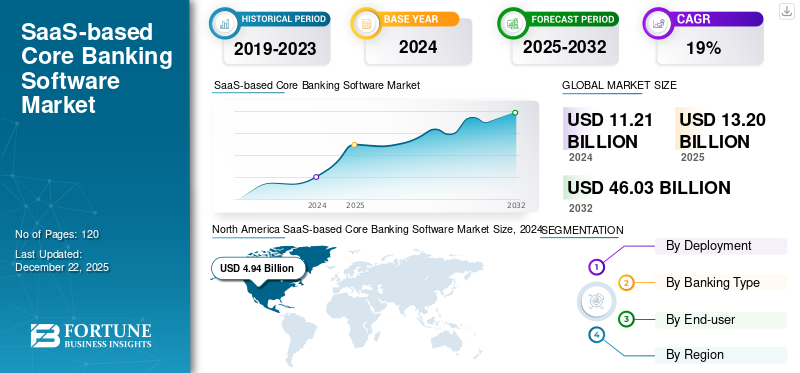
The global SaaS-based core banking software market size was valued at USD 13.2 billion in 2025. The market is projected to grow from USD 15.77 billion in 2026 to USD 65.78 billion by 2034, exhibiting a CAGR of 19.54% during the forecast period. North America dominated the market with a share of 44.07% in 2024.
SaaS-based core banking software offers banks and financial institutions a cost-effective alternative as it eliminates the need for significant upfront investments in hardware and reduces maintenance costs.
- According to industry experts, banks that moved to SaaS-based systems saved upto 40% on infrastructure and maintenance costs compared to legacy systems.
- According to Accenture, as of 2024, around 76% of banking customers prefer digital-first services.
- As per the survey by industry experts, around 70% of financial institutions stated that security and compliance improvements are key reasons for switching to SaaS platforms.
Download Free sample to learn more about this report.
SAAS-BASED CORE BANKING SOFTWARE MARKET KEY TAKEAWAYS
 Market Size & Forecast
- 2025 Market Size: USD 13.20 Billion
- 2026 Market Size: USD 15.77 Billion
- 2034 Forecast Market Size: USD 65.78 Billion
- CAGR: 19.54% from 2026–2034
 Market Share
- North America dominated the SaaS-based core banking software market with a 44.07% share in 2024.
- Public cloud segment held the largest market share in 2024.
- Large banks segment accounted for the dominant market share in 2024.
 Key Regional Highlights
North America
North America led the market in 2024, driven by rapid digital transformation, high mobile banking adoption, and strong cloud implementation.
Europe
Europe is the second-largest market, supported by rising demand for real-time banking solutions and regulatory compliance requirements.
Asia Pacific
Asia Pacific is expected to register the highest CAGR during the forecast period due to increasing banking modernization and technology investments.
U.S.
The market is growing due to rising digital banking adoption, with digital banking users expected to exceed 216.8 million by 2025.
Japan
The market is supported by increasing banking digitalization, cloud adoption, and demand for advanced core banking platforms.
Read More

GENERATIVE AI IMPACT
Generative AI impact on SaaS-based core banking software is significant. Players in the market adopt generative AI to generate code for core banking applications, reducing manual effort and speeding up the development of new banking features. Generative AI helps to generate the backend logic for customer verification, loan processing and fraud detection features. Due to this, the time required for the development decreases. Also, generative AI automatically generates customer reports or analyzes transaction data for insights. Generative AI can offer personalized customer experience by analyzing data and generating customized recommendations and product offerings tailored to individual customers.
IMPACT OF RECIPROCAL TARIFF
The impact of reciprocal tariffs on the market is complex. SaaS providers operate on subscription-based pricing models, and increased costs due to tariffs may force companies to hike their prices, possibly affecting demand. SaaS platforms rely on hardware and third-party software tools that are sourced globally. Reciprocal tariffs on technology imports will disrupt supply chains, causing delays and increasing procurement costs.
Many SaaS core banking providers depend on global cloud infrastructure providers such as Amazon Web Services (AWS), Microsoft Azure, or Google Cloud. Suppose there are tariffs imposed on cloud-based solutions or services. In that case, it will affect pricing and the ability of SaaS vendors to expand their services or offer competitive pricing in certain regions.
SAAS-BASED CORE BANKING SOFTWARE MARKET TRENDS
Popularity of API-driven Open Banking System Boosts Market Growth
In recent years, the financial and banking services industry has shifted its focus to open banking. This innovative banking approach is transforming how financial institutions operate and interact with their customers. Through open banking, third-party financial service providers can access transactions, consumer banking, and other financial data from banks and non-bank financial institutions through application programming interfaces (APIs).
Implementing API-based architectures is driving the open banking movement, renovating core banking systems into platforms that support extensive third-party integration. As per Finastra’s Banking as a Service Outlook 2023, around 85% of banks stated that open banking is a strategic priority. According to the Open Banking Implementation Entity, call volume through API has increased by 385% in 2022, and due to this, the European open banking market has witnessed significant growth. This growth has supported the formation of diverse financial ecosystems where specialized providers can provide complementary services through a unified customer experience.
Therefore, the popularity of API-driven open banking systems is expected to boost market growth.
MARKET DYNAMICS
MARKET DRIVERS
Shift in Consumer Behavior and Expectations Propel Market Growth
In recent years, consumer expectations have changed. As per a Salesforce report, around 73% of banking customers said that having a smooth digital experience is one the main reasons they opt for digital banking, and due to these banks are focusing on enhancing their customer experience instead of just offering more products.
The demand for hyper-personalization has surged, with customers expecting personalized financial insights and recommendations. According to Accenture, banks leveraging their core systems to deliver tailored experiences have witnessed a 40% increase in customer engagement and a 30% reduction in attrition rates.
Therefore, a shift in consumer behavior and expectations is driving the SaaS-based core banking software market growth.
MARKET RESTRAINTS
Data Security Concerns to Limit Market Expansion
Core banking operations handle extremely sensitive financial and customer data. These banks often hesitate to host this information off-premises due to concerns related to cyber-attacks, regulatory penalties, and data breaches. Therefore, data privacy and security concerns are restricting market growth.
MARKET OPPORTUNITIES
Expansion in Emerging Markets is Expected to Create Opportunities for Players
Expanding core banking software in emerging countries such as Africa, Asia Pacific, and South America is expected to create opportunities for players. Emerging countries, including India, Africa, Brazil, and others, are witnessing a transformation in their banking landscapes, and core banking providers are at the forefront of this change.
Emerging markets have a huge underbanked population. Therefore, core banking software providers can offer this market affordable, mobile-first solutions that help to expand financial access to the underbanked population, mainly in rural and underserved areas. For instance, In India, the government’s Pradhan Mantri Jan Dhan Yojana initiatives aim to bring millions of unbanked population into the formal financial system.
Thereby, expansion in emerging markets is expected to surge the SaaS-based core banking software market share of the players.
SEGMENTATION ANALYSIS
By Deployment
Public Cloud Segment Dominated Owing to Increasing Need for On-Demand Scaling
Based on deployment, the market is classified into public cloud, private cloud, and hybrid cloud.
Among these, the public cloud segment dominated the market in 2024, as it offers scalability, faster deployment, and on-demand scaling. For instance, banks scale up during the peak seasons and down during low activity periods. Public cloud deployment helps banks to reduce downtime and ensure smooth recovery in case of disasters.
The hybrid cloud deployment is estimated to grow with the highest CAGR during the forecast period. Banks operate in highly regulated environments and must comply with local data laws and industry-specific standards. Therefore, adopting a hybrid cloud is increasing as a hybrid setup allows sensitive workloads to be stored in the private cloud while other workloads move to the public cloud.
By Banking Type
Large Banks Led Market as They Offer Personalized, Digital-first and Real-time Customer Experience
Based on banking type, the market is segmented into large banks, midsize banks, small banks, community banks, and credit unions.
Among these, large banks dominated the market in 2024. Large banks require systems to handle massive transaction volumes and millions of customers. SaaS solutions built on cloud-native architecture are used for this purpose. Large banks focus on providing personalized, digital-first, and real-time experience. Due to this, the demand for SaaS solutions is increasing as they provide open APIs, integration with digital channels, and real-time processing that helps enable instant payments, dynamic product offerings, and hyper-personalization.
Community banks are estimated to register the highest CAGR during the forecast period. This is due to the SaaS solution eliminates the need for expensive hardware, data centers, and IT infrastructure and offers subscription-based pricing, which is easier for community banks to manage.
By End-user
Adoption of SaaS-based Core Banking Software to Identify Frauds Fosters Retail Banking Segment Growth
Based on end-user, the market is segmented into retail banking, treasury, corporate banking, and wealth management.
Among these, the retail banking segment captured the largest market share in 2024. Retail banks focus more on customer-centric experiences, so the bank needs real-time data, integrated systems, and AI/ML tools to personalize offers, identify frauds, and improve service. The demand for SaaS-based solutions is increasing as this solution easily integrates analytics tools, third-party APIs, and CRM platforms. This leads to a more engaging, predictive, and personalized customer experience.
The wealth management segment is estimated to register the highest CAGR during the forecast period. Wealth management focuses on adopting platforms that offer digital portals, mobile apps, chatbots, and real-time dashboards as their client wants to track performance, communicate with advisors, and adjust goals on their own time. SaaS solutions enable this level of agile, omni-channel engagement.
SAAS-BASED CORE BANKING SOFTWARE MARKET REGIONAL OUTLOOK
By region, the market is categorized into North America, South America, Europe, Middle East & Africa, and Asia Pacific.
North America
North America SaaS-based Core Banking Software Market Size, 2024 (USD Billion)
To get more information on the regional analysis of this market, Download Free sample
North America dominated the market with the highest share in 2024, driven by digital transformation across traditional banks, evolving customer expectations, and the need for operational efficiency. Digital banking or mobile banking usage has surged in the region. The implementation of cloud services and the presence of many financial institutions in the region are aiding the market growth.
Download Free sample to learn more about this report.
The U.S. is estimated to witness significant growth in coming years, owing to increased mobile and digital banking use. Digital banking users in the U.S. are expected to surpass 216.8 million by the end of 2025. Bank of America leads with around 30 million active mobile app users and over 40 million online banking customers. According to American Banker, around 70% of banks in the U.S. have digital transformation as a top strategic priority. Therefore, due to the above reasons, the demand for SaaS-based core banking software is increasing in the U.S.
Asia Pacific
The market in Asia Pacific is estimated to grow with the highest CAGR during the forecast period. Financial institutions in the region strive to remain competitive and up-to-date with modern technology, and due to this demand for SaaS-based core banking software is increasing. The core banking system represents significant investments to banks, but the benefits of this system are worth it. As per KPMG, core banking system upgrades in the region tend to cost around USD 50 million to USD 200 million, depending on the project's complexity.
Europe
Europe is the second-largest market for SaaS-based core banking software, owing to increasing demand for real-time banking solutions. Banks in the region are increasingly adopting core banking software to enhance security and comply with regulatory requirements.
Middle East & Africa
The Middle East & Africa region is estimated to grow significantly in the coming years. Banks across the region are increasing their IT budgets by an average of 4.4% to support modernization efforts and meet evolving compliance requirements.
South America
South America is likely to register a steady growth rate over the forecast period. The number of fintech startups in the region has reached 3,000 in 2023. These startups primarily focus on providing financial services to the unbanked population, driving the need for SaaS-based core banking software.
COMPETITIVE LANDSCAPE
KEY INDUSTRY PLAYERS
Continuous Development and Introduction of New Products by Key Companies Resulted in Their Dominating Positions in the Market
Key players in the market are entering into strategic partnerships and acquisitions with other players. The significant players implement this strategy to integrate services with advanced technologies. Also, through business strategies, the companies are expanding their business and gaining expertise by reaching a mass customer base. Various companies collaborate to enhance their product offerings. Market players aim to develop their products based on emerging technologies to resolve companies' challenges.
List of Key SaaS-based Core Banking Software Companies Profiled
- Mambu (Netherlands)
- nCino (U.S.)
- Skaleet (France)
- Backbase (Netherlands)
- Avaloq (Switzerland)
- Ohpen (Netherlands)
- FIS (U.S.)
- TCS BaNCS (India)
- Oracle FLEXCUBE (India)
- Temenos (Switzerland)
- EdgeVerve (India)
- SDK Finance (Lithuania)
- United Bank (U.S.)
- Finastra (U.K.)
… and more
KEY INDUSTRY DEVELOPMENTS
- February 2025: nCino acquired Sandbox Banking to help financial institutions overcome costly integration challenges.
- December 2024: Backbase partnered with Seven, a consulting firm based in Morocco, to drive digital banking innovation in Africa and the Middle East.
- June 2024: nCino introduced Banking Advisor, a new AI solution to provide financial institutions with a modern approach to proactive portfolio management.
- January 2024: Temenos launched Temenos Banking Cloud to help banks deploy software solutions in 24 hrs and reduce modernization costs.
- June 2023: Avaloq partnered with BlackRock to enhance its investment technology solutions for private banks and wealth managers.
REPORT COVERAGE
The global SaaS-based core banking software market analysis provides market size & forecast by all the segments included in the report. It includes details on the market dynamics and market trends expected to drive the market in the forecast period. It offers information on key industry developments, new product launches, and details on partnerships, mergers & acquisitions. The report covers a detailed competitive landscape with information on the market share and profiles of key players.
Request for Customization to gain extensive market insights.
REPORT SCOPE & SEGMENTATION
|
ATTRIBUTE |
DETAILS |
|
Study Period |
2021-2034 |
|
Base Year |
2025 |
|
Estimated Year |
2026 |
|
Forecast Period |
2026-2034 |
|
Historical Period |
2021-2024 |
|
Growth Rate |
CAGR of 19.54% from 2026 to 2034 |
|
Unit |
Value (USD Billion) |
|
Segmentation |
By Deployment
By Banking Type
By End-User
By Region
|
Frequently Asked Questions
Fortune Business Insights says that the global market value stood at USD 13.2 billion in 2025 and is projected to reach USD 65.78 billion by 2034.
In 2024, the market value stood at USD 4.94 billion.
The market is expected to exhibit a CAGR of 19.54% during the forecast period of 2026-2034.
The large banks segment led the market.
A shift in consumer behavior and expectations is propelling the market growth.
Mambu, Temenos, Avaloq, Oracle FLEXICUBE, nCino, Skaleet, and Backbase are the top players in the market.
North America dominated the market in 2024.
The wealth management segment is estimated to register the highest CAGR during the forecast period.



- 2021-2034
- 2025
- 2021-2024
- 120
Get 30-60 hrs Free Customization
Expand Regional and Country Coverage, Segments Analysis, Company Profiles, Competitive Benchmarking, and End-user Insights.




















Related Reports
-
US +1 833 909 2966 ( Toll Free )
-
Get In Touch With Us