Salicylic Acid Market Size, Share & Industry Analysis, By Application (Pharmaceutical, Food & Preservatives, Cosmetics), By Region (North America, Europe, Asia Pacific, Latin America, MEA), and Regional Forecast, 2026-2034
 Download Free Sample
Salicylic Acid Market Overview
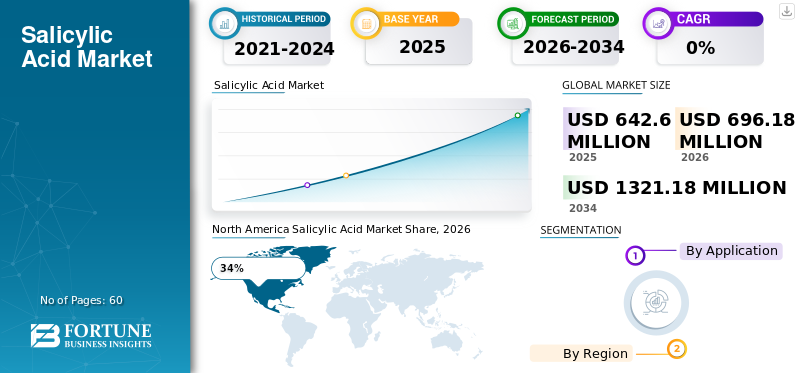
The salicylic acid market size was valued at USD 603.46 million in 2025 and is projected to grow from USD 653.64 million in 2026 to USD 1,238.43 million by 2034, exhibiting a CAGR of 8.32% during the forecast period.

The salicylic acid market is supported by broad demand from pharmaceuticals, cosmetics, personal care, specialty chemicals, and selected preservation applications. Salicylic acid is valued for its keratolytic, antimicrobial, anti-inflammatory, and chemical-intermediate properties. Manufacturers supply multiple purity grades designed for pharmaceutical, cosmetic, technical, and industrial requirements. The salicylic acid market report reflects growing procurement from skincare formulators, pharmaceutical manufacturers, contract manufacturers, and specialty chemical producers. The salicylic acid market analysis also highlights increasing demand for high-purity material, consistent particle characteristics, reliable documentation, and regulatory-compliant production. Pharmaceutical applications remain an important foundation, while cosmetics and personal care are strengthening their position through acne-care, exfoliation, scalp-care, and targeted treatment formulations.
The USA salicylic acid market is characterized by established pharmaceutical manufacturing, advanced dermatology products, and strong demand for functional skincare ingredients. Salicylic acid is widely incorporated into acne cleansers, exfoliating formulations, medicated treatments, shampoos, and other personal-care products. The pharmaceutical supply chain also uses salicylic acid as an intermediate and active ingredient in selected formulations. The salicylic acid market Insights for the United States indicate that buyers increasingly prioritize pharmaceutical-grade quality, traceability, dependable supply, and formulation support. Demand from contract manufacturers and private-label skincare producers is creating additional procurement opportunities. North American buyers are also emphasizing formulation compatibility, documentation, batch consistency, and responsible sourcing when selecting salicylic acid suppliers.
Download Free sample to learn more about this report.
Salicylic Acid Market Key Takeaways
 Global Market Size & Forecast
- 2025 Market Size: USD 603.46 million
- 2026 Market Size: USD 653.64 million
- 2034 Forecast Market Size: USD 1,238.43 million
- CAGR: 8.32% from 2026–2034
 Market Share
- The market in Asia-Pacific dominated with a 27% share in 2025.
- Cosmetics dominated the application segment with a 49% market share.
- Pharmaceutical applications accounted for a 42% market share.
 Key Regional Highlights
Asia Pacific
The market in Asia-Pacific dominated with a 27% share in 2025, driven by skincare demand and pharmaceutical production.
North America
The market in North America accounted for a 26% share, supported by advanced cosmetics and pharmaceutical applications.
Europe
The market in Europe accounted for a 24% share, driven by skincare demand and established pharmaceutical industries.
United Kingdom
The market in the UK accounted for 20% of Europe’s market, supported by growing skincare and pharmaceutical demand.
Japan
The market in Japan accounted for 18% of Asia-Pacific’s market, driven by advanced skincare and pharmaceutical applications.
Read More

Salicylic Acid Market Latest Trends
The salicylic acid market trend are increasingly shaped by premium skincare, multifunctional formulations, high-purity pharmaceutical ingredients, and controlled-delivery technologies. Cosmetic formulators are moving beyond traditional acne products and incorporating salicylic acid into body-care, scalp-care, pore-refining, exfoliating, and blemish-management formulations. The ingredient is also being combined with complementary actives to improve consumer acceptance and address multiple skin concerns in a single product.
A major trend within the salicylic acid market research report landscape is the development of delivery systems that improve dispersion, stability, water compatibility, and controlled release. Encapsulation is gaining attention because it can help formulators manage the handling characteristics of salicylic acid and design more sophisticated personal-care products. In 2024, Flychem introduced encapsulated salicylic acid products using its ProbiCap technology, illustrating the movement toward specialized ingredient formats.
Another important trend is increasing differentiation between pharmaceutical-grade, cosmetic-grade, and technical-grade material. Buyers are seeking specifications tailored to the final application rather than treating salicylic acid as a standardized commodity. Sustainability, manufacturing transparency, quality assurance, export documentation, and supply continuity are becoming stronger purchasing considerations. The salicylic acid industry analysis therefore increasingly focuses on quality differentiation, application-specific grades, formulation assistance, and regional supply-chain resilience.
Download Free sample to learn more about this report.
Salicylic Acid Market Dynamics
DRIVER
Rising demand for dermatological and personal-care formulations
The strongest driver for the salicylic acid market is the expanding use of salicylic acid in dermatological, skincare, and personal-care products. Its ability to exfoliate dead skin cells and support pore-cleansing formulations has established it as a widely recognized active ingredient for acne and blemish management. Pharmaceutical and cosmetic manufacturers use the ingredient in cleansers, creams, gels, lotions, toners, peels, shampoos, and specialized treatment products. The growing emphasis on skin health has increased demand from both mass-market and premium personal-care manufacturers.
The salicylic acid market growth is also supported by the expansion of targeted skincare routines. Consumers increasingly seek products addressing acne, clogged pores, uneven texture, excess oil, and scalp concerns. This creates opportunities for manufacturers to develop multiple formulations around the same active ingredient. Pharmaceutical demand provides another stable foundation because salicylic acid is used in topical treatments and as an intermediate for salicylate-related products. Market studies identify pharmaceutical applications as a major demand center, while cosmetics and personal care continue to attract formulation innovation.
From a B2B perspective, the driver extends beyond finished-product demand. Ingredient suppliers benefit when brands launch new product lines, contract manufacturers expand capacity, and pharmaceutical producers seek dependable API or intermediate inputs. Buyers increasingly require stable purity, low impurity levels, reproducible specifications, and regulatory documentation. Consequently, suppliers capable of supporting high-volume contracts and specialized grades are better positioned to capture recurring business.
RESTRAINT
Regulatory restrictions and application-specific safety requirements
Regulatory requirements represent a significant restraint for the salicylic acid market because acceptable concentrations, product categories, labeling practices, and permitted uses can differ across jurisdictions. Manufacturers supplying cosmetics, pharmaceuticals, and food-related applications must maintain appropriate documentation and comply with the requirements of destination markets. This increases compliance costs and can lengthen product-development cycles.
The food and preservatives segment faces particular pressure because regulatory acceptance of salicylic acid for food applications varies substantially across markets. Industry participants must therefore distinguish clearly between historical applications and currently permitted uses. Some Asian markets have moved toward tighter controls, encouraging food manufacturers to investigate alternative preservation systems.
The restraint also affects product development. Cosmetic brands must balance efficacy with irritation potential and consumer expectations around safe, gentle formulations. Pharmaceutical manufacturers face more stringent requirements concerning purity, residual substances, production controls, and documentation. These factors favor established producers with strong quality systems but can create barriers for smaller suppliers.
Price volatility in feedstocks and regional supply-demand imbalances can further complicate procurement. Recent market observations have shown meaningful differences between regional pricing conditions, with supply constraints and plant maintenance influencing availability in some markets.
MARKET OPPORTUNITY
Expansion of high-purity and advanced-delivery salicylic acid products
The salicylic acid market Opportunities are expanding through high-purity grades, encapsulated ingredients, controlled-release systems, and application-specific solutions. Conventional salicylic acid remains important, but ingredient suppliers can create additional value by improving solubility, dispersibility, stability, sensory characteristics, and compatibility with modern formulations.
Encapsulation is particularly attractive because traditional salicylic acid can present formulation challenges related to solubility and irritation management. New delivery systems allow suppliers to offer differentiated ingredients rather than competing solely on commodity pricing. Flychem's 2024 introduction of encapsulated salicylic acid illustrates this direction, with liquid and powder formats developed for personal-care and pharmaceutical formulations.
Another opportunity exists in pharmaceutical-grade supply. Buyers increasingly prefer suppliers that can provide globally recognized quality standards, manufacturing consistency, analytical documentation, and reliable export capabilities. Suppliers with integrated manufacturing and strong quality-control systems can develop long-term relationships with pharmaceutical companies and contract manufacturers.
The salicylic acid market outlook also includes opportunities in scalp care, body care, professional dermatology, specialty cosmetics, and combination formulations. These applications allow manufacturers to increase the value generated from salicylic acid through differentiated finished products. Agricultural and specialty chemical applications can provide additional demand outside traditional skincare and pharmaceutical categories.
CHALLENGE
Managing supply-chain complexity while maintaining consistent quality
One of the major challenges in the salicylic acid industry report landscape is maintaining consistent supply, quality, and pricing across international markets. Salicylic acid production depends on chemical feedstocks, manufacturing capacity, energy availability, transportation infrastructure, and regulatory compliance. Disruptions at major production facilities can influence regional availability and procurement strategies.
Manufacturers serving pharmaceutical and cosmetic customers cannot easily substitute materials without completing qualification and quality checks. This makes supplier continuity particularly important. A buyer may require extensive documentation, analytical testing, validation, and approval before changing suppliers. Consequently, supply interruptions can have a greater operational impact than they would for less specialized chemical commodities.
Another challenge is the need to serve customers across different purity grades and packaging requirements. Pharmaceutical customers may require stringent specifications, while technical applications can prioritize cost efficiency and volume availability. Suppliers therefore need flexible production and logistics systems.
The salicylic acid market analysis also identifies competitive pressure from large-scale producers in Asia. Producers with efficient manufacturing infrastructure can compete aggressively on volume and pricing. European and North American buyers may nevertheless prioritize quality, documentation, and supply reliability, creating a market in which cost and technical performance must be balanced carefully.
Salicylic Acid Market Segmentation
By Application
Pharmaceutical applications form one of the most important segments of the salicylic acid market because salicylic acid is used directly in selected dermatological treatments and indirectly as a chemical intermediate. It is associated with topical preparations for conditions involving excessive keratin buildup, including products addressing warts, corns, calluses, and certain dermatological disorders. It is also an important precursor for acetylsalicylic acid and other salicylate-related chemistry.
Pharmaceutical buyers generally place greater emphasis on purity, reproducibility, analytical testing, GMP-oriented manufacturing, and regulatory documentation. This creates opportunities for suppliers able to deliver consistent pharmaceutical grades across long-term contracts. One major market analysis places pharmaceutical applications at about 42% of the global application mix, demonstrating the importance of this segment.
Food and preservation applications represent 9%, a smaller but historically significant area of salicylic acid demand. The compound has been associated with antimicrobial and preservation functions, but its use in food is subject to regulatory restrictions that vary between markets. This means B2B opportunities are highly dependent on local legislation and application-specific approvals.
Manufacturers supplying this segment must maintain strict product identification and documentation to prevent unsuitable material from entering regulated food channels. The salicylic acid market Forecast for food-related applications therefore depends not only on food processing volumes but also on regulatory acceptance. Where restrictions increase, producers may shift their focus toward specialty chemicals, pharmaceuticals, cosmetics, or industrial applications.
To know how our report can help streamline your business, Speak to Analyst
Cosmetics and personal care represent one of the most commercially dynamic segments of the salicylic acid market. The ingredient is widely recognized for exfoliating and pore-cleansing functions and is incorporated into cleansers, serums, masks, toners, creams, peels, body-care products, and scalp formulations. Demand is supported by growing consumer awareness of active ingredients and the popularity of targeted skincare.
Cosmetic formulators are increasingly looking for differentiated salicylic acid formats, including encapsulated, water-compatible, and controlled-delivery ingredients. Market studies identify skincare and personal care as a leading application area, with one recent assessment placing skincare at about 49%.
For B2B suppliers, the segment offers opportunities through formulation support, technical documentation, customized particle sizes, purity grades, and consistent supply. Premium skincare brands also encourage ingredient suppliers to provide traceability and sustainability information.
Salicylic Acid Market Regional Analysis
North America
North America is an established salicylic acid market with strong pharmaceutical, dermatology, and personal-care demand. The United States represents the largest commercial center in the region because of its extensive skincare industry, pharmaceutical manufacturing base, contract manufacturing activity, and mature retail distribution. Demand is distributed across OTC dermatological products, cosmetic formulations, pharmaceutical intermediates, and specialty chemical applications.
The regional market benefits from high consumer familiarity with salicylic acid. Brands continue to introduce products addressing acne, body blemishes, exfoliation, scalp care, and skin texture. This broad application base gives ingredient suppliers multiple routes to market.
B2B buyers in North America generally emphasize quality consistency, documentation, dependable delivery, and formulation compatibility. Suppliers able to provide pharmaceutical-grade and cosmetic-grade material with strong analytical support can build relationships with manufacturers and contract formulators.
North America is estimated to account for roughly 26% of the global salicylic acid market in the regional distribution used for this report. The region's mature demand structure provides stability, while product innovation remains a major source of incremental procurement.
Europe
Europe is a major salicylic acid market because of its advanced pharmaceutical and cosmetics industries. Germany, the United Kingdom, France, Italy, and other European markets support demand through dermatological products, personal care, pharmaceutical intermediates, and specialty chemical manufacturing.
European formulators tend to place strong emphasis on product safety, regulatory compliance, documentation, and responsible sourcing. This encourages suppliers to maintain detailed technical files and consistent production practices. The region also has a strong premium skincare industry, supporting demand for higher-value formulations.
The salicylic acid market share for Europe is estimated at about 24% under the regional framework applied here. This is consistent with published market research identifying Europe as a leading regional market.
Germany Salicylic Acid Market
Germany is an important European market for salicylic acid because of its pharmaceutical manufacturing, chemical industry, and sophisticated personal-care sector. Demand is supported by dermatological formulations, pharmaceutical intermediates, specialty chemicals, and professional skincare.
German buyers generally emphasize analytical quality, traceability, supply reliability, and regulatory conformity. Pharmaceutical producers require tightly controlled specifications, while cosmetics manufacturers increasingly seek ingredients compatible with premium formulation standards.
Germany is estimated to represent about 28% of the European salicylic acid market. Its role is strengthened by a large industrial base and strong research capabilities. Suppliers seeking German customers need robust quality systems, technical documentation, and dependable logistics.
United Kingdom Salicylic Acid Market
The United Kingdom salicylic acid market benefits from strong demand for skincare, pharmaceutical products, dermatological solutions, and specialty personal-care formulations. British consumers have high awareness of active skincare ingredients, supporting product development around acne control, exfoliation, body care, and scalp treatments.
The market also benefits from a substantial base of cosmetic brands, contract manufacturers, and research-oriented companies. Suppliers can compete through quality, innovation, formulation support, and flexible order sizes.
The United Kingdom is estimated to account for approximately 20% of Europe's salicylic acid market. Recent product activity demonstrates continued interest in salicylic-acid-based body-care and skincare formulations.
Asia Pacific
Asia-Pacific Salicylic Acid Market Share, 2025 (%)
To get more information on the regional analysis of this market, Download Free sample
Asia Pacific represents a highly important salicylic acid market due to its large pharmaceutical manufacturing base, rapidly expanding personal-care industry, chemical production capabilities, and growing middle-class consumer population. China and India are particularly significant, while Japan and South Korea contribute through advanced cosmetics and pharmaceutical applications.
The region offers both supply-side and demand-side advantages. Large chemical manufacturing centers support cost-efficient production, while rising skincare awareness creates additional downstream demand. India is particularly important because of its pharmaceutical manufacturing capabilities and established salicylate producers.
Asia Pacific is estimated to account for about 27% of the global salicylic acid market. Published research identifies the region as one of the strongest demand centers, particularly because of expanding skincare and pharmaceutical consumption.
Japan Salicylic Acid Market
Japan represents a mature salicylic acid market characterized by high-quality cosmetics, pharmaceutical manufacturing, and advanced formulation capabilities. Japanese personal-care companies are known for developing specialized products with carefully controlled ingredient systems, creating demand for consistent and high-quality salicylic acid.
The country's aging population and sophisticated healthcare infrastructure also support pharmaceutical demand. Cosmetic manufacturers focus heavily on gentle formulations, skin texture, pore care, and targeted dermatological applications.
Japan is estimated to represent about 18% of the Asia-Pacific salicylic acid market. Suppliers competing in Japan generally need strong quality assurance, detailed technical documentation, reliable delivery, and the ability to meet exact formulation specifications.
China Salicylic Acid Market
China is one of the largest salicylic acid market centers in Asia Pacific due to its integrated chemical industry, pharmaceutical manufacturing base, cosmetics production, and large domestic consumer market. The country is also an important production hub for salicylic acid and related chemicals.
Chinese manufacturers benefit from extensive chemical infrastructure and access to feedstocks, while domestic skincare demand continues to support downstream applications. Pharmaceutical and personal-care companies are increasingly developing targeted formulations using established active ingredients.
China is estimated to represent approximately 36% of the Asia-Pacific salicylic acid market. Regulatory changes are also influencing application patterns, particularly in food preservation, encouraging manufacturers to redirect capacity toward approved pharmaceutical, cosmetic, and specialty applications.
Rest of World
Rest of World includes Latin America, the Middle East, and Africa. These markets provide emerging opportunities for salicylic acid suppliers through pharmaceutical manufacturing, imported skincare products, cosmetics, and specialty chemical applications. Demand is generally more fragmented than in North America, Europe, or Asia Pacific, but regional development is increasing the need for reliable ingredient supply.
Latin America has an established beauty and personal-care sector, creating opportunities for acne-care and exfoliating formulations. Brazil and Mexico are particularly relevant because of their large consumer markets and growing local manufacturing capabilities.
The Middle East has opportunities in premium skincare, dermatology, and pharmaceutical distribution, while African markets can benefit from increasing healthcare access and local pharmaceutical development. Rest of World is estimated to represent about 13% of the global salicylic acid market under the regional allocation used in this report.
List of Top Salicylic Acid Companies
- Thermo Fisher Scientific Inc.
- Alta Laboratories Ltd.
- Siddharth Carbochem Products Ltd.
- Zhenjiang Gaopeng Pharmaceutical Co., Ltd.
- Novocap SA
- Hebei Jingye Medical Technology Co.
Top Two Companies by Estimated Market Share
- Alta Laboratories Ltd. — 8.5%
- Zhenjiang Gaopeng Pharmaceutical Co., Ltd. — 7.8%
Investment Analysis and Opportunities
Investment opportunities in the salicylic acid market are concentrated in high-purity production, backward integration, capacity expansion, specialty grades, and advanced delivery systems. Pharmaceutical-grade manufacturing is particularly attractive because customers require consistent quality and are less likely to change suppliers without qualification. This supports long-term business relationships for producers with strong manufacturing and regulatory capabilities.
Investment in specialty personal-care ingredients is another promising area. Encapsulation, controlled release, water-compatible formats, and combination-active systems can help ingredient suppliers move from commodity competition toward differentiated products. Manufacturers that provide formulation assistance can capture additional value by becoming technical partners rather than simple raw-material vendors.
India is emerging as an important investment location because of its pharmaceutical manufacturing base and expanding salicylate capacity. Recent industry announcements indicate additional domestic production and capacity-ramp activity, demonstrating continued investment in the regional supply chain.
B2B investors should also evaluate opportunities in regional warehousing, customized packaging, quality-control laboratories, and export-oriented distribution. These services can reduce lead times and improve supply reliability for customers across pharmaceutical and cosmetics industries.
New Product Development
New product development in the salicylic acid market is increasingly focused on solving formulation limitations rather than simply producing conventional salicylic acid. Encapsulation is one of the clearest areas of innovation because it can improve dispersion, handling, stability, and controlled delivery. In 2024, Flychem introduced KOSAVA encapsulated salicylic acid in liquid and powder formats for personal-care and pharmaceutical formulations.
Finished-product manufacturers are also creating new salicylic-acid formats. In 2024, PanOxyl introduced an acne body spray containing salicylic acid, demonstrating expansion from conventional facial products into body-care applications.
Other development directions include salicylic acid combined with niacinamide, soothing ingredients, botanical extracts, ceramides, antioxidants, and other actives. The goal is to deliver acne control or exfoliation while improving consumer comfort.
Pharmaceutical manufacturers are exploring more controlled topical delivery systems, while cosmetic companies are developing lightweight gels, sprays, serums, masks, and scalp products. Suppliers are therefore expected to invest increasingly in formulation laboratories, analytical services, particle engineering, encapsulation, and customized ingredient systems.
Five Recent Developments (2023-2025)
- Codex Labs introduced a skincare collection containing salicylic-acid-based exfoliating products, including a face scrub and body scrub designed for acne-prone and blemish-focused routines.
- Flychem launched KOSAVA encapsulated salicylic acid using ProbiCap technology, offering specialized liquid and powder formats for personal-care and pharmaceutical formulation.
- Crown Laboratories expanded the PanOxyl portfolio with an Acne Banishing Body Spray formulated with salicylic acid, broadening salicylic-acid usage into body acne care.
- Proactiv introduced new acne-focused products, including a BHA cleanser using salicylic acid for acne and skin-texture management.
Report Coverage of Salicylic Acid Market
The salicylic acid market report covers the industry's major application categories, regional demand patterns, competitive environment, supply-chain considerations, product development activity, and investment opportunities. The analysis focuses on pharmaceutical, food and preservation, and cosmetics applications, with additional consideration of specialty chemical uses where relevant.
The salicylic acid market research report evaluates demand from manufacturers, contract formulators, pharmaceutical companies, personal-care brands, chemical processors, and distributors. It also considers differences between pharmaceutical-grade, cosmetic-grade, technical-grade, and application-specific material.
Request for Customization to gain extensive market insights.
Regional coverage includes North America, Europe, Asia Pacific, Latin America, and the Middle East and Africa, with dedicated analysis of Germany, the United Kingdom, Japan, and China. The regional analysis evaluates manufacturing infrastructure, downstream industries, regulatory conditions, procurement patterns, and competitive positioning.
The salicylic acid industry report also reviews major manufacturers including Thermo Fisher Scientific, Alta Laboratories, Siddharth Carbochem Products, Zhenjiang Gaopeng Pharmaceutical, Novocap, and Hebei Jingye Medical Technology. Competitive analysis emphasizes production capabilities, product grades, quality systems, geographic reach, application focus, and supply reliability.
The salicylic acid market outlook further examines emerging opportunities in encapsulation, high-purity ingredients, pharmaceutical intermediates, advanced skincare, body care, scalp care, and specialized formulation systems. Recent developments are included to identify the direction of manufacturer investment and product innovation. The report is intended for ingredient manufacturers, pharmaceutical companies, cosmetics companies, investors, distributors, procurement teams, contract manufacturers, and other B2B participants seeking salicylic acid market Insights and salicylic acid market Opportunities.
Frequently Asked Questions
Fortune Business Insights says that the global market value stood at USD 603.46 million in 2025 and is projected to reach USD 1,238.43 million by 2034.
The market is expected to exhibit a CAGR of 8.32% during the forecast period of 2026-2034.
Cosmetics was the leading application segment, holding approximately 49% share, driven by growing use of salicylic acid in cleansers, serums, peels, toners, shampoos, and anti-aging skincare products.
Thermo Fisher Scientific Inc., Alta Laboratories Ltd., and Siddharth Carbochem Products Ltd.are among the major players in the global market.
Major trends include rising demand for multifunctional skincare ingredients and increased investment in sustainable production and high-purity processing technologies.



- 2021-2034
- 2025
- 2021-2024
- 60
-

(Offer valid till 31st Oct 2026)
Get 30-60 hrs Free Customization
Expand Regional and Country Coverage, Segments Analysis, Company Profiles, Competitive Benchmarking, and End-user Insights.


















-
US +1 833 909 2966 ( Toll Free )
-
Get In Touch With Us