Sandstone Market Size, Share & Industry Analysis by Form (Tiles, Slabs, and Others), By Application (Building & Construction, Monuments & Memorials, Paving, and Others), and Regional Forecast, 2026-2034
 Download Free Sample
KEY MARKET INSIGHTS
 Listen to Audio Version
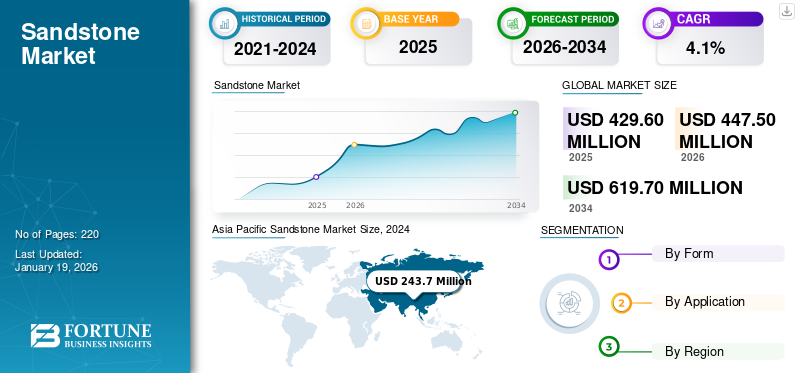
The global sandstone market size was valued at USD 429.6 million in 2025. The market is projected to grow from USD 447.5 million in 2026 to USD 619.7 million by 2034, exhibiting a CAGR of 4.1% during the forecast period. Asia Pacific dominated the sandstone market with a market share of 57.00% in 2025.
Sandstone is a natural sedimentary rock made of sand-sized mineral particles or rock fragments. It is widely used in construction, flooring, cladding, paving, and decorative applications. It is valued for its durability, strength, and natural aesthetic appeal, making it a popular choice in both structural and ornamental applications. The market is expanding due to rapid urbanization, large-scale infrastructure projects, and the rising use of natural stones in architectural and interior designs. Emerging economies are exhibiting product demand on account of housing and commercial developments. Developed regions are contributing to luxury residential projects, commercial complexes, and landscaping activities. The growing preference for eco-friendly and visually appealing building materials is further likely to drive the market expansion during the forecast period. The major manufacturers operating in the market include Levantina, Amrize, Stonemart, SKYZ Stones Pvt. Ltd., and Arihanta Industries.
Download Free sample to learn more about this report.
SANDSTONE MARKET KEY TAKEAWAYS
 Market Size & Forecast
- 2025 Market Size: USD 429.6 million
- 2026 Market Size: USD 447.5 million
- 2034 Forecast Market Size: USD 619.7 million
- CAGR: 4.1% from 2026–2034
 Market Share
- Asia Pacific dominated the sandstone market with a market share of 57.00% in 2025.
- The building & construction segment dominated the global granite market share.
- The paving segment holds a considerable share of the market, driven by the extensive product use in pathways, driveways, patios, landscaping, and outdoor flooring.
 Key Regional Highlights
North America
The North America region captured 11.00% of the global market in 2025, generating USD 49.8 million in revenue, and is projected to reach USD 51.6 million in 2026.
Europe
Europe maintained a strong presence in the global market, reaching USD 101.3 million in 2025, accounting for 24.00% share, and is expected to reach USD 105.1 million in 2026.
Asia Pacific
In 2025, Asia Pacific generated USD 243.7 million, contributing 57.00% to global market revenue, and is projected to grow to USD 255 million in 2026.
U.S.
The U.S. play a key role in driving product consumption with increasing investments in urban redevelopment
Japan
The rising adoption of sandstone in flooring, wall cladding, paving, and decorative works is fueling product demand in both residential and commercial projects.
Read More

MARKET DYNAMICS
MARKET DRIVERS
Rapid Infrastructure Growth and Rising Preference for Aesthetic Construction to Drive Market Demand
The increasing pace of infrastructure development is significantly boosting product demand. With expanding urbanization, the need for durable and visually appealing materials in housing, commercial complexes, and public infrastructure is on the rise. It is known for its strength, weather resistance, and natural aesthetics and has become a preferred choice in construction and architectural projects. Additionally, the growing popularity of decorative and heritage-style designs in modern urban planning is further enhancing product adoption. Large-scale investments in smart cities and sustainable urban projects are further expected to drive the global sandstone market growth.
MARKET RESTRAINTS
Volatility in Raw Materials and Transportation Costs to Restrict Market Growth
The market faces significant restraints due to constant fluctuations in raw material, energy, and labor costs. Rising fuel prices and high energy consumption during quarrying and processing augment overall production expenses. Logistics is another major challenge as the material is bulky and heavy, which leads to significant transportation costs. Global supply chain disruptions and higher freight rates further increase the burden. Seasonal variations in quarrying also affect supply consistency, resulting in unstable pricing. Such unpredictability makes long-term planning difficult for manufacturers and traders. To cope with these challenges, companies are increasingly adopting efficient resource management and exploring cost-optimized logistics solutions.
MARKET OPPORTUNITIES
Expansion of Luxury Real Estate and Tourism Infrastructure to Create New Growth Prospects
The market is expected to witness strong opportunities with the rising expansion of luxury real estate and tourism infrastructure. Developers are increasingly using sandstone in premium housing, hotels, resorts, and commercial spaces due to its durability, natural appeal, and a wide range of finishes. The growing preference for natural and sustainable materials in upscale projects is further driving product demand. Additionally, the tourism sector is fueling adoption through heritage restoration programs, cultural landmarks, and religious structures. Governments in emerging economies are investing heavily in modern tourism facilities while also preserving historic sites. This push from real estate and tourism projects is creating significant growth opportunities for market players.
- According to the Observatory of Economic Complexity (OEC), the global trade of sandstone, merely cut into blocks, was valued at USD 149 million in 2023, with India emerging as the leading exporter at USD 86 million and the U.K. as the top importer at USD 66.2 million.
SANDSTONE MARKET TRENDS
Growing Use of Sandstone in Sustainable Landscaping and Restoration Projects
The market is witnessing a growing trend in sustainable landscaping and heritage restoration. In urban spaces, sandstone is being widely adopted for parks, gardens, pavements, and outdoor designs due to its durability, natural aesthetics, and eco-friendly properties. Rising awareness about green building practices is also pushing their use in residential and commercial projects. Additionally, the government is actively investing in the restoration of monuments, temples, and heritage structures, where it plays a vital role in maintaining authenticity and cultural significance. This growing application in both modern infrastructure and traditional preservation is expected to strengthen market growth in the coming years.
MARKET CHALLENGES
Environmental Concerns and Rising Competition from Alternative Materials Pose Challenges to the Market
The market faces challenges due to the environmental impact associated with quarrying and processing, which often lead to land degradation, dust emissions, and high water consumption. These issues have resulted in stricter government regulations and sustainability requirements, increasing compliance costs for producers. Additionally, competition from alternative materials, such as granite, marble, ceramic tiles, and engineered stones, is intensifying. These substitutes offer greater consistency, lower maintenance, and higher strength in some applications. As a result, manufacturers are under pressure to adopt eco-friendly practices, enhance product quality, and introduce value-added solutions to remain competitive in the market.
Download Free sample to learn more about this report.
Segmentation Analysis
By Form
Rise in Residential and Commercial Projects to Foster the Demand for Sandstone Tiles
Based on form, the market is segmented into tiles, slabs, and others.
The tiles segment held a dominant market share in 2024, driven by their rising demand in residential housing, commercial complexes, and interior design projects. Tiles are widely used in flooring, wall cladding, paving, and decorative works due to their durability, easy installation, and aesthetic appeal. Rapid urbanization and growth in modern housing and increasing preference for natural and sustainable building materials are fueling the demand for tiles. Additionally, government investments in affordable housing and urban infrastructure are further contributing to segment growth.
The slabs segment holds a significant share of the market. Slabs are extensively used in large-scale construction projects, monuments, countertops, and premium architectural designs. Their strength, versatility, and availability in a wide range of finishes make them suitable for both structural and ornamental purposes. Growing investments in luxury real estate, high-end housing, and landscaping projects are propelling the demand for slabs, further supporting market expansion.
By Application
Building & Construction Segment to Grow with Rising Urbanization and Infrastructure Development
Based on application, the market is segmented into building & construction, monuments & memorials, paving, and others.
The building & construction segment dominated the global granite market share in 2024, driven by the extensive use of sandstone in flooring, wall cladding, facades, staircases, and decorative interiors. Rapid urbanization, expanding residential housing, and large-scale investments in commercial complexes, hotels, and public infrastructure are fueling the product demand across both developed and emerging economies. It is preferred for its durability, natural beauty, and versatility, making it suitable for sustainable and eco-friendly construction practices. Additionally, government initiatives and urban redevelopment are significantly boosting product adoption in this segment.
The monuments & memorials segment holds a significant share of the market, supported by the deep cultural and historical value of sandstone. It has long been the preferred material for sculptures, temples, heritage structures, and the restoration of ancient monuments due to its durability and natural appearance. Rising investments in tourism-led projects and preservation programs initiated by governments and cultural institutions are further driving product demand. Additionally, the wide variety of colors, patterns, and finishes enhances its use in both traditional memorials and modern commemorative structures.
The paving segment holds a considerable share of the market, driven by the extensive product use in pathways, driveways, patios, landscaping, and outdoor flooring. It is preferred for these applications due to its durability, slip resistance, and ability to withstand varying weather conditions. The growing demand for visually appealing outdoor spaces in residential housing, luxury real estate, resorts, and commercial projects is further supporting market expansion. Additionally, the rising emphasis on sustainable landscaping and eco-friendly urban planning continues to encourage the product adoption in paving applications.
Sandstone Market Regional Outlook
By geography, the market is categorized into Asia Pacific, North America, Europe, Latin America, and the Middle East & Africa.
Asia Pacific
Asia Pacific Sandstone Market Size, 2024 (USD Million) To get more information on the regional analysis of this market, Download Free sample
In 2025, Asia Pacific generated USD 243.7 million, contributing 57.00% to global market revenue, and is projected to grow to USD 255 million in 2026. due to rapid urbanization, industrial growth, and extensive construction activities across countries such as China, India, and Japan. The rising adoption of sandstone in flooring, wall cladding, paving, and decorative works is fueling product demand in both residential and commercial projects. Government initiatives in affordable housing, smart cities, and large-scale infrastructure developments are further bolstering market growth. Increasing population and growing demand for premium residential and commercial spaces are also contributing to regional expansion. Additionally, the availability of vast reserves in the region continues to drive the market growth.
North America
The North America region captured 11.00% of the global market in 2025, generating USD 49.8 million in revenue, and is projected to reach USD 51.6 million in 2026. The market in North America is experiencing steady growth, driven by a strong construction industry and a robust demand for premium building materials. It is widely used in residential housing, commercial complexes, public infrastructure, and landscaping projects. The U.S. and Canada play a key role in driving product consumption with increasing investments in urban redevelopment, luxury real estate, and heritage restoration projects. Both countries also emphasize sustainable and eco-friendly construction materials, which further support the preference for natural stones. Additionally, the use of the material in flooring, wall cladding, facades, and decorative works continues to rise with the escalating demand for high-end architectural designs. These factors together ensure consistent market expansion across the region.
Europe
Europe maintained a strong presence in the global market, reaching USD 101.3 million in 2025, accounting for 24.00% share, and is expected to reach USD 105.1 million in 2026. In Europe, the market is driven by sustainable construction trends and a rising preference for natural materials in modern architecture. The renovation of old infrastructure, restoration of heritage buildings, and urban redevelopment projects are major factors boosting demand. Countries such as Germany, France, Italy, and the U.K. are witnessing an increasing application of the material in flooring, wall cladding, facades, and decorative works. Additionally, the region’s strong focus on eco-friendly construction, its established infrastructure, and demand for premium architectural designs keep Europe a significant consumer.
Latin America
The Latin America market generated USD 13.5 million in 2025, representing 3.00% of the global market landscape, and is expected to reach USD 13.9 million in 2026. In Latin America, the market is growing steadily, driven by rapid urbanization, expanding infrastructure, and rising construction activities across residential and commercial sectors. Countries such as Brazil and Mexico are key contributors supported by strong investments in housing, public infrastructure, and urban redevelopment projects. Growing interest in sustainable and natural building materials has also increased the use of these materials in modern architecture. In addition, its application in interior decoration, landscaping, and high-end real estate projects is further supporting market growth across the region.
Middle East & Africa
Middle East & Africa recorded a market size of USD 21.2 million in 2025, capturing 5.00% of the global market share, and is projected to reach USD 21.9 million in 2026. In the Middle East and Africa, the market is expanding due to large-scale infrastructure projects, rapid urban development, and growth of the construction sector. Countries such as South Africa and the GCC are driving product demand with significant investments in residential housing, commercial complexes, and public infrastructure. The rising preference for natural stones in luxury real estate, hotels, and landscaping projects further contributes to market growth. Additionally, ongoing economic diversification efforts and the increasing adoption of sustainable building materials are strengthening the demand across the region.
COMPETITIVE LANDSCAPE
Key Industry Players
Supply Chain Integration and Purity Levels to Emerge as Key Basis of Market Competition
The global sandstone market is highly competitive, with key players focusing on technological advancements, mergers & acquisitions, and capacity expansion to increase their market presence. Global companies include Levantina, Amrize, Stonemart, SKYZ Stones Pvt. Ltd., and Arihanta Industries. These companies compete based on purity levels, cost-effective processing techniques, supply chain integration, and regional dominance while investing in sustainable extraction technologies to address environmental concerns. While global leaders show domination in developed markets, the aggressive growth of regional industry players can be seen in emerging economies, intensifying industry competition.
LIST OF KEY SANDSTONE COMPANIES
- Levantina (Spain)
- Amrize (Canada)
- Graymont (Canada)
- Stonemart (India)
- Mumal Marbles (India)
- Xishi Group (China)
- SKYZ Stones Pvt. Ltd. (India)
- Arihanta Industries (India)
- Vetter Stone (U.S.)
REPORT COVERAGE
The sandstone market analysis provides the market size and forecast on the basis of all the segments included in the report. It includes details on the market dynamics and trends expected to drive the market over the forecast period. It offers information on the key regions/countries, key industry developments, new product launches, details on partnerships, and mergers & acquisitions. The report covers a detailed competitive landscape with information on the market share and profiles of key players.
Request for Customization to gain extensive market insights.
Report Scope & Segmentation
|
ATTRIBUTE |
DETAILS |
|
Study Period |
2021-2034 |
|
Base Year |
2025 |
|
Estimated Year |
2026 |
|
Forecast Period |
2026-2034 |
|
Historical Period |
2021-2024 |
|
Growth Rate |
CAGR of 4.1% from 2026-2034 |
|
Unit |
Value (USD Million) and Volume (Million Ton) |
|
Segmentation |
By Form · Tiles · Slabs · Others |
|
By Application · Building & Construction · Monuments & Memorials · Paving · Others |
|
|
By Geography · North America (By Form, By Application, and By Country) o U.S. (By Application) o Canada (By Application) · Europe (By Form, By Application, and By Country) o Germany (By Application) o U.K. (By Application) o France (By Application) o Italy (By Application) o Spain (By Application) o Russia (By Application) o Rest of Europe (By Application) · Asia Pacific (By Form, By Application, and By Country) o China (By Application) o India (By Application) o Japan (By Application) o South Korea (By Application) o Rest of Asia Pacific (By Application) · Latin America (By Form, By Application, and By Country) o Brazil (By Application) o Mexico (By Application) o Rest of Latin America (By Application) · Middle East & Africa (By Form, By Application, and By Country) o GCC (By Application) o South Africa (By Application) · Rest of the Middle East & Africa (By Application) |
Frequently Asked Questions
The global sandstone market size was valued at USD 429.6 million in 2025. The market is projected to grow from USD 447.5 million in 2026 to USD 619.7 million by 2034, exhibiting a CAGR of 4.1% during the forecast period.
In 2025, the Asia Pacific market value stood at USD 243.7 million.
The market is expected to exhibit a CAGR of 4.1% during the forecast period of 2026-2034.
The key factors driving the market are the expanding infrastructure projects and the rising demand for aesthetic construction.
Levantina, Amrize, Stonemart, SKYZ Stones Pvt. Ltd., and Arihanta Industries are the top players in the market.
Asia Pacific dominated the market in 2025.
Rising demand for natural and sustainable building materials, the increasing use of sandstone in residential and commercial construction, and growing adoption in interior design and landscaping projects are some of the key factors expected to favor the product adoption.



- 2021-2034
- 2025
- 2021-2024
- 220
Get 30-60 hrs Free Customization
Expand Regional and Country Coverage, Segments Analysis, Company Profiles, Competitive Benchmarking, and End-user Insights.


















Related Reports
-
US +1 833 909 2966 ( Toll Free )
-
Get In Touch With Us