Smart Home Devices Market Size, Share & Industry Analysis, By Type (Lighting Systems, Speakers & Voice Assistants, Thermostats & HVAC Control, Security & Access Control, Entertainment Devices, Kitchen Appliances, Home Appliances, and Others), By Protocol (Wired, Wireless [WiFi, Bluetooth, Zigbee, and Others], and Hybrid), By Application (New Construction And Retrofit), By Distribution Channel (Specialty Stores, Brand Stores, Wholesale Channels, Online Channels, and Others), and Regional Forecast, 2026-2034
 Download Free Sample
(Offer valid till 15th Oct 2026)

KEY MARKET INSIGHTS
 Listen to Audio Version
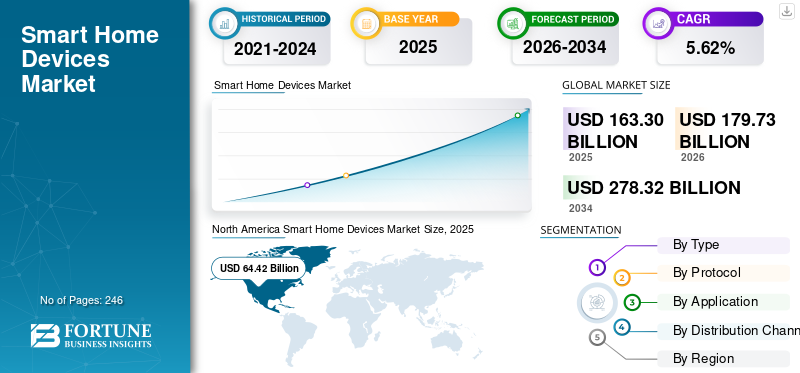
The global smart home devices market size was valued at USD 163.30 billion in 2025. The market is projected to grow from USD 179.73 billion in 2026 to USD 278.32 billion by 2034, exhibiting a CAGR of 5.62% during the forecast period. North America dominated the global smart home devices market with a market share of 39.45% in 2025.
Smart home products offer enhanced user comfort and convenience through automation, improved security, and improved energy efficiency. Users can streamline their household tasks with such appliances. Advancements in AI and IoT technology-based home products, along with increasing demand for energy-efficient home solutions, are the primary factors driving global market growth. In 2025, Amazon, Inc. launched Alexa+ AI assistant technology-powered four new Echo devices: Echo Dot Max, Echo Studio, Echo Show 8, and Echo Show 11. These products are designed with state-of-the-art language models that deliver efficient voice assistant solutions to household users.
The global smart home devices market is characterized by key players including Samsung Electronics Co. Ltd., LG Electronics Inc., Robert Bosch GmbH, Koninklijke Philips N.V., and Panasonic Holdings Corporation. These companies invest significantly in R&D activities to develop innovative AI-based home products.
Download Free sample to learn more about this report.
MARKET DYNAMICS
MARKET DRIVERS
Rising Demand for Smart Housing Facilities to Drive Market Growth
Smart homes primarily comprise intelligent lighting controls, connected washing machines & other appliances, and voice assistant systems. The rising adoption of smart housing facilities and increasing households’ disposable income is driving the demand for smart household products and favor the global smart home devices market growth. In addition, the consistent focus of real estate developers on embedding intelligent infrastructure, including smart plugs, HVAC systems, and home-automation hubs, is positively contributing to industry growth. Custom Electronic Design and Installation Association CEDIA's 2025 Professional Smart Home Market Analysis data revealed that U.S. households increasingly prefer luxury smart home features and housing projects of different area sizes. Around 40% of U.S. households have AI-powered security features, including person detection.
MARKET RESTRAINTS
Data Privacy and Security Concerns to Restrain Market Growth
Smart devices, when used, often collect sensitive user behavior and household data. Weak encryption and insecure IoT devices could lead to data theft incidents. The increasing frequency of such data theft incidences is expected to limit product demand across many countries. In addition, the increasing incidences of cyber threats limit consumers’ interest in adopting newer, innovative products, thereby restraining the global smart home devices market growth.
MARKET OPPORTUNITIES
Increasing Adoption of Assisted Living & Elderly Care Home Devices to Augment Market Growth
The rising population, aging, and increasing adoption of elderly care & assisted living technology-based products are creating new market growth opportunities for better home & living comfort among aged individuals. In addition, advancements in the development of fall-detection sensor-based devices and other health monitoring devices enable aged individuals to better take care of themselves, favoring global market growth. According to the Government of China, the number of Chinese individuals aged 60 years and above is expected to increase from 297 million in 2023 to 400 million by 2035.
SMART HOME DEVICES MARKET TRENDS
Integration of Health Monitoring Features in Smart Devices to Favor Growth
Smart devices equipped with health monitoring features offer enhanced preventive healthcare insights and personalized daily well-being advice to users. Consistent efforts by manufacturers to develop home products that track room air quality, monitor users’ sleep patterns, and analyze other room conditions are favoring global market growth. Additionally, the growing awareness of maintaining health and personal care is increasing the demand for smart home devices.
MARKET CHALLENGES
Geopolitical Tensions to Challenge Key Players’ Business Revenue Growth
The limited availability and uncertain cost of raw materials and supplies used to produce home appliances pose challenges for companies in managing their business operational overheads. Furthermore, geopolitical tensions and logistic bottlenecks are significantly impacting the key players’ business operational efficiencies, thereby hampering market growth.
Download Free sample to learn more about this report.
Segmentation Analysis
By Type
Wider Adoption of Entertainment Devices to Lead the Segment Growth
By type, the market is segmented into lighting systems, speakers & voice assistants, thermostats & HVAC control, security & access control, entertainment devices, kitchen appliances, home appliances, and others.
The entertainment devices segment is slated to hold a leading global market share of 36.96% in 2025. Its major share is attributed to the significant adoption of entertainment devices, including televisions, soundbars, and streaming devices, among middle- and upper-income household groups worldwide. In addition, the consistent integration of televisions with Google TV, Apple TV, and other platforms by manufacturers is positively contributing to segmental revenue growth by providing an enhanced streaming experience.
To know how our report can help streamline your business, Speak to Analyst
The rising demand for energy-saving and innovative cooking appliances and refrigerators to facilitate smooth daily kitchen operations led the kitchen appliances segment to grow at the fastest rate of 7.43% during 2026-2034. Furthermore, advancements in the development of kitchen appliances equipped with features such as predictive maintenance alerts, artificial intelligence, and machine learning-guided cooking, and voice assistance are creating new segmental growth opportunities.
By Protocol
Better Smartphone Connectivity through Wireless Protocols Encouraged the Wireless Segment
By protocol, the market is segmented into wired, wireless, and hybrid. The wireless segment exhibited a leading global market share of 65.64% in 2025. The segment is projected to grow at the fastest rate of 6.08% from 2026 to 2034. The segment’s leading share is attributed to the high consumer preference for wireless devices, enabling better connectivity for smartphones and wearable devices compared to counterpart protocol types. Furthermore, the ease of installing wireless devices, compared to their counterparts, has made IoT-connected devices a preferred choice among households.
The wireless segment is further sub-segmented into WiFi, Bluetooth, Zigbee, and others. The largest share of the WiFi segment is attributed to the significant adoption of WiFi routers and the increasing preference for devices supporting internet connectivity worldwide. In addition, the significant utilization of WiFi technologies in video conferencing activities for work-from-home office settings accelerates the segment’s growth at the fastest rate worldwide.
By Application
Significant Need for Installing Diverse Product Ranges at New Houses Boosted the New Construction Segment
Based on application, the smart home devices market is bifurcated into new construction and retrofit. The new construction segment exhibited a leading global market share of 55.65% in 2025. The segment is projected to grow at the fastest rate of 6.13% from 2026 to 2034. Its leading share is attributed to the significant need for installing a diverse range of integrated smart home automation systems in new housing facilities, compared to retrofit projects requiring the replacement of a limited number of home products. Additionally, governmental investment in building residential infrastructure facilities is expected to increase the product installation rate, driving the segment’s growth.
The increasing investment by households in home renovation projects, combined with the growing number of households replacing their existing home products with new technology-based items, is accelerating the growth of the retrofit segment.
By Distribution Channel
Rising Adoption of Online Shopping Led the Online Channels Segment to Grow at an Exponential Rate
Based on distribution channel, the market is segmented into specialty stores, brand stores, wholesale channels, online channels, and others. The online channels segment exhibited a leading global market share of 41.12% in 2025 and is projected to increase at a fastest growth rate of 6.63% during 2026-2034. The online channels segment's fastest growth is attributed to the rising adoption of e-commerce shopping for household goods among households across many countries. Furthermore, the increasing demand for subscription-based services of smart household products, enabling consumers to trial newly available products, is creating new segmental growth opportunities.
Consistent efforts by Samsung, Apple, and other brands to broaden their retail base of brand stores are positively contributing to product sales from these stores, driving growth in the brand stores' segment. Additionally, the consistent provision of discounted products by brand stores and the increasing demand for IoT-connected smart home ecosystems among households are favoring the segment’s revenue growth.
Smart Home Devices Market Regional Outlook
By geography, the market is categorized into North America, Europe, Asia Pacific, South America, and the Middle East & Africa.
North America Smart Home Devices Market Size, 2025 (USD Billion) To get more information on the regional analysis of this market, Download Free sample
The North America region exhibited a leading global market share of 39.45% in 2025. The region’s market size reached USD 70.38 billion in 2026. The growing number of single-family and multi-family households, along with an increasing preference for installing integrated home systems that combine lighting, entertainment systems, security systems, and other features, is favoring market growth across the U.S. and Canada. Furthermore, the rising demand for smart housing facilities and governmental assistance in allocating nursing homes and community living facilities is positively contributing to the region’s smart home market growth.
The U.S. market size reached USD 54.25 billion in 2025. High disposable spending on AI-based home products and a rising product replacement rate among households are primarily driving U.S. market growth. In addition, the increasing trend of conducting retrofit/renovation projects, along with the growing demand for connected home products, is favoring U.S. market expansion.
The European region held a second-leading global market share in 2025. Strong government appliance emission-related standards and rising consumer demand for energy-efficient home appliances are mainly driving regional market growth. In addition, the growing infrastructure of housing facilities and the increasing preference for smart technology-based products are positively contributing to market growth in the region.
The Asia Pacific region held the third-leading global market share in 2025. The Asia Pacific smart home market is projected to grow at the fastest rate of 7.96% from 2026 to 2034. The rising demand for integrated technology-based products and growing consumer preference for space-saving home appliances are primarily driving market growth in China, India, and Southeast Asia. Furthermore, the increasing replacement rates of home products and the consistent introduction of AI and IoT-based smart devices by manufacturers are favoring market growth across Japan, South Korea, and Australia.
The smart home devices market in the South America and Middle East & Africa regions is expected to witness a moderate growth rate from 2026 to 2034. The market in South America is set to reach a valuation of USD 5.91 billion in 2025. The increasing urbanization and growing number of middle-income households in Brazil, Argentina, and Colombia are primarily driving the growth of the market.
The rising demand for luxury housing facilities and the increasing trend of online shopping for home goods among households in South Africa, the UAE, and Saudi Arabia are mainly driving the growth of the Middle East & African market. In the Middle East & African market, South Africa is expected to reach a market value of USD 3.75 billion by 2025.
COMPETITIVE LANDSCAPE
Key Industry Players
Consistent Focus on Technology Innovation to Help Key Players Reinforce their Market Position
The global smart home devices market is highly competitive, with leading players including Samsung Electronics Co., Ltd., LG Electronics Inc., Robert Bosch GmbH, Koninklijke Philips N.V., and Panasonic Holdings Corporation. Samsung Electronics Co., Ltd. is a leading player in the global smart home market. These companies partner with smart home technology solution providers to offer innovative devices to global consumers. For instance, in October 2022, Samsung Electronics Co. Ltd. partnered with Google to develop Matter, an interoperable, IoT-based smart home system for household users.
LIST OF KEY SMART HOME DEVICES COMPANIES PROFILED
- Samsung Electronics Co. Ltd. (South Korea)
- LG Electronics Inc. (South Korea)
- Robert Bosch GmbH (Germany)
- Koninklijke Philips N.V. (Netherlands)
- Panasonic Holdings Corporation (Japan)
- Haier Group Corporation (China)
- Xiaomi Corporation (China)
- Generac Holdings Inc. (U.S.)
- Crestron Electronics (U.S.)
- Siemens AG (Germany)
- Johnson Controls International plc. (Ireland)
KEY INDUSTRY DEVELOPMENTS
- December 2025: E-Home Household Service Holdings Limited acquired Fuzhou Yunding Mutual Chain Information Technology Co., Ltd., a company specializing in the provision of artificial intelligence access control systems and smart community services. The acquisition would enable the company to expand its presence in the smart home services industry.
- October 2024: Develco Products, a Danish IoT technology provider, acquired Datek Smart Home, a Norwegian division of Datek, to expand its presence in the sensor-based home devices and IoT solutions industry.
- July 2024: LG Electronics (LG) acquired an 80% stake in Athom, a smart home platform company based in Enschede, Netherlands. The company plans to acquire the remaining 20% stake by 2027. The acquisition enables the company to elevate its AI-based home innovation capabilities.
- June 2023: ABB Group, a Swedish electrical corporation company acquired Eve Systems GmbH, a smart home product provider across Europe and the U.S. The acquisition is aimed at expanding ABB’s presence in the European and American home and building solutions business.
- August 2022: Amazon, Inc. invested USD 1.7 billion to acquire iRobot, expanding its presence in the home cleaning products category.
REPORT COVERAGE
Request for Customization to gain extensive market insights.
Report Scope & Segmentation
|
ATTRIBUTE |
DETAILS |
|
Study Period |
2021-2034 |
|
Base Year |
2025 |
|
Estimated Year |
2026 |
|
Forecast Period |
2026-2034 |
|
Historical Period |
2021-2024 |
|
Growth Rate |
CAGR of 5.62% from 2026-2034 |
|
Unit |
Value (USD Billion) |
|
Segmentation |
By Type, Protocol, Application, Distribution Channel, and Region |
|
By Type |
· Lighting Systems · Speakers & Voice Assistants · Thermostats & HVAC Control · Security & Access Control · Entertainment Devices · Kitchen Appliances · Home Appliances · Others |
|
By Protocol |
· Wired · Wireless o WiFi o Bluetooth o Zigbee o Others · Hybrid |
|
By Application |
· New Construction · Retrofit |
|
By Distribution Channel |
· Specialty Stores · Brand Stores · Wholesale Channels · Online Channels · Others |
|
By Geography |
· North America (By Type, Protocol, Application, Distribution Channel, and Country) o U.S. (By Type) o Canada (By Type) o Mexico (By Type) · Europe (By Type, Protocol, Application, Distribution Channel, and Country) o Germany (By Type) o France (By Type) o Italy (By Type) o Spain (By Type) o U.K. (By Type) o Russia (By Type) o Rest of Europe (By Type) · Asia Pacific (By Type, Protocol, Application, Distribution Channel, and Country) o China (By Type) o India (By Type) o Japan (By Type) o Australia (By Type) o Rest of Asia Pacific (By Type) · South America (By Type, Protocol, Application, Distribution Channel, and Country) o Brazil (By Type) o Argentina (By Type) o Rest of South America (By Type) · Middle East & Africa (By Type, Protocol, Application, Distribution Channel, and Country) o South Africa (By Type) o UAE (By Type) o Rest of the Middle East & Africa (By Type) |
Frequently Asked Questions
Fortune Business Insights says that the global market value stood at USD 163.30 billion in 2025 and is projected to reach USD 278.32 billion by 2034.
In 2025, the market value stood at USD 64.42 billion.
The global market is forecasted to grow at a CAGR of 5.62% during the study period (2026-2034).
By type, the entertainment devices segment exhibited a leading global market share throughout the forecast period (2026-2034).
The rising demand for smart housing facilities is a key factor driving the global market.
Samsung Electronics Co. Ltd., LG Electronics Inc., Robert Bosch GmbH, Koninklijke Philips N.V., and Panasonic Holdings Corporation are among the prominent players in the market.
North America dominated the market in 2025.
The increasing adoption of assisted living & elderly care home devices is expected to favor the product adoption.



- 2021-2034
- 2025
- 2021-2024
- 246
-
(Offer valid till 15th Oct 2026)
Get 30-60 hrs Free Customization
Expand Regional and Country Coverage, Segments Analysis, Company Profiles, Competitive Benchmarking, and End-user Insights.



















Related Reports
-
US +1 833 909 2966 ( Toll Free )
-
Get In Touch With Us