Smart Luggage Market Size, Share & Industry Analysis, By Product Type (Duffel Bags, Strollers, Travel Backpacks, and Others), By Luggage Connectivity (RFID, GPS, and Bluetooth), By Material (Nylon, Leather, Canvas, Plastic, and Others), By Weight (Soft Luggage and Hard Luggage), By Distribution Channel (Specialty Stores, Brand Stores, Online Retail, and Others), and Regional Forecast, 2026-2034
 Download Free Sample
(Offer valid till 30th Sep 2026)

Smart Luggage Market Overview
 Listen to Audio Version
The global smart luggage market size reached USD 3.40 billion in 2025. The market is projected to grow from USD 3.77 billion in 2026 to USD 10.23 billion by 2034, exhibiting a CAGR of 13.29% over the forecast period. North America dominated the smart luggage market with a market share of 35.58% in 2025.
The global smart luggage industry is an emergent travel gear segment designed around connected backpacks/suitcases/duffels used for business, leisure, and frequent-flyer commuting. Several features of such smart bags, including app-connected locks, GPS/Bluetooth tracking, and built-in USB/power banks, enhance convenience and security while in transit. The factors driving global market growth include high consumer willingness to pay for premium, tech-enabled accessories, increasing global air travel volumes, the practical need to reduce luggage mishandling anxiety through real-time location visibility, and the need to protect luggage from theft. For instance, IATA recorded high air travel demand in 2024, with total traffic up 10.4% vs. 2023, strengthening the expanding addressable base of travelers who benefit from on-the-go charging and smart-tracking use cases.
Major players leading the global market include Samsonite International S.A., Away Travel Inc., TUMI Holdings, Inc., Delsey Paris, and Xiaomi Corporation. Collectively, these companies focus on product innovation (GPS tracking, removable batteries, app connectivity), premium design positioning, and direct-to-consumer and e-commerce expansion, while also strengthening global distribution partnerships and compliance with airline battery regulations to drive adoption and sustain growth.
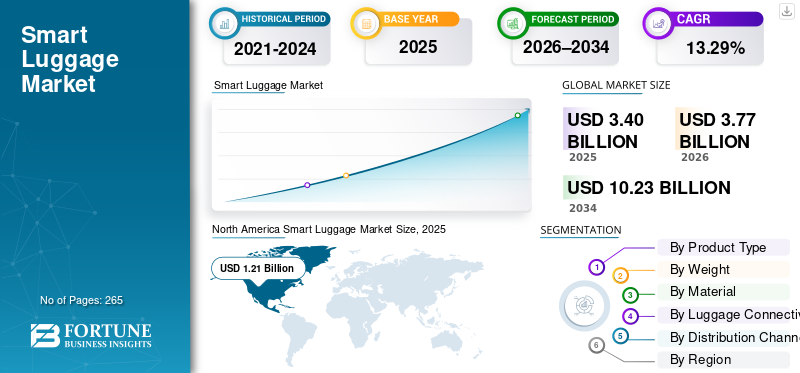
Download Free sample to learn more about this report.
Smart Luggage Market Key Takeaways
 Global Market Size & Forecast
- 2025 Market Size: USD 3.40 billion
- 2026 Market Size: USD 3.77 billion
- 2034 Forecast Market Size: USD 10.23 billion
- CAGR: 13.29% from 2026–2034
 Market Share
- North America dominated the smart luggage market with a 35.58% share in 2025.
- The hard-shell luggage segment is projected to maintain its leading position, growing at a 14.04% CAGR from 2026–2034.
- The GPS tracking-enabled luggage segment is expected to register the fastest growth at a 14.65% CAGR from 2026–2034.
 Key Regional Highlights
North America
North America led the market in 2025, valued at USD 1.21 billion, and is projected to reach USD 1.33 billion in 2026.
Europe
Europe is projected to grow at a 11.47% CAGR, reaching USD 0.94 billion in 2026.
Asia Pacific
Asia Pacific is expected to reach USD 1.13 billion in 2026, retaining its position as the third-largest regional market.
U.S.
U.S. The smart luggage market was estimated at approximately USD 1.05 billion in 2025.
Japan
Japan The smart luggage market is expected to witness steady growth, supported by rising adoption of connected travel accessories and increasing demand for premium luggage solutions.
Read More

SMART LUGGAGE MARKET TRENDS
Rising Adoption of Lightweight, Compact, and Sustainable Smart Luggage is a Key Market Trend
Manufacturers are increasingly focusing on sustainable and lightweight construction materials to improve portability and better align with environmental regulations and consumer preferences. The use of durable polycarbonate shells, recycled plastics, and energy-efficient electronic components helps reduce overall product weight while enhancing durability and quality. The trend is gaining momentum among premium buyers and eco-conscious consumers, permitting brands to innovate their offerings, reinforce ESG positioning, and appeal to sustainability-driven purchasing decisions.
Download Free sample to learn more about this report.
MARKET DYNAMICS
Market Drivers
Rising Global Air Travel and Frequent Mobility to Boost Market Growth
The consistent rise in global air passenger traffic has notably broadened the consumer base for smart luggage. As the number of business travelers, digital nomads, and leisure tourists increases, they seek greater convenience, security, and efficiency during their journeys. Smart features such as real-time tracking, remote locking, and integrated charging solve typical travel issues, such as lost baggage and device downtime, making smart luggage a highly favored option among frequent flyers.
Growing Demand for Premium and Connected Travel Accessories to Propel Market Expansion
Consumers of today’s generation are tech-savvy and increasingly willing to invest in tech-enabled, premium, and connected travel gear that fits their high-paced lifestyle. An app-based product ecosystem, high smartphone penetration, and growing awareness of travel safety have bolstered the adoption of smart backpacks and other luggage systems. Through design innovation, the use of lightweight materials, and the provision of battery solutions that comply with airline regulations, manufacturers are turning smart baggage into a worthwhile upgrade option over traditional luggage, especially among urban consumers and those inclined to technology, which further drives market expansion.
Market Restraints
High Product Prices and Airlines Regulations to Hamper Market Growth
Stringent and rigid airline protocols for carrying lithium-ion batteries, including bans on non-removable power banks, have tightened product design flexibility and often create confusion for consumers, slowing the product adoption. Moreover, smart baggage comes with hefty pricing tags compared to traditional luggage systems owing to embedded sensors and electronics, which hampers penetration in price-sensitive markets. These factors, collectively, obstruct mass-market product adoption and create hurdles for manufacturers attempting to scale smart baggage adoption globally.
Market Opportunities
Product Expansion Through Smart Features and Targeting Untapped Markets
The integration of smart technologies, including biometric locks, AI-enabled tracking, and an IoT-based travel ecosystem, presents a significant opportunity for market growth. Furthermore, the increasing spending power of consumers and the rapid escalation in air travel across developing countries in Asia Pacific, South America, and the Middle East are widening the consumer base. Manufacturers emphasizing airline compliance, reducing product prices, and leveraging their online distribution networks can unlock a large number of potential consumers in these high-growth regions.
Market Challenges
Restricted Market Penetration Owing to Specialized Usage Requirements to Pose a Challenge
Data security concerns remain a significant barrier to the global smart luggage market growth, as connected luggage solutions collect sensitive user information, including health metrics and behavioral data. Ensuring robust cybersecurity frameworks, regulatory compliance, and secure data storage adds layers of complexity and expense for manufacturers. These challenges notably restrain adoption across healthcare, retail, and residential applications, where expectations for data privacy and protection are particularly high.
SEGMENTATION ANALYSIS
By Product Type
Versatility and High Adoption Rate Supplemented Travel Backpacks Segment Growth
Based on product type, the market is segmented into duffel bags, strollers, travel backpacks, and others.
The travel backpacks segment led market growth in 2025, largely due to broad consumer adoption across leisure, business, and daily commuting use cases. Smart travel backpacks command higher average selling prices than traditional backpacks by combining features such as USB-C charging, GPS/Bluetooth tracking, anti-theft systems, and laptop protection. Furthermore, their replacement cycle, strong appeal to tech-savvy and millennial consumers, and growing online sales traction further reinforce revenue generation as compared to their other counter type.
The segment is projected to continue growing at the fastest CAGR of 14.65% from 2026 to 2034, maintaining its leading position in the market.
To know how our report can help streamline your business, Speak to Analyst
By Weight
High Number of Smart Features and Affordable Pricing Boosted Soft Luggage Segment Expansion
Based on weight, the market is segmented into soft luggage and hard luggage.
The soft luggage segment led the market in 2025. The segment drives higher-value share, owing to its flexibility, lighter weight, ease of compliance with airline baggage restrictions, and lower prices than hard luggage. Modern-day travelers increasingly opt for soft, smart luggage for its external compartments, expandable storage capacity, and mobility, especially for short to medium trips. Moreover, smart feature integration, including removable batteries and tracking modules, is highly cost-effective in soft luggage designs, making them more accessible to price-conscious and frequent travelers.
The segment is poised to continue flourishing at a 14.04% CAGR from 2026 to 2034, sustaining its top position in the market.
By Luggage Connectivity
Seamless Integration with Smartphones and Low Power Consumption Attributed to a Higher Share of Bluetooth Connectivity
Based on luggage connectivity, the market is segmented into RFID, GPS, and Bluetooth.
The Bluetooth segment accounted for the largest global smart luggage market share. The segment’s domination is driven by its low power consumption, seamless integration with smartphones, and cost-effectiveness. Bluetooth technology is broadly used for anti-theft alerts, proximity-based tracking, and smart locking features, making it superlative for short-distance travel use cases such as hotels and airports. Compared with GPS-enabled luggage, Bluetooth solutions offer lower product costs and longer battery life, which helps drive higher adoption among mass-market consumers.
GPS is the second-fastest growing segment, expected to grow at a CAGR of 12.78% during the forecast period.
By Material
Lightweight, Durability, and Scalability Propelled Plastic Segment Growth
Based on material, the market is segmented into nylon, leather, canvas, plastic, and others.
The plastic segment accounted for the largest market share in 2025, driven by its higher durability, lightweight properties, and ease of integration with electronic components. Materials such as ABS plastic and polycarbonate provide increased protection for embedded sensors, tracking modules, and batteries while maintaining impact resistance. Moreover, design flexibility, mass production, higher scalability, and a cost advantage work in favor of the material, driving higher revenue growth.
The nylon segment is anticipated to expand at the highest CAGR of 14.70% over the assessment period from 2025 to 2032.
By Distribution Channel
Online Retail Segment Led Market Due to Direct-to-Consumer (DTC) Scalability
Based on distribution channel, the market is segmented into specialty stores, brand stores, online retail,
and others.
The online retail segment accounted for the largest market share in 2025. The segment's largest share is primarily due to its wider product visibility, direct-to-consumer (DTC) scalability, and ability to showcase feature-rich, premium offerings. Smart luggage demands an in-depth explanation of security advantages, battery life, and connectivity features, which is effectively delivered through social media, digital content, reviews, and various comparison tools. Moreover, major e-commerce platforms and brand websites offer higher margins, frequent premium upselling, and global reach, resulting in stronger revenue contribution than specialty or brand-exclusive stores.
The brand stores segment is projected to grow at a CAGR of 13.50% in the coming years.
Smart Luggage Market Regional Outlook
Regionally, the market is divided into North America, South America, Europe, Asia Pacific, and the Middle East & Africa.
North America
North America Smart Luggage Market Size, 2025 (USD Billion)
To get more information on the regional analysis of this market, Download Free sample
North America held the dominant share in 2025, valued at USD 1.21 billion, and is expected to reach USD 1.33 billion in 2026. Market growth in the region is driven by early, strong smartphone and IoT device penetration, high per-capita air travel, and consumer willingness to spend more on premium, convenience-oriented travel gear. Frequent weekend gateways, business trips, leisure trips, adventure and recreational activities, and the rising acceptance of digital travel tools have boosted demand for features such as smart locks, real-time tracking, and integrated charging. Moreover, the region benefits from strong brand presence, advanced e-commerce ecosystems, and effective direct-to-consumer strategies, which improve product visibility and adoption.
U.S. Smart Luggage Market
Given North America’s strong contribution and the U.S. dominance in the region, the U.S. market can be estimated at around USD 1.05 billion in 2025, accounting for roughly 31.02% of global smart luggage sales. Market growth in the U.S. is supplemented by the world’s highest volumes of domestic and international travelers, coupled with early adoption of smart consumer electronics and high disposable income.
Europe
Other regions, such as Europe and Asia Pacific, are anticipated to witness steady growth in the coming years. During the forecast period, the Europe region is projected to grow at a 11.47% rate and reach a valuation of USD 0.94 billion in 2026. Market growth is driven by frequent cross-border travel, strong intra-regional and international tourism, and rising demand for airline-compliant, durable luggage. The increasing adoption of premium travel accessories, high awareness of baggage security, and a growing emphasis on lightweight, sustainable materials, especially across Western European countries such as Germany, France, and the U.K., further boost market expansion.
U.K Smart Luggage Market
The U.K. market in 2025 was valued at USD 0.10 billion, representing roughly 12.78% of global smart luggage revenues.
Germany Smart Luggage Market
Germany’s market was valued at USD 0.15 billion in 2025, equivalent to around 12.02% of global smart luggage sales.
Asia Pacific
The Asia Pacific market is estimated to reach USD 1.13 billion in 2026 and secure its position as the third-largest region. In the region, China and India were valued at USD 0.37 and 0.352 billion, respectively, in 2025, growing at CAGRs of 14.99% and 16.22%, respectively. Rising disposable incomes, rapid growth in air passenger traffic, and an expanding middle-class population are driving market growth. Additionally, the presence of cost-competitive manufacturing bases and rising outbound tourism further bolsters the adoption of advanced luggage across the region.
South America and Middle East & Africa
Over the forecast period, South America and the Middle East & Africa regions are projected to witness significant growth. The South America market in 2025 was valued at USD 0.23 billion. Growing consumer awareness of smart, security-enhanced luggage products, along with expanding air passenger traffic and regional and international tourism, is likely to drive South America market growth. In the Middle East & Africa, the UAE was valued at USD 0.03 billion in 2025, growing at a CAGR of 14.24%.
Competitive Landscape
Key Industry Players
Technology-Driven Differentiation Fueling Competitive Positioning
The smart luggage market exhibits a moderately consolidated and innovation-driven competitive landscape, with established luggage brands and emerging tech-focused players competing on product functionality, design, and connectivity features. Market participants primarily adopt product innovation, premiumization, and direct-to-consumer (DTC) strategies, focusing on airline-compliant battery solutions, lightweight materials, and app-based ecosystems to differentiate offerings. Additionally, players are expanding their global e-commerce presence, strategic partnerships, and geographic reach to capture demand from tech-savvy, frequent travelers across both developed and emerging markets.
LIST OF KEY SMART LUGGAGE COMPANIES PROFILED
- Samsonite International S.A. (Hong Kong)
- TUMI Holdings, Inc. (U.S.)
- Delsey Paris (France)
- Away Travel, Inc. (U.S.)
- Briggs & Riley Travelware (U.S.)
- Rimowa GmbH (Germany)
- Victorinox AG (Switzerland)
- Xiaomi Corporation (China)
- Travelpro Products, Inc. (U.S.)
- Horizn Studios GmbH (Germany)
Key Industry Developments
- September 2025: TUMI partnered with iFabric to integrate antimicrobial textile technology into select travel products, enhancing product innovation and performance. This collaboration aims to bring advanced material science into TUMI’s luggage and accessory lines, particularly relevant for smart luggage by improving hygiene and durability, which are increasingly important to global travelers.
- July 2025: TUMI opened its first flagship store in China, marking a major retail expansion effort into one of the fastest-growing travel goods markets globally. This move strengthens TUMI’s physical presence in Asia Pacific, enabling the brand to better engage with local consumers, showcase its premium smart luggage collections firsthand, and enhance brand visibility in a region with robust travel and tech adoption.
- July 2025: Briggs & Riley Travelware unveiled the new ZDX Collection, featuring upgraded smart travel innovations and functional enhancements. Briggs & Riley expanded its product portfolio with the ZDX Collection, which includes luggage, backpacks, and duffels designed for the modern traveler.
- May 2025: Away Travel, Inc. began selling select Away luggage products on Amazon and announced upcoming availability at Nordstrom stores, marking a key expansion initiative beyond its traditional direct-to-consumer model. This strategic shift enables Away to meet customers where they already shop, increase its market reach, and provide easier access to its travel gear through established retail partners.
- April 2025: Samsonite Group announced the launch of innovative circular luggage collections with Digital Product Passports. Samsonite’s strategic move focused on sustainability and transparency in the smart luggage space. By embedding Digital Product Passports into select limited-edition collections, the company provides detailed digital information about materials, origin, and compliance throughout the product lifecycle.
- February 2024: TUMI extended its multi-year partnership with McLaren Racing into McLaren’s Extreme E and McLaren Shadow Esports teams, reinforcing its brand positioning through high-performance associations. This strategic partnership bridges high-end travel gear with elite motorsport, emphasizing product innovation inspired by performance engineering.
REPORT COVERAGE
The smart Luggage market report provides a detailed analysis of the market and focuses on key aspects such as the competitive landscape, services, and leading product types. It also offers global market trends and insights, highlighting key industry developments. In addition to the aforementioned factors, the report on the global market outlook includes several factors that have contributed to the market's growth in recent years. The report’s free sample pages provide a brief overview of the report's coverage.
Request for Customization to gain extensive market insights.
Report Scope & Segmentation
|
ATTRIBUTE |
DETAILS |
|
Study Period |
2021-2034 |
|
Base Year |
2025 |
|
Estimated Year |
2026 |
|
Forecast Period |
2026-2034 |
|
Historical Period |
2021-2024 |
|
Growth Rate |
CAGR of 13.29% from 2026 to 2034 |
|
Unit |
Value (USD Billion) |
|
Segmentation |
By Product Type
|
|
By Weight
|
|
|
By Material
|
|
|
By Luggage Connectivity
|
|
|
By Distribution Channel
|
|
|
By Region
|
Frequently Asked Questions
According to Fortune Business Insights, the global market size was USD 3.40 billion in 2025 and is anticipated to reach USD 10.23 billion by 2034.
The market will grow at a CAGR of 13.29% and exhibit strong growth during the forecast period.
By product type, the travel backpacks segment dominated the market.
Global air travel and frequent mobility drive global market growth.
Samsonite International S.A., Away Travel Inc., TUMI Holdings, Inc., Delsey Paris, and Xiaomi Corporation are major players in the market.
North America held the highest market share in 2025.
An app-based product ecosystem, high smartphone penetration, and growing awareness of travel safety are likely to bolster the adoption of smart luggage among consumers.



- 2021-2034
- 2025
- 2021-2024
- 265
-
(Offer valid till 30th Sep 2026)
Get 30-60 hrs Free Customization
Expand Regional and Country Coverage, Segments Analysis, Company Profiles, Competitive Benchmarking, and End-user Insights.



















Related Reports
-
US +1 833 909 2966 ( Toll Free )
-
Get In Touch With Us