Smart Port Market Size, Share, Industry Analysis, By Port Type (Seaport and Inland Port), By Technology (Internet of Things (IoT), Blockchain, Process Automation, and Artificial Intelligence (AI)), By Throughput Capacity (Extensively Busy Ports (Above 18 Billion TEU), Moderately Busy Ports (5–18 Billion TEU), and Scarcely Busy Ports (Below 5 Billion TEU)), By Element (Smart Port Infrastructure, Terminal Automation & Cargo Handling, Smart Safety & Security, Traffic Management Systems (TMS), Port Community Systems (PCS)), and Regional Forecast, 2026-2034
 Download Free Sample
KEY MARKET INSIGHTS
 Listen to Audio Version
The global smart port market size was valued at USD 3.4 billion in 2025 and is projected to grow from USD 4.2 billion in 2026 to USD 23.10 billion by 2034, exhibiting a CAGR of 23.80% during the forecast period. Asia Pacific dominated the smart port market with a market share of 72.80% in 2025.
A smart port is a contemporary and cutting-edge port that utilizes advanced digital technologies, including the Internet of Things (IoT), big data analytics, and automation, to improve its operational efficiency, safety, and security. The objective of this port is to enhance the whole port ecosystem, encompassing its infrastructure, tools, and personnel, to establish a more sustainable, effective, and robust port.
Smart ports are designed to address the issues encountered by traditional ports, such as congestion, delays, inefficiencies, and environmental effects. Through the incorporation of digital technologies, smart ports can enhance and simplify various port operations, including cargo handling, inventory control, and logistics transport. This can greatly decrease the time and expenses related to port operations, while also enhancing the port's safety and security.
Through cloud computing, intelligent ports can manage and analyze vast quantities of data, which is essential for enhancing their operations. Block chain technology allows for secure and transparent data sharing among port participants, thereby facilitating effective communication and cooperation. Furthermore, artificial intelligence and machine learning are employed to assess data and offer insights to port managers, enabling them to make informed decisions that can improve efficiency and lower expenses.
During the early stages of the COVID-19 pandemic, global supply chains faced significant disruptions. Lockdowns and restrictions resulted in reduced workforce availability, which delayed cargo handling and transportation at ports. This led to a notable decrease in the flow of goods through smart ports as many operations were halted or slowed down due to health and safety measures.
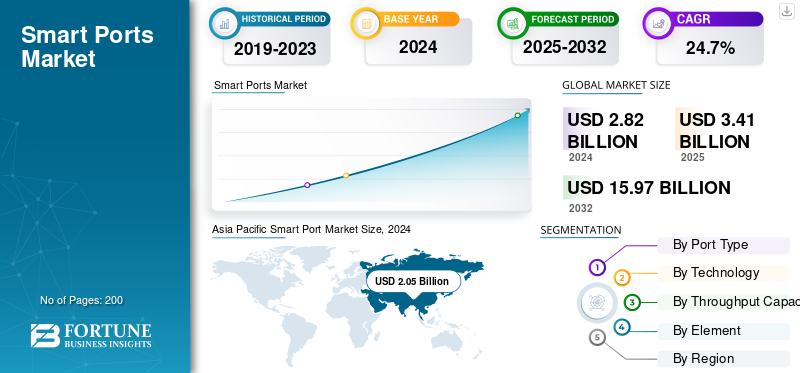
Download Free sample to learn more about this report.
Smart Port Market Key Takeaways
 Market Size & Forecast
- 2025 Market Size: USD 3.4 billion
- 2026 Market Size: USD 4.2 billion
- 2034 Forecast Market Size: USD 23.10 billion
- CAGR: 23.80% from 2026-2034
 Market Share
- Asia Pacific dominated the smart port market with a 72.80% share in 2025.
- The seaport segment is projected to account for a 74.46% share in 2026.
- The Internet of Things (IoT) segment is projected to hold a 44.61% share in 2026.
 Key Regional Highlights
Asia Pacific
Asia Pacific accounted for USD 2.48 billion in 2025 and is projected to reach USD 3.07 billion in 2026.
Europe
Europe generated USD 0.50 billion in 2025 and is expected to reach USD 0.60 billion in 2026.
North America
North America reached USD 0.19 billion in 2025 and is projected to grow to USD 0.23 billion in 2026.
U.S.
The smart port market is valued at USD 0.20 billion in 2026.
Japan
The smart port market is valued at USD 0.23 billion in 2026.
Read More

Market Dynamics
Market Drivers
Rising International Maritime Trade Activities to Contribute to Strong Market Expansion
Maritime shipping is essential for global commerce. The primary means of transport for global trade is ocean shipping, and according to UNCTAD, approximately 80% of the volume of the international goods trade is transported by sea; this proportion is even greater for many developing nations. This mode of transport is more affordable and practical for international trade compared to road, rail, and air transportation.
As reported by UNCTAD, global maritime commerce increased by 4.1% in the 2021 fiscal year and is projected to continue expanding at a steady annual rate exceeding 2.4% from 2022 through 2026. The expansion of the global shipping fleet showed similar patterns, increasing by 3% in 2021. Maritime trade recovered in 2021 due to the release of pent-up demand, along with restocking and inventory building. There was a notable change in consumption habits, with customers moving away from services to goods, particularly health items and pharmaceuticals, in addition to home office gear. There was also a shift in shopping trends and a notable growth of the e-commerce industry. The abrupt increase in demand in 2021 following the dire circumstances of 2020 caused by the pandemic led to shortages in shipping capacity, containers, and equipment.
Numerous shipowners are opting to acquire new ships or utilize retrofitted vessels to address this demand-supply imbalance. In recent times, Asia Pacific has become a global center for manufacturing, thanks to its abundance of raw materials and workforce. Consequently, the need for container ships in this region is markedly high due to a rise in the export of both manufactured and raw materials. Additionally, as reported in the UNCTAD Review of Maritime Transport 2021, Asia represented an impressive 54% of the global maritime trade, a figure anticipated to rise, thereby boosting the need for ports. Hence, rising maritime trade activities will stimulate the market’s growth.
Market Restraints
Threats Linked to Data Breaches and Client Data Security at Seaports to Impede Market Expansion
It is difficult to stop data from becoming misaligned or lost in ports due to the ever-changing environment. Any possible dead zones will prevent ports from effectively collecting and sharing data. This presents a challenge for smart ports since, unlike traditional ones, they cannot isolate problems at particular tasks or stages within the process, requiring continuous close collaboration throughout operations. The network must also be secure and highly mobile due the exceptionally complex characteristics of ports, encompassing the crucial operational and security tasks necessary for the effective transportation of cargo. Each year, millions of cyber-attacks and data breaches occur, serving as a warning for digital security.
- For example, in May 2020, the port of Shahid Rajaee in Iran experienced nearly total disruption in all its operational activities. A significant backlog occurred on the canals and highways leading to the plant when all the computers managing the movement of ships, vehicles, and goods failed simultaneously.
- In March 2020, a ransomware known as Mespinoza/Pysa targeted the port of Marseilles. While marine infrastructures were not the primary focus of the attack in this case, they were still negatively affected due to their connection with Aix-Marseille-Provence's systems. The Chief Information Security Officers (CISOs) from various impacted organizations seemingly collaborated to significantly reduce the impact.
- In August 2021, the Houston port thwarted an assault that took advantage of a major vulnerability in a password management system. With a CVSS score of 9.8 out of 10, the CVE-2021-40539 vulnerability allowed hackers to easily place web shells into an organization's information system. This enabled various actions, from retrieving sensitive data to deploying malware. These factors can restrain the market’s growth.
Market Opportunities
Government Initiatives to Develop Smart Port Infrastructure to Present Significant Market Growth Opportunities
Seaports have a crucial role in global supply chains and logistics. Ports need to embrace digital transformation as other market players are already advancing with the latest digital technologies. Currently, ports face ongoing pressure to enhance their efficiency while reducing their costs. Governments are urging port operators to enhance their throughput capacity using the current infrastructure and increased oversight as ship sizes have expanded, competition has intensified, shipping lines have embraced digitalization, and rivalries among shipping companies have escalated. These factors lead a port to choose digital operations. Numerous infrastructural advancements exist globally to enhance operational efficiency.
- For example, in March 2021, the Maritime Administration of the U.S. Department of Transportation released a Notice of Funding Opportunity (NOFO). The notice invited states and port authorities to seek USD 230 million in federal grant via the Port Infrastructure Development Program for projects related to port and intermodal infrastructure (PIDP).
- In 2020, the U.K. government committed USD 257 million to build a new port infrastructure to accelerate the nation’s departure from the European Union’s customs union. Therefore, initiatives from governments supported by different stakeholders will guarantee that the future of smart ports is secure.
Similarly, India boasts 205 recognized minor and intermediate ports, in addition to 12 major ones. The National Perspective Plan for Sagarmala proposes the development of six new mega ports throughout the country. India's ports and shipping industry play a crucial role in sustaining the growth of trade and commerce in the country. India, featuring a coastline of approximately 7,517 kilometers, ranks as the sixteenth-largest maritime nation globally.
The India Brand Equity Foundation (IBEF) intends to invest USD 82 billion in port initiatives by 2035. In February 2021, the Indian Parliament approved the Major Port Authorities Bill, 2020. Between April 2000 and June 2021, Indian ports attracted a total Foreign Direct Investment (FDI) inflow of USD 1.63 billion. The legislation seeks to distribute decision-making power and enhance quality in the governance of major ports. Consequently, governmental efforts in the development of smart port infrastructure in different regions will enhance the smart port market growth.
SMART PORT MARKET TRENDS
Rising Need for Immediate Data and Transparency in Supply Chains to Drive Market Trends
The growing need for real-time data and transparency in the supply chain will significantly propel the smart port market. With global trade volumes on the rise, supply chains are becoming more intricate, thereby making timely and precise data on the transportation of goods and equipment crucial.
Intelligent ports utilize cutting-edge technologies, such as IoT sensors, big data analytics, and automation to deliver real-time data, allowing port operators to enhance their operations and lower costs. Instant information is essential for efficient supply chain management since it allows companies to swiftly spot and address problems, enhancing the overall productivity of the supply chain. These ports provide immediate information on cargo transit, stock levels, and equipment placement, among other data, enabling port managers to oversee and control their operations instantly.
Download Free sample to learn more about this report.
SEGMENTATION ANALYSIS
By Port Type
Seaport Segment Dominated Market Owing to Emphasis on High Operational Efficiency based on Technological Advancements
By port type, the market is classified into seaport and inland port.
The seaport segment is projecteed to dominate the market with a share of 74.46% in 2026 and will be the fastest-growing segment during the forecast period of 2025-2032. The evolution of seaports into smart ports is driven by a combination of technological advancements, operational needs, governmental support, environmental considerations, and the increasing demands of global trade. These factors collectively facilitate the transition toward more efficient and sustainable port operations in the smart port market. Seaports are increasingly adopting advanced technologies, such as Artificial Intelligence (AI), Internet of Things (IoT), and blockchain to transform traditional operations into smart systems. These technologies enable real-time data collection and analysis, facilitating better decision-making and operational efficiency.
By Technology
Rising Implementation of Industry 4.0 to Enhance Port Efficiency to Boost Need for Internet of Things (IoT)
Based on technology, the market is segmented into Internet of Things (IoT), blockchain, process automation, and Artificial Intelligence (AI).
The internet of things (IoT) segment is projecteed to dominate the market with a share of 44.61% in 2026 and is expected to become the fastest-growing segment in the coming years. Internet of Things (IoT) is a pivotal technology in the evolution of smart ports, significantly impacting operational efficiency, safety, and decision-making processes. As the smart port market continues to grow, IoT will remain a cornerstone technology facilitating this transformation through innovative solutions that address the challenges faced by traditional port infrastructures.
To know how our report can help streamline your business, Speak to Analyst
By Throughput Capacity
Due to its Cargo Holding Capacity Management Extensively Busy Ports Segment Became Largest Segment in 2024
By throughput capacity, the market is categorized into extensively busy ports (above 18 billion TEU), moderately busy ports (5–18 billion TEU), and scarcely busy ports (below 5 billion TEU).
The extensively busy ports (above 18 billion TEU) segment is projecteed to dominate the market with a share of 46.37% in 2026. These ports manage a volume exceeding 18 billion TEU annually. Some of the extremely busy ports are located in China, Singapore, and South Korea, serving as a crucial hub for trade operations. These ports feature intelligent infrastructure, involving substantial investments in components, such as terminal automation, cargo management, port community systems, and safety & security.
The moderately busy ports (5 to 18 billion TEU) segment is not only the fastest-growing within the smart port market, but also represents a critical area for investment and technological advancements. As these ports modernize and adopt smart technologies, they are poised to enhance their operational efficiency and competitiveness significantly.
By Element
Increase in International Trade Operations and Necessity to Enhance Port Efficiency to Boost Demand for Smart Port Infrastructure
By element, the market is categorized into smart port infrastructure, terminal automation & cargo handling, smart safety & security, Traffic Management Systems (TMS), and Port Community Systems (PCS).
The smart port infrastructure segment is projecteed to dominate the market with a share of 33.19% in 2026. Smart port infrastructure comprises automated docking systems, shore power, automated gates, and advanced energy & environmental solutions. The smart energy & environment solution sub-segment encompasses smart lighting, smart meters, professional services, managed services, and waste processing & disposal units.
The Traffic Management Systems (TMS) segment is estimated to register the fastest growth rate during the forecast period. This segment is expected to continue its upward trajectory as ports increasingly adopt smart technologies to handle the complexities of modern maritime logistics. This growth is also likely to be supported by ongoing investments in infrastructure and technology aimed at improving operational efficiency and enhancing service delivery in the maritime sector.
SMART PORT MARKET REGIONAL OUTOOK
Geographically, the market is segmented into North America, Europe, Asia Pacific, and the rest of the world.
Asia Pacific
Asia Pacific Smart Port Market Size, 2025 (USD Billion) To get more information on the regional analysis of this market, Download Free sample
The Asia Pacific market accounted for USD 2.48 Billion in 2025, representing 72.82% of the global industry, and is expected to reach USD 3.07 Billion in 2026. Asia Pacific is a key area in international maritime commerce. The UNCTAD Review of Maritime Transport states that in 2021, the region accounted for 54% of maritime trade. It is regarded as a profitable region for sea trade. In recent years, Asia Pacific has experienced fast economic growth in manufacturing and energy industries, resulting in heightened maritime trade activities. The Organization for Economic Cooperation and Development (OECD) forecasts that by 2050, maritime trade volumes will triple, leading to a rise in the global freight demand. The growth of seaborne trade has consequently resulted in a higher demand for vessels that will be utilized to carry manufactured products to different regions around the globe.
The UNCTAD Maritime Transport 2021 report states that in 2020, developing countries, especially those in the Asia Pacific's transitioning economies, represented 60% of global exports and 70% of imports. A significant portion of East Asia, especially China, has undergone growth, and there has also been a rise in the volume of containerized traffic on the Transpacific route linking North America with East Asia. A lesser volume of trade occurred with developed countries, which generated 40% of global marine exports and 31% of imports.
Asia Pacific is among the fastest-growing regions in the world, driven by various factors, such as being a global manufacturing center, interconnected supply chains, affordable production expenses, and export-based development strategies of individual countries. This has resulted in the growing amount of cargo being transported from this region. Significant freight transport occurs via maritime routes, leading to a yearly rise in the number of ports in Asia Pacific, while the current ports are experiencing development. Automation, improved work processes, introduction of new equipment, and employee training are all parts of the strategy to enhance the efficiency of current port facilities. The Japan market is valued at USD 0.23 billion by 2026, the China market is valued at USD 2.29 billion by 2026, and the India market is valued at USD 0.12 billion by 2026.
North America
North America maintained a strong presence in the global market, reaching USD 0.19 Billion in 2025, accounting for 5.44% share, and is expected to reach USD 0.23 Billion in 2026. The North American smart port market is experiencing significant growth due to the rising demand for containerized goods and the need for efficient and reliable port operations. The market is driven by the increasing need for real-time information and supply chain visibility, with port operators adopting digital technologies like IoT, big data analytics, and automation to optimize operations and reduce costs. Sustainability is also a key focus, with many ports adopting green technologies and sustainable practices. The U.S. market is valued at USD 0.20 billion by 2026.
Europe
In 2025, Europe generated USD 0.5 Billion, contributing 14.96% to global market revenue, and is projected to grow to USD 0.6 Billion in 2026. The market in Europe is experiencing growth due to the adoption of digital technologies and automation aimed at enhancing port efficiency and competitiveness. Major European ports like Rotterdam and Hamburg are investing significantly in advanced technologies such as smart containers and autonomous vessels. Sustainability is also a key focus, with many ports implementing green technologies to minimize their environmental impact. The U.K. market is valued at USD 0.07 billion by 2026, while the Germany market is valued at USD 0.24 billion by 2026.
Competitive Landscape
Key Industry Players
Leading Players Are Focusing on Integrating Advanced Technologies to Gain Strong Foothold
The smart port market is somewhat fragmented, with significant players being active in this market. The leading ten companies in the market include Intel Corporation, Trelleborg, Kaleris, and Huawei Technologies Co., Ltd. ABB Limited, Abu Dhabi Ports, Royal Dutch Shell, Cisco System, Inc., IBM Corporation, and KONGSBERG. These market players have wide range of services portfolio, broader regional presence, and significant industry experience. These market players are emphasizing integrating advance technologies such AI and IoT in their service portfolio to gain competitive advantage in the market.
LIST OF KEY SMART PORT MARKET PLAYERS
- Intel Corporation (U.S.)
- Trelleborg (Sweden)
- Kaleris (U.S.)
- Huawei Technologies Co., Ltd. (China)
- ABB Ltd. (Switzerland)
- Abu Dhabi Ports (U.A.E)
- Royal Dutch Shell (U.K.)
- Cisco System, Inc. (U.S.)
- IBM Corporation (U.S.)
- KONGSBERG (Norway)
KEY INDUSTRY DEVELOPMENTS
- December 2024 - Kongsberg Digital revealed that it had entered a major partnership with Transnet SOC Ltd. (Transnet) to provide advanced simulator technology to the Transnet Academy located in Durban, South Africa.
- February 2023 – Harwich Haven Authority declared that it had awarded a contract to Kongsberg Norcontrol Ltd. for the provision & installation of, and assistance in a Vessel Traffic Services (VTS) system and a Port Management Information System (PMIS). The VTS system will utilize Kongsberg Norcontrol’s 7th generation VTS technology, which is operational in ports globally. Together with its completely integrated Port Management Information System (PMIS), this will guarantee that vessels arriving at the Haven are handled in an efficient and safe manner.
- June 2022 – ABB and the Port of Toulon, France, obtained a contract to link the biggest shore-to-ship initiative in France. At a critical point in its sustainability initiative, the Port of Toulon, which accommodates more than 1.6 million ferry and cruise travelers yearly, announced that it was dedicated to employing the ABB shore connection technology. ABB’s solution successfully provided for all energy needs for three ferries making concurrent port visits or for a single cruise liner. Vessels would have access to nearly 50 or 60 Hz power connections.
- April 2022 – Accenture acquired Ergo, a consulting service specializing in integrated data and AI located in Argentina. It fostered the growth of a culture centered on data-driven decision-making through analytics, Artificial Intelligence (AI), and big data. In the Hispanic South American region, comprising Argentina, Chile, and Colombia, the acquisition expanded Accenture's Cloud First capabilities to facilitate data-driven transformations for clients.
- June 2021 – Hapag-Lloyd and Ocean Network Express (ONE) Pte. Ltd., based in Singapore, declared successful integration with the TradeLens platform, which aided in providing a more prompt and uniform perspective on logistics data for their global containerized freight. TradeLens is a neutral, third-party platform launched by IBM and A.P. Moller - Maersk to help modernize the global supply chain ecosystems. It operates on IBM Cloud and IBM Blockchain.
REPORT COVERAGE
The report outlines competitive dynamics by assessing business segments, product offerings, target market earnings, geographical reach, and significant strategic initiatives by leading manufacturers. The smart port market is consolidated, featuring key players, such as Royal Dutch Shell, Cisco Systems, Inc., KONGSBERG, ABB Ltd., Huawei Technologies Co., Ltd., Kaleris, IBM Corporation, Trelleborg, Intel Corporation, and Abu Dhabi Ports. The research includes qualitative insights, such as market dynamics (drivers, constraints, challenges, and prospects), essential regulation assessment, pricing evaluation, and Porter’s Five Forces Analysis throughout North America, Europe, Asia Pacific, and the rest of the world regions. Additionally, the report includes sub-segments that are examined throughout all the regions.
Request for Customization to gain extensive market insights.
Report Scope & Segmentation
| ATTRIBUTE | DETAILS |
| Study Period | 2021-2034 |
| Base Year | 2025 |
| Estimated Year | 2026 |
| Forecast Period | 2026-2034 |
| Historical Period | 2021-2024 |
| Growth Rate | CAGR of 23.80% from 2026 to 2034 |
| Unit | Value (USD Billion) |
| Segmentation | By Port Type
|
By Technology
|
|
By Throughput Capacity
|
|
By Element
|
|
By Region
|
Frequently Asked Questions
As per the Fortune Business Insights study, the market size was valued at USD 4.2 billion in 2026 and is anticipated to USD 23.10 Billion by 2034.
The market is likely to record a CAGR of 23.80% over the forecast period of 2026-2034.
The top ten players in the market are Cisco System, Inc., KONGSBERG, IBM Corporation, Trelleborg, ABB Ltd., Royal Dutch Shell, Kaleris, Intel Corporation, Huawei Technologies Co., Ltd., and Abu Dhabi Ports.
China dominated in the market in 2025.



- 2021-2034
- 2025
- 2021-2024
- 200
Get 30-60 hrs Free Customization
Expand Regional and Country Coverage, Segments Analysis, Company Profiles, Competitive Benchmarking, and End-user Insights.



















Related Reports
-
US +1 833 909 2966 ( Toll Free )
-
Get In Touch With Us