Smart Water Management Market Size, Share & Industry Analysis, By Solution (Meter Data Management, Advance Pressure Management, Water Quality Monitoring, Storm and Flood Management, Irrigation Management, and Others), By Technology (AI & ML, IoT, GIS, and Others), By Application (Agriculture, Industrial/Manufacturing, Urban Development and Smart Cities, Power Generation Plant, Residential Communities, and Tourism and Hospitality Facilities), and Regional Forecast, 2026–2034
 Download Free Sample
KEY MARKET INSIGHTS
 Listen to Audio Version
The global smart water management market size was valued at USD 17.53 billion in 2025 and is projected to grow from USD 19.47 billion in 2026 to USD 47.14 billion by 2034, exhibiting a CAGR of 11.70% during the forecast period. North America dominated the smart water management market with a market share of 34.70% in 2025.
Water is a valuable resource that is scarce in some regions. By 2030, the global demand for usable freshwater is projected to exceed the available sustainable supply by 40%. According to data from non-governmental organizations, about 1.1 billion people globally will lack access to clean water, and approximately 2.7 billion will experience drought conditions for at least one month every year. This situation arises from inadequate infrastructure, pollution, overloaded distribution systems, conflict, and poor management of water resources. As a result, the adoption of smart water management solutions is on the rise. These solutions employ various technologies to enhance water management, address imbalances, reduce water loss, improve water quality, and predict and manage water scarcity, ultimately transforming the future of water systems.
Players in the market, including Xylem, Suez, ABB, Siemens AG, and Trimble Inc., among others, are focusing on providing customized solutions based on regional regulatory and environmental conditions, for instance, ABB tailoring SCADA systems for Gulf water reuse projects.
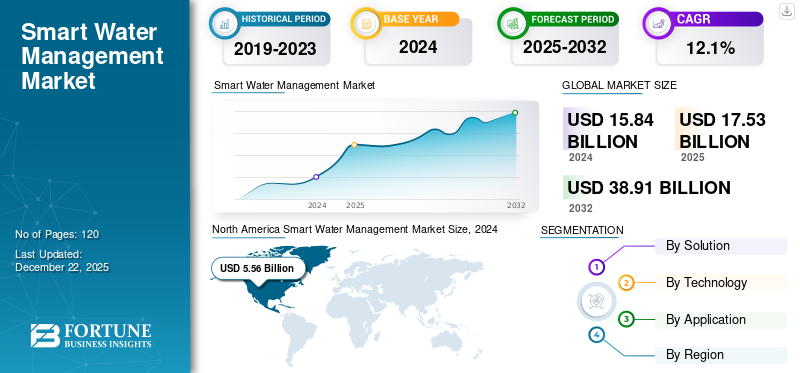
Download Free sample to learn more about this report.
Smart Water Management Market KEY TAKEAWAYS
 Global Market Size & Forecast
- 2025 Market Size: USD 17.53 billion
- 2026 Market Size: USD 19.47 billion
- 2034 Forecast Market Size: USD 47.14 billion
- CAGR: 11.70% from 2026–2034
 Market Share
- North America dominated the smart water management market with a 34.70% share in 2025.
- The meter data management segment is projected to account for the largest market share of 24.21% in 2026.
- The IoT segment is projected to hold a 38.85% share in 2026.
 Key Regional Highlights
Asia Pacific
Asia Pacific reached USD 4.86 billion in 2025, driven by smart city projects and water infrastructure digitalization.
North America
North America accounted for USD 6.08 billion in 2025, supported by infrastructure modernization and digital water management.
Europe
Europe captured 19.40% of the global market in 2025, driven by climate resilience and smart water technologies.
U.S.
The market is projected to reach USD 5.49 billion by 2026, fueled by investments in water infrastructure and smart utilities.
Japan
The market is projected to reach USD 1.27 billion by 2026, supported by growing adoption of smart water management solutions.
Read More

IMPACT OF GENERATIVE AI
Increasing Demand for Generative AI for Transforming Smart Water Management to Boost Market Growth
Communities across the globe are experiencing water scarcity and management challenges, which are worsening in many areas due to population growth, urbanization, and climate change. Recent advancements in generative AI are transforming the way water utilities manage their resources, promising improved efficiency in water management. These technologies have the potential to assist water utilities in tackling longstanding issues, including aging infrastructure and water loss. Investment in digital water solutions in the U.S. is projected to grow by 6.5% annually, reaching an annual capital expenditure of USD 10.8 billion by 2030.
By analyzing data on weather forecasts, water availability, usage patterns, and population growth projections, AI systems help local governments to optimize distribution networks and allocate water more effectively, especially in regions facing water scarcity.
In the wastewater treatment sector, aeration is a crucial step in the water purification process. This step requires a significant amount of energy to pump oxygen into basins, which is necessary for the growth of the microbial population essential for effective wastewater treatment. In fact, aeration can account for up to 60% of a wastewater facility's total energy consumption. By considering data related to historical wastewater flow rates, pollutant levels, water parameters from both sources and products, weather patterns, and water use forecasts, artificial intelligence (AI) can be utilized to continuously monitor and adjust aeration rates in real-time. This helps to achieve optimal aeration levels in wastewater treatment facilities.
IMPACT OF RECIPROCAL TARIFF
Reciprocal tariff will have a significant impact on the market as these solutions largely depend on hardware components, including IoT devices, smart meters, gateways, controllers, communication chips, and other components, many of which are manufactured in China, Taiwan, the U.S., and Germany. Reciprocal tariffs will raise import duties on these components, making equipment more expensive for utilities and project developers. This leads to higher capital expenditure (CAPEX) and may discourage adoption in price-sensitive regions. Tariff wars may lead to delays in the procurement of essential components such as pressure sensors, flow meters, and data loggers, impacting deployment timelines. Companies may need to reconfigure sourcing strategies or move to local or alternative suppliers, which may not meet the same quality or cost benchmarks.
Smart Water Management Market Trends
Popularity of Desalination for Reducing the Impact of Water Scarcity Acts as a Key Market Trend
Smart water technology is a rapidly evolving technology that addresses some of the world’s most pressing water challenges. With the global population projected to reach 10 billion by 2050 and climate change worsening water scarcity in many areas, the demand for innovative water solutions is increasing. Desalination is a process that removes salt and other minerals from seawater to make it suitable for drinking. The growing demand for water has led to an increase in the use of desalination technology, particularly in arid regions where fresh water is limited. However, traditional desalination methods have often relied on fossil fuels, which significantly contribute to greenhouse gas emissions.
One of the newest advancements in desalination is the integration of solar energy into the process. Solar-powered desalination plants utilize photovoltaic panels to generate electricity, which powers the desalination process. This approach allows for the production of clean water without depending on fossil fuels, thereby reducing the carbon footprint associated with desalination. As a result, it presents a more sustainable solution for communities in need of clean water.
A new desalination plant in Neom, Saudi Arabia, is set to be powered entirely by renewable energy sources. This makes it one of the world’s most sustainable and environmentally friendly desalination facilities. The plant will utilize solar and wind power to produce fresh water, significantly reducing the carbon footprint associated with traditional desalination processes while addressing the region's increasing demand for water.
Therefore, the popularity of desalination for reducing the impact of water scarcity is driving the smart water management market growth.
Download Free sample to learn more about this report.
MARKET DYNAMICS
Market Drivers
Rising Water Scarcity to Boost Demand for Management Solutions in Market
Water is one of the most valuable resources on the planet, yet it is being wasted at an alarming rate. With a rapidly increasing global population and the worsening effects of climate change, water scarcity has become a persistent issue that threatens agriculture and other industries and daily life. The rising demand for water requires innovative solutions to optimize its use and ensure sustainability. Therefore, it is crucial for governments, businesses, and individuals to adopt smarter water management practices.
Smart water management systems are becoming increasingly important as access to clean water becomes more of a concern. These systems use technologies such as the Internet of Things (IoT) sensors, data analysis, and machine learning to optimize water usage, identify leaks, and improve water distribution. Dubai Electricity and Water Authority (DEWA) has installed over 2 million smart meters for electricity and water in the city to improve energy and water efficiency. The smart meters provide real-time data and analysis on water consumption, allowing DEWA to monitor usage and identify areas where it can improve efficiency.
Thereby, rising water scarcity is expected to boost the market growth.
Market Restraints
High Implementation Cost Hampers Market Growth
The implementation of smart management solutions can be too expensive for developing countries, small municipalities, and businesses with limited budgets. These solutions include various types of sensors, smart water meters, analytics platforms, SCADA systems, digital twins, GIS tools, and other technologies. Additionally, infrastructure upgrades, software integration, and ongoing maintenance further increase the overall costs, making affordability a significant challenge. Thereby, the high implementation cost of smart water management hampers market growth
Market Opportunities
Increasing Government and Corporate Investments by Market Players to Create Lucrative Growth Opportunities
Improving water supply and sanitation, along with enhancing water resources management, significantly drives economic growth and plays a vital role in poverty eradication. The demand for water is increasing while the supply is declining. By 2050, the global population is projected to reach 10 billion, and currently, about 2 billion people lack access to safe drinking water, with 3.6 billion are without access to safe sanitation services. To tackle these challenges, governments and private sector organizations globally are increasing investments in smart water infrastructure, creating numerous business opportunities for solution providers, technology vendors, and systems integrators. This includes advancements such as digital metering, leak detection, and smart irrigation systems. Initiatives such as the U.S. Infrastructure Investment and Jobs Act (IIJA), India’s Jal Jeevan Mission, and the EU Green Deal have allocated billions of dollars toward modernizing water infrastructure. Thereby, increasing government and corporate investments to create lucrative opportunities for market players.
SEGMENTATION ANALYSIS
By Solution
Deployment of Smart Water Meters Led to Dominance of Meter Data Management Solution Segment
Based on solution, the market is segmented into meter data management, advance pressure management, water quality monitoring, storm and flood management, irrigation management, and others.
The meter data management segment is projected to reach for 24.21% of the global market share in 2026, as utilities across the globe shift toward data-driven operations. Due to the deployment of smart water meters the demand for meter data management is increasing as it helps to collect, store, validate, and analyze meter data efficiently. Traditionally, water utilities have relied on manual meter readings and estimated billing, which often led to revenue losses and consumer dissatisfaction. Meter data management solves this by enabling automated, real-time billing based on actual usage, improving accuracy and operational transparency.
Storm and flood management is estimated to grow with the highest CAGR during the forecast period, due to the rising frequency and intensity of extreme weather events, driven by climate change and urbanization. Across regions, floods have become one of the most damaging natural disasters, causing losses in billions of dollars annually and putting critical infrastructure, lives, and ecosystems at risk. Governments, municipalities, and city planners are therefore prioritizing investments in real-time monitoring of water quality, predictive analytics, and flood response platforms to enhance resilience from these disasters and public safety.
By Technology
IoT Dominated Market Owing to Increasing Adoption by Governments to Manage Water Resources
By technology, the market is segmented into IoT, AI & ML, GIS, and others.
The IoT segment is expected to lead the market, contributing 38.85% globally in 2026, as utilities and governments seek more efficient, responsive, and data-driven solutions to manage water resources. IoT plays a primary role by enabling real-time monitoring, automated control, and predictive analytics across the whole water infrastructure, starting from source to distribution to wastewater.
IoT sensors measure parameters such as pH, turbidity, temperature, and chemical content to ensure compliance with health and environmental standards. These sensors send instant alerts when values deviate from safe thresholds, enabling quick corrective action. This is especially important in densely populated urban areas or industrial zones where water contamination can have severe consequences.
The AI & ML segment is expected to grow with the highest CAGR during the forecast period, as water utilities face significant losses due to leaks, pipe bursts, and aging infrastructure. AI & ML algorithms analyze historical and real-time sensor data to predict leaks before they happen, reducing non-revenue water (NRW), and predict maintenance. This minimizes downtime, prevents major failures, and extends asset life.
By Application
To know how our report can help streamline your business, Speak to Analyst
Adoption of Smart Water Solutions for Agricultural Activities Boosted Segment Expansion
By application, the market is segmented into agriculture, industrial/manufacturing, urban development and smart cities, power generation plant, residential communities, tourism and hospitality facilities.
The agriculture segment is projected to reach for 29.32% of the global market share in 2026. Agricultural production currently uses 70% of the water supply. Feeding the global population in 2050, which is expected to reach 10 billion, will require a 50% increase in agricultural growth and 15% higher water usage. Smart water systems integrated with drones, satellite imaging, and mobile apps allow farmers to monitor irrigation zones remotely and get alerts on the system’s health or soil dryness. This boosts the scalability and ease of use of these systems, even in rural areas.
Many governments are promoting micro-irrigation, water-efficient farming, and digital agriculture through subsidies, tax benefits, and infrastructure investments. Programs such as India’s PMKSY, the EU’s Common Agricultural Policy, and the USDA smart farming grants are accelerating the adoption of smart water solutions in farms of all sizes.
The urban development and smart cities segment is expected to grow with the highest CAGR during the forecast period. The world is becoming more and more urban, which is posing new and difficult challenges for urban water management. As per, UN Department of Economic and Social Affairs, the global population is 4.2 billion, and around 55% lives in cities. This trend is expected to continue; by 2050, the urban population will double, and almost 7 out of 10 people will live in urban centers. This increasing urbanization is driving the demand for products.
SMART WATER MANAGEMENT MARKET REGIONAL OUTLOOK
The market is geographically studied across North America, South America, Europe, the Middle East & Africa, and Asia Pacific, and each region is further studied across countries.
North America
North America Smart Water Management Market Size, 2025 (USD Billion)
To get more information on the regional analysis of this market, Download Free sample
In 2025, North America represented USD 6.08 billion, accounting for 34.70% of the worldwide market, and is projected to grow to USD 6.66 billion in 2026. The dominance is driven by aging infrastructure, climate stress, regulatory mandates, and a strong push for digital transformation. With robust public funding and high technology readiness, the region is expected to remain a global leader in smart water management solution adoption. The U.S. market is projected to reach USD 5.49 billion by 2026.
In the U.S., the market is projected to experience significant growth during the forecast period. The COVID-19 pandemic served as a wake-up call for the government to reinvest in water infrastructure. It highlights that water supply challenges go beyond infrastructure and scarcity; it is also a critical public health concern. In 2021, the Bipartisan Infrastructure Law allocated USD 50 billion to enhance water infrastructure and systems.
West County Wastewater (WCW) in Richmond, CA, is upgrading its treatment plant while also working to reduce its carbon footprint. The utility manages 6 miles of pressure-force mains, 249 miles of sewer pipelines, 17 lift stations, and a water quality and resource recovery plant that processes 12.5 million gallons of wastewater each day.
Asia Pacific
Asia Pacific contributed 27.70% to the global market in 2025, with a valuation of USD 4.86 billion, and is projected to reach USD 5.54 billion in 2026. The region is witnessing rapid economic growth, but the region is also struggling with a serious water crisis, which threatens to set back its robust development. To counter these setbacks, countries in the region are taking strategic steps toward the digitalization of the integrated water cycle. The Japan market is projected to reach USD 1.27 billion by 2026, the China market is estimated to reach USD 1.55 billion by 2026, and the India market is projected to reach USD 0.88 billion by 2026. Governments across the region are launching smart city and water infrastructure initiatives, for instance,
- India’s Jal Jeevan Mission and Smart Cities Mission promote digital water supply monitoring.
- Australia’s Water-Sensitive Urban Design (WSUD) supports smart stormwater solutions.
- China’s Sponge City Program focuses on urban flood control and water conservation.
Europe
Europe is estimated to witness significant growth in the coming years, as European countries are highly focused on climate change mitigation and adaptation. The Europe market generated USD 3.39 billion in 2025, representing 19.40% of the global market landscape, and is expected to reach USD 3.71 billion in 2026. The increasing frequency of floods, droughts, and extreme weather events is pushing cities and utilities to adopt real-time flood monitoring, stormwater management, and AI-driven water forecasting tools. Smart water systems enable early warning systems, emergency planning, and optimized water resource allocation. The UK market is valued ated to reach USD 0.79 billion by 2026 and the Germany market is estimated to reach USD 0.62 billion by 2026.
Middle East & Africa
The Middle East & Africa region is anticipated to grow at a healthy rate during the forecast period. The Middle East & Africa market was valued at USD 1.92 billion in 2025, capturing 10.90% of global revenue, and is estimated to reach USD 2.14 billion in 2026. Most countries in the Middle East, including Saudi Arabia, UAE, Kuwait, Oman, and Qatar, are in arid or hyper-arid zones with minimal rainfall and heavy reliance on non-renewable groundwater or desalination. In Africa, northern regions including Egypt, Morocco, and sub-Saharan countries face prolonged droughts and erratic rainfall patterns. Therefore, the adoption of smart water management systems such as IoT-enabled leak detection, flow meters, and irrigation optimization is increasing as it maximizes water efficiency and minimizes wastage.
South America And Latin America
South America is likely to register steady growth during the forecast period. Many South American countries face significant losses in treated water due to leaks, aging pipes, and unauthorized consumption. In cities such as Sao Paulo, Buenos Aires, and Lima, non-revenue water often exceeds 30–40%. Due to this, the adoption of smart water management is on the rise in the region. The market in Latin America reached USD 1.28 billion in 2025, representing 7.30% of total market revenue, and is projected to reach USD 1.42 billion in 2026.
Competitive Landscape
Key Market Players
Market Players Implement Merger & Acquisition Strategies to Expand Their Presence
Key players, including ABB, Itron, IBM, Siemens, among others in the market, adopt a variety of business strategies to strengthen their market position, enhance operational capabilities, and respond to evolving customer and regulatory demands. These strategies are aimed at improving technological innovation, scalability, service integration, and global reach, especially in a landscape shaped by digital transformation and sustainability mandates.
List of Key Smart Water Management Companies Profiled
- ABB (Switzerland)
- Itron (U.S.)
- IBM Corporation (U.S.)
- Schneider Electric (France)
- Siemens (Germany)
- SUEZ (France)
- Veolia (France)
- Honeywell International (S.)
- Badger Meter (U.S.)
- Xylem (U.S.)
- KarIoT (India)
- Trimble (U.S.)
- Thermax (India)
- Arad (Israel)
….and more
KEY INDUSTRY DEVELOPMENTS
- January 2025 – Itron entered into a collaboration with Publiacqua for modernizing the water distribution system.
- January 2025 – KETOS partnered with Siemens to enhance water quality solutions and improve management practices for water operators. This collaboration focuses on the municipal and industrial water sectors, aiming to deliver effective water quality management solutions.
- December 2024 – Xylem acquired Idrica to integrate Idrica’s water data management and analytics into Xylem’s Vue platform.
- April 2024 – Suze collaborated with Vodafone to accelerate the global distribution of remote water meter reading through Narrowband IoT (NB-IoT) communication networks.
- January 2024 – ABB acquired Real Tech, an optical sensor company, to expand its smart water management offering.
INVESTMENT OPPORTUNITIES
The investment landscape for smart water management is rapidly evolving due to companies are technologically advanced. A recent report by the global law firm White & Case LLP, titled "Currents of Capital 2025," indicates a significant surge in investment in the global water sector during 2024, with even greater capital expected to be deployed in 2025.
According to the study, 30% of global investors invested more than USD 500 million in 2024, with 15% investing over USD 1 billion. This increase in capital investment has largely been driven by infrastructure funds, each of which has invested approximately USD 1.3 billion in private capital. This amount is now approaching the level of public sector investments, which average around USD 1.5 billion per entity. Additionally, about 72% of organizations expect to invest more in 2025 compared to the previous year, reflecting growing confidence in the sector and an increasing recognition of water's role in ensuring economic security and sustainable development.
Currently, North America and Western Europe lead in investment activities, however, this landscape is evolving. Asian investors are entering Western markets to access innovative water management technologies, and around 29% of all respondents are considering new regions for investment. Additionally, 40% of infrastructure funds now view the Middle East as a significant growth opportunity.
REPORT COVERAGE
The market research report provides a detailed market analysis. It focuses on key points, such as leading companies, offerings, and applications. Besides this, the report offers an understanding of the latest market trends and highlights key industry developments. In addition to the above-mentioned factors, the report contains several factors that have contributed to the growth of the market in recent years.
Request for Customization to gain extensive market insights.
REPORT SCOPE & SEGMENTATION
|
ATTRIBUTE |
DETAILS |
|
Study Period |
2021-2034 |
|
Base Year |
2025 |
|
Estimated Year |
2026 |
|
Forecast Period |
2026-2034 |
|
Historical Period |
2021-2024 |
|
Growth Rate |
CAGR of 11.70% from 2026 to 2034 |
|
Unit |
Value (USD Billion) |
|
Segmentation |
By Solution
By Technology
By Application
By Region
|
|
Companies Profiled in the Report |
|
Frequently Asked Questions
The market is projected to reach USD 47.14 billion by 2034.
In 2025, the market was valued at USD 17.53 billion.
The market is projected to grow at a CAGR of 11.70% during the forecast period.
The meter data management led the market in terms of market share.
Rising water scarcity is expected to boost the growth of the market.
Xylem, Badger Meter, ABB, SUEZ, Itron, and Siemens are the top players in the market.
North America dominated the market in terms of share.
By application, the urban development and smart cities segment is expected to grow with the highest CAGR during the forecast period.



- 2021-2034
- 2025
- 2021-2024
- 120
Get 30-60 hrs Free Customization
Expand Regional and Country Coverage, Segments Analysis, Company Profiles, Competitive Benchmarking, and End-user Insights.




















Related Reports
-
US +1 833 909 2966 ( Toll Free )
-
Get In Touch With Us