Soap Dispenser Market Size, Share & Industry Analysis, By Product Type (Manual and Automatic/Touchless), By Material (Plastic, Stainless Steel, and Others), By Mounting Type (Wall-Mounted and Countertop/Free-Standing), By Application (Residential, Commercial, and Institutional), and Regional Forecast, 2026-2034
 Download Free Sample
(Offer valid till 30th Sep 2026)

Soap Dispenser Market Size and Future Outlook
 Listen to Audio Version
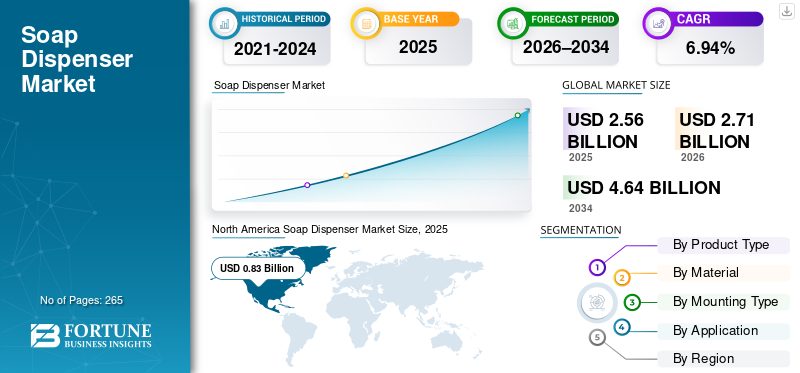
The global soap dispenser market size was valued at USD 2.56 billion in 2025. The market is projected to grow from USD 2.71 billion in 2026 to USD 4.64 billion by 2034, exhibiting a CAGR of 6.94% during the forecast period. North America dominated the soap dispenser market with a market share of 32.42% in 2025.
The soap dispenser industry is growing at a steady pace, driven by rising hygiene awareness among people, the increased use of touchless and automated dispensers, and strict sanitation regulations in healthcare, hospitality, and commercial sectors. Moreover, the rising trend of urbanization and the desire for beautifully designed bathroom sets in homes also contribute to market growth. Technological advancements, such as sensor-operated and Internet of Things (IoT)- enabled dispensers, are making it more convenient for users and helping minimize cross-contamination. Besides, the green trend is driving more refillable, environmentally friendly dispensing products, supplementing market expansion.
- For instance, according to the U.S. Census Bureau’s American Housing Survey (AHS), homeowners spent around USD 68.9 billion on bathroom renovations, with bathroom remodels as the major home improvement category. This, in turn, highlights sustained and growing demand for bathroom improvements, often associated with design and aesthetic enhancement.
Furthermore, many key industry players, such as Simplehuman, Umbra, ASI (American Specialties, Inc.), GOJO Industries, and Bobrick Washroom Equipment, Inc., operating in the market, are focusing on product innovation, particularly the development of design-oriented, sensor-based dispensers that improve user convenience, hygiene, and aesthetic appeal across residential and commercial applications.
Download Free sample to learn more about this report.
Soap Dispenser Market Key Takeaways
 Global Market Size & Forecast
- 2025 Market Size: USD 2.56 billion
- 2026 Market Size: USD 2.71 billion
- 2034 Forecast Market Size: USD 4.64 billion
- CAGR: 6.94% (2026–2034)
 Market Share
- North America dominated the market with a 32.42% share in 2025.
- The manual segment accounted for the largest market share in the global market.
- The plastic segment dominated the market in 2024 due to its lower cost, lightweight nature, and manufacturing flexibility.
 Key Regional Highlights
Asia Pacific
Asia Pacific accounted for USD 0.78 billion in 2025, ranking as the second-largest regional market.
North America
North America generated USD 0.83 billion in 2025 and is projected to reach USD 0.87 billion in 2026.
Europe
Europe held USD 0.69 billion in 2025 and is projected to witness steady growth during the forecast period.
U.S.
U.S. market is projected to witness steady growth during the forecast period.
Japan
Japan market was valued at USD 0.06 billion in 2025.
Read More

SOAP DISPENSER MARKET TRENDS
Growing Shift Toward Design-Oriented and Touchless Soap Dispensers
The demand for touchless soap dispensers is growing as awareness of the importance of hygiene and contamination-free solutions rises, particularly in homes and commercial environments. Moreover, consumers have been favoring bathroom accessories that are not only functional but also visually appealing and in line with modern interior aesthetics. Consequently, market players are integrating sensor technology with high-quality materials and sophisticated designs, enabling dispensers to meet hygienic needs and serve aesthetic roles in contemporary bathrooms.
Download Free sample to learn more about this report.
MARKET DYNAMICS
MARKET DRIVERS
Growing Consumer Consciousness Toward Health & Hygiene to Boost Market Growth
Soap dispenser demand is significantly driven by higher consumer awareness of personal and environmental hygiene, driven by global health campaigns and behavioral changes post-COVID-19 pandemic. Consumers are now more concerned about regularly washing their hands as a preventive health measure, which has consequently triggered widespread adoption of dependable, easily accessible soap dispensing solutions in residential, commercial, and public areas. This greater emphasis on cleanliness is pushing producers to develop new, automated, and high-quality material products, thereby directly fueling the soap dispenser market growth.
- The data from UNICEF/WHO reveal that over the period 2015 to 2024, 1.6 billion individuals worldwide used basic hygiene services, thereby increasing global coverage from 66% to 80%, including access to handwashing facilities with soap and water at home. This development indicates that more attention is being paid to hygiene behavior and installations worldwide, which, in turn, stimulates demand for products such as soap dispensers.
MARKET RESTRAINTS
High Cost of Automatic and Touchless Dispensers to Restrict Market Growth
The comparatively high pricing of smart and sensor-based soap dispensers limits their adoption among mass consumers, especially in developing, price-sensitive regions, further hampering market growth. Smart features, including battery systems, infrared sensors, and superior-quality materials, double the product prices compared to manual dispensers. Consequently, consumers and small commercial users often opt for cost-effective, basic dispensers, thereby hindering the penetration of technologically advanced, design-oriented products.
MARKET OPPORTUNITIES
Rising Consumer Demand for Premium and Aesthetically Designed Bathrooms to Generate Major Growth Opportunities
Higher disposable incomes, urbanization, and greater investment in home decor are prompting consumers’ renewed interest in bathroom upgrades, with stylish, coordinated accessories. This transition toward more luxurious, design-focused home interiors is fueling a high demand for visually appealing soap dispensers that complement modern bathroom designs. Therefore, manufacturers can set themselves apart by offering unique product designs, using different materials, and adding new finishes, which can lead to both higher margins and a wider footprint in the home segment.
MARKET CHALLENGES
Fragility and Reliability Concerns Pose a Critical Challenge to Market Growth
Advanced soap dispensers are typically fitted with various electrical components, sensors, and batteries, among others, that require timely maintenance and replacement. In cases of inconsistent sensor performance, frequent battery discharge, or clogging of the dispenser due to soap viscosity, the user’s experience can be negatively affected. Thus, individual users and facility operators exhibit reluctance to adopt or continue using automatic dispensers. This makes it challenging for manufacturers to deliver products that are reliable, durable, and easy to maintain for a long time at competitive prices.
Segmentation Analysis
By Product Type
Manual Segment to Take the Lead in Market Due to Its Cost-effectiveness
Based on the product type, the market is divided into manual and automatic/touchless.
The manual segment is anticipated to account for the largest soap dispenser market share. The high segmental share is primarily attributed to the cost-effectiveness, simple design, and wide application in homes, offices, and institutional settings. Manual dispensers are pretty popular in developing countries and high-traffic public facilities due to their low price, easy maintenance, and ability to dispense different kinds of soap. Hence, these dispensers remain the main source of sales volume globally, and they are able to maintain their lead in revenue share despite the faster growth of the automatic dispenser market segments.
The automatic soap dispenser segment is anticipated to rise with a CAGR of 8.24% over the forecast period.
To know how our report can help streamline your business, Speak to Analyst
By Material
High-Volume Sales and Affordability Boosted Plastic Segment Growth
Based on material, the market is segmented into plastic, stainless steel, and others.
In 2024, the plastic segment dominated the global market due to its lower cost, lightweight nature, and manufacturing flexibility. Plastic enables manufacturers to design and produce dispensers in a wide range of sizes, shapes, and colors at lower cost, fueling mass adoption in both residential and commercial applications. This, in turn, helps achieve frequent replacement cycles and high-volume sales of plastic dispensers, contributing significantly to overall market revenues.
The stainless steel segment is projected to grow at a CAGR of 8.36% over the forecast period.
By Application
Consistent Market Demand and Extensive Deployment Across Multiple Venues to Drive Commercial Application Growth
Based on the application, the market is segmented into residential, commercial, and institutional.
The commercial is anticipated to witness a dominating market share over the forecast period. The extensive deployment across hospitality venues, offices, public restrooms, and retail spaces. High traffic in commercial environments demands durable, long-lasting dispensing solutions and frequent handwashing, leading to bulk orders and regular replacements. Consequently, consistent demand from corporate malls, airports, corporate offices, and hotels generates higher cumulative revenues compared to institutional and residential applications.
The residential segment is projected to grow at a CAGR of 7.92% over the forecast period.
By Mounting Type
Wall-mounted Segment Commanded Market Due to Its Ease of Maintenance
Based on mounting type, the market is segmented into wall-mounted and countertop/free-standing.
The wall-mounted segment dominated the global market, driven by the prevalent use in healthcare, commercial, and institutional settings. Their excellent features, including ease of maintenance, space-saving design, and suitability for high-footfall restrooms such as those in malls, make them the preferred choice for professional and public environments. Subsequently, large-scale installations in schools, colleges, hospitals, offices, malls, airports, and transportation hubs generate higher overall revenues than freestanding/countertop alternatives. Furthermore, the segment is set to hold a 62.11% share in 2025.
In addition, the countertop/free-standing segment is projected to grow at a CAGR of 8.12% during the study period.
Soap Dispenser Market Regional Outlook
By geography, the market is categorized into Europe, North America, Asia Pacific, South America, and the Middle East & Africa.
North America
North America Soap Dispenser Market Size, 2025 (USD Billion)
To get more information on the regional analysis of this market, Download Free sample
North America held the dominant share in 2025, valued at USD 0.83 billion, and is expected to reach USD 0.87 billion in 2026. The region’s emphasis on sanitation and hygiene across healthcare, commercial, and public facilities, supported by rigid guidelines and health authority recommendations, drives market growth.
U.S. Soap Dispenser Market
Given North America’s strong contribution and the U.S.'s dominance in the region, the U.S. accounted for USD 0.72 billion in 2025, roughly 28.18% of global soap dispenser sales.
Europe
Europe is projected to record a growth rate of 5.87% in the coming years, which is the third-highest among all regions, and was valued at USD 0.69 billion by 2025. The region is estimated to have a strong consumer preference for refillable, eco-friendly, sustainable, and well-designed, aesthetically appealing bathroom accessories, supporting a rise in demand for soap dispensers.
U.K. Soap Dispenser Market
The U.K. market in 2025 was valued at USD 0.08 billion, representing roughly 3.18% of global soap dispenser revenues.
Germany Soap Dispenser Market
Germany’s market was valued at USD 0.12 billion in 2025, equivalent to around 4.77% of global soap dispenser sales.
Asia Pacific
Asia Pacific was valued at USD 0.78 billion in 2025 and ranked second-largest in the market. In the region, India and China were valued at USD 0.24 billion and USD 0.26 billion, respectively, in 2025. South Korea is another prominent market in the region and is forecast to grow moderately over the coming years.
Japan Soap Dispenser Market
The Japan market in 2025 was valued at USD 0.06 billion, accounting for roughly 2.52% of global soap dispenser revenues. High inclination toward sanitation and hygiene practices, adoption of touchless and automated dispenser technologies, and demand for compact, premium bathroom accessories supplement the country’s market growth.
China Soap Dispenser Market
China’s market in 2025 was valued at USD 0.26 billion in revenues, representing roughly 10.02% of global soap dispenser sales.
India Soap Dispenser Market
The India market in 2025 was valued at USD 0.24 billion, accounting for roughly 9.48% of global soap dispenser revenues.
South America and Middle East & Africa
The South America and Middle East & Africa regions are expected to witness moderate growth in this market space during the forecast period. The South America market was valued at USD 0.17 billion in 2025. Improving sanitation infrastructure and increasing awareness of hygiene practices in these regions drive market growth. In the Middle East & Africa, the UAE was valued at USD 0.02 billion in 2025. Saudi Arabia is also one of the prominent markets in the region and is expected to grow significantly over the forecast period.
South Africa Soap Dispenser Market
The South Africa market was valued at USD 0.02 billion in 2025, accounting for roughly 0.66% of global soap dispenser revenues.
COMPETITIVE LANDSCAPE
Key Industry Players
Innovation and Differentiation Drive Market Positioning
The global soap dispenser market faces fierce competition from prominent players such as Simplehuman, Umbra, ASI (American Specialties, Inc.), GOJO Industries, and Bobrick Washroom Equipment, Inc., as well as domestic industry participants. These players mainly compete by innovating in product design, materials, and automation technologies to serve better evolving consumer demand for hygiene and aesthetic appeal. Key players also strongly emphasize broadening their geographical reach across both residential and commercial applications while maintaining competitiveness through pricing and digital marketing.
LIST OF KEY SOAP DISPENSER COMPANIES PROFILED
- GOJO Industries, Inc. (U.S.)
- Bobrick Washroom Equipment, Inc. (U.S.)
- American Specialties, Inc. (ASI) (U.S.)
- Simplehuman, LLC (U.S.)
- Umbra Ltd. (Canada)
- Tork (Essity AB) (Sweden)
- Sloan Valve Company (U.S.)
- Kimberly-Clark Professional (U.S.)
- OPHARDT Hygiene-Technik GmbH (Germany)
- SVAVO Group (China)
KEY INDUSTRY DEVELOPMENTS
- December 2025: GOJO Industries proactively endorsed and encouraged consumers to switch or upgrade to automatic, touchless soap dispensers for better facility hygiene and sustainability, stressing reduced waste, water savings, and lower maintenance.
- November 2025: GOJO Industries launched the PURELL CX10 Countermount Dispensing System, a new touch-free dispenser with Energy-on-The-Refill technology that excludes battery maintenance and improves hygiene with smart sensor operation for commercial and healthcare environments.
- March 2025: Bobrick Washroom Equipment extended its Automatic Soap Dispenser lineup, SureFlo, featuring top-fill bulk soap capacity that not only reduces waste but also operating costs while maintaining hygiene and touch-free operation in heavy-footfall washrooms.
- February 2025: American Specialties, Inc. continued improving its automatic soap dispensing systems, EZ Fill, providing infrared sensor control and top-fill multi-feed technology for flexible settings and simple maintenance.
REPORT COVERAGE
Request for Customization to gain extensive market insights.
Report Scope & Segmentation
|
ATTRIBUTE |
DETAILS |
|
Study Period |
2021-2034 |
|
Base Year |
2025 |
|
Estimated Year |
2026 |
|
Forecast Period |
2026-2034 |
|
Historical Period |
2021-2024 |
|
Growth Rate |
CAGR of 6.94% from 2026-2034 |
|
Unit |
Value (USD Billion) |
|
Segmentation |
By Product Type, Material, Mounting Type, Application, and Region |
|
By Product Type |
· Manual · Automatic/Touchless |
|
By Material |
· Plastic · Stainless Steel · Others |
|
By Mounting Type |
· Wall-Mounted · Countertop / Free-Standing |
|
By Application |
· Residential · Commercial · Institutional |
|
By Region |
· North America (By Product Type, Material, Mounting Type, Application, and Country) o U.S. (By Product Type) o Canada (By Product Type) o Mexico (By Product Type) · Europe (By Product Type, Material, Mounting Type, Application, and Country/Sub-region) o Germany (By Product Type) o U.K. (By Product Type) o France (By Product Type) o Spain (By Product Type) o Italy (By Product Type) o Rest of Europe (By Product Type) · Asia Pacific (By Product Type, Material, Mounting Type, Application, and Country/Sub-region) o China (By Product Type) o Japan (By Product Type) o India (By Product Type) o Australia (By Product Type) o Rest of Asia Pacific (By Product Type) · South America (By Product Type, Material, Mounting Type, Application, and Country/Sub-region) o Brazil (By Product Type) o Argentina (By Product Type) o Rest of South America (By Product Type) · Middle East & Africa (By Product Type, Material, Mounting Type, Application, and Country/Sub-region) o South Africa (By Product Type) o UAE (By Product Type) o Rest of Middle East & Africa (By Product Type) |
Frequently Asked Questions
According to Fortune Business Insights, the global market value stood at USD 2.56 billion in 2025 and is projected to reach USD 4.64 billion by 2034.
In 2025, the market value stood at USD 0.83 billion.
The market is expected to grow at a CAGR of 6.94% over the forecast period of 2026-2034.
By product type, the manual segment is expected to lead the market.
Rising hygiene awareness among people and the increased use of touchless and automated dispensers are driving market expansion.
Simplehuman, Umbra, ASI (American Specialties, Inc.), GOJO Industries, and Bobrick Washroom Equipment, Inc. are the major players in the global market.
North America dominated the market in 2025.



- 2021-2034
- 2025
- 2021-2024
- 265
-
(Offer valid till 30th Sep 2026)
Get 30-60 hrs Free Customization
Expand Regional and Country Coverage, Segments Analysis, Company Profiles, Competitive Benchmarking, and End-user Insights.











-
US +1 833 909 2966 ( Toll Free )
-
Get In Touch With Us