Socks Market Size, Share & Industry Analysis, By Product (Casual, Athletic, Formal, and Others), By Material (Cotton, Polyester, Nylon, Wool, and Others), By End-User (Men, Women, and Kids), By Price Range (Economy, Mid-range, and Luxury), By Fabric Technology (Moisture-Wicking, Anti-microbial, Cushioned, Compression, Thermal, and Others), By Distribution Channel (Supermarkets/Hypermarkets, Department Stores, Specialty Stores, Pharmacy Stores, Online Channels, and Others), and Regional Forecast, 2026-2034
 Download Free Sample
(Offer valid till 30th Sep 2026)

Socks Market Size and Future Outlook
 Listen to Audio Version
The global socks market size was valued at USD 29.09 billion in 2025 and is projected to grow from USD 30.37 billion in 2026 to USD 40.96 billion by 2034, exhibiting a CAGR of 3.81% during the forecast period. Asia Pacific dominated the socks market with a market share of 56.68% in 2025.
Youngsters typically use functional and performance socks to stay comfortable while engaging in recreational activities. The growing number of fashion-conscious consumers and the emergence of athleisure culture are expected to drive demand for the product. Manufacturers produce socks with moisture-wicking, antibacterial, and thermal features to enhance users' experiences while they are sustainably worn. For instance, in April 2025, G-Shock launched G-Shock-branded socks featuring moisture-wicking, shock resistance, and tactical strength.
Major players operating in the global market include Hanesbrands Inc., Gildan Activewear Inc., Nike, Inc., Adidas AG, and VF Corporation. These players invest in automation, the development of recycled fibers, and the establishment of direct-to-consumer (DTC) channels to expand product reach globally.
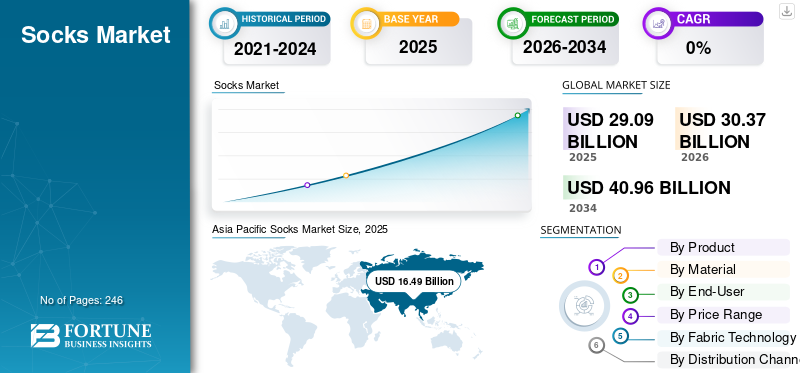
Download Free sample to learn more about this report.
SOCKS MARKET KEY TAKEAWAYS
 Market Size & Forecast
- 2025 Market Size: USD 29.09 billion
- 2026 Market Size: USD 30.37 billion
- 2034 Forecast Market Size: USD 40.96 billion
- CAGR: 3.81% from 2026–2034
 Market Share
- Asia Pacific dominated the socks market with a 56.68% share in 2025.
- The casual segment accounted for the largest market share, holding 49.81% in 2025.
- The cotton segment held a 40.32% share in 2025.
 Key Regional Highlights
Asia Pacific
Asia Pacific accounted for 56.70% of the global market in 2025, reaching USD 16.49 billion, driven by rising apparel demand and expanding middle-income households.
Europe
Europe reached USD 4.90 billion in 2025 (16.13% share), driven by demand for premium and sustainable products.
North America
North America is expected to witness steady growth, supported by strong demand for athletic and performance wear.
U.S.
The market reached USD 4.51 billion in 2025, fueled by growing demand for athletic, casual, and premium socks.
Japan
The market reached USD 1.96 billion in 2025, supported by strong fashion awareness and seasonal demand.
Read More

SOCKS MARKET TRENDS
Growing Adoption of AI-Based Style Recommendations to Favor Market Growth
Consumers prefer wearables that are personalized in terms of style, fit, and color preferences. In response to consumer expectations, brands are producing print-on-demand products with size customization and made-to-order designs. The growing adoption of AI-based style recommendations, digital printing, and 3D body-scanning technologies by key players is driving global market growth.
Download Free sample to learn more about this report.
MARKET DYNAMICS
MARKET DRIVERS
Technological Advancements in Product Fabric and Manufacturing to Drive Market Growth
Technological advancements in manufacturing practices, from traditional knitting to advanced, precision-based production using 3D knitting techniques and computerized circular knitting machines, are positively contributing to the socks market growth. In addition, consistent development of hosiery fabric with moisture-wicking properties, antimicrobial treatments, compression technology, and temperature-regulation capabilities significantly enhances consumers’ product usage experience, favoring global product demand.
MARKET RESTRAINTS
Increasing Consumer Accessibility to Counterfeit Products to Restrain Market Growth
Increased consumer access to counterfeit products, which can lead to skin irritation after use, is severely restraining product demand. In addition, the high availability of such products, along with their competitive pricing, is negatively affecting key brands’ product sales, thereby hampering global market growth.
MARKET OPPORTUNITIES
Rising Demand for Eco-friendly Material-based Products to Augment Market Growth
A growing number of eco-conscious consumers who prefer personal wearables with an emphasis on sustainability is creating new business opportunities for manufacturers to develop such ethical products. In addition, consistent production by manufacturers of hosiery made from eco-friendly raw materials, including organic cotton, recycled polyester, bamboo fibers, and biodegradable fabrics, is positively contributing to market growth.
MARKET CHALLENGES
Intense Competition from Local and Global Manufacturers to Challenge Market Growth
Intense competition from local and global manufacturers, offering products at competitive prices, poses challenges for key players in their market expansion efforts. Furthermore, the proliferation of unorganized manufacturers providing products at lower prices poses significant challenges for key players seeking to strengthen their market positions in emerging economies, including Asia, Europe, and Africa.
Segmentation Analysis
By Product
Wide Adoption of Casual Wearables Led to the Dominance of the Casual Segment
By product, the market is segregated into casual, athletic, formal, and others. The casual segment exhibited a leading global socks market share of 49.81% in 2025. Its largest market share is attributed to the widespread usage of casual wearables in office and casual settings. In addition, the growing trend of wearing casual and athleisure dressings in urban and semi-urban areas is further strengthening segmental growth.
To know how our report can help streamline your business, Speak to Analyst
The athletic segment is expected to grow at a 4.89% CAGR during the forecast period (2026-2034). Increasing sports participation, a growing fitness culture, and rising demand for performance-oriented products across many countries drive the fastest growth in the athletic segment. In addition, the increasing number of individuals participating in running, yoga, cycling, and other activities that require breathable fabric-based knee socks is positively contributing to the segment’s growth. The increasing popularity of athleisure fashion is also favoring segmental revenues.
By Material
Better Breathability of Cotton-based Products Lead the Cotton Segment Expansion
Based on material, the market is categorized into cotton, polyester, nylon, wool, and others. Cotton remains the dominant material segment with a global market share of 40.32% in 2025. During use, cotton-based products better absorb moisture and allow air to circulate. The segment’s leading share is driven by high consumer demand for cotton-fabric knee socks that are comfortable, skin-friendly, and breathable. Furthermore, manufacturers’ adoption of sustainable business practices, including the use of organic cotton and blended fabrics in hosiery production, is driving the segment’s revenue growth.
The others segment, which includes various materials such as bamboo fiber and recycled polyester, is projected to grow at the fastest rate of 5.97% from 2026 to 2034. The other segment’s fastest growth is attributed to rising consumer interest in bamboo-fiber-based products with enhanced performance features, such as moisture wicking and thermal retention. In addition, the growing popularity of recycled fiber-based knee socks with antibacterial and moisture-retention properties is accelerating revenue growth in other segments.
By End-User
High Consumption Frequency of Footwear Among Men Led the Men Segment Growth
Based on end-user, the market is divided into men, women, and kids. The men's segment is slated to exhibit a leading global market share of 53.10% in 2025. The men’s segment holds the largest share of the global market, primarily due to higher consumption frequency and the broader adoption of products across formal, casual, and athletic wear. Men generally purchase products more frequently for workwear, sports, and daily use, which contributes to consistent demand. Additionally, the growing corporate workforce and increasing participation in fitness and sports among men further support segmental dominance. The presence of a wide product variety from business dress products to performance sports products designed specifically for men also enhances sales volume within this category.
The kids segment is slated to grow at the fastest-CAGR of 5.25% during the forecast period from 2026 to 2034. The kids' segment is expected to grow fastest, driven less by larger child populations and more by rising parental spending, the premiumization of children’s apparel, rapid replacement cycles as children grow, and increased demand for functional products (such as anti-slip, breathable, and character-themed). While fertility rates globally are declining, the children’s category is growing due to higher unit value and stronger retail/online penetration.
By Price Range
High Consumption Demand for the Affordable Products Led to the Dominance of the Economy Segment
Based on price range, the market is segmented into economy, mid-range, and luxury. The economy segment held a leading 50.56% share in 2025 and is expected to maintain this position from 2026 to 2034. Its leading share is attributed to the high consumer demand for the affordable products that fulfil users’ everyday needs. In addition, the widespread availability of such affordable products at supermarkets and online platforms led the economy segment to generate considerable product revenues.
The luxury segment is slated to grow at the fastest-CAGR during the forecast period (2026-2034). Its fastest growth is due to the rising demand for premium fashion accessories among middle- and upper-income consumers across many countries. In addition, the rising number of brands using superior materials, including merino wool, cashmere, and Egyptian cotton, and sustainable fibers, to produce kneesock is favoring the luxury segment’s growth.
By Fabric Technology
Wide Acceptability of Active Lifestyles Led to the Dominance of the Moisture-Wicking Segment
Based on fabric technology, the market is segmented into moisture-wicking, anti-microbial, cushioned, compression, thermal, and others. The moisture-wicking segment is projected to hold a leading global market share of 30.54% in 2025. Its major share is attributed to the wide consumer acceptance of the kneesock, which features moisture-wicking fabric technology. This technology better absorbs body sweat, reduces odor, and prevents blisters. Besides, the rising adoption of active lifestyles and the growth in sport participation rates, which require athletes to use performance-enhancing wearables, including moisture-wicking fabric-based knee socks, are favoring the segment’s growth.
The compression segment is slated to grow at the fastest CAGR during the forecast period from 2026-2034. The segment’s fastest growth is attributed to the rising popularity of legwear that supports users' blood circulation and features compression technology among diabetic patients and health-conscious individuals. Furthermore, the increasing prevalence of varicose veins, deep vein thrombosis, and swelling, along with growing awareness of foot health and the benefits of using compression technology-based products, is accelerating segmental growth.
By Distribution Channel
Increasing Adoption of Online Shopping Held the Online Channels Segment Growth
Based on distribution channel, the market is segmented into supermarkets/hypermarkets, department stores, specialty stores, pharmacy stores, online channels, and others. The online channels segment held a leading global market share of 36.02% in 2025. The segment is slated to grow at the fastest CAGR during the forecast period from 2026 to 2034. The rising adoption of online shopping for consumer goods, along with greater convenience for consumers in shopping for products from online portals & home delivery options, is primarily driving the growth of the segment. Furthermore, the growing number of direct-to-consumer (D2C) brands promoting their products on social media sites is expected to increase online product sales, driving the segmental revenue growth.
The specialty stores segment is projected to grow rapidly from 2026 to 2034. The consistent provision of specialty shops with branded products and expert advice on product selection primarily supports sales of these products. Furthermore, the brand's expanding retail footprint, which offers luxury products, is accelerating segment growth.
Socks Market Regional Outlook Market Growth
By geography, the market is categorized into North America, Europe, Asia Pacific, South America, and the Middle East & Africa.
Asia Pacific
The Asia Pacific region’s market is projected to grow at the fastest rate of 4.36% from 2026 to 2034. The region exhibited a leading global market share of 56.70%, with market size reaching USD 16.49 billion in 2025. The region’s fastest growth is attributed to the expanding number of middle-income households and an increasing preference for skin-breathable fabric-based apparel in China, India, and Southeast Asia. In addition, evolving fashion trends and the growing number of brand stores & specialty shops offering luxury products are accelerating the region’s market growth.
Asia Pacific Socks Market Size, 2025 (USD Billion)
To get more information on the regional analysis of this market, Download Free sample
Japan Socks Market
The Japanese market in 2025 stood at around USD 1.96 billion, accounting for roughly 6.45% of global product revenues. An aging population, seasonal climatic changes, and strong fashion-consciousness support the demand for the product.
China Socks Market
China’s market is projected to be one of the largest worldwide, with revenues estimated at around USD 7.41 billion in 2025, representing roughly 24.40% of global product sales. The presence of a large number of apparel manufacturers, a high urban consumer base, and significant demand for casual, athleisure, and premium products is primarily generating product revenues in China.
India Socks Market
The Indian market in 2025 reached around USD 4.72 billion, accounting for roughly 15.54% of the global market revenues.
North America
The North American region held a third-leading global market share from 2026 to 2034. Robust demand for athletic & performance wearables, and high participation in sports activities in the U.S. and Canada, is primarily generating product revenues in these countries. Furthermore, the consistent expansion of online retail and the rising number of direct-to-consumer (DTC) brands offering luxury products are driving market growth in the region
U.S. Socks Market
The U.S. market size reached USD 4.51 billion in 2025. The U.S. market accounted for around 14.85% of the global market sales in 2025. The U.S. is the largest market in North America, driven by high disposable income, strong demand for athletic, casual, and performance-enhancing products, and a well-established retail and e-commerce infrastructure. Increasing interest in premium, sustainable, and health-focused sock technologies, such as compression and moisture-wicking fabrics, continues to boost consumer spending.
Europe
The European region is expected to exhibit a third leading global market position during the forecast period (2026-2034). The European market size reached USD 4.90 billion in 2025, accounting for approximately 16.13% of the global product sales. High demand for premium, sustainable, and fashion-oriented products, combined with a significant production base of Kneesock in Germany, Italy, and the U.K., is primarily driving product consumption in the region. Furthermore, advancements in the development of innovative fabrics and the rising adoption of athleisure products are accelerating market growth across Europe.
U.K. Socks Market
The U.K. market in 2025 reached around USD 0.70 billion, representing approximately 2.30% of global product revenues.
Germany Socks Market
Germany’s market reached approximately USD 1.09 billion in 2025, equivalent to around 3.59% of global product sales.
South America and the Middle East & Africa
The markets in South America and the Middle East & Africa are expected to grow at a moderate rate from 2026 to 2034 over the global market forecast period. The South American market in 2025 reached a valuation of USD 0.80 billion. Growing urbanization and increasing demand for affordable sports products are driving market growth in Brazil and Colombia. Emerging fashion consciousness and growing awareness about foot health are gaining traction, driving product demand in Saudi Arabia and the UAE. In the Middle East & African market, South Africa reached a market value of USD 0.53 billion in 2025.
UAE Socks Market
The UAE market reached approximately USD 0.43 billion in 2025, accounting for roughly 1.42% of the global market revenues.
COMPETITIVE LANDSCAPE
Key Industry Players
Key Players Emphasis on Expanding their Portfolios to Maintain their Market Position
Key players operating in the global market include Hanesbrands Inc., Gildan Activewear Inc., Nike, Inc., Adidas AG, and VF Corporation. These players focus on expanding their portfolios and building distribution networks to maintain their market position. Additionally, they consistently launch marketing campaigns to promote their products sustainably. For instance, in January 2023, Gildan launched new positioning and marketing campaigns for its Gildan, American Apparel, and Comfort Colors brands, which debuted at Impressions Expo in Long Beach, California, U.S.
LIST OF KEY SOCKS COMPANIES PROFILED
- Hanesbrands Inc. (U.S.)
- Gildan Activewear Inc. (Canada)
- NIKE, Inc. (U.S.)
- Adidas AG (Germany)
- VF Corporation (U.S.)
- PUMA SE (Germany)
- Calzedonia S.p.A. (Italy)
- MAS Holdings (Pvt) Ltd. (Sri Lanka)
- Renfro Corporation (U.S.)
- FALKE KGaA (Germany)
KEY INDUSTRY DEVELOPMENTS
- July 2025: TRUEENERGY, a performance footwear clothing innovator, unveiled its Premium Merino Wool collection of products that combine the natural intelligence of Merino Wool with advanced Tru-X Technology.
- April 2025: Shobhit Gaur launched The Sock Street (TSS), a direct-to-consumer lifestyle brand to build its portfolio of fashion-conscious essentials.
- March 2025: Nike launched upgraded Dri-FIT sock lines and introduced sustainable performance leg wearables made from recycled polyester and eco-friendly dyes.
- November 2024: Feetures announced the grand opening of its new 60,000-square-foot distribution center, located in Hickory, North Carolina, U.S., to enhance logistics and support the growth of its sock business.
- October 2024: Smartwool partnered with Altra to launch limited-edition cold-weather running collections (including knee socks) sold through specialty retailers such as REI.
- June 2024: Balenzia Socks, an Indian brand, expanded its footprint by opening its latest store at Jolly Grant Airport in Dehradun, India. At the store, the company is offering premium products of various categories, including casual wear, formal wear, and athletic wear.
- January 2024: Hanesbrands Inc. extended a long-term apparel partnership with the Georgia Institute of Technology to support research on manufacturing and material efficiency. This academic partnership enables Hanes to explore advanced textile manufacturing, materials, and process efficiencies that can be scaled up for the mass production of kneesocks.
REPORT COVERAGE
The global socks market analysis provides an in-depth study of market insights, size, and forecasts for all market segments included in the report. In addition, the report on the market outlooks, market dynamics, and market trends expected to drive the market during the forecast period. It offers information on the technological advancements, new product launches, key industry developments, and details on partnerships, mergers & acquisitions. The market research report also encompasses a detailed competitive landscape with information on the market share and profiles of key operating players.
Request for Customization to gain extensive market insights.
Report Scope & Segmentation
| ATTRIBUTE | DETAILS |
| Study Period | 2021-2034 |
| Base Year | 2025 |
| Forecast Period | 2026-2034 |
| Historical Period | 2021-2024 |
| Growth Rate | CAGR of 3.81% from 2026 to 2034 |
| Unit | Value (USD Billion) |
| Segmentation | By Product, Material, End-User, Price Range, Fabric Technology, Distribution Channel, and Region |
| By Product |
|
| By Material |
|
| By End-User |
|
| By Price Range |
|
| By Fabric Technology |
|
| By Distribution Channel |
|
| By Geography |
|
Frequently Asked Questions
Fortune Business Insights says that the global market value stood at USD 29.09 billion in 2025 and is projected to reach USD 40.96 billion by 2034.
In 2025, the market value stood at USD 16.49 billion.
At a CAGR of 3.81%, the global market is forecast to grow during 2026-2034.
The casual segment led the market in terms of by product segment.
Technological advancements in sock fabric and manufacturing are driving the global market.
Hanesbrands Inc., Gildan Activewear Inc., NIKE, Inc., Adidas AG, and VF Corporation are some of the top players in the market.
Asia Pacific dominated the market in 2025.
The rising demand for eco-friendly and material-based leg wearables is expected to favor product adoption.



- 2021-2034
- 2025
- 2021-2024
- 246
-
(Offer valid till 30th Sep 2026)
Get 30-60 hrs Free Customization
Expand Regional and Country Coverage, Segments Analysis, Company Profiles, Competitive Benchmarking, and End-user Insights.



















Related Reports
-
US +1 833 909 2966 ( Toll Free )
-
Get In Touch With Us