Solar-Powered EV Charging Stations Market Size, Share & Industry Analysis, By Component (Solar Panels, EV Charging Units, Battery Energy Storage System), By Charging Infrastructure Architecture (Grid-connected Solar EV, Off-grid Solar EV, Hybrid Solar & Battery Storage), By Charging Current Type (AC, DC, and Ultra-fast DC), By Installation Site (Residential Solar EV Charging, Commercial Parking Facilities, Highway & Transit Corridor Charging), By Energy Storage Integration (Solar Charging Stations Without Storage, Lithium-ion Battery-integrated Stations), and Regional Forecast, 2026-2034
 Download Free Sample
(Offer valid till 15th Oct 2026)

Solar-Powered EV Charging Stations Market Size and Future Outlook
 Listen to Audio Version
The global solar-powered EV charging stations market size was valued at USD 3.84 billion in 2025. The market is projected to grow from USD 4.62 billion in 2026 to USD 19.74 billion by 2034, exhibiting a CAGR of 19.9% during the forecast period. Asia Pacific dominated the solar-powered EV charging stations market with a market share of 41.93% in 2025.
Solar-powered EV charging stations are charging facilities that utilize solar panels to generate electricity for charging electric vehicles, often combined with energy storage systems and smart energy management technologies to improve efficiency and sustainability. Market growth is driven by increasing adoption of Electric Vehicles (EVs), rising investments in renewable energy solutions, expanding charging infrastructure, government incentives, growing environmental awareness, and efforts to reduce carbon emissions and dependence on fossil fuels.
Major players operating in the market include ABB Ltd., Siemens AG, Schneider Electric SE, Beam Global, Tesla, Inc., ChargePoint Holdings, Inc., Wallbox N.V., EVBox, Enel X, and Delta Electronics. These companies are competing through solar-integrated charging technologies, energy storage systems, smart charging platforms, charging network expansion, and advanced energy management solutions.
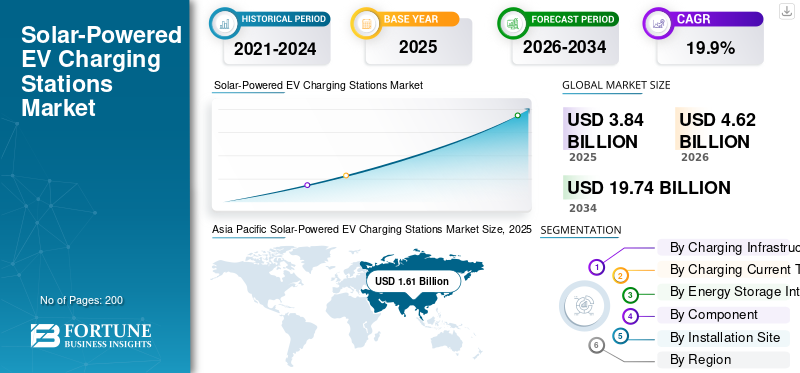
Download Free sample to learn more about this report.
Solar-Powered EV Charging Stations Market Key Takeaways
 Global Market Size & Forecast
- 2025 Market Size: USD 3.84 billion
- 2026 Market Size: USD 4.62 billion
- 2034 Forecast Market Size: USD 19.74 billion
- CAGR: 19.9% from 2026–2034
 Market Share
- Asia Pacific dominated the solar-powered EV charging stations market with a 41.93% share in 2025.
- The hybrid solar & battery storage charging stations segment is projected to grow at a CAGR of 21.9% during the forecast period.
- The ultra-fast DC solar EV chargers segment is projected to grow at a CAGR of 22.0% during the forecast period.
 Key Regional Highlights
North America
North America accounted for the third-largest market share, supported by rising EV adoption and investments in charging infrastructure modernization.
Asia Pacific
Asia Pacific held the largest market share and is expected to register the fastest growth during the forecast period.
Europe
Europe represented the second-largest market and is projected to expand at a CAGR of 17.5% during the forecast period.
U.S.
The market is estimated to reach USD 0.86 billion in 2026.
Japan
The market is estimated to reach USD 0.15 billion in 2026.
Read More

SOLAR-POWERED EV CHARGING STATIONS MARKET TRENDS
Integration of Smart Energy Management and AI-Based Charging Systems to Augment Market Growth
The market is witnessing a strong trend toward the integration of smart energy management platforms and AI-enabled charging solutions. Operators are increasingly deploying intelligent systems that optimize solar powered EV charging stations, energy generation, battery storage utilization, and charging schedules based on electricity demand and weather conditions. These technologies improve energy efficiency, reduce operational costs, and enhance charging station reliability. Advanced monitoring capabilities also support predictive maintenance, helping charging network operators maximize asset performance while improving the overall user experience.
- In November 2022, Delta Electronics launched its AI-powered DeltaGrid EVM platform, integrating EV charging, solar energy, and energy storage into a unified management system. The solution enhances charging efficiency, grid stability, energy optimization, and operational management, supporting the expansion of solar-powered EV charging infrastructure across Europe, Japan, Southeast Asia, and Taiwan.
Expansion of Solar-Powered Fast Charging Networks Along Transit Corridors to Propel Market Growth
The deployment of solar-powered fast charging stations across highways, urban centers, and commercial corridors is emerging as a key market trend. Governments and private operators are investing in large-scale charging networks to support growing electric vehicle adoption and long-distance travel. Solar integration helps reduce dependence on conventional grid electricity while supporting sustainability goals. The combination of fast charging technologies, renewable energy generation, and battery storage systems is creating a more resilient charging infrastructure capable of serving increasing numbers of EV users efficiently.
- In June 2025, BESCOM and GIZ inaugurated India’s first solar-integrated EV charging station powered by second-life batteries near Kempegowda International Airport, Bengaluru. The facility combines a 45 kW solar power system with 100 kWh battery storage, enabling round-the-clock charging for up to 23 vehicles simultaneously while enhancing renewable energy sources utilization and charging infrastructure sustainability.
MARKET DYNAMICS
MARKET DRIVERS
Download Free sample to learn more about this report.
Rising Adoption of Electric Vehicles Accelerates Charging Infrastructure Investments
The rapid adoption of electric vehicles worldwide is a major driver for the solar-powered EV charging stations market growth. As EV ownership expands across passenger, commercial, and public transportation segments, demand for accessible and sustainable charging solutions continues to increase. Governments are supporting EV deployment through incentives, emissions regulations, and infrastructure programs. Solar-powered charging stations offer an environmentally friendly alternative to conventional charging methods, helping operators meet sustainability objectives while accommodating the increasing charging requirements of a growing global EV fleet.
Decarbonization Goals and Renewable Energy Deployment Support Market Expansion
National carbon reduction targets and renewable energy policies are driving investments in solar-powered EV charging infrastructure. Governments, municipalities, and corporations are increasingly prioritizing renewable energy solutions to reduce carbon emissions and dependence on fossil fuels. The solar-powered charging stations industry aligns with these objectives by enabling clean energy-powered transportation. Growing commitments to net-zero emissions, sustainable transportation systems, and renewable energy integration are encouraging utilities, businesses, and charging operators to expand solar charging deployments across residential, commercial, and public applications.
- In August 2024, the Climate Pledge, co-founded by Amazon and Global Optimism, launched the JOULE initiative in Bengaluru to develop renewable energy-powered shared EV charging stations. Supported by a USD 2.65 million investment, the project aims to serve over 5,500 electric vehicles by 2030, reduce carbon emissions, and accelerate commercial fleet electrification through collaborative charging infrastructure deployment.
MARKET RESTRAINTS
High Initial Capital Requirements Limit Large-Scale Deployment
Despite long-term economic benefits, the high upfront investment associated with solar-powered EV charging stations remains a significant market restraint. Infrastructure developers must invest in solar panels, charging equipment, battery storage systems, land acquisition, and grid interconnection facilities. These capital requirements can discourage smaller operators and delay project implementation, particularly in developing regions. Financing challenges, lengthy permitting processes, and uncertainty regarding return on investment may further limit the pace of deployment, especially for large-scale charging infrastructure projects.
MARKET OPPORTUNITIES
Growth of Off-Grid and Remote Charging Solutions Creates New Revenue Streams
The increasing need for EV charging access in remote locations presents a significant opportunity for market participants. Solar-powered charging stations can operate independently or with minimal grid support, making them suitable for rural communities, tourist destinations, logistics hubs, and remote industrial sites. Improvements in battery storage technologies and energy management systems are enhancing off-grid charging performance. As governments seek broader charging coverage and energy accessibility, solar-powered charging infrastructure is becoming an attractive solution for underserved regions worldwide.
- In November 2024, Energy Plug Technologies launched an off-grid EV charging station powered by renewable energy and advanced battery energy storage systems (BESS). The modular solution integrates solar power, battery storage, and Level 2/Level 3 charging capabilities. Further, enabling sustainable EV charging in remote, rural, and underserved locations while reducing dependence on conventional grid infrastructure and supporting the expansion of charging network expansion.
Commercial Fleet Electrification Generates Demand for Dedicated Solar Charging Hubs
The ongoing electrification of commercial vehicle fleets is creating substantial opportunities for solar-powered charging infrastructure providers. Logistics companies, public transit agencies, ride-hailing operators, and corporate fleet owners are seeking cost-effective and sustainable charging solutions. Solar-powered charging hubs can help reduce energy expenses while supporting environmental sustainability commitments. The growing deployment of electric buses, delivery vans, and commercial vehicles is expected to drive investments in dedicated charging facilities integrated with solar generation and energy storage capabilities.
- In January 2025, Tata Power Renewable Energy and Tivolt Electric Vehicles partnered to develop EV charging infrastructure for commercial fleets across India. The collaboration includes deployment of charging stations at dealerships, customer sites, and public locations, while exploring solar-powered charging solutions to reduce operating costs and support sustainable fleet electrification.
MARKET CHALLENGES
Managing Solar Energy Variability While Maintaining Reliable Charging Performance
One of the primary challenges faced by the market is ensuring reliable charging availability despite fluctuations in solar energy generation. Weather conditions, seasonal variations, and geographical factors can affect solar power output, creating operational complexities for charging station operators. Maintaining consistent charging performance often requires sophisticated energy storage systems, grid backup arrangements, and advanced energy management technologies. Balancing energy supply and charging demand while controlling costs remains a critical challenge as solar-powered charging networks continue to expand globally.
Segmentation Analysis
By Charging Infrastructure Architecture
Grid Connectivity and Reliable Energy Access Sustain Grid-connected Solar EV Charging Stations Market Demand
Based on charging infrastructure architecture, the market is segmented into grid-connected solar EV charging stations, off-grid solar EV charging stations, hybrid solar & battery storage charging stations, and microgrid-integrated solar charging stations.
The grid-connected solar EV charging stations segment dominated the market in 2025 due to its ability to combine solar energy generation with stable grid electricity, ensuring uninterrupted charging availability. These systems support large-scale commercial, public, and highway charging applications where reliability and high utilization rates are critical. Grid connectivity enables operators to manage peak demand efficiently while reducing energy costs through renewable power integration. Favorable government policies, expanding charging networks, and compatibility with existing electrical infrastructure further strengthen segment leadership across major EV markets.
The hybrid solar & battery storage charging stations segment is projected to expand at a CAGR of 21.9% during the solar-powered EV charging stations market forecast period. The growth is driven by increasing demand for energy independence, improved charging reliability, and enhanced utilization of solar power through integrated storage systems. Falling battery costs and rising deployment in commercial charging hubs further support rapid adoption.
By Charging Current Type
Expansion of Public Fast-Charging Networks Boosts DC Fast Solar EV Chargers Market Demand
Based on charging current type, the market is segmented into AC solar EV chargers, DC fast solar EV chargers, and ultra-fast DC solar EV chargers.
The DC fast solar EV chargers segment held the largest market share in 2025 due to its ability to deliver significantly shorter charging times while utilizing renewable solar energy. These systems are widely deployed across commercial charging hubs, highways, urban corridors, and fleet charging facilities where high vehicle throughput is essential. Growing EV ownership, increasing long-distance travel requirements, and investments in public charging infrastructure continue to support demand. Their balance of charging speed, operational efficiency, and scalability strengthens their position across global charging networks.
- In April 2026, ChargePoint launched Express Solo, a next-generation DC fast charger capable of delivering up to 600 kW charging power. The system integrates solar energy, battery storage, and bidirectional charging capabilities while enabling scalable, high-density charging infrastructure with lower installation costs and improved operational efficiency across North America and Europe.
The ultra-fast DC solar EV chargers segment is projected to grow at a CAGR of 22.0% during the forecast period. The growth is driven by rising demand for charging times comparable to conventional refueling, increasing deployment along major transportation corridors, and advancements in high-power charging technologies integrated with solar generation and energy storage systems.
By Energy Storage Integration
Growing Deployment of Battery-Backed Charging Hubs Advances Lithium-ion Battery-Integrated Stations Market Growth
Based on energy storage integration, the market is segmented into solar charging stations without storage, lithium-ion battery-integrated stations, second-life EV battery-integrated stations, and hybrid energy storage-integrated stations.
The lithium-ion battery integrated stations segment accounted for the largest market share in 2025 due to their ability to store excess solar energy and provide reliable charging services during periods of low solar generation. These systems enhance energy utilization, reduce grid dependence, and support fast-charging applications across commercial, public, and highway charging locations. Declining battery costs, improving energy density, and increasing integration with renewable energy infrastructure have accelerated deployment. Their proven performance, scalability, and widespread availability continue to strengthen adoption across global solar-powered EV charging networks.
The second-life EV battery-integrated stations segment is projected to grow at a CAGR of 22.8% during the forecast period. The growth is supported by increasing availability of retired EV batteries, growing focus on circular economy initiatives, and demand for cost-effective energy storage solutions. These systems help reduce storage costs while extending battery life and improving renewable energy utilization.
- In February 2024, MG Motor India and BatX Energies unveiled India’s first off-grid solar EV charging station powered by repurposed EV batteries. The system integrates second-life battery storage and solar energy generation to support sustainable charging, reduce grid dependence, lower carbon emissions, and advance circular economy practices in electric mobility infrastructure.
By Component
Expanding Fast-Charging Deployments Sustain EV Charging Units Segment Market Leadership
Based on component, the market is segmented into solar panels, EV charging units, Battery Energy Storage Systems (BESS), Energy Management Systems (EMS), and power conversion systems & inverters.
The EV charging units segment held the largest market share in 2025, as charging hardware represents the core operational component of every solar-powered EV charging station. Growing deployment of public, commercial, residential, and fleet charging infrastructure continues to drive demand for AC, DC fast, and ultra-fast charging equipment. The rising electric vehicle adoption, expansion of charging networks, and increasing investments in charging infrastructure further support segment growth. Continuous technological advancements focused on faster charging speeds, connectivity, and user experience reinforce the segment’s dominant position across global markets.
The Battery Energy Storage Systems (BESS) segment is projected to expand at a CAGR of 23.0% during the forecast period. The growth is driven by increasing demand for solar energy storage, improved charging reliability, reduced grid dependence, and declining battery costs. Growing integration of renewable energy systems and fast-charging applications further accelerates BESS deployment across solar-powered EV charging stations.
- In March 2026, Canadian Solar’s e-STORAGE announced the delivery of 420 MWh of battery energy storage systems for Drax projects in the U.K. The deployment will enhance renewable energy integration, improve grid flexibility, support energy storage infrastructure expansion, and strengthen the reliability of clean energy-powered systems supporting future sustainable transportation and charging networks.
By Installation Site
To know how our report can help streamline your business, Speak to Analyst
Rising Commercial EV Traffic and Public Accessibility Sustain Commercial Parking Facilities Market Demand
Based on installation site, the market is segmented into residential solar EV charging, commercial parking facilities, highway & transit corridor charging, fleet charging depots, and public urban charging infrastructure.
The commercial parking facilities segment dominated the market in 2025 owing to the growing deployment of solar-powered charging stations across shopping centers, office complexes, airports, hotels, educational institutions, and retail destinations. These locations offer high vehicle dwell times, making them ideal for solar-integrated charging solutions. Businesses are increasingly investing in EV charging infrastructure to attract customers, support sustainability initiatives, and generate additional revenue streams. Strong utilization rates, expanding EV ownership, and increasing corporate commitments toward clean energy continue to reinforce the segment’s leading market position.
- In September 2025, Chandigarh announced the deployment of solar-powered EV charging hubs integrating rooftop solar panels, battery storage systems, super-fast chargers, and battery swapping facilities. The initiative aims to create a fully renewable energy-powered charging ecosystem, supporting electric mobility adoption while reducing carbon footprints and strengthening sustainable urban transportation infrastructure.
The fleet charging depots segment is anticipated to grow at a CAGR of 21.9% during the forecast period. The growth is fueled by accelerating fleet electrification across logistics, delivery, public transit, and corporate transportation sectors. Operators are increasingly deploying solar-powered charging depots with integrated energy storage to reduce operating costs, improve energy efficiency, and support large-scale EV fleet operations.
Solar-Powered EV Charging Stations Market Regional Outlook
By region, the market is categorized into Europe, North America, Asia Pacific, South America, and the Middle East & Africa.
Asia Pacific
Asia Pacific Solar-Powered EV Charging Stations Market Size, 2025 (USD Billion)
To get more information on the regional analysis of this market, Download Free sample
Asia Pacific holds the largest solar-powered EV charging stations market share and is expected to register the fastest growth during the forecast period. The region benefits from strong electric vehicle adoption, large-scale renewable energy investments, expanding charging infrastructure, and supportive government policies in China, India, Japan, and South Korea. Rapid urbanization, increasing deployment of solar-powered charging networks, and growing investments in battery energy storage systems further accelerate market expansion. The presence of major EV manufacturers and renewable energy suppliers strengthens regional leadership.
- In June 2026, Recharge Power and Energy Decarb formed a joint venture to develop renewable energy and battery energy storage projects across Australia. The partnership will deliver integrated solar photovoltaic (PV) and BESS solutions for commercial and industrial customers, supporting energy resilience, reducing electricity costs, and accelerating clean energy infrastructure deployment in one of the world's fastest-growing energy storage markets.
China Solar-Powered EV Charging Stations Market
The China market in 2026 is estimated at around USD 1.28 billion, accounting for roughly 27.8% of the global market revenues. Growth is supported by large-scale EV adoption, extensive charging network deployment, strong solar energy investments, government incentives, and expanding battery storage integration across commercial and public charging infrastructure.
Japan Solar-Powered EV Charging Stations Market
The Japan market in 2026 is estimated at around USD 0.15 billion, accounting for roughly 3.2% of the global market revenues. Market growth is driven by smart charging initiatives, renewable energy integration, growing EV adoption, advanced energy management technologies, and government efforts supporting low-carbon transportation infrastructure development.
India Solar-Powered EV Charging Stations Market
The India market in 2026 is estimated at around USD 0.22 billion, accounting for roughly 4.7% of the global market revenues. Rapid market expansion is fueled by accelerating EV adoption, ambitious renewable energy targets, charging infrastructure investments, fleet electrification programs, and increasing deployment of solar-powered charging networks nationwide.
Europe
Europe represents the second-largest market and is projected to expand at a CAGR of 17.5% during the forecast period. Stringent carbon emission regulations, ambitious climate targets, and widespread adoption of renewable energy solutions continue to drive market growth. Countries including Germany, U.K., France, and the Netherlands are actively investing in sustainable transportation infrastructure and solar-integrated charging stations. Strong government incentives, increasing electric vehicle penetration, and growing deployment of smart charging technologies support continued market development across both public and commercial charging applications.
- In May 2026, European Energy commenced construction of the Indian Queens hybrid renewable energy project in Cornwall, U.K., combining a 67.96 MW solar installation with a 95 MWh battery energy storage system. The project enhances renewable energy integration, grid flexibility, and energy storage capabilities while supporting long-term clean energy infrastructure development and efficient utilization of grid-connected renewable power assets.
Germany Solar-Powered EV Charging Stations Market
The Germany market in 2026 is estimated at around USD 0.18 billion, accounting for roughly 3.8% of the global market revenues. Growth is supported by stringent emission regulations, strong renewable energy adoption, expanding public charging infrastructure, corporate sustainability initiatives, and increasing investments in solar-integrated mobility solutions.
U.K. Solar-Powered EV Charging Stations Market
The U.K. market in 2026 is estimated at around USD 0.22 billion, accounting for roughly 4.8% of the global market revenues. Market growth is driven by transportation electrification policies, rising EV ownership, renewable energy investments, expanding charging infrastructure, and growing demand for sustainable and low-carbon mobility solutions.
North America
North America accounts for the third-largest share of the market, supported by growing EV adoption and substantial investments in charging infrastructure modernization. The U.S. and Canada are witnessing increased deployment of solar-powered charging stations across commercial properties, highways, workplaces, and fleet facilities. Rising corporate sustainability initiatives, expanding renewable energy capacity, and government funding programs aimed at accelerating transportation electrification continue to support market growth. Technological advancements in energy management systems and battery storage integration further strengthen regional solar-powered EV charging stations market demand.
- In May 2026, PowerBank Corporation announced a hybrid solar and battery energy storage project in New York, combining 500 kW of solar generation with 20 MWh of battery storage capacity. The project is designed to enhance renewable energy utilization, improve grid resilience, support energy storage deployment, and advance clean energy infrastructure development across the region.
U.S. Solar-Powered EV Charging Stations Market
The U.S. market in 2026 is estimated at around USD 0.86 billion, accounting for roughly 18.6% of the global market revenues. Growth is driven by large-scale charging infrastructure investments, rising electric vehicle adoption, federal clean energy programs, commercial fleet electrification, and increasing deployment of solar-powered charging facilities.
South America
South America is experiencing steady market growth as governments and private sector stakeholders increase investments in renewable energy and electric mobility infrastructure. Countries such as Brazil and Chile are promoting clean transportation initiatives while expanding solar energy capacity. Growing awareness regarding carbon footprint reduction, improving EV adoption rates, and rising deployment of charging networks are creating favorable conditions for market development. The increasing availability of solar resources and the gradual expansion of charging infrastructure are expected to support long-term growth opportunities across the region.
- In June 2026, Grenergy signed a 12-year power purchase agreement for the fifth phase of its Oasis de Atacama hybrid solar-plus-storage platform in Chile. The project combines 242 MW of solar capacity with 1,412 MWh of battery storage, supporting large-scale renewable energy integration, grid flexibility, and long-term clean energy infrastructure expansion across Latin America.
Middle East & Africa
The Middle East & Africa represent the fourth-largest market, driven by growing diversification efforts beyond fossil fuel-based energy systems and increasing investments in sustainable transportation. Countries including the UAE, Saudi Arabia, and South Africa are actively supporting renewable energy projects and EV infrastructure deployment. Abundant solar resources, expanding smart city initiatives, and rising interest in carbon emission reduction are encouraging the adoption of solar-powered charging solutions. Continued investments in clean energy infrastructure and public charging networks are expected to drive future market expansion.
- In November 2025, Beam Global introduced its EV ARC solar-powered EV charging system and BeamBike off-grid charging solution in Abu Dhabi through Beam Middle East. The deployment supports clean mobility initiatives by providing rapidly deployable, grid-independent charging infrastructure powered by renewable energy, helping advance sustainable transportation and EV adoption across the Middle East region.
COMPETITIVE LANDSCAPE
Key Industry Players
Renewable Energy Integration, Smart Charging Technologies, and Network Expansion Define Competitive Landscape
The global solar-powered EV charging stations market is moderately fragmented, with established energy technology providers, EV charging companies, and renewable energy infrastructure developers competing through integrated solar charging solutions, battery storage capabilities, and smart energy management platforms. Key players, including ABB Ltd., Siemens AG, Schneider Electric SE, Tesla, Inc., Beam Global, ChargePoint Holdings, Wallbox, and Delta Electronics, focus on expanding charging networks, enhancing charging efficiency, and integrating advanced energy storage systems. Strategic partnerships, technology collaborations, and investments in AI-enabled energy management are helping companies strengthen market positions. In 2025, several industry participants accelerated deployments of solar-powered fast-charging hubs integrated with battery storage and smart grid technologies to improve charging reliability and renewable energy utilization.
LIST OF KEY SOLAR-POWERED EV CHARGING STATIONS COMPANIES PROFILED
- ABB Ltd. (Switzerland)
- Siemens AG (Germany)
- Schneider Electric SE (France)
- Tesla, Inc. (U.S.)
- ChargePoint Holdings, Inc. (U.S.)
- Beam Global (U.S.)
- Wallbox N.V. (Spain)
- Delta Electronics, Inc. (Taiwan)
- EVBox (Netherlands)
- Enel X (Italy)
- Eaton Corporation plc (Ireland)
- Blink Charging Co. (U.S.)
- Alfen N.V. (Netherlands)
- Kempower Oyj (Finland)
- Power Electronics S.L. (Spain)
KEY INDUSTRY DEVELOPMENTS
- May 2026: ABB E-mobility launched its OM X-Series distributed EV charging platform, designed for megawatt-scale charging sites. The system integrates battery energy storage directly through a shared DC bus architecture, enabling enhanced energy efficiency, grid management, vehicle-to-grid capabilities, and scalable charging infrastructure for high-power commercial and fleet charging applications.
- May 2026: Siemens unveiled a 1.25 MW solar-plus-storage microgrid at its North Carolina facility, integrating battery energy storage systems, smart energy management, and EV charging infrastructure. The project supports renewable energy integration, grid stability, carbon-neutral operations, and sustainable electric vehicle charging using solar-generated clean energy.
- April 2026: Source, a joint venture between SSE and TotalEnergies, partnered with Siemens eMobility and Evolt Charging to expand ultra-rapid EV charging infrastructure across the U.K. and Ireland. The collaboration supports the deployment, maintenance, and operation of renewable energy-powered charging hubs, helping improve charging network reliability, uptime, and large-scale EV adoption.
- December 2025: Siemens’ Heliox brand launched a next-generation 44 kW bidirectional DC charger with vehicle-to-grid (V2G) capabilities. The system enables EVs to return power to the grid, supports intelligent energy management, backup power applications, and time-of-use charging, helping strengthen grid integration, energy resilience, and sustainable EV charging infrastructure.
- June 2025: Wallbox and ENSOL EV expanded their partnership to deploy Supernova DC fast chargers across Texas, Florida, and Georgia. The initiative integrates solar energy and battery storage systems with fast EV charging infrastructure, supporting smart charging, clean energy adoption, and sustainable electric mobility growth.
- February 2024: Schneider Electric launched the EVlink Pro DC 180 kW fast-charging station for commercial buildings, fleet depots, and industrial facilities. The solution integrates intelligent energy management, load balancing, and interoperability with building systems, enabling efficient EV charging, supporting renewable energy adoption, and advancing electrification, decarbonization, and sustainable transportation infrastructure.
- June 2022: Siemens invested USD 25 million in wireless EV charging technology company WiTricity to accelerate the development and commercialization of wireless charging infrastructure. The collaboration focuses on advancing interoperable charging systems, supporting global standardization efforts, improving charging convenience, and enabling wider adoption of electric vehicles through next-generation charging technologies.
REPORT COVERAGE
The global solar-powered EV charging stations market analysis provides an in-depth study of the market size and forecast by all the market segments included in the market report. It includes details on the market dynamics and trends expected to drive the market over the forecast period. It offers information on technological advancements, new product launches, key automotive industry developments, and details on partnerships, mergers, and acquisitions. The market report scope also encompasses a detailed competitive landscape with information on the market share and profiles of key operating players.
Request for Customization to gain extensive market insights.
Report Scope & Segmentation
| ATTRIBUTE | DETAILS |
| Study Period | 2021-2034 |
| Base Year | 2025 |
| Estimated Year | 2026 |
| Forecast Period | 2026-2034 |
| Historical Period | 2021-2024 |
| Growth Rate | CAGR of 19.9% from 2026-2034 |
| Unit | Value (USD Billion) |
| Segmentation | By Component, By Charging Infrastructure Architecture, By Charging Current Type, By Installation Site, By Energy Storage Integration, and By Region |
| By Component |
|
| By Charging Infrastructure Architecture |
|
| By Charging Current Type |
|
| By Energy Storage Integration |
|
| By Installation Site |
|
| By Region |
|
Frequently Asked Questions
Fortune Business Insights says that the global market value stood at USD 3.84 billion in 2025 and is projected to reach USD 19.74 billion by 2034.
In 2025, the market value stood at USD 1.61 billion.
The market is expected to exhibit a CAGR of 19.9% during the forecast period.
The commercial parking facilities segment leads the market by installation site.
Rising adoption of electric vehicles accelerates charging infrastructure investments.
Major players in the market include ABB Ltd., Siemens AG, Schneider Electric SE, Beam Global, Tesla, Inc., ChargePoint Holdings, Inc., Wallbox N.V., EVBox, Enel X, and Delta Electronics.
Asia Pacific holds the largest share of the market.



- 2021-2034
- 2025
- 2021-2024
- 200
-
(Offer valid till 15th Oct 2026)
Get 30-60 hrs Free Customization
Expand Regional and Country Coverage, Segments Analysis, Company Profiles, Competitive Benchmarking, and End-user Insights.




















Related Reports
-
US +1 833 909 2966 ( Toll Free )
-
Get In Touch With Us