Solar PV Glass Market Size, Share & Industry Analysis, By Category (Single-Glass and Dual-Glass), By Coating (AR-Coated, Uncoated, and Others), By Technology (Crystalline Silicon and Thin-Film), By Application (Utility-Scale, Commercial & Industrial, Residential Rooftop, and Others) and Regional Forecast, 2026-2034
 Download Free Sample
Solar PV Glass Market Size and Future Outlook
 Listen to Audio Version
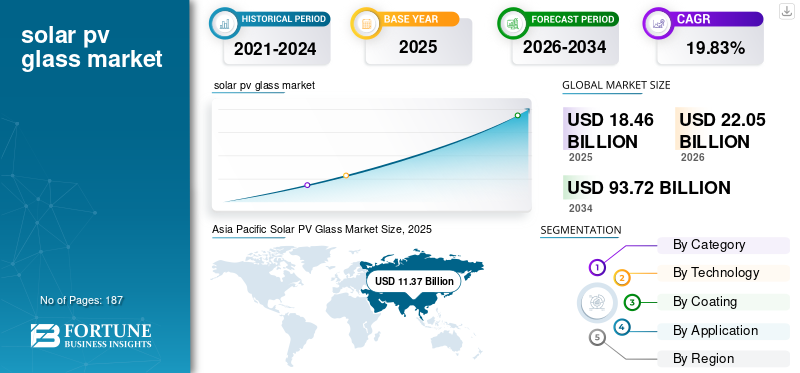
The global solar PV Glass market size was valued at USD 18.46 billion in 2025 and is projected to grow from USD 22.05 billion in 2026 and is expected to reach USD 93.72 billion by 2034, exhibiting a CAGR of 19.83% during the forecast period. Asia Pacific dominated the global solar PV glass market with a market share of 61.59% in 2025.
Solar PV glass is a specialized, high-transparency glass used as a protective and light-transmitting layer in photovoltaic modules, playing a critical role in module efficiency, durability, and lifetime performance. Typically manufactured as tempered low-iron glass, it protects solar cells from mechanical stress, moisture ingress, UV radiation, and environmental exposure while maximizing solar transmittance. Key performance attributes, including thickness, iron content, surface treatment (anti-reflective coatings and textured surfaces), mechanical strength, and thermal stability, directly influence power output, degradation rates, and suitability across various applications, such as utility-scale solar farms, commercial and industrial (C&I) rooftops, and residential installations.
The demand for solar PV glass is expanding rapidly, driven by accelerating global solar capacity additions, declining module costs, and robust policy support for renewable energy deployment. Growth is further reinforced by the transition toward high-efficiency module architectures, such as bifacial, glass-glass, and larger-format modules, which increase glass consumption per watt and require higher-performance products. At the same time, the regionalization of solar manufacturing supply chains, particularly in China, Southeast Asia, India, Europe, and North America, is prompting significant investments in dedicated PV glass capacity to ensure supply security, meet local content requirements, and support domestic module manufacturing ecosystems.
Leading companies, including Xinyi Solar, Flat Glass Group, CSG Holding, AGC, Saint-Gobain, and Borosil Renewables, are shaping the competitive landscape through large-scale capacity expansions, advancements in low-iron and ultra-thin glass manufacturing, and the development of high-performance coatings such as anti-reflective and anti-soiling layers. Strategic priorities increasingly focus on improving optical transmittance, mechanical strength, and durability to support high-efficiency module designs, including bifacial and glass-glass modules, while reducing breakage rates and overall module costs. In parallel, manufacturers are expanding their regional production footprints and entering long-term supply agreements with Tier-1 module makers to align with local-content policies, trade barriers, and supply-chain resilience goals, as evidenced by the development of greenfield plants, furnace upgrades, and financing initiatives aimed at scaling domestic solar glass output.
Download Free sample to learn more about this report.
Solar PV Glass Market Key Takeaways
 Market Size & Forecast
- 2025 Market Size: USD 18.46 Billion
- 2026 Market Size: USD 22.05 Billion
- 2034 Forecast Market Size: USD 93.72 Billion
- CAGR: 19.83% from 2026–2034
 Market Share
- Asia Pacific dominated the global solar PV glass market with a 61.59% share in 2025.
- The dual-glass segment accounted for a dominant market share of 57.7% in 2025.
- The single-glass segment is expected to grow at a CAGR of 19.31% during the forecast period.
 Key Regional Highlights
Asia Pacific
Asia Pacific led the market with USD 11.37 billion in revenue in 2025, accounting for approximately 61.57% of global sales.
Europe
Europe generated USD 3.12 billion in 2025, contributing approximately 16.92% of global market revenue.
North America
North America reached USD 2.85 billion in 2025, supported by growing solar energy installations.
U.S.
The solar PV glass market reached USD 2.64 billion in 2025 and is expected to grow to USD 2.97 billion in 2026.
Japan
The market reached USD 0.62 billion in 2025 and is projected to reach USD 0.72 billion in 2026.
Read More

Solar PV Glass Market Trends
Adoption of Localization Policies are a Significant Trend in the Solar PV Glass Market
Localization policies and trade actions are increasingly shaping the solar PV glass market, as governments and buyers strive to reduce their dependence on imports and establish more resilient, regionally anchored solar supply chains. While PV glass has historically been supplied at scale from a few manufacturing hubs, the economics of cross-border sourcing are becoming more volatile due to duties, eligibility rules, and procurement preferences tied to “local” manufacturing. In the U.S., the Inflation Reduction Act (IRA) created a domestic content bonus framework for qualifying clean electricity projects, which is strengthening demand signals for locally sourced components and encouraging upstream investments and long-term contracting.
In Europe, industrial policies, such as the Net-Zero Industry Act (NZIA), aim to scale EU clean-tech manufacturing capacity, supporting more regionalized planning across solar manufacturing value chains. Meanwhile, India’s imposition of anti-dumping duties on textured tempered solar glass imports from China and Vietnam illustrates how trade remedies are being used to protect domestic producers and directly influence where new PV glass capacity is built. Overall, this trend is prompting PV glass suppliers to expand their regional production footprints, secure bankable offtake agreements with module manufacturers, and position capacity in “policy-aligned” geographies to remain competitive.
Download Free sample to learn more about this report.
MARKET DYNAMICS
Market Drivers
Rising Adoption of Bifacial/Glass-Glass Module Architectures is Increasing Solar PV Glass Demand
Solar PV glass demand is rising strongly as global solar deployments expand and module designs increasingly consume more glass per module. Beyond overall capacity additions, the market is being structurally supported by the rapid adoption of bifacial and dual-glass (glass-glass) module architectures, which require glass on both the front and rear sides, imposing tighter optical, mechanical, and durability specifications. This creates a “double pull” on PV glass demand, higher module production volumes combined with higher glass intensity per watt, particularly in utility-scale projects where bifacial technology delivers superior energy yields. Reflecting this shift, LONGi Solar launched its Hi-MO series bifacial dual-glass modules in March 2024, emphasizing enhanced durability and performance under harsh environmental conditions, which underscores how leading Tier-1 module manufacturers are standardizing on glass-glass formats. As bifacial modules move further into the mainstream, PV glass is increasingly positioned as a volume-critical and specification-sensitive upstream input rather than a commoditized material.
Market Restraints
High CAPEX and Energy-Intensive Manufacturing Economics Constrain Rapid PV Glass Supply Expansion
Despite strong downstream demand, the solar PV glass market is constrained by the capital-intensive and energy-heavy nature of glass manufacturing, where capacity additions depend on large furnaces with long construction, commissioning, and stabilization timelines. PV glass production also requires low-iron raw materials, tight quality control, and high-temperature continuous operations, making costs highly sensitive to energy prices and raw material availability. These factors limit the speed at which supply can respond to demand surges and expose producers to margin pressure during pricing downturns. The impact of these economics was visible in 2023-2024, when several Chinese PV glass manufacturers announced furnace maintenance, cold repairs, or temporary curtailments amid weak pricing and elevated energy costs, highlighting how utilization discipline and cost management often take precedence over aggressive capacity ramp-ups. As a result, even in a structurally growing solar market, PV glass supply expansion remains constrained by high upfront investment risk and operating cost volatility rather than demand alone.
Market Opportunities
Localization and Trade Policy Support are Opening up New Market Growth
A significant opportunity is emerging as governments and module manufacturers increasingly prioritize localized solar supply chains to reduce import dependence, mitigate tariff exposure, and comply with policy-driven sourcing requirements. In markets such as the U.S. and Europe, clean-energy industrial policies are strengthening incentives for regionally manufactured components, improving the long-term visibility for domestic PV glass investments. A clear example of policy translating into capacity action occurred in December 2024, when India imposed anti-dumping duties on textured tempered solar glass imports from China and Vietnam. Shortly thereafter, Borosil Renewables announced plans to resume and accelerate domestic capacity expansion, explicitly linking the decision to improved trade protection and market visibility. This illustrates how localization measures are creating new “whitespace” for PV glass suppliers with regional manufacturing footprints, enabling them to secure long-term offtake, improve pricing stability, and position PV glass as a strategic, not commoditized input within national solar manufacturing ecosystems.
Market Challenges
Cyclical oversupply Can Disrupt Utilization Rates and Delay Investment Decisions in PV Glass
The solar PV glass market faces a recurring challenge from capacity cyclicality, where aggressive expansions can outpace near-term module demand, leading to inventory build-ups, sharp ASP declines, and sudden utilization corrections. As PV glass is produced in large, continuous furnaces, manufacturers have limited flexibility to “fine-tune” output without incurring high costs. Periods of oversupply often trigger cold repairs, temporary shutdowns, or coordinated output cuts to stabilize prices. This volatility creates uncertainty for both producers and buyers: suppliers struggle to maintain margins and justify new furnace investments, while module makers face shifting input prices and supply reliability risks. The downside of this cycle was clearly visible in September 2024, when major Chinese PV glass manufacturers confirmed they were idling furnaces and putting capacity into cold repair in response to a severe supply glut; Flat Glass and Xinyi Solar both reported meaningful volumes already under cold repair as of mid-2024, illustrating how quickly the market can swing from expansion to curtailment.
Solar PV Glass Market Segmentation Analysis
By Category
Dual-Glass Segment Leads due to Increasing Deployment in High-Humidity
Based on category, the global Solar PV Glass market is bifurcated into single-glass and dual-glass modules.
The dual-glass is expected to account for a dominant Solar PV glass market share of 57.7% in 2025, driven by the expanding adoption of TOPCon/HJT, increasing deployment in high-humidity, desert, and coastal environments, and customer preference for lower degradation risk. Dual-glass is also increasingly favored where more extended warranties and higher energy yields are essential, especially in utility-scale and harsh-climate projects.
The single-glass category still has a significant share globally owing to its lower cost, lighter weight, and broad compatibility across legacy crystalline silicon module designs. The single-glass segment is expected to grow at a CAGR of 19.31% during the forecast period.
By Technology
Crystalline Silicon Dominates due to Massive Upstream And Downstream Manufacturing Capacity
Based on technology, the global Solar PV glass market is segmented into crystalline silicon and thin-films.
The crystalline silicon, which dominates the market, accounting for approximately 96.8% share in 2025, is reinforced by massive upstream and downstream manufacturing capacity, standardized module form factors, and a mature global supply chain that favors high-volume, repeatable glass specifications. The continuous wafer thinning, larger wafer formats, and higher power classes further increase reliance on high-transmittance, low-iron, AR-coated PV glass, strengthening the link between c-Si technology evolution and PV glass demand. As a result, most incremental growth in PV glass volume and value remains structurally tied to crystalline silicon technology roadmaps rather than alternative cell architectures.
The thin-film segment is expected to grow at a CAGR of 18.71% during the forecast period of 2026-2034.
By Coatings
AR-Coated PV Glass Leads as Module Makers Pursue Higher Power Classes
By coating, the market is trifurcated into AR-coated, uncoated, and others.
AR-coated PV glass holds the largest share, accounting for approximately 65.55% in 2025, and continues to expand as module makers pursue higher power classes and lower reflection losses, particularly relevant as bifacial adoption grows and developers benchmark output against tighter performance guarantees.
The other category (textured/patterned & multi-functional coatings) is also gaining relevance in specialized designs and next-generation modules where manufacturers seek incremental optical advantages, soiling mitigation, and performance stability across operating conditions.
The uncoated segment is expected to grow at a CAGR of 17.81% during the forecast period (2026-2034).
By Application
To know how our report can help streamline your business, Speak to Analyst
Utility-Scale Segment Dominates due to Rapid Expansion of Large Solar Parks
Based on application, the global solar PV glass market is segmented into Utility-scale, commercial and industrial (C&I), residential, and others.
Utility-scale applications represent the largest share of the global solar PV glass market, accounting for around 59.91% of the total in 2025. The rapid expansion of large solar parks and the continuous addition of gigawatt-scale capacity worldwide drive the product demand. The growth is supported by government-led renewable energy targets, auction-based procurement mechanisms, and the prioritization of low-levelized cost of electricity (LCOE) in utility projects. In addition, the increasing adoption of bifacial and high-efficiency modules in utility-scale installations is raising glass intensity per module, further reinforcing the segment’s dominance in overall PV glass consumption.
The residential rooftop market is expected to grow at a CAGR of 19.18% during the forecast period (2026-2034).
Solar PV Glass Market Regional Outlook
By geography, the Solar PV Glass market has been studied across North America, Europe, the Asia Pacific, Latin America, and the Middle East & Africa.
North America
Asia Pacific Solar PV Glass Market Size, 2025 (USD Billion)
To get more information on the regional analysis of this market, Download Free sample
North America was valued at USD 2.85 billion in 2025, accounting for approximately 15.44% of the global solar PV glass market. The region is supported by steady utility-scale additions, continued expansion of distributed generation (C&I and residential), and the gradual shift toward higher-spec glass requirements as bifacial adoption and higher-efficiency modules gain penetration. Procurement in North America also places strong emphasis on long-term reliability and bankability, which supports demand for low-iron, tempered, and AR-coated PV glass across both large projects and premium rooftop installations.
U.S. Solar PV Glass Market
The U.S. solar PV glass market reached USD 2.64 billion in 2025 and is expected to touch USD 2.97 billion in 2026, driven by ongoing utility-scale buildout and vigorous distributed solar activity in select states. The market is also supported by increasing preference for higher-efficiency module formats and performance-backed procurement, which strengthens the mix toward higher-value coated glass specifications.
Europe
Europe reached USD 3.12 billion in 2025, contributing approximately 16.92% of global revenues. Growth is driven by strong renewable targets, rising utility-scale and distributed installations, and increasing demand for higher-efficiency and durability-oriented module designs, which support the use of AR-coated and premium low-iron glass. The region also shows momentum for more robust glass configurations in markets with stronger rooftop penetration and evolving building-energy regulations.
Germany Solar PV Glass Market
Germany reached USD 0.69 billion in 2025 and is expected to touch USD 0.78 billion in 2026, supported by a high rooftop deployment intensity and a strong preference for higher-efficiency modules that increase the PV glass value per watt.
U.K. Solar PV Glass Market
The U.K.’s market reached approximately USD 0.32 billion in 2025 and is expected to touch USD 0.36 billion in 2026, supported by increasing corporate power purchase agreements and the repowering of older solar assets, which encourage the use of higher-efficiency modules and improved glass specifications. Policy stability and grid decarbonization targets further reinforce steady demand for premium PV glass in both utility and commercial installations.
Asia Pacific
Asia Pacific is the largest region in 2025, valued at USD 11.37 billion, accounting for approximately 61.57% of global solar PV glass revenues. The region benefits from the world’s largest concentration of solar manufacturing and installations, sustained gigawatt-scale utility deployment, and the rapid adoption of higher-efficiency module platforms, which increase demand for low-iron, AR-coated, and increasingly dual-glass-compatible PV glass. The region also leads in scale-driven cost competitiveness, supporting both volume expansion and technology-driven shifts in product mix.
China Solar PV Glass Market
China remains the dominant contributor in the Asia Pacific region, estimated at USD 7.93 billion in 2025 and USD 9.69 billion in 2026, supported by massive domestic installations, strong module production scale, and ongoing efficiency upgrades that reinforce premium PV glass consumption.
India Solar PV Glass Market
India touched USD 1.35 billion in 2025 and is expected to reach USD 1.74 billion in 2026, reflecting an accelerating utility-scale buildout, an expanding manufacturing footprint, and an increasing adoption of higher-efficiency module platforms.
Japan Solar PV Glass Market
Japan reached USD 0.62 billion in 2025 and is expected to reach USD 0.72 billion in 2026, supported by a quality-focused market that favors high-spec PV glass and steady distributed additions.
Latin America
Latin America was valued at USD 0.64 billion in 2025, accounting for approximately 3.49% of the global market. Solar PV glass market growth is supported by expanding utility-scale pipelines, improving solar competitiveness, and the gradual expansion of distributed solar in select markets. While the region remains smaller in absolute size, it shows higher upside potential as installations scale and module specifications upgrade toward higher-value coated glass.
Brazil Solar PV Glass Market
Brazil reached USD 0.33 billion in 2025 and is expected to touch USD 0.39 billion in 2026, driven by strong utility additions and robust distributed growth that supports higher PV glass demand.
Middle East & Africa
MEA was valued at USD 0.47 billion in 2025, representing approximately 2.57% of global revenues. Growth is supported by expanding utility-scale solar in GCC markets, rising C&I solar activity in South Africa, and increasing project development across RoMEA, where electrification needs and cost competitiveness support continued solar additions. The region also increasingly adopts higher-performance module designs in large projects, supporting demand for coated PV glass.
GCC Solar PV Glass Market
GCC reached USD 0.22 billion in 2025 and is expected to touch USD 0.25 billion in 2026, supported by large solar park deployments and continued investment in high-scale utility projects.
Competitive Landscape
KEY INDUSTRY PLAYERS
Key Players Focus on Long-Term Supply Contracts to Gain Competitive Edge
The global solar PV glass market is moderately concentrated, led by large PV glass specialists and diversified glass groups that compete on scale, yield control, ultra-thin glass capability, and coating/process technology. In parallel, the industry is moving toward capacity expansion near module manufacturing hubs to reduce logistics cost and breakage risk, shorten lead times, and improve customer responsiveness, making regional supply alignment and long-term supply contracts increasingly central to competitive advantage.
For instance, Xinyi Solar’s 2024 annual results (Feb 2025) detailed its extensive daily melt capacity and operational adjustments in response to demand cycles, highlighting the importance of furnace scale and uptime management.
List of Top Solar PV Glass Manufacturers Companies
- Xinyi Solar (China)
- Flat Glass Group (China)
- FGG / Fuyao Glass (China)
- IRICO Group New Energy (China)
- Cebrace (Brazil)
- Borosil Renewables (India)
- Luoyang Float Glass Group Co., Ltd (China)
- Almaden (China)
- Kibing Group (China)
- AGC Inc. (Japan)
KEY INDUSTRY DEVELOPMENTS
- December 2025: Xinyi Solar announced that it is constructing two new solar glass production lines in Indonesia, with commercial production scheduled to commence in Q1 2026. This signals the arrival of fresh capacity in Southeast Asia, reinforcing how leading PV glass manufacturers are diversifying their manufacturing footprints and positioning supply closer to the fast-growing regional module ecosystems.
- September 2025: IRICO said its Shangrao base pushed new PV-glass product development, including 1.6mm ultra-thin high-transmissivity glass, low-iron ultra-high-transmissivity glass, and high-transmissivity double-coated glass.
- June 2025: Xinyi Solar reported an operational solar glass melting capacity of around 23,200 tonnes/day, highlighting its scale advantage as the world’s largest PV glass producer. The company also indicated that it would selectively suspend capacity and maintain flexibility to idle or restart lines, reflecting its active supply discipline amid pricing pressure. This highlights how leading players are leveraging scale and operational control to optimize utilization, costs, and margins in the cyclical PV glass market.
- April 2025: Almaden (China) announced plans to build a ~500,000-ton/year solar PV glass manufacturing facility in the UAE, including a large-scale melting furnace and downstream processing lines. The project represents a strategic overseas capacity expansion aimed at easing reliance on China-based production amid domestic oversupply. It also positions Almaden closer to rapidly growing Middle East solar demand and key export routes to Europe and South Asia, strengthening regional supply diversification.
- January 2025: Borosil Renewables announced a 50% increase in its solar glass production capacity, raising daily output from ~1,000 TPD to ~1,500 TPD after receiving board approval in December 2024. The move follows the Indian government’s introduction of a reference price on imported solar glass, helping level the playing field for domestic manufacturers.
REPORT COVERAGE
The report provides a comprehensive analysis of the market, focusing on key aspects, including leading companies, product processes, and Porter’s Five Forces analysis. Additionally, the report provides valuable insights into market trends and highlights key industry developments. In addition to the factors mentioned above, the report also encompasses several factors that contributed to the market's growth in recent years.
Request for Customization to gain extensive market insights.
REPORT SCOPE & SEGMENTATION
|
ATTRIBUTE |
DETAILS |
|
Study Period |
2021-2034 |
|
Base Year |
2025 |
|
Estimated Year |
2026 |
|
Forecast Period |
2026-2034 |
|
Historical Period |
2021-2024 |
|
Growth Rate |
CAGR of 19.83% from 2026 to 2034 |
|
Unit |
Value (USD Billion) |
|
Segmentation |
By Category · Single-Glass · Dual-Glass |
|
By Coatings · Uncoated · AR-coated · Others |
|
|
By Technology · Crystalline Silicon · Thin-Film |
|
|
By Application · Utility- Scale · Commercial & Industrial Rooftop · Residential Rooftop · Others |
|
|
By Region
|
Frequently Asked Questions
According to a Fortune Business Insights study, the market size stood at USD 18.46 billion in 2025.
The market is likely to grow at a CAGR of 19.83% over the forecast period (2026-2034).
By application, the utility-scale segment leads the market.
The market size of the Asia Pacific stood at USD 11.37 billion in 2025.
Rising adoption of bifacial/glass-glass module architectures is the key factor driving the market.
Some of the top players in the market include Xinai Solar, Flat Glass Group, and IRICO are the leading players in the market.
The global market size is expected to reach USD 93.72 billion by 2034.



- 2021-2034
- 2025
- 2021-2024
- 187
Get 30-60 hrs Free Customization
Expand Regional and Country Coverage, Segments Analysis, Company Profiles, Competitive Benchmarking, and End-user Insights.



















-
US +1 833 909 2966 ( Toll Free )
-
Get In Touch With Us