Specialty Biocides Market Size, Share & Industry Analysis, By Product Type (Halogen Compounds, Organosulfur Biocides, Metallic Compounds, and Others), By Application (Water Treatment, Hygiene and Disinfectants, Paints and Coatings, Wood Preservation, and Others), and Regional Forecast, 2026-2034
 Download Free Sample
Specialty Biocides Market Size and Future Outlook
 Listen to Audio Version
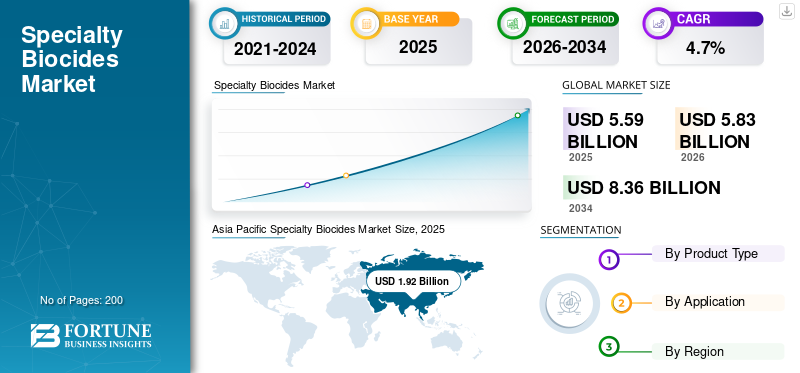
The global specialty biocides market size was valued at USD 5.59 billion in 2025. The market is projected to grow from USD 5.83 billion in 2026 to USD 8.36 billion by 2034, exhibiting a CAGR of 4.7% during the forecast period. Asia Pacific dominated the specialty biocides market with a market share of 34.34% in 2025.
Specialty biocides are microbial-control chemistries and formulated systems used to inhibit or eliminate bacteria, fungi, algae, yeast, and related microorganisms in targeted industrial and commercial applications. They are supplied as halogen compounds, organosulfur biocides, metallic compounds, and other specialty classes used in water treatment, wood preservation, hygiene and disinfectant formulations, paints and coatings, and broader material-protection applications where performance is driven by efficacy, compatibility, regulatory compliance, and application-specific stability.
The market growth is driven by the rising need for water treatment, durable preservation systems, and hygiene-oriented formulations across industrial and institutional value chains. Growth is further supported by tighter product-stewardship requirements, broader use of preservation systems in paints and coatings, and the need to control microbial contamination in processed water, stored products, and treated materials. At the same time, regulatory scrutiny, toxicological review requirements, and formulation compatibility constraints continue to shape product selection, portfolio strategy, and regional adoption patterns.
Furthermore, the market comprises several major players, including LANXESS, Ecolab, Solenis, Nouryon, and Thor Group, as well as specialty suppliers serving water treatment, material protection, wood preservation, and formulated hygiene applications. Broad product portfolios, regulatory registration capabilities, technical support, and manufacturing and distribution footprints support these companies’ competitive positioning in the global market.
Download Free sample to learn more about this report.
Specialty Biocides Market Key Takeaways
 Global Market Size & Forecast
- 2025 Market Size: USD 5.59 billion
- 2026 Market Size: USD 5.83 billion
- 2034 Forecast Market Size: USD 8.36 billion
- CAGR: 4.7% from 2026–2034
 Market Share
- Asia Pacific dominated the specialty biocides market with a 34.34% share in 2025.
- The Halogen Compounds segment accounted for the largest market share in 2025.
- The Water Treatment segment held the largest application share of 29.8% in 2025.
 Key Regional Highlights
Asia Pacific
Asia Pacific led the global market with USD 1.92 billion in 2025 and is projected to reach USD 2.02 billion in 2026.
North America
North America is projected to reach USD 1.26 billion in 2026.
Europe
Europe is projected to grow at a 4.8% CAGR, reaching USD 1.52 billion in 2026.
U.S.
U.S. market reached USD 1.07 billion in 2025.
Japan
Japan market drive regional demand through industrial growth and expanding microbial control applications.
Read More

SPECIALTY BIOCIDES MARKET TRENDS
Water Treatment Demand, Regulatory Stewardship, and Preservation-Focused Reformulation are Significant Market Trends
The demand is increasingly shaped by water-treatment requirements, material-preservation needs, and regulatory frameworks that require strong efficacy documentation, product stewardship, and application-specific safety assessments. Industrial users are prioritizing microbial-control systems that protect process water, stored formulations, treated surfaces, and finished materials while aligning with regional compliance expectations. This supports continued use of established chemistries and targeted reformulation toward more efficient dosage profiles, broader compatibility, and lower odor or labeling burdens in selected applications.
Alongside compliance pressure, manufacturers are paying greater attention to longer service life, improved preservation performance, and total-cost optimization in water, hygiene, coatings, and wood-treatment systems. Portfolio strategies increasingly emphasize differentiated formulations, technical service support, and application guidance that improve real-world performance in variable operating conditions. As sustainability reporting expands, suppliers are also highlighting responsible-use documentation, stewardship programs, and process efficiency benefits to support procurement and qualification decisions.
- For instance, water infrastructure upgrades, industrial water reuse efforts, and higher hygiene standards across institutional and product-preservation applications continue to support demand for specialty microbial-control solutions.
MARKET DYNAMICS
MARKET DRIVERS
Download Free sample to learn more about this report.
Water Treatment Requirements, Hygiene Needs, and Expanding Preservation Demand Drive Market Growth
Water treatment remains the largest demand center for specialty biocides, supported by the need to control microbial growth in industrial cooling water, process water, and related treatment systems. Specialty biocides are also increasingly used to protect stored formulations and treated substrates from spoilage, degradation, odor, and loss of performance. This creates a broad and relatively resilient demand base across municipal, industrial, and institutional environments.
Beyond water systems, hygiene and disinfectant formulations, paint and coating preservation, and wood protection continue to support value growth. Manufacturers are expanding specialty grades and application support to improve efficacy, compatibility, and compliance across end uses where microbial control is critical to product stability and service performance.
- For instance, industrial and institutional users increasingly prioritize microbial-control programs that reduce contamination risk, improve asset reliability, and support product shelf life.
MARKET RESTRAINTS
Regulatory Complexity, Toxicological Review Burdens, and Formulation Constraints Can Restrict Market Expansion
While specialty biocides remain essential in many applications, approval pathways, toxicological review requirements, and evolving labeling standards can slow product introduction and increase compliance costs. Regional differences in authorized activities, concentration limits, and stewardship expectations add complexity for suppliers operating across multiple geographies.
In addition, formulation compatibility and substrate sensitivity can restrict product selection in coatings, wood-treatment, and hygiene systems. Some users also face pressure to reduce treatment frequency, optimize doses, or substitute specific chemistries, which can lengthen qualification timelines and complicate portfolio planning for suppliers.
MARKET OPPORTUNITIES
Water Reuse Investments and Specialty Formulation Upgrades are Creating Lucrative Growth Opportunities
Rising water-stress concerns, industrial recycling initiatives, and infrastructure upgrades can expand the addressable market for specialty biocides in water-treatment programs that require reliable microbial control and operational stability. At the same time, premium preservation requirements in paints, coatings, wood treatment, and product-care formulations create opportunities for higher-value specialty solutions with stronger efficacy and broader compatibility.
Opportunities also exist in formulation optimization, where suppliers can support customers by providing improved dosing strategies, blended systems, and technical guidance that enhance performance while managing compliance expectations. These capabilities can improve conversion rates in regulated applications and support pricing resilience in specialized use cases.
MARKET CHALLENGES
Multi-Regional Compliance, Customer Qualification Cycles, and Public-Safety Scrutiny Can Hamper Market Growth
A key challenge is managing multi-regional registration frameworks, evolving hazard communication requirements, and customer-specific qualification demands simultaneously. This increases documentation burdens and can slow market entry for new grades or reformulated products, especially in uses that require significant technical validation.
In addition, end users are increasingly sensitive to handling, environmental, and public-safety considerations associated with microbial-control chemistries. Suppliers therefore need strong stewardship, field support, and application-specific performance assurance to maintain customer confidence while sustaining long-term specialty biocides market growth.
Segmentation Analysis
By Product Type
Extensive Industrial and Municipal Use Fueled Halogen Compounds Segment Growth
Based on product type, the market is segmented into halogen compounds, organosulfur biocides, metallic compounds, and others.
The halogen compounds segment accounted for the largest specialty biocides market share in 2025. The segment’s growth is driven by broad use in industrial and municipal water-treatment applications where fast-acting microbial control, dosing flexibility, and established treatment protocols support high-volume consumption. Furthermore, the segment is set to hold a 18.0% share in 2025.
The organosulfur biocides segment is expected to grow significantly, driven by broad use in process water, preservation systems, and industrial treatment programs where non-oxidizing efficacy and system compatibility are important. The organosulfur biocides segment is projected to grow at a 4.4% CAGR during the study period.
By Application
To know how our report can help streamline your business, Speak to Analyst
Need to Control Biofouling and System Instability Led to Water Treatment Segment Dominance
By application, the market is categorized into water treatment, hygiene and disinfectants, paints and coatings, wood preservation, and others.
The water treatment segment accounted for the largest share in 2025. The segment’s growth is driven by the need to control biofouling, microbial contamination, and system instability in industrial water loops, cooling systems, and related treatment environments. Furthermore, the segment is set to hold a 29.8% share in 2025.
The hygiene and disinfectants segment is also expected to grow favorably over the projected period. The segment’s demand is driven by institutional hygiene requirements, stronger contamination-control protocols, and ongoing demand for formulated disinfection systems across commercial and industrial end uses. The segment is expected to grow at a CAGR of 4.5% over the forecast period.
Specialty Biocides Market Regional Outlook
By region, the market is categorized into North America, Europe, Asia Pacific, Latin America, and the Middle East & Africa.
Asia Pacific
Asia Pacific Specialty Biocides Market Size, 2025 (USD Billion)
To get more information on the regional analysis of this market, Download Free sample
Asia Pacific held the dominant share in 2025, valued at USD 1.92 billion, and is expected to maintain its leading share in 2026, valued at USD 2.02 billion. The region benefits from industrial scale, rising water-treatment requirements, broadening hygiene demand, and continued growth in product-preservation applications across manufacturing value chains. China remains the largest market, while India, Japan, South Korea, and Southeast Asia continue to support demand driven by industrial activity, infrastructure expansion, and application-specific microbial-control needs.
China Specialty Biocides Market
In 2025, the China market reached USD 0.83 billion. China’s market demand is supported by manufacturing expansion and water-management policies are both supporting demand.
To know how our report can help streamline your business, Speak to Analyst
North America
North America is also a significant contributor to the market, with the market estimated to reach USD 1.26 billion by 2026. The market’s growth is supported by a mix of infrastructure renewal, wastewater compliance, and steady industrial hygiene demand. In the U.S., EPA says the infrastructure investment and jobs act delivers more than USD 50 billion for drinking water, wastewater, and stormwater systems. Application intensity remains strong in the U.S., supported by established treatment practices, institutional demand, and technical-service-driven product adoption.
U.S. Specialty Biocides Market
In 2025, the U.S. market reached USD 1.07 billion. The U.S. dominates regional consumption because growth is concentrated in regulated, performance-critical uses. EPA defines antimicrobial pesticides broadly to cover products used to protect water, industrial processes, systems, and surfaces from microbial contamination, fouling, and deterioration.
Europe
Europe is expected to experience significant growth in the coming years. During the forecast period, the European region is projected to grow at a 4.8% rate, reaching a valuation of USD 1.52 billion in 2026. The market’s growth is supported by a highly regulated product environment and rising pressure on water-treatment efficiency. The EU Biocidal Products Regulation requires products to be authorized and proven safe and effective before market placement, which favors higher-value specialty formulations over commodity offerings.The region benefits from mature formulation know-how, established regulatory frameworks, and an emphasis on compliance documentation and application performance.
U.K. Specialty Biocides Market
The U.K. market in 2025 was valued at around USD 0.15 billion, representing approximately 4.1% of global market revenue.
Germany Specialty Biocides Market
Germany’s market reached approximately USD 0.35 billion in 2025, accounting for about 5.1% of global sales.
Latin America
Latin America is experiencing steady growth and in 2026 the region is expected to reach a valuation of USD 0.54 billion. The demand is growing from a more infrastructure- and resource-driven base. The strongest demand drivers are sanitation gaps, expansion of wastewater collection and treatment, and rising interest in reuse and circular water management.
Brazil Specialty Biocides Market
Brazil’s market reached approximately USD 0.24 billion in 2025, equivalent to around 4.4% of global sales.
Middle East & Africa
The Middle East & Africa region is gradually expanding, driven by demand for industrial and municipal water treatment, ongoing infrastructure development, and the need for specialty disinfection and preservation systems in high-temperature and water-sensitive operating environments. Water treatment remains the region’s most important application, while hygiene and coatings preservation continue to contribute incremental demand growth.
GCC Specialty Biocides Market
The GCC market reached USD 0.21 billion in 2025, accounting for approximately 3.8% of global revenues. GCC demand is supported by industrial water treatment programs, energy-related operations, infrastructure investments, and the need for reliable microbial control systems in harsh operating conditions.
COMPETITIVE LANDSCAPE
Key Industry Players
Key Players Expanding Production Footprints, Registration Capabilities, and Specialty Grades to Maintain Market Positions
The market includes a mix of global specialty biocide suppliers, water-treatment specialists, hygiene-solution providers, and material-protection companies that supply active ingredients and formulated systems for industrial and commercial end uses. Competition is shaped by efficacy, depth of regulatory registration, supply reliability, application support, and the ability to provide targeted solutions across water treatment, wood preservation, hygiene and disinfectants, paints and coatings, and related preservation categories. Leading companies differentiate through technical service, stewardship programs, formulation expertise, and global manufacturing and distribution reach. Some key market players include LANXESS, Ecolab, Solenis, Nouryon, and Thor Group.
LIST OF KEY SPECIALTY BIOCIDES COMPANIES PROFILED
- LANXESS (Germany)
- Ecolab (U.S.)
- Solenis (U.S.)
- Nouryon (Netherlands)
- Thor Group (U.K.)
- Clariant (Switzerland)
- Troy Corporation (U.S.)
- Italmatch Chemicals (Italy)
- Hofmann Chemie AG (Switzerland)
- Chemtex Speciality Limited (India)
- Excel Industries (India)
KEY INDUSTRY DEVELOPMENTS
- January 2026: Enviro Tech, an Arxada company, launched PD2 Litter Treatment, an EPA-registered peracetic-acid-based granular product for poultry litter management, signaling further expansion of specialty antimicrobial solutions into agricultural hygiene and biosecurity applications.
- September 2025: Enviro Tech, an Arxada company, launched Peragreen 26WW, a high-strength peracetic-acid-based antimicrobial control solution for medium- to large-scale municipal wastewater systems. Further, signaling stronger positioning in wastewater disinfection and industrial water-treatment biocides.
- April 2024: LANXESS introduced Aqucar A 20 for oil and gas applications, a water-treatment microbiocide tailored for long-term reservoir preservation, signaling continued expansion of specialty biocides into energy-sector microbial control.
- January 2023: Nouryon launched Triameen Y12D, an antimicrobial active in the U.S., enabling customers to formulate high-efficiency disinfectants for household, institutional, and industrial uses, signaling continued product development in specialty hygiene and disinfection chemistries.
- July 2022: LANXESS completed the acquisition of IFF’s microbial control business, becoming one of the world’s largest suppliers of microbial-control and biocidal products, signaling consolidation and broader scale in antimicrobial actives and formulated specialty biocides.
- August 2021: LANXESS announced the acquisition of IFF’s microbial control business, adding antimicrobial active ingredients and formulations used in material protection, preservatives, disinfectants, industrial water treatment, and paints & coatings. Further, signaling a major portfolio and global-footprint expansion in specialty biocides.
- April 2021: Arxada introduced Tanasote, an oil-based copper wood preservative designed as a BPR-authorized alternative in Europe, signaling product innovation in specialty wood-protection biocides and a stronger sustainability-led positioning in treated-timber applications.
REPORT COVERAGE
The global market analysis provides an in-depth study of market size & forecast by all the market segments included in the report. It includes details on market dynamics and trends expected to drive the market during the forecast period. It offers information on technological advancements, new product launches, key industry developments, and partnerships, mergers & acquisitions. The market research report also includes a detailed competitive landscape, providing market share and profiles of key players.
Request for Customization to gain extensive market insights.
Report Scope & Segmentation
| ATTRIBUTE | DETAILS |
| Study Period | 2021-2034 |
| Base Year | 2025 |
| Estimated Year | 2026 |
| Forecast Period | 2026-2034 |
| Historical Period | 2021-2024 |
| Growth Rate | CAGR of 4.7% from 2026 to 2034 |
| Unit | Value (USD Billion), Volume (Kiloton) |
| Segmentation | By Product Type, Application, and Region |
| By Product Type |
|
| By Application |
|
| By Region |
|
Frequently Asked Questions
Fortune Business Insights estimates that the global market size was USD 5.59 billion in 2025 and is projected to reach USD 8.36 billion by 2034.
Recording a CAGR of 4.7%, the market is slated to exhibit steady growth during the forecast period.
The water treatment application segment led in 2025.
Asia Pacific held the highest market share in 2025.
LANXESS, Ecolab, Solenis, Nouryon, and Thor Group are some of the prominent players in the market.
The key factor driving market growth is the rising need for effective microbial control in water treatment, hygiene, wood preservation, and paints & coatings applications, where biocides help maintain product performance, safety, and durability.
The major factors expected to favor product adoption are tightening hygiene and preservation requirements, increasing demand for water treatment, broader use in paints and coatings and in wood protection, and the shift toward high-performance specialty formulations that meet regulatory and end-use needs.



- 2021-2034
- 2025
- 2021-2024
- 200
Get 30-60 hrs Free Customization
Expand Regional and Country Coverage, Segments Analysis, Company Profiles, Competitive Benchmarking, and End-user Insights.


















Related Reports
-
US +1 833 909 2966 ( Toll Free )
-
Get In Touch With Us