Spherical Alumina Market Size, Share & Industry Analysis, By Type (1-30µm, 30-80µm, 80-100µm, and Others), By Application (Thermal Interface Materials, Thermally Conductive Plastics, High Thermal Conductive AI Base CCL, Alumina Ceramic Substrate Surface Spraying, and Others), and Regional Forecast, 2026-2034
 Download Free Sample
KEY MARKET INSIGHTS
 Listen to Audio Version
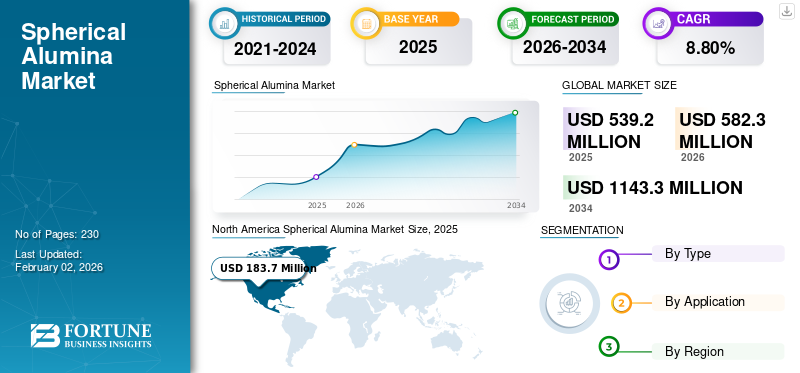
The global spherical alumina market size was valued at USD 539.20 million in 2025 and is projected to grow from USD 582.30 million in 2026 to USD 1,143.30 million by 2034, recording a CAGR of 8.80% during the forecast period of 2026-2034. North America dominated the spherical alumina market with a market share of 34.10% in 2025.
Spherical alumina is alumina particles shaped into a spherical form. This unique physical shape enhances its properties, such as flowability, packing density, and surface area, compared to irregularly shaped alumina particles. The product is demanded in various applications, including as a filler in polymers & ceramics, in abrasive & polishing applications, and as a support material in catalysis. Its spherical structure can significantly improve the mechanical and thermal properties of the composites in which it is incorporated.
The COVID-19 pandemic significantly impacted various industries worldwide, and this market is no exception. The pandemic influenced the demand for this form of alumina through shifts in manufacturing activities, supply chain disruptions, and changes in end-use industry demands. Major companies in the market temporarily paused operations, which affected production and supply chains. The pandemic also reduced the product demand from industries, such as electronics and ceramics, which were affected by lockdowns and reduced consumer spending.
On the other hand, sectors, such as electronics and healthcare experienced an increase in demand for technological and medical products, which boosted the need for this type of alumina. This heightened consumption of electronics was due to remote work setups, and there was a higher demand for medical equipment and devices to treat COVID-19-positive patients.
Download Free sample to learn more about this report.
Global Spherical Alumina Market Key Takeaways
 Market Size & Forecast
- 2025 Market Size: USD 539.20 Million
- 2026 Market Size: USD 582.30 Million
- 2034 Forecast Market Size: USD 1,143.30 Million
- CAGR: 8.80% from 2026–2034
 Market Share
- North America dominated the spherical alumina market with a 34.10% share in 2025.
- The 1-30µm segment is projected to account for 35.12% of the market in 2026.
- The Thermal Interface Materials (TIMs) segment is projected to account for 29% of the market in 2025.
 Key Regional Highlights
North America
Generated USD 183.7 million in 2025 and is projected to reach USD 198.6 million in 2026.
Europe
Generated USD 107.4 million in 2025 and is projected to reach USD 115.8 million in 2026.
Asia Pacific
Generated USD 162.9 million in 2025 and is projected to reach USD 176.5 million in 2026.
U.S.
The spherical alumina market is projected to reach USD 154.9 million by 2026.
Japan
The spherical alumina market is projected to reach USD 25.7 million by 2026.
Read More

Spherical Alumina Market Trends
Growing Product Demand for Electric Vehicle Application to Boost Market Growth
The demand for spherical alumina is closely linked to the EV market due to its use in battery technology and other components. As electric vehicles become more popular, the need for advanced materials, such as spherical alumina, which can improve battery performance and efficiency, is anticipated to increase. This trend highlights the spherical alumina market growth as the EV sector expands.
One of the significant challenges in EV battery technology is managing the heat buildup during rapid charging and discharging cycles. The product assists in addressing this issue by enhancing the thermal management of batteries, ensuring that they operate within optimal temperature ranges. This contributes to safer battery operation and potentially prolongs the battery's lifespan, a key concern for electric vehicle manufacturers and users.
Download Free sample to learn more about this report.
Spherical Alumina Market Growth Factors
Increasing Demand for LED Lighting to Bolster Market Growth
As the global focus on energy efficiency becomes stronger, LED lighting, which is known for its low energy consumption, has experienced increased adoption. Spherical alumina is used in the production of LED lights due to its thermal conductivity and light diffusion properties. In LED applications, it is commonly used as a filler material or in the form of a heat sink. Its spherical shape assists in efficiently dissipating heat away from the LED chips, which is crucial for maintaining performance and extending the lifespan of the LEDs. Additionally, its insulating properties help safeguard the electronic components from thermal damage.
Spherical alumina is being increasingly employed in the LED lighting sector, particularly in the production of phosphors and other components that enhance the performance of LED lights. The increase in LED installations, especially in new construction projects, has led to a corresponding rise in the demand for high-quality products.
RESTRAINING FACTORS
High Production Cost to Restrain Market Growth
The high costs of production can significantly hinder the product’s adoption in various industries. The complex production processes, such as spray drying and sol-gel synthesis, contribute to these elevated costs. The specialized manufacturing process needed for this type of alumina can be more costly than traditional alumina products, including expenses related to employing advanced technologies to achieve the spherical shape and desired particle size distribution.
Spherical Alumina Market Segmentation Analysis
By Type Analysis
1-30µm Segment Dominated Market Due to Their Unique Combination of Properties
Based on type, the market is classified into 1-30µm, 30-80µm, 80-100µm, and others.
The 1-30µm segment is projected to dominate the market with a share of 35.12% in 2026 and is expected to experience substantial growth. The product particles in the 1-30 micrometer range are important in high-performance applications due to their unique combination of properties. These particles offer excellent thermal conductivity, which makes them ideal for use in Thermal Interface Materials (TIMs), where efficient heat dissipation is crucial. Their small, uniform size enhances packing density and flowability, ensuring even distribution within composites and resins.
Spherical alumina particles in the 30-80 micrometer range are highly valued in various industrial applications, particularly those that require excellent thermal management, high mechanical strength, and reliable electrical insulation. These larger-sized product particles offer distinct advantages over their smaller counterparts, making them suitable for a broader range of applications and hence the segment is growing at a significant rate.
By Application Analysis
To know how our report can help streamline your business, Speak to Analyst
Thermal Interface Materials Segment Dominated Market Due to Their Exceptional Thermal Conductivity
In terms of application, the market is segmented into thermal interface materials, thermally conductive plastics, high thermal conductive AI base CCL, alumina ceramic substrate surface spraying, and others.
The Thermal Interface Materials (TIMs) segment dominated the spherical alumina market share in 2023. This type of alumina is a crucial material in Thermal Interface Materials (TIMs) due to their exceptional thermal conductivity, which is essential for efficient heat dissipation in electronic devices. TIMs are used to enhance the thermal connection between heat-generating components (such as CPUs, GPUs, and power transistors) and heat sinks or spreaders. This segment is foreseen to gain 29% of the market share in 2025.
Similarly, the product is utilized in high thermal conductive aluminum base Copper-Clad Laminates (CCLs) to enhance their thermal management capabilities. Aluminum base CCLs are crucial in electronic circuits, providing a substrate that efficiently dissipates heat away from sensitive components. This segment is anticipated to exhibit a CAGR of 8.80% during the forecast period (2024-2032).
REGIONAL INSIGHTS
By region, the market is segmented into North America, Europe, Asia Pacific, Latin America, and the Middle East & Africa.
North America
North America Spherical Alumina Market Size, 2025 (USD Million)
To get more information on the regional analysis of this market, Download Free sample
In 2025, the North America market stood at USD 183.7 million, representing 34.10% of global demand, and is projected to grow to USD 198.6 million in 2026. The demand for spherical alumina is growing in the region across several key sectors due to its unique properties and versatile applications. Spherical alumina, known for its high thermal conductivity, flowability, and mechanical strength, is being increasingly used in electronics, automotive, aerospace, and energy industries. The U.S. market is foreseen to grow with a valuation of USD 154.9 million in 2026.
To know how our report can help streamline your business, Speak to Analyst
Europe
The Europe region captured 19.90% of the global market in 2025, generating USD 107.4 million in revenue, and is projected to reach USD 115.8 million in 2026. The automotive industry in Europe, especially with the push toward Electric Vehicles (EVs) and hybrid technologies, is a significant factor driving the market’s growth in the region. Spherical alumina enhances thermal management in battery systems, power electronics, and thermal interfaces. European automakers are focusing on improving the efficiency and safety of EV components, which will heighten the need for advanced thermal management solutions. The UK market is projected to reach USD 20.9 million by 2026, and the Germany market is projected to reach USD 33.1 million by 2026.
Asia Pacific
Asia Pacific maintained a strong presence in the global market, reaching USD 162.9 million in 2025, accounting for 30.20% share, and is expected to reach USD 176.5 million in 2026. In the electronics industry, Asia Pacific is a major hub for the production of electronic devices, including smartphones, tablets, and computer components. Spherical alumina is used in Thermal Interface Materials (TIMs) to ensure efficient heat dissipation in high-performance electronic components. The Chinese market is foreseen to gain USD 67.7 million in 2025. As the region continues to lead in electronics manufacturing, the demand for the product for effective thermal management is expected to grow. The Japan market is projected to reach USD 25.7 million by 2026, the China market is projected to reach USD 73.9 million by 2026, and the India market is projected to reach USD 42.6 million by 2026.
Middle East & Africa
The Middle East & Africa market accounted for USD 47.9 million in 2025, representing 8.90% of the global industry, and is expected to reach USD 51.3 million in 2026.The Middle East & Africa is experiencing a rise in technology adoption and electronic device manufacturing. As the production of consumer electronics and telecommunications infrastructure expands, the need for effective thermal management solutions increases. The GCC market is predicted to stand at USD 20.8 million in 2025.
Latin America
In 2025, Latin America represented USD 37.3 million, accounting for 6.90% of the worldwide market, and is projected to grow to USD 40.1 million in 2026.
KEY INDUSTRY PLAYERS
Key Players Adopted Business Expansion Strategies to Maintain Market Dominance
In terms of the competitive landscape, the market depicts the presence of established and emerging companies. Denka Company Limited, Nippon Steel Corporation, Resonac Holdings Corporation, and Hindalco Industries Ltd. are the key players in this market. These players have a significant manufacturing capacity and are creating industry-specific applications. They are also expanding their production capacity and distribution & sales network in different parts of the world.
LIST OF TOP SPHERICAL ALUMINA COMPANIES:
- Denka Company Limited (Japan)
- Hebei Suoyi New Material Technology Co., Ltd. (China)
- Nippon Steel Corporation (Japan)
- GNPGraystar Specialty Materials (U.S.)
- Resonac Holdings Corporation (Japan)
- Suzhou Ginet New Material Technology Co., Ltd. (China)
- Aluminum Corporation of China Limited (China)
- Hindalco Industries Ltd. (India)
- Jiangsu NOVORAY New Material Co., Ltd (China)
KEY INDUSTRY DEVELOPMENTS:
- July 2024: Resonac Corporation joined a new group of ten partners, named "US-JOINT," to conduct research and development for the company's semiconductor back-end process in Silicon Valley. The activities of the Japan-based open consortiums, led by Resonac (known as "JOINT" and "JOINT2"), are being expanded in the U.S. through US-JOINT, which now includes the participation of five U.S.-based companies. The R&D for US-JOINT will be carried out at a newly established R&D center in Union City, California, through co-investment with the partners.
- May 2022: Denka Company Limited invested in expanding the production of spherical alumina. The company initiated a new production line for this type of alumina at the TuasPlant of Denka Advantech Pte. Ltd. (DAPL), Denka's subsidiary in Singapore. The new production line for this type of alumina in Singapore will enhance the company's production capacity by 30%, supporting its continued growth in the field of environment & energy.
REPORT COVERAGE
The report provides a detailed analysis of the market. It focuses on key aspects, such as leading companies, types, and product applications. Besides this, it offers insights into the current industry trends and highlights key industry developments. In addition to the factors mentioned above, the report encompasses several factors contributing to the market's growth.
Request for Customization to gain extensive market insights.
Report Scope & Segmentation
|
ATTRIBUTE |
DETAILS |
|
Study Period |
2021-2034 |
|
Base Year |
2025 |
|
Estimated Year |
2026 |
|
Forecast Period |
2026-2034 |
|
Historical Period |
2021-2024 |
|
Unit |
Value (USD Million) and Volume (Kiloton) |
|
Growth Rate |
CAGR of 8.80% from 2026 to 2034 |
|
Segmentation |
By Type
|
|
By Application
|
|
|
By Region
|
Frequently Asked Questions
Fortune Business Insights says that the global market size was valued at USD 539.20 million in 2025 and is projected to record a valuation of USD 1,143.30 million by 2034.
In 2025, the North America market value stood at USD 183.7 million.
Recording a CAGR of 8.80%, the market will exhibit steady growth during the forecast period of 2026-2034.
In 2023, the Thermal Interface Materials (TIMs) was the leading segment in the market by application.
Growing demand for LED lighting applications will drive the growth of the market.
North America dominated the spherical alumina market with a market share of 34.10% in 2025.



- 2021-2034
- 2025
- 2021-2024
- 230
Get 30-60 hrs Free Customization
Expand Regional and Country Coverage, Segments Analysis, Company Profiles, Competitive Benchmarking, and End-user Insights.


















Related Reports
-
US +1 833 909 2966 ( Toll Free )
-
Get In Touch With Us