Standard Powered Wheelchair Market Size, Share & Industry Analysis, By Application (Neurological Conditions, Disability, Trauma & Injuries, and Others), By Age Group (Adult and Pediatric), By End-user (Healthcare Settings {Hospitals & ASCs, Specialty Clinics, and Rehabilitation Centers}, Homecare Settings, and Others), and Regional Forecast, 2026-2034
 Download Free Sample
KEY MARKET INSIGHTS
 Listen to Audio Version
The global standard powered wheelchair market size was valued at USD 1.51 billion in 2025. The market is projected to grow from USD 1.66 billion in 2026 to USD 3.68 billion by 2034, exhibiting a CAGR of 10.45% during the forecast period. North America dominated the standard powered wheelchair market with a market share of 52.80% in 2025.
A standard powered wheelchair is a battery-operated mobility device designed for users with limited mobility. The wheelchairs are typically controlled using a joystick and are suitable for indoor use on relatively smooth surfaces.
The market is mainly driven by the increasing incidence of mobility issues across the globe. As the need for effective mobility solutions increases, standard powered wheelchairs are playing a vital role in improving the quality of life for individuals with physical limitations. This increasing adoption is expected to drive the growth of the market.
Key players in the market include Invacare Corporation, Sunrise Medical, and Pride Mobility Products Corp. These companies are focusing on expansion into other geographies and enhancing product accessibility through strategic collaborations, partnerships, and the introduction of new models.
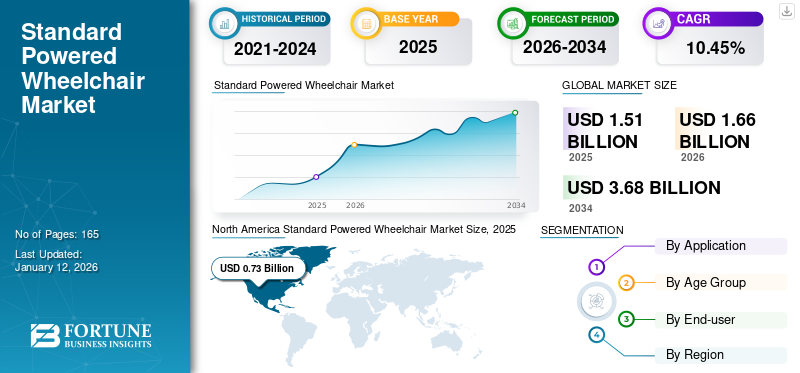
Download Free sample to learn more about this report.
STANDARD POWERED WHEELCHAIR MARKET KEY TAKEAWAYS
 Global Market Size & Forecast
- 2025 Market Size: USD 1.51 billion
- 2026 Market Size: USD 1.66 billion
- 2034 Forecast Market Size: USD 3.68 billion
- CAGR: 10.45% from 2026–2034
 Market Share
- North America dominated the standard powered wheelchair market with a 52.80% share in 2025.
- The disability segment held the largest market share in 2024.
- The homecare settings segment dominated the global market in 2024.
 Key Regional Highlights
North America
North America the market reached USD 0.73 billion in 2025 and is projected to grow to USD 0.80 billion in 2026.
Europe
Europe the market was valued at USD 0.39 billion in 2025 and is expected to reach USD 0.43 billion in 2026.
Asia Pacific
Asia Pacific the market reached USD 0.27 billion in 2025 and is projected to grow to USD 0.30 billion in 2026
U.S.
The market is driven by the high prevalence of mobility impairments and strong adoption of advanced powered wheelchairs.
Japan
The market is expected to witness steady growth, supported by an aging population and increasing demand for mobility assistance devices.
Read More

MARKET DYNAMICS
Market Drivers
Increasing Cases of Mobility Disorders to Drive Market Growth
In recent years, there has been a surge in cases of mobility disorders, trauma & injuries, and other conditions that impair movement. This trend is driving the demand for effective solutions aimed at enhancing the quality of life for affected individuals. Standard powered wheelchairs have emerged as essential devices in addressing these needs. As a result, their adoption increased significantly among individual users and within healthcare settings, thereby contributing to the market growth.
- For instance, according to the 2023 data published by the U.K. Office for National Statistics, approximately 16.1 million people in the U.K. had a disability in 2023, representing 24.0% of the total country population.
Moreover, the increasing geriatric population, which is particularly susceptible to mobility impairments, is also leading to an increasing demand for mobility devices. This demographic trend is expected to propel the global standard powered wheelchair market growth over the coming years.
Market Restraints
Rising Preference for Complex Rehab Technology (CRT) Powered Wheelchairs to Hamper Market Growth
Despite the significant product adoption, the market faces competition from complex rehab technology (CRT) powered wheelchairs offering highly specialized features. CRT-powered wheelchairs are customizable and designed to meet the unique needs of users with severe disabilities, offering advanced features such as tailored seating, advanced control systems, and enhanced comfort.
- For instance, in May 2025, Redman Power Chair mentioned that CRT wheelchairs are ideal for patients with adverse neuromuscular diagnoses or serious injuries.
These features provide substantial benefits for users requiring complex mobility solutions. Such benefits of CRT wheelchairs often make them a preferred choice among healthcare providers and patients, potentially hampering product demand, thereby slowing the growth of the market.
Market Opportunities
Launch of Mobility Schemes and Favorable Reimbursement Coverage to Support Market Growth
In recent years, various government bodies have launched initiatives aimed at improving access to mobility devices. These efforts include the introduction of new reimbursement schemes and the expansion of existing coverage, significantly enhancing accessibility for a broader segment of the population.
In addition to reimbursement coverage, governments, national organizations, and private companies are launching newer and improved schemes to favor the affordability of these devices to the general population.
- For instance, in May 2025, Surewise, a national insurance company, provides coverage for electric models of wheelchairs ranging up to USD 2,700, along with mobility scooter insurance for advanced powered wheelchairs exceeding that value.
Moreover, key players are implementing promotion campaigns to increase their product sales across the globe. Various charitable organizations are providing favorable schemes and conducting campaigns to increase the awareness of this equipment. Such a scenario is expected to drive market expansion in the forthcoming years.
Market Challenges
Inadequate Infrastructure and Shortage of Trained Professionals May Limit Market Growth
Access to appropriate wheelchair provision services is vital for the proper functioning of standard powered wheelchairs to support the health and well-being of people with mobility impairments. This typically involves a multi-step process that includes assessment, selection, fitting, training, and ongoing support.
In many regions, especially in rural or remote areas, there is a lack of necessary infrastructure to support this process. This includes a shortage of trained professionals and an underdeveloped supply chain.
- For instance, as per the article published by the NCBI in March 2021, there is limited access to appropriate wheelchair provision services in many settings due to the complexity of healthcare settings and high rates of staff turnover.
These systematic gaps in service provision pose a major challenge to the widespread adoption in the coming years.
STANDARD POWERED WHEELCHAIR MARKET TRENDS
Technological Advancements to Fuel Market Growth
Currently, innovations such as improved battery technologies, lightweight frame materials, and enhanced control systems are making wheelchairs more efficient, durable, and user-friendly. The integration of smart features such as programmable settings, joystick controls, and compatibility with mobile devices is enhancing user experience and independence.
Additionally, manufacturers are focusing on ergonomic designs and customizable options to cater to diverse user needs, thereby expanding product demand. Furthermore, the integration of sensors and AI-based navigation systems is emerging as a key trend, offering safer and more intuitive operational capabilities.
- For instance, as per the data published by the LAUTECH Journal of Engineering and Technology in 2024, recent developments in standard powered wheelchairs have extended their capabilities by incorporating control and navigational intelligence.
These technological advancements are expected to significantly improve the quality of life for individuals with mobility impairments, especially among younger users and travelers, thereby further boosting product demand.
Download Free sample to learn more about this report.
IMPACT OF COVID-19
The COVID-19 pandemic witnessed a negative impact on the market in 2020. Many patients postponed or canceled their therapies, surgeries, or medical appointments during the pandemic, reducing the immediate need for a standard powered wheelchair in healthcare settings. Additionally, the pandemic led to significant disruptions in the supply chain for this equipment. This caused delays in the delivery of equipment, creating shortages and declining market growth.
However, the market began to recover following the relaxation of lockdown restrictions. As healthcare facilities resumed regular operations, there was a surge in patient volume across hospitals. This increased product utilization contributed to the market rebound and set the stage for renewed growth.
SEGMENTATION ANALYSIS
By Application
Rising Geriatric Population Encouraged Disability Segment Growth
Based on application, the market is classified into neurological conditions, disability, trauma & injuries, and others.
The disability segment held the largest market share in 2024, driven by the rising number of disabled individuals, especially the aged ones, adopting standard powered wheelchairs for daily activities.
The neurological conditions segment accounted for the second-largest share in 2024. The growth of the segment is attributed to the increasing prevalence of neurological conditions such as Parkinson's disease and multiple sclerosis. These conditions often lead to decreased mobility, which may drive the demand for powered wheelchairs, including standard ones.
- For instance, according to the data published by the European Medical Journal in March 2024, the worldwide prevalence of Parkinson’s disease is projected to rise to 25.2 million cases by 2050.
The trauma & injuries segment is anticipated to expand substantially over the forecast period. Increasing traumatic injuries, fractures, and road accidents are contributing to temporary or permanent loss of mobility. In such cases, the product serves as essential supportive equipment for daily activities, leading to increased adoption.
The others segment is expected to grow significantly due to the growing number of obese people, partially paralyzed individuals, and others who increasingly depend on supportive equipment for daily movement.
By Age Group
Adult Segment Led Market Due to Higher Prevalence of Disability
Based on age group, the market is classified into adult and pediatric.
The adult segment dominated the market in 2024. The higher burden of disability among adolescents than among adults is the major factor behind the high product adoption. Moreover, this system is preferred by adults with paralysis, arthritis, chronic pain, or age-related mobility decline. Such a scenario is expected to fuel the segment’s growth in the coming years.
- For instance, according to the data published by the Disability and Health Journal in January 2025, the estimated prevalence of disability among adolescents was 15.1%.
The pediatric segment is expected to grow significantly during the forecast period. Increasing efforts to introduce custom-made wheelchairs for the pediatric age group are increasing product innovation and diversification. The growing availability of pediatric-specific models is attracting a broader customer base, which is expected to fuel the segment’s growth during the forecast period.
By End-user
Increasing Demand for Home-based Care Boosted Homecare Settings Segment Growth
Based on end-user, the market is segmented into healthcare settings, homecare settings, and others. Homecare settings held the highest market share in 2024. The increasing number of home care settings across the globe spurs the product usage for individuals with mobility issues. Additionally, the increasing demand for home-based care in emerging countries is further contributing to segment growth.
- For instance, according to the data published by CAREHOME.CO.UK in March 2025, there were around 16,566 care homes in the U.K.
The healthcare settings segment is projected to expand at the highest CAGR during the forecast period. Improvements in healthcare infrastructure and increased healthcare spending worldwide are favoring the adoption of advanced supportive equipment for patients with limited mobility in these settings. This is expected to propel the segment’s expansion during the forecast timeframe.
The others segment held a lower share in 2024. However, its growth is attributed to the rising number of long-term care centers, nursing homes, and other settings globally that are driving the sale of standard powered wheelchairs to patients in these settings, as these wheelchairs are utilized to support residents with limited mobility.
STANDARD POWERED WHEELCHAIR MARKET REGIONAL OUTLOOK
By geography, the market is categorized into North America, Europe, Asia Pacific, Latin America, and Middle East & Africa.
North America
North America Standard Powered Wheelchair Market Size, 2025 (USD Billion)
To get more information on the regional analysis of this market, Download Free sample
In 2025, North America held 52.80% of the global market share, reaching a valuation of USD 0.73 billion, and is projected to grow to USD 0.8 billion in 2026. The region’s growth is attributed to the strong presence of major players offering advanced products. Moreover, the favorable reimbursement policies continue to support the utilization of standard powered wheelchairs in the region’s healthcare settings.
In the U.S., a large population suffers from neurological conditions that lead to mobility impairment, driving the need for mobility solutions.
- For instance, in 2024, the Centers for Disease Control & Prevention CDC stated that approximately 12.2% of the U.S. population has a mobility impairment.
Europe
The market in Europe reached USD 0.39 billion in 2025, representing 54.52% of total market revenue, and is projected to reach USD 0.43 billion in 2026, driven by the increasing number of residential care and nursing home facilities, especially in countries such as the U.K. Additionally, leading companies are focusing on increasing their product supply to these facilities for better management of patients with mobility issues, boosting market growth.
- For instance, in March 2025, CAREHOME.CO.UK mentioned 11,525 residential care homes and 5,041 nursing homes in the U.K.
Asia Pacific
Asia Pacific contributed approximately USD 0.27 billion to the global market in 2025, accounting for 60.79% share, and is expected to reach USD 0.3 billion in 2026. The higher disability among children in Southeast Asian countries and growing awareness of the advanced model of wheelchairs are expected to spur the region’s market growth. Moreover, the increasing per capita healthcare investments, rapid urbanization, and aging population across key markets are contributing to increased product adoption in the region.
- For instance, a study published by the NCBI in September 2022 reported that the prevalence of disabilities among children and adolescents was highest in Southeast Asia at 13.6% and least in Europe.
Latin America and Middle East & Africa
The Middle East & Africa region captured 64.01% of the global market in 2025, generating USD 0.06 billion in revenue, and is projected to reach USD 0.06 billion in 2026.
In 2025, Latin America generated USD 0.07 billion, contributing 61.92% to global market revenue, and is projected to grow to USD 0.08 billion in 2026. The Latin America and Middle East & Africa markets are expected to grow at a stagnant rate during the forecast period. Market growth in these regions is influenced by the increasing number of spinal cord injuries and trauma cases in Brazil, Mexico, South Africa, and other parts of the Middle East. Moreover, the rising awareness is encouraging the adoption of advanced wheelchair technologies in these regions.
- For instance, according to the article published by NCBI in November 2022, there were approximately 40 new cases of spinal cord injuries per million population in a year in Brazil, which was roughly 6,000 to 8,000 new cases annually.
COMPETITIVE LANDSCAPE
Key Industry Players
Focus on Key Growth Strategies to Increase Prominent Players’ Market Positions
The market is fragmented, with major companies, including Sunrise Medical, Ottobock, and Invacare Corporation, accounting for a significant portion of the global standard powered wheelchair market share in 2024. This dominant market share is attributed to their extensive geographic reach and diverse product portfolios. These companies are also actively launching new products tailored to the needs of disabled patients, driven by the increasing global rates of disability.
In addition, other significant players, including Drive Devilbiss International, Pride Mobility, and Products Corp., are focusing on increased investments, distribution channel expansion, and strategic collaborations and partnerships across global markets. These efforts are expected to help them increase their share in the global market.
LIST OF KEY STANDARD POWERED WHEELCHAIR COMPANIES PROFILED
- Ottobock (Germany)
- Sunrise Medical (U.K.)
- Invacare Corporation (U.S.)
- Drive Devilbiss International (U.S.)
- Pride Mobility Products Corp. (U.S.)
- Hoveround Corporation (U.S.)
- Merits Health Products (U.S.)
KEY INDUSTRY DEVELOPMENTS
- January 2025: Invacare Corporation attended the Arab Health Exhibition at the Dubai World Trade Centre to showcase its product line of advanced mobility and healthcare solutions, including standard powered wheelchairs.
- June 2024: Drive Devilbiss International acquired Mobility Designed, Inc.’s full portfolio of products, further enhancing its portfolio.
- March 2024: Sunrise Medical launched the QUICKIE Q50 R Carbon, the lightest folding power wheelchair with a transport weight of only 32 lbs.
- November 2023: Pride Mobility Products Corp. launched Group 2 Jazzy Air MED, a standard power wheelchair offering 12 inches of seat elevation to provide users with a next-level mobility experience.
- August 2021: Invacare Corporation launched the AVIVA STORM RX power wheelchair, further setting a new standard for rear-wheel drive power mobility.
REPORT COVERAGE
Request for Customization to gain extensive market insights.
Report Scope & Segmentation
|
ATTRIBUTE |
DETAILS |
|
Study Period |
2021–2034 |
|
Base Year |
2025 |
|
Estimated Year |
2026 |
|
Forecast Period |
2026-2034 |
|
Historical Period |
2021-2024 |
|
Growth Rate |
CAGR of 10.45% from 2026-2034 |
|
Unit |
Value (USD Billion) |
|
Segmentation |
By Application
|
|
By Age Group
|
|
|
By End-user
|
|
|
By Region
|
Frequently Asked Questions
Fortune Business Insights says that the global market value stood at USD 1.66 billion in 2026 and is projected to reach USD 3.68 billion by 2034.
In 2025, the market value stood at USD 0.73 billion.
The market is expected to exhibit a CAGR of 10.45% during the forecast period of 2026-2034.
By end-user, the homecare settings segment led the market.
The key factors driving the market are the increasing prevalence of disability and technological advancements in wheelchairs.
Ottobock, Sunrise Medical, and Invacare Corporation are the top players in the market.
North America dominated the standard powered wheelchair market with a market share of 52.80% in 2025.



- 2021-2034
- 2025
- 2021-2024
- 165
Get 30-60 hrs Free Customization
Expand Regional and Country Coverage, Segments Analysis, Company Profiles, Competitive Benchmarking, and End-user Insights.













.webp)






Related Reports
-
US +1 833 909 2966 ( Toll Free )
-
Get In Touch With Us