Stretchable Conductive Material Market Size, Share & Industry Analysis, By Product (Graphene, Carbon Nanotube, Silver), By Application (Wearables, Biomedical, Photovoltaics), and Regional Forecast, 2026-2034
 Download Free Sample
Stretchable Conductive Material Market Overview
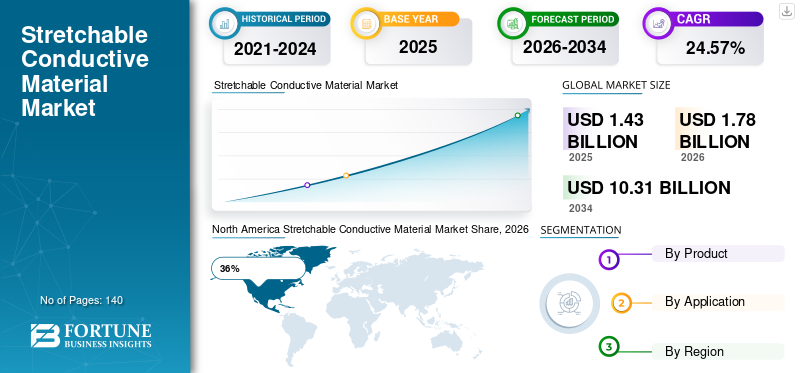
The global stretchable conductive material market size was valued at USD 1.43 billion in 2025. The market is projected to grow from USD 1.78 billion in 2026 to USD 10.31 billion by 2034, exhibiting a CAGR of 24.57% during the forecast period.

The stretchable conductive material market is witnessing rapid transformation due to the growing adoption of flexible electronics, wearable devices, soft robotics, smart textiles, and biomedical monitoring systems. Stretchable conductive materials are engineered to maintain electrical conductivity even under repeated mechanical deformation, making them critical for next-generation electronic manufacturing. The increasing use of graphene, carbon nanotubes, and silver-based conductive compounds across advanced electronics manufacturing has strengthened industrial demand globally. stretchable conductive material market trends indicate rising integration of conductive elastomers into healthcare sensors, automotive electronics, and flexible displays.
The USA stretchable conductive material market is expanding due to advanced research activities, increasing wearable healthcare adoption, and strong investment in flexible electronic manufacturing. Universities, defense laboratories, and technology firms are accelerating product innovation for smart fabrics, military electronics, and biomedical patches. Demand from the sports technology and remote patient monitoring sectors continues to increase procurement of high-performance conductive polymers and nanomaterial-based conductive films. Stretchable Conductive Material industry analysis in the United States highlights strong collaboration between electronics manufacturers and material science companies to commercialize lightweight and high-durability conductive solutions.
Download Free sample to learn more about this report.
Stretchable Conductive Material Market Key Takeaways
 Global Market Size & Forecast
- 2025 Market Size: USD 1.43 Billion
- 2026 Market Size: USD 1.78 Billion
- 2034 Forecast Market Size: USD 10.31 Billion
- CAGR: 24.57% from 2026–2034
 Market Share
- The market in North America dominated with a revenue share of 36% in 2025.
- Silver-based conductive materials held the largest share at 37%.
- Wearables accounted for the largest application share at 41%.
 Key Regional Highlights
North America
North America held the largest regional share at 36%, supported by strong adoption of flexible electronics.
Europe
Europe accounted for 28% of the market, driven by investments in advanced conductive materials.
Asia-Pacific
Asia-Pacific captured 31% of the market, supported by expanding electronics and wearable device manufacturing.
U.S
Rising adoption of wearable electronics, biomedical sensors, and flexible devices is supporting market growth.
Japan
Growing demand for flexible electronics and advanced wearable technologies is supporting market expansion.
Read More

stretchable conductive material market Latest trends
The stretchable conductive material market is experiencing major technological advancements driven by wearable electronics and flexible sensor applications. One of the strongest stretchable conductive material market trends is the transition toward ultra-thin conductive films with enhanced elasticity and lower resistance levels. Manufacturers are integrating silver nanowires, conductive inks, and graphene composites into smart clothing, foldable devices, and biomedical patches. Growing consumer interest in health monitoring wearables has accelerated demand for skin-compatible conductive substrates capable of supporting long-term electrical performance.
Download Free sample to learn more about this report.
Another significant trend in the stretchable conductive material market research report is the rising focus on sustainable and printable electronics. Companies are developing environmentally friendly conductive materials using recyclable polymers and low-energy manufacturing techniques. Flexible photovoltaic devices are also emerging as a major application area because stretchable conductive materials improve device adaptability and lightweight performance. stretchable conductive material market Insights further reveal increasing investment in AI-enabled smart sensors and electronic textiles. Industrial automation and human-machine interaction technologies are expected to generate substantial commercial opportunities for conductive elastomer manufacturers and nanomaterial suppliers over the coming years.
stretchable conductive material market Dynamics
DRIVER
Rising Demand for Wearable Electronics and Smart Healthcare Devices
The growing global adoption of wearable electronics is a primary driver accelerating the stretchable conductive material market growth. Fitness trackers, smartwatches, electronic skin patches, and smart textiles require conductive materials capable of maintaining flexibility and electrical efficiency during continuous motion. Conductive polymers and nanomaterial-based films are increasingly preferred in wearable technology manufacturing because they support lightweight designs and improved durability. stretchable conductive material market analysis indicates that healthcare monitoring devices are becoming a major demand contributor due to rising chronic disease management requirements and remote patient monitoring applications.
Biomedical industries are rapidly integrating stretchable conductive materials into biosensors and medical imaging systems. Flexible electrodes used in diagnostic equipment provide enhanced patient comfort and better signal accuracy. Automotive and defense sectors are also adopting stretchable conductive materials in intelligent cockpit systems, motion detection devices, and human-machine interfaces. Increasing investment in flexible electronic research and smart textile innovation continues to strengthen commercial adoption across industrial sectors. The growing shift toward miniaturized electronics further expands the application scope for highly conductive and mechanically resilient materials.
RESTRAINT
High Manufacturing Complexity and Production Costs
Despite significant technological progress, the stretchable conductive material market faces restraints associated with high manufacturing complexity and material costs. Conductive nanomaterials such as graphene and silver nanowires require specialized fabrication techniques and advanced processing infrastructure. Maintaining conductivity under repeated stretching conditions remains technically challenging for large-scale commercial production. Stretchable Conductive Material industry report findings show that several manufacturers struggle with balancing elasticity, durability, and conductivity while maintaining cost efficiency.
The use of precious metals in conductive formulations significantly increases product pricing, limiting adoption among cost-sensitive manufacturers. Small and medium-sized electronics companies often face procurement difficulties due to high raw material expenses and limited supplier availability. Scalability also remains a challenge because many advanced conductive materials are still produced in research-oriented environments rather than high-volume industrial facilities. Product reliability testing under extreme environmental conditions further adds to operational expenditures. These factors collectively slow widespread penetration across low-cost consumer electronics segments and developing economies.
OPPORTUNITY
Expansion of Smart Textiles and Flexible Photovoltaic Systems
The rapid emergence of smart textiles presents substantial opportunities for the stretchable conductive material market outlook. Textile manufacturers are incorporating conductive fibers into clothing for sports performance monitoring, military communication systems, and healthcare diagnostics. stretchable conductive material market opportunities are increasing as smart garments become more commercially viable across fitness, industrial safety, and medical rehabilitation sectors. Conductive fabrics with embedded sensors provide real-time monitoring capabilities while maintaining comfort and flexibility.
Flexible photovoltaic systems are also creating strong market expansion opportunities. Stretchable conductive materials improve energy conversion adaptability in foldable solar panels and portable energy devices. Demand from consumer electronics manufacturers for lightweight and bendable power systems continues to rise. stretchable conductive material market forecast studies indicate increasing integration of conductive elastomers into flexible battery systems and electronic packaging applications. Companies investing in printable electronics and large-area conductive coating technologies are expected to secure long-term competitive advantages in emerging electronics markets.
CHALLENGE
Performance Stability and Long-Term Durability Concerns
Performance stability remains a major challenge within the stretchable conductive material market. Repeated mechanical deformation can reduce conductivity efficiency over time, particularly in high-strain industrial environments. Manufacturers must develop materials capable of maintaining electrical performance under bending, stretching, twisting, and environmental exposure. stretchable conductive material market research report assessments highlight durability testing as a critical factor influencing product commercialization and customer acceptance.
Another challenge involves compatibility between conductive materials and electronic device architectures. Integrating stretchable conductors into existing manufacturing systems often requires redesigning production processes and equipment. Biomedical applications also demand strict regulatory compliance and biocompatibility testing, increasing commercialization timelines. Variations in material performance under temperature fluctuations and moisture exposure further complicate industrial implementation. Supply chain instability for advanced nanomaterials can additionally disrupt production continuity, creating operational risks for manufacturers dependent on high-purity conductive compounds.
stretchable conductive material market Segmentation
By Product
Graphene-based materials account for approximately 34% of the stretchable conductive material market share due to their exceptional electrical conductivity, lightweight structure, and mechanical flexibility. Graphene conductive films are increasingly utilized in wearable electronics, flexible sensors, and foldable displays. Manufacturers prefer graphene because it enables thin conductive layers with excellent thermal management capabilities. stretchable conductive material market trends indicate strong research investment in graphene composites for biomedical electrodes and smart textile integration. Graphene materials also demonstrate superior corrosion resistance and chemical stability compared to traditional conductive compounds. Electronics manufacturers are incorporating graphene inks into printable electronics and flexible circuit systems to improve conductivity retention under deformation.
Carbon nanotube materials hold nearly 29% of the stretchable conductive material market Size because of their strong tensile strength and high electron mobility. These materials are widely used in conductive elastomers, flexible batteries, and electronic skins. Stretchable Conductive Material industry analysis reveals rising demand for carbon nanotube composites in motion sensing devices and biomedical monitoring systems. Their ability to form interconnected conductive networks makes them highly effective for stretchable electronic applications. Manufacturers are focusing on hybrid conductive formulations combining carbon nanotubes with polymers to improve elasticity and durability. Carbon nanotube conductive films are increasingly integrated into aerospace electronics and robotics because they maintain conductivity during repetitive motion cycles.
Silver-based conductive materials represent around 37% of the stretchable conductive material market share due to their superior electrical conductivity and strong industrial reliability. Silver nanowires and conductive pastes are extensively used in wearable sensors, flexible touchscreens, and printed electronics. stretchable conductive material market Insights show that silver materials are particularly preferred in high-performance medical electronics where signal accuracy and conductivity stability are essential. Silver conductive inks support advanced printing techniques for flexible circuit production and photovoltaic applications. Electronics manufacturers utilize silver compounds in stretchable antennas and communication devices because of their low resistance characteristics.
To know how our report can help streamline your business, Speak to Analyst
By Application
Wearables account for approximately 41% of the stretchable conductive material market share due to increasing global adoption of smartwatches, fitness trackers, and electronic textiles. Stretchable conductive materials enable lightweight and flexible device architectures that improve user comfort and functionality. stretchable conductive material market report findings indicate strong demand for conductive elastomers and printed conductive inks in wearable healthcare systems and sports monitoring technologies. Consumer electronics companies are developing advanced wearable sensors capable of monitoring temperature, heart rate, and movement patterns in real time. Stretchable conductive films are widely integrated into smart clothing and wireless communication modules.
Biomedical applications hold nearly 32% of the stretchable conductive material market Size as healthcare providers increasingly adopt flexible monitoring systems and implantable devices. Stretchable conductive materials are widely used in biosensors, flexible electrodes, and diagnostic patches designed for continuous physiological monitoring. stretchable conductive material market analysis highlights rising utilization in remote patient monitoring and rehabilitation technologies. Hospitals and medical device manufacturers are investing in stretchable conductive sensors capable of improving patient comfort and data accuracy. Flexible electronic skin systems are gaining popularity for monitoring neurological and muscular activity.
Photovoltaic applications represent approximately 27% of the stretchable conductive material market share because of rising interest in lightweight and flexible solar technologies. Stretchable conductive materials improve adaptability and efficiency in foldable solar panels and portable power systems. stretchable conductive material market forecast studies indicate growing investment in wearable solar devices and energy-harvesting electronic systems. Manufacturers are integrating conductive nanomaterials into photovoltaic cells to improve mechanical flexibility without compromising conductivity performance. Flexible solar panels are increasingly used in transportation, military systems, and portable electronics. Conductive elastomers also enhance durability under repeated bending and environmental stress conditions.
stretchable conductive material market Regional outlook
North America Stretchable Conductive Material Market Share, 2026 (%)
To get more information on the regional analysis of this market, Download Free sample
North America
North America accounts for approximately 36% of the stretchable conductive material market share due to strong technological innovation and advanced electronics manufacturing capabilities. The region benefits from high adoption of wearable healthcare devices, smart textiles, and biomedical monitoring systems. stretchable conductive material market research report findings indicate substantial investment in flexible electronics research by universities, technology firms, and defense organizations. The United States remains the dominant contributor because of its extensive semiconductor and wearable technology ecosystem.
The region also experiences growing demand from aerospace, automotive electronics, and industrial automation sectors. Manufacturers are focusing on developing high-performance conductive polymers and nanocomposite materials for commercial-scale production. Increasing use of stretchable conductive sensors in sports analytics and remote healthcare applications further supports market expansion. Government funding for advanced material science research and flexible electronic manufacturing continues to strengthen North America’s competitive position in the global market.
Europe
Europe holds nearly 28% of the stretchable conductive material market share supported by strong industrial automation and sustainable electronics initiatives. Regional manufacturers are emphasizing eco-friendly conductive materials and energy-efficient production technologies. Stretchable Conductive Material industry report analysis shows increasing collaboration between electronics companies and research institutes focused on flexible sensor innovation and smart textile commercialization.
The automotive sector plays a major role in regional demand because conductive materials are increasingly integrated into intelligent interior systems and advanced driver interfaces. Healthcare technology development across Europe also drives procurement of flexible conductive sensors and biomedical monitoring equipment. Flexible photovoltaic systems and wearable healthcare solutions continue to generate commercial opportunities for conductive material suppliers throughout the region.
Germany stretchable conductive material market
Germany contributes approximately 14% of the European stretchable conductive material market due to its strong industrial manufacturing infrastructure and advanced engineering capabilities. The country is a major center for automotive electronics, industrial robotics, and smart factory technologies. stretchable conductive material market Insights highlight rising investment in conductive nanomaterials for flexible electronic applications and industrial sensor systems.
German manufacturers are actively integrating stretchable conductive technologies into intelligent automotive interiors and wearable industrial monitoring devices. The country’s healthcare technology sector is also expanding adoption of flexible biosensors and rehabilitation monitoring equipment. research institutions continue to collaborate with electronics companies to improve conductive material durability and scalable production processes. Strong emphasis on sustainable manufacturing and energy-efficient electronic systems further supports long-term market development.
United Kingdom stretchable conductive material market
The United Kingdom accounts for approximately 24% of the European stretchable conductive material market driven by growing wearable technology adoption and biomedical innovation. stretchable conductive material market trends indicate increasing research activity in smart textiles, flexible medical electronics, and printable conductive materials. Universities and technology startups are accelerating development of lightweight conductive films and stretchable sensors for healthcare applications.
The country’s strong digital healthcare ecosystem supports growing demand for remote patient monitoring systems and electronic skin devices. Flexible conductive materials are also gaining traction in sports performance monitoring and defense communication technologies. The expansion of flexible electronics manufacturing capabilities and increasing investment in nanotechnology research continue to strengthen the UK market landscape.
Asia-Pacific
Asia-Pacific dominates manufacturing activities and represents approximately 31% of the stretchable conductive material market share. The region benefits from large-scale electronics production, rising consumer electronics demand, and extensive semiconductor manufacturing infrastructure. stretchable conductive material market growth is particularly strong in countries with advanced flexible display manufacturing and wearable technology industries.
Regional manufacturers are aggressively investing in printable electronics, smart textiles, and flexible energy systems. Rapid urbanization and increasing healthcare digitization are accelerating adoption of wearable monitoring devices and conductive biomedical sensors. Asia-Pacific also serves as a major production hub for graphene and conductive nanomaterial manufacturing, improving supply chain accessibility for electronics companies worldwide.
Japan stretchable conductive material market
Japan contributes approximately 26% of the Asia-Pacific stretchable conductive material market due to its strong electronics innovation ecosystem and advanced material science capabilities. stretchable conductive material market analysis indicates rising adoption of flexible sensors in robotics, healthcare electronics, and automotive systems. Japanese companies are focusing on ultra-thin conductive materials capable of supporting compact and lightweight device designs.
The country is also a leader in smart textile development and electronic skin technologies for healthcare monitoring. Flexible conductive films are increasingly integrated into foldable displays and intelligent consumer electronics. Collaboration between electronics manufacturers and research laboratories continues to drive innovation in high-performance conductive polymers and nanomaterials. Strong emphasis on precision manufacturing further enhances Japan’s competitive position in the global market.
China stretchable conductive material market
China accounts for approximately 12% of the Asia-Pacific stretchable conductive material market due to extensive electronics manufacturing capacity and large-scale industrial production capabilities. stretchable conductive material market forecast assessments highlight strong domestic demand for wearable electronics, flexible displays, and smart healthcare systems. The country is a major producer of graphene and conductive nanomaterials used in flexible electronic manufacturing.
Government support for semiconductor development and advanced material innovation continues to accelerate market expansion. Chinese manufacturers are investing heavily in printable electronics and low-cost conductive film technologies for commercial applications. The growing electric vehicle industry and increasing adoption of smart industrial systems further contribute to rising demand for stretchable conductive materials across multiple sectors.
Rest of World
The Rest of World region accounts for approximately 5% of the stretchable conductive material market share, supported by increasing adoption of flexible electronics in emerging economies. Countries in the Middle East, Latin America, and Africa are gradually investing in wearable healthcare technologies and smart industrial systems. stretchable conductive material market opportunities are expanding as telecommunications infrastructure and healthcare digitization improve across developing regions.
Industrial modernization and renewable energy initiatives are encouraging demand for flexible conductive materials in smart sensors and photovoltaic systems. Universities and research centers in emerging economies are also participating in nanotechnology research and flexible electronics development. Although infrastructure limitations remain a challenge, rising awareness of advanced wearable technologies and growing electronics manufacturing investments are expected to strengthen regional market participation.
List of Top Stretchable Conductive Material Companies
- DuPont
- 3M
- CHASM
- Rajasthan Electric Industries
- ANP CORPORATION
- Applied Nanotech, Inc.
- Indium Corporation
- Vorbeck Materials Corp.
- Dycotec Materials Ltd
- Minco
Top Two Companies by Market share
- DuPont – 18%
- 3M – 15%
Investment analysis and opportunities
The stretchable conductive material market is attracting strong investment from electronics manufacturers, healthcare technology firms, and nanomaterial developers. Venture capital funding and strategic partnerships are increasing across flexible electronics and wearable technology sectors. stretchable conductive material market opportunities are especially prominent in smart healthcare, flexible photovoltaic systems, and industrial automation applications. Companies are investing heavily in scalable manufacturing technologies for graphene composites, conductive polymers, and silver nanowire formulations.
research institutions and private investors are supporting development of low-cost printable conductive materials for commercial deployment. Expansion of flexible electronic production facilities in Asia-Pacific and North America is expected to strengthen supply chain efficiency and reduce manufacturing costs. stretchable conductive material market Insights indicate rising acquisition activity among nanotechnology firms seeking advanced conductive material portfolios. Demand for intelligent textiles, electronic skin systems, and lightweight communication devices continues to create long-term investment potential for global manufacturers and technology innovators.
New Product Development
New product development within the stretchable conductive material market is focused on improving conductivity stability, elasticity, and environmental durability. Manufacturers are introducing advanced conductive inks and hybrid nanocomposite materials capable of supporting next-generation wearable electronics and biomedical devices. stretchable conductive material market trends reveal increasing adoption of printable conductive technologies for flexible circuits and smart textile applications.
Several companies are developing ultra-thin graphene films and self-healing conductive polymers to improve long-term device performance. Flexible sensor manufacturers are also introducing biocompatible conductive materials for skin-contact healthcare applications. Conductive hydrogels and stretchable battery materials are gaining attention due to their ability to support lightweight and compact electronic designs. Innovation in silver nanowire networks and carbon nanotube dispersion technologies is further enhancing product reliability and large-scale manufacturing efficiency. The market continues to witness rapid commercialization of intelligent conductive systems for robotics, foldable electronics, and renewable energy devices.
Five Recent Developments (2023-2025)
- DuPont introduced advanced stretchable conductive inks designed for wearable medical electronics and flexible sensor applications.
- 3M expanded research activities focused on high-durability conductive adhesives for smart textile manufacturing.
- CHASM launched enhanced carbon nanotube conductive films targeting flexible display and foldable electronics production.
- Indium Corporation developed new silver-based conductive pastes optimized for stretchable photovoltaic systems and printed electronics.
- Vorbeck Materials Corp. announced advanced graphene composite technologies for lightweight aerospace and defense electronic systems.
report Coverage
The stretchable conductive material market report provides comprehensive analysis of industry structure, technological developments, competitive landscape, and application trends across global markets. The report evaluates key conductive material types including graphene, carbon nanotubes, and silver-based conductive compounds. stretchable conductive material market research report coverage includes wearable electronics, biomedical devices, and photovoltaic applications with detailed assessment of demand patterns and innovation strategies.
Request for Customization to gain extensive market insights.
The report also examines manufacturing advancements, supply chain developments, and emerging commercial opportunities across major regions. Stretchable Conductive Material industry analysis includes evaluation of investment activities, product development strategies, and market expansion initiatives adopted by leading manufacturers. Regional assessments cover North America, Europe, Asia-Pacific, and Rest of World markets with country-level insights for major manufacturing economies. The study further analyzes competitive positioning, technological innovation trends, and industrial adoption patterns shaping the future of flexible electronic materials.
Frequently Asked Questions
Fortune Business Insights says that the global market value stood at USD 1.43 billion in 2025 and is projected to reach USD 10.31 billion by 2034.
The market is expected to exhibit a CAGR of 24.57% during the forecast period of 2026-2034.
Silver-based conductive materials were the leading product segment, accounting for approximately 37% of the market, due to their superior electrical conductivity and industrial reliability.
Key players include DuPont, 3M, CHASM, Rajasthan Electric Industries, ANP CORPORATION, and Applied Nanotech, Inc.
Major trends include the development of ultra-thin, highly elastic conductive films and growing adoption of sustainable, printable electronics and AI-enabled smart sensors. North America leads with approximately 36% market share, supported by strong technological innovation and advanced electronics manufacturing.


- 2021-2034
- 2025
- 2021-2024
- 140
-

(Offer valid till 15th Oct 2026)
Get 30-60 hrs Free Customization
Expand Regional and Country Coverage, Segments Analysis, Company Profiles, Competitive Benchmarking, and End-user Insights.




















-
US +1 833 909 2966 ( Toll Free )
-
Get In Touch With Us