String Instruments Market Size, Share & Industry Analysis, By Product (Guitar, Violin, Cello, and Others), By End-User (Professional and Amateurs), By Distribution Channel (Specialty Stores, Online Retail, and Others), and Regional Forecast, 2026-2034
 Download Free Sample
(Offer valid till 15th Oct 2026)

KEY MARKET INSIGHTS
 Listen to Audio Version
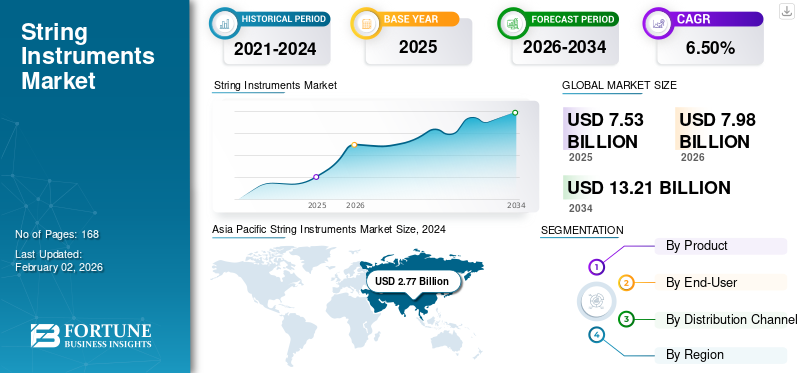
The global string instruments market size was valued at USD 7.53 billion in 2025. The market is projected to grow from USD 7.98 billion in 2026 to USD 13.21 billion by 2034, exhibiting a CAGR of 6.50% during the forecast period.
String instruments, also known as chordophones, are musical instruments that create sound through vibrating strings, which can be manipulated by bows, picks, or fingers. The market is witnessing considerable growth led by rising number of amateur and professional musicians and expanding digital music platforms. Consumer interest in music as an art form has grown in recent years and is linked to reduced stress, depression, and anxiety and improved mental health. It can also assist in improving the listener’s emotional state and sleep quality. For instance, according to Engaging with Music 2023, a global study released by the International Federation of the Phonographic Industry (IFPI), a U.K.-based organization providing data regarding the global recording industry, cited that around 71% of individuals consider music significant for their mental health and nearly 78% individuals say that it assists them to cope with stress and relax. In addition, the average time spent by individuals listening to music weekly was around 20.7 hours, a rise from nearly 20.21 hours in 2022.
Technological advancements in string musical instruments include synthetic and durable strings to enhance product quality. The market also benefits from strong demand driven by music education programs and e-commerce expansion. Key players in the market include Yamaha Corporation, Fender, Gibson, C.F. Martin & Co., and Roland Corporation. Major brands emphasize product innovation through technologically advanced string instruments such as guitar violins, and material development.
The COVID-19 pandemic negatively influenced the global musical instrument industry including string instruments on account of public gathering restrictions and the cancellation of several concerts, musical events, and weddings across the globe, and closure of music academies and schools, leading to a decline in product demand. Moreover, halted production activities and supply chain disruptions negatively impacted product availability. The temporary closure of physical stores also caused a decline in product sales worldwide, hampering the global market expansion.
Download Free sample to learn more about this report.
String Instruments Market Key Takeaways
 Global Market Size & Forecast
- 2025 Market Size: USD 7.53 billion
- 2026 Market Size: USD 7.98 billion
- 2034 Forecast Market Size: USD 13.21 billion
- CAGR: 6.50% from 2026–2034
 Market Share
- Asia Pacific dominated the global string instruments market in 2024.
- The guitar segment accounted for the largest market share in 2024.
- The professional end-user segment contributed the highest revenue share in 2024.
 Key Regional Highlights
Asia Pacific
Asia Pacific reached USD 2.77 billion in 2025.
North America
North America held the second-largest market share in 2024.
Europe
Europe recorded steady market growth.
U.S
Strong demand from professional and amateur musicians
Japan
Rising demand driven by growing music education.
Read More

MARKET DYNAMICS
MARKET DRIVERS
Rising Popularity of Live Concerts and Musical Events to Positively Influence Market Dynamics
The growing popularity of live concerts and music festivals is a significant driver for market expansion. As more individuals attend live performances, the demand for high-quality sound and diverse musical genres increases, directly boosting sales of string instruments such as guitars, violins, and cellos. Live events showcase the versatility and emotional impact of string instruments, inspiring both amateur and professional musicians to invest in new equipment. Additionally, the surge in live performances also encourages manufacturers to innovate and develop durable, high-performance instruments to meet the robust demand for stage use, supporting sustained global string instruments market growth.
MARKET RESTRAINTS
High Pricing of the Product to Limit Market Expansion
The growth of the market is restricted by the exorbitant pricing of quality instruments that deter beginners, students, and budget-conscious consumers. Premium instruments including violins, guitars, and cellos often cost several hundred to thousands of dollars, creating a substantial barrier to entry for aspiring musicians. Recent tariffs and rising cost of raw materials have further increased prices, making it harder for educational institutes and individuals to afford these instruments. This financial burden discourages participation in music education and reduces overall product demand, especially in emerging economies. Consequently, the high cost restricts the expansion of the string music instruments market and slows the adoption rate among new users.
MARKET OPPORTUNITIES
Expanding Music Education Programs to Offer Potential Growth Opportunities
Expansion of music education programs along with music schools and academies offers immense growth opportunities for market players to tap into globally. Governments and private organizations are increasingly investing in music curriculum for schools, recognizing the cognitive and social benefits of musical training. This trend is especially prominent in developing countries where rising disposable incomes and cultural appreciation for music are driving the demand for accessible instruments. Partnerships between manufacturers and educational institutes to provide affordable, entry-level string music equipment can significantly broaden the consumer base. Additionally, the rise of online music learning platforms and virtual lessons is making music education more accessible, further stimulating interest and purchase of musical devices among students and beginners worldwide.
STRING INSTRUMENTS MARKET TRENDS
Integration of Advanced Technology in String Music Instruments
Advanced technology is transforming string music devices through innovation in materials, electronics, and digital integration. The use of carbon fiber in violins and cellos has made instruments lighter, more durable, and resistant to climate changes, benefiting traveling musicians and positively influencing market trends. Electric and hybrid string devices including electro-acoustic guitars and MIDI-enable violins allow musicians to blend acoustic resonance with electronic sound manipulation, expanding creative possibilities. Recent developments include MEMS microphones and fiber-optic sensors embedded along strings, capturing nuanced harmonics and enabling new playing techniques. 3D printing is also enabling personalized instrument designs and rapid prototyping. These advancements enhance sound quality and durability and offer musicians greater versatility, ergonomic comfort, and expressive potential.
Segmentation Analysis
By Product
Widespread Popularity and Growing Trend of Electric Guitars to Boost Segmental Growth
Based on product, the market is segmented into guitar, violin, cello, and others.
The guitar segment dominated the string instruments market share in 2024. The growth of the segment is attributed to the increasing popularity of electric guitars and other high quality products across diverse music genres, affordability, and strong demand for music instruments among younger generations and amateur musicians. The rise in electric and acoustic guitar sales, driven by social trend and the influence of digital platforms, boosts product demand. Major players such as Fender and Gibson continue to innovate with new models, further expanding product application.
The cellos segment is expected to grow at the fastest CAGR over the forecast period. The accelerated growth for cello can be attributed to rising interest in orchestral music education, increasing adoption among new hobbyists, and relatively smaller market base that allows for more rapid expansion compared to more mature product segments.
By End-User
Rising Interest in Live Music Concerts and Music Festivals to Drive Professional Segment Growth
Based on end-user, the market is bifurcated into professional and amateurs.
The professional segment contributed the highest revenue share in 2024. The dominance is attributed to the consistent demand from trained musicians, orchestras, and music production studios that require high-quality, durable, and acoustically superior instruments. Professional musicians invest in premium string music tools such as violins, guitars, cellos, and basses, often custom-made or handcrafted, to meet performance standards. Additionally, increasing participation in live concerts, international music festivals, and recording session continues to fuel product demand from this segment, driving its dominance.
The amateurs segment is expected to grow at the fastest CAGR over the forecast period. The segment growth is likely driven by increasing interest in music as a hobby, especially among the younger generation and working professionals. The widespread availability of affordable entry-level string music devices is encouraging more individuals to take up playing as a recreational activity. Additionally, the rise of online tutorials, virtual music classes, and mobile learning apps has made it easier for beginners to learn without formal training. Social media platforms also motivate amateurs to share their progress and gain recognition, further driving engagement. These factors collectively create a supportive ecosystem for the expansion of the amateurs segment.
By Distribution Channel
Personalized Service and Expert Guidance to Drive Growth of Specialty Stores
Based on distribution channel, the market is segmented into specialty stores, online retail, and others.
The specialty stores segment dominated the market in terms of revenue. The segment’s growth is attributed to the ability of these stores to offer personalized service, expert advice, and hands-on experience with instruments. These stores typically provide a curated selection of high-quality string instruments along with customization options, maintenance services, and repair support, which attract both seasoned musicians and serious learners. Customers value the opportunity to physically test instruments, consult with knowledgeable staff, and receive tailored recommendations, benefits often lacking in general retail or online platforms. This in-store experience builds trust and loyalty, contributing to the continued growth of the segment.
Meanwhile, the online retail segment is projected to surge at the highest CAGR over the forecast period. The growth is primarily driven by the accessibility, convenience, and competitive pricing it offers to consumers. Online platforms allow customers to browse a wide range of instruments, compare features, and prices, and make purchases from the comfort of their homes. Moreover, detailed product descriptions, customer reviews, and video demonstrations help buyers make informed decisions. The rise of e-learning and virtual music classes is further likely to encourage beginners to buy instruments online, supplementing market growth.
String Instruments Market Regional Outlook
By geography, the market is categorized into North America, Europe, Asia Pacific, South America, and the Middle East & Africa.
Asia Pacific
Asia Pacific String Instruments Market Size, 2024 (USD Billion)
To get more information on the regional analysis of this market, Download Free sample
The Asia Pacific accounted for the largest market share in 2024. The region is experiencing strong growth due to rising disposable incomes, expanding middle-class population, and increasing interest in music among the youth. Countries such as India, China, Japan, and South Korea are witnessing a surge in music education, both in schools and through private institutions. The popularity of Western music genres and local adaptations is also driving the demand for guitars, violins, and other instruments. Additionally, the growth of e-commerce and availability of affordable instruments are making string instruments more accessible across urban and semi-urban areas.
Download Free sample to learn more about this report.
North America
North America accounted for the second-largest share in the global market in 2024. The growth is primarily driven by rich musical heritage, high consumer spending on musical activities, and a strong presence of professional musicians and music schools. Technological advancements in music instruments manufacturing and digital integration such as electric and smart guitars are attracting tech-savvy musicians, further consolidating market growth.
The U.S. market leads the North America string instruments market due to well-established music industry with widespread participation in genres such as classical, jazz, rock, and country music, boosting demand for string music instruments. The growth of online music platforms, increased amateur interest in music as a hobby, and the availability of premium and entry-level instruments across online and offline channels further push market expansion in the country.
Europe
The growth of the Europe market is attributed to its deep-rooted cultural tradition in classical and folk music, along with string institutional support for music education. Countries including Germany, Italy, and France have a long tradition of string music devices craftsmanship and usage, fostering steady demand. Government-funded music programs, conservatories, and orchestras contributed significantly to instrument adoption among students and professionals. Moreover, the presence of renowned manufacturers and increasing participation in music festivals and live performances further support the market’s expansion across the region.
South America and the Middle East & Africa
The South America market is projected to experience steady growth driven by region’s musical culture and resurgence of traditional and folk music involving music instruments such as guitars and charangos. Increased participation in community music events and growing access to affordable instruments also support product demand. The Middle East & Africa is expected to grow at a considerable growth rate. The factors supporting the growth in the region include rising urbanization, increasing youth interest in Western and fusion music, and gradual improvements in music education infrastructure.
COMPETITIVE LANDSCAPE
Key Industry Players
Continuous Innovation in Product Offerings and Strategic Collaborations to Help Key Players Increase their Market Share
The string instruments market is moderately fragmented, with the presence of both global brands and regional manufacturers. Key players in the market include Yamaha Corporation, Fender, Gibson, C.F. Martin & Co., and Roland Corporation. These companies compete on factors such as product quality, pricing, brand reputation, and distribution reach. Major strategies adopted by players include continuous product innovation, such as integrating digital features in traditional instruments and launching eco-friendly or customizable models. Many brands are expanding their online presence through e-commerce partnerships and direct-to-consumer platforms. Collaborations with artists, music academies, and influencers are also common strategies to boost brand visibility and customer engagement across global markets.
LIST OF KEY COMPANIES PROFILED
- Yamaha Corporation (Japan)
- Fender Musical Instruments Corporation (U.S.)
- Gibson Brands, Inc. (U.S.)
- C.F. Martin & Co., Inc. (U.S.)
- Roland Corporation (Japan)
- Samick Musical Instruments Co., Ltd. (South Korea)
- Godin Guitars (Canada)
- Schecter Guitar Research (U.S.)
- Karl Hofner GmbH & Co. KG (Germany)
- Ibanez (Japan)
KEY INDUSTRY DEVELOPMENTS
- October 2024: Fender Musical Instruments Corporation announced the launch of Jaguar Bass, an electric bass guitar that combines elements from both the Fender Jazz Bass and Precision Bass, while retaining a distinctive design reminiscent of the original Fender Jaguar guitar. It has a C-shaped maple neck, typically with a 7.25"-radius rosewood fretboard that includes aged pearloid block inlays, a premium touch not commonly found on standard models.
- July 2024: Yamaha Corporation, launched the Back to School Music Sweepstakes to encourage musicians to play musical instruments and audio devices according to their music genre needs.
- July 2024: Cortek, South Korea-based guitar manufacturer, launched its new Artisan C4/C5 Deluxe Bass Guitars. The new products are developed using lightweight materials and are available in black, candy blue, and candy red colors.
- April 2024: Yamaha Corporation, opened Symphonies Story, a music instrument store in Ahmedabad, Gujarat. By opening the store, the company would be able to provide music training and sell instruments to the city's consumers.
- November 2023: C.F. Martin & Co. Inc., introduced its D-19 190th Anniversary model. The new guitar model was launched to celebrate the company’s 190 years in the market.
REPORT COVERAGE
The global market report provides market size and forecast on the basis of various segments. It details the market trends and dynamics expected to lead the market over the forecast period. In addition, it provides information on key industry developments, new product launches, and details on partnerships, mergers, and acquisitions. It covers a detailed competitive landscape with information on the market share and profiles of key players.
Request for Customization to gain extensive market insights.
Report Scope & Segmentation
|
ATTRIBUTE |
DETAILS |
|
Study Period |
2021-2034 |
|
Base Year |
2025 |
|
Estimated Year |
2026 |
|
Forecast Period |
2026-2034 |
|
Historical Period |
2021-2024 |
|
Growth Rate |
CAGR of 6.50% from 2026-2034 |
|
Unit |
Value (USD Billion) |
|
Segmentation |
By Product
|
|
By End-User
|
|
|
By Distribution Channel
|
|
|
By Geography
|
Frequently Asked Questions
Fortune Business Insights says that the global market value stood at USD 7.98 billion in 2026 and is projected to record a valuation of USD 13.21 billion by 2034.
In 2025, the market value stood at USD 7.98 billion.
The market is projected to grow at a CAGR of 6.50% during the forecast period.
By product, the guitar segment led the market in 2025.
The rising number of amateur and professional musicians, expanding digital music platforms, and growing consumer interest in music as an art form drive the market growth.
Yamaha Corporation, Fender, Gibson, C.F. Martin & Co., and Roland Corporation are the top players in the market.
Asia Pacific dominated the market in 2025.
Expanding music education programs and integration of advanced technology along with social trend and the influence of digital platforms will likely encourage consumers to opt for music instruments and drive market expansion.



- 2021-2034
- 2025
- 2021-2024
- 168
-
(Offer valid till 15th Oct 2026)
Get 30-60 hrs Free Customization
Expand Regional and Country Coverage, Segments Analysis, Company Profiles, Competitive Benchmarking, and End-user Insights.



















Related Reports
-
US +1 833 909 2966 ( Toll Free )
-
Get In Touch With Us