Power Generation Market Size, Share & Industry Analysis, By Type (Conventional/Non-Renewable {Nuclear and Fossil Fuels}, Non-Conventional/Renewable {Solar, Wind, Hydro, and Others}, By End-User (Residential, Commercial, Industrial, and Others), and Regional Forecast, 2026-2034
 Download Free Sample
Power Generation Market Size
 Listen to Audio Version
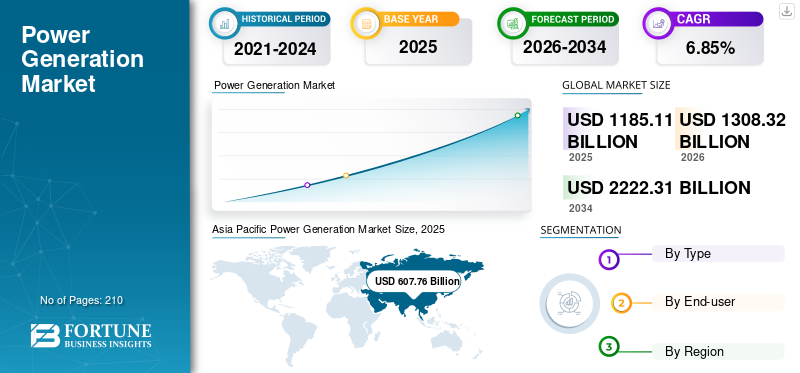
The global power generation market size was valued at USD 1185.11 billion in 2025 and is projected to grow from USD 1308.32 billion in 2026 to USD 2222.31 billion by 2034, exhibiting a CAGR of 6.85% during the forecast period. Asia Pacific dominated the power generation market with a market share of 51.28% in 2025. The Power generation market in the U.S. is projected to grow significantly, reaching an estimated value of USD 307.89 billion by 2032.
Power generation refers to the production of electrical power from different energy sources such as sunlight, wind, water, fossil fuels, and other sources at the power plants. Power plants use steam boilers, wind turbines, solar panels, and other technologies to convert these sources into electricity. The power generated at plants is transmitted through high-voltage power lines to substations, where it is stepped down to lower voltages and further distributed to homes and businesses through local power lines.
The outbreak of COVID-19 pandemic negatively impacted the market. The temporary halts in commercial and industrial activities and workforce shortages in power plants due to the imposition of lockdowns and government regulations led to a downfall in electricity demand, further affecting the market growth.
Download Free sample to learn more about this report.
Power Generation Market Key Takeaways
 Market Size & Forecast
- 2025 Market Size: USD 1,185.11 billion
- 2026 Market Size: USD 1,308.32 billion
- 2034 Forecast Market Size: USD 2,222.31 billion
- CAGR: 6.85% from 2026-2034
 Market Share
- Asia Pacific dominated the power generation market with a 51.28% share in 2025.
- The non-conventional/renewable segment will hold the largest share of 64.63% in 2026.
- The industrial segment will account for a 44.87% share in 2026.
 Key Regional Highlights
Asia Pacific
Asia Pacific generated USD 607.76 billion in 2025 and is projected to reach USD 677.96 billion in 2026.
Europe
Europe accounted for USD 211.60 billion in 2025 and is expected to reach USD 230.44 billion in 2026.
North America
North America generated USD 208.07 billion in 2025 and is projected to reach USD 228.79 billion in 2026.
U.S.
The power generation market is projected to reach USD 200.25 billion in 2026.
Japan
The power generation market is projected to reach USD 48.64 billion in 2026.
Read More

Power Generation Market Trends
Installation of Grid-energy Storage Systems to Enhance Market Outlook
Grid-energy storage is gaining traction in the modern power grid for storing surplus energy and releasing it when demand peaks or renewable sources are not generating electricity, such as during nighttime or weather disruptions. It includes several technologies such as Battery Energy Storage Systems (BESS), pumped hydroelectric storage, and others for storing the surplus energy generated from solar, wind, hydro, and other power plants. In addition, due to the rising focus on conserving electricity and increasing the share of renewable energy sources in the energy mix, the installation of grid energy storage systems is witnessing a rise globally. For instance, in April 2024, Socomec, a global energy storage solutions manufacturer, launched the Energy Storage System (ESS) Grid Lab near Strasbourg, France. It is constructed in around 500m² for developing technologies that enhance grid security, resilience, and reliability.
Download Free sample to learn more about this report.
Power Generation Market Growth Factors
Urbanization and Industrialization to Play a Key Role in Market Expansion
The rise in urbanization and industrialization, supported by the growth in the population across the world, has been driving the power generation capacities globally. Urbanization leads to the expansion of residential, commercial, and industrial facilities that require reliable power supply for lighting, heating, cooling, machinery, and other essential services. In addition, urban growth necessitates the construction of new buildings, transportation networks, and utilities, all of which require electricity. Moreover, the governments of Brazil, India, and other developing countries are encouraging FDI and supporting the growth of SMEs, which would play a key role in increasing the demand for power during the forecast period. UNCTAD's global Foreign Direct Investment (FDI) has increased from around USD 962 billion in 2020 to about USD 1.3 trillion in 2022. Thus, the expansion of residential, commercial, and industrial sectors due to urbanization and Industrialization is projected to drive the market growth during the forecast period.
Rising Electrification Globally to Stimulate Market Growth
The rising support by nations' governments globally to expand the electricity supply to remote and rural areas contributes to the demand for power generation. The National Electrification Plan (NEP), launched in 2017, aims to achieve universal electricity access across Ethiopia by 2025. The plan targets 65% of the population to be connected to the grid, with the remaining 35% accessing electricity through off-grid technologies such as standalone solar systems and mini-grids. In addition, the transition of the transportation sector from fossil-based fuels to electricity-based is also playing a key role in increasing electricity consumption in the global economy. The EV30@30 campaign, launched in June 2017 at the 8th Clean Energy Ministerial (CEM), aims to speed up the adoption of Electric Vehicles (EVs). Its goal is for electric vehicles to make up at least 30% of new vehicle sales by 2030. The campaign currently includes 13 member countries and has support from 23 companies and organizations. Hence, the electrification of sectors such as transportation, heating (electric heating systems), cooking (induction cooktops), and others would play a key role in driving the global power generation market growth in the forthcoming years.
RESTRAINING FACTORS
High Upfront Costs for the Construction of Power Plants May Constrain Market Expansion
The high cost incurred in the construction of power plants, coupled with the additional cost incurred for operating the power plants, is limiting the global power generation market growth. South Sudan, Niger, Yemen, and many other financially deficit countries are facing the challenges of high costs for the construction of power plants. These nations also struggle to secure affordable financing from the World Bank, IMF, and other global organizations due to perceived risks, inadequate credit ratings, and high interest rates, which hinder their ability to fund large-scale energy infrastructure projects independently. In addition, the financial barrier slows down infrastructure development and limits access to advanced technologies such as renewable energy systems and energy storage solutions that require substantial upfront investment. Hence, the high cost of the development and operation of the power plants results as a significant restraining factor for the development of the global market.
Power Generation Market Segmentation Analysis
By Type Analysis
Non-conventional/Renewable Segment Dominates Due to Rising Carbon Neutrality Initiatives
Based on type, the market is segmented into conventional/non-renewable and non-conventional/renewable.
The conventional/non-renewable segment consisting of coal, oil, gas, and nuclear-based products currently holds a considerable share of the market due to their established infrastructure for a longer period. The drawbacks of carbon emissions from coal, oil, and natural gas have led to a downfall in their installation in recent years. They are poised to continue to diminish during the forecast period as well. The segment is foreseen to capture 64.63% of the market share in 2025.
By End-User Analysis
Industrial Segment Dominates Owing to the Operation of Large-Sized Machinery
Based on end-user, the market is divided into residential, commercial, industrial, and others.
The industrial segment will hold the dominating share of 44.87% of the market in 2026 due to the extensive use of electricity for machinery, production processes, heating, cooling, lighting, and others for industrial operations. Moreover, the rising industrialization, propelled by the surge in global population, would lead to the growth of the industrial segment in the market. The segment gained 45.05% of the market share in 2024.
The commercial segment is anticipated to grow at the fastest rate in the coming years, owing to the rising inclination from fossil-fuel-based products toward electric products. In addition, the increasing electrification of the commercial buildings is projected to play a key role in the growth of the commercial segment in the forthcoming years.
To know how our report can help streamline your business, Speak to Analyst
REGIONAL INSIGHTS
Geographically, the market is studied across North America, Europe, Asia Pacific, Latin America, and the Middle East & Africa.
Asia Pacific Power Generation Market Size, 2025 (USD Billion)
To get more information on the regional analysis of this market, Download Free sample
Asia Pacific
In 2025, Asia Pacific generated USD 607.76 billion, contributing 51.28% to global market revenue, and is projected to grow to USD 677.96 billion in 2026. Asia Pacific holds the largest market share and is expected to grow at the fastest rate during the study period owing to the rapid economic development occurring in China, Indonesia, India, and other countries. The Chinese market is foreseen to grow with a value of USD 369.61 billion in 2026. The expansion of industrial and commercial activities is experiencing a surge, further leading to the demand for power generation in the region. India is estimated to hold USD 82.12 billion in 2026, while Japan is predicted to hit USD 48.64 billion in the same year.
North America
The North America region captured 17.56% of the global market in 2025, generating USD 208.07 billion in revenue, and is projected to reach USD 228.79 billion in 2026. North America also holds a considerable share of the market due to the rapid transition toward cleaner energy sources such as natural gas and renewable energy. The growing investment in the energy sector for energy storage and grid modernization is also playing a key role in the development of the market. The U.S. market is likely to hit USD 200.25 billion in 2026.
Europe
Europe maintained a strong presence in the global market, reaching USD 211.6 billion in 2025, accounting for 17.85% share, and is expected to reach USD 230.44 billion in 2026. Europe’s market for power generation holds a significant share owing to the growing installation of solar and wind power projects. The U.K. market continues to expand, projected to reach a market value of USD 22.25 billion in 2026. The government's commitment to achieve carbon neutrality by 2050 is also contributing to the growth of renewable energies, further propelling the market growth. Germany is estimated to reach USD 35.45 billion in 2026, while France is expected to gain USD 27.07 billion in 2025.
Latin America
The Latin America market generated USD 66.76 billion in 2025, representing 5.63% of the global market landscape, and is expected to reach USD 72.23 billion in 2026. Latin America is expected to grow steadily during the assessment period owing to the expansion of hydroelectric power projects. In addition, the growing electrification programs for expanding electricity in rural and remote areas are further leading to market growth.
Middle East & Africa
Middle East & Africa recorded a market size of USD 90.92 billion in 2025, capturing 7.67% of the global market share, and is projected to reach USD 98.88 billion in 2026. The Middle East & Africa is witnessing significant growth in the power generation market owing to the construction of new cities and growing residential & commercial sectors. The growing focus of the regional countries' governments on increasing the tourism industry is also leading to the expansion of commercial sectors such as hotels, airports, metros, and others. The GCC market is foreseen to be worth USD 54.54 billion in 2025.
KEY INDUSTRY PLAYERS
Key Players Deploy Smart Grid Technologies to Conserve Energy
The leading companies are deploying smart grid technologies and battery storage systems to conserve energy. Enel is one of the key players active in the power generation industry, focusing heavily on the renewable sectors. The company generated 93,986 GWh of electricity from renewable sources in the first nine months of 2023, a 12.6% year-on-year increase. The company’s installed renewables capacity grew to 54,821 MW, up from 51,563 MW the previous year. Significant increases in green power generation were recorded in Italy, Iberia, Latin America, and North America, with a 7.2% rise in North America.
LIST OF TOP POWER GENERATION COMPANIES:
- State Grid Corporation of China (China)
- Enel (Italy)
- EDF Energy (France)
- TEPCO (Japan)
- KEPCO (South Korea)
- Reliance Power (India)
- Iberdrola (Spain)
- NextEra Energy Inc (U.S.)
- American Electric Power (U.S.)
- China Huaneng Group Co Ltd (China)
- China Datang Corp (China)
- Kansai Electric Power Company (Japan)
- NTPC Limited (India)
- China Energy Investment Corporation (China)
- Engie (France)
KEY INDUSTRY DEVELOPMENTS:
- March 2024 - Korea Western Power Co. (KOWEPO) and EDF Renewables entered a joint development agreement for a 1.5 GW solar farm in Khazna, United Arab Emirates (UAE). They are also in advanced talks with Abu Dhabi's Emirates Water and Electricity Co. (EWEC) for a similar project in the Al-Ajban area.
- February 2024 - Energies PH, Inc., through its affiliate San Bernardino Ocean Power Corp., entered a contract with Inyanga Marine Energy Group to build Southeast Asia’s first tidal power plant on Capul Island, Northern Samar, Philippines. The 1 MW plant, using Inyanga's HydroWing technology, will be deployed in late 2025. It will connect to Capul's current 750 kW diesel power plant and include a microgrid with tidal power, solar PV, and energy storage, offering a sustainable alternative to fossil fuels.
- December 2023 - Telstra signed a Power Purchase Agreement (PPA) with Global Power Generation (GPG) for electricity from a 100 MW solar farm near Bundaberg, Queensland, Australia. Construction started in 2024, with operations beginning in late 2025. The agreement secures up to 153 GWh annually, enough to power about 30,000 homes.
- December 2023 - Vestas received an order from Pattern Energy to power the SunZia Wind project in New Mexico, U.S. This 1.1 GW order includes 242 V163-4.5 MW turbines, making it the largest single onshore project and the biggest order globally for Vestas’ newest high-capacity turbine.
- January 2022 - SSE acquired its first solar project, a 30MW solar farm at Littleton Pastures near Evesham, Worcestershire, U.K., which was scheduled for completion in late 2023. The 77-acre site will power approximately 9,400 homes. This project is part of SSE's USD 13.1 billion investment program aimed at achieving net zero. SSE is investing around USD 7.34 million daily in low-carbon infrastructure and developing over 1 GW in solar and battery storage, including a recently announced 50 MW battery storage project in Wiltshire.
REPORT COVERAGE
The report provides a detailed analysis of the market and focuses on key aspects such as prominent companies, product types, and leading applications of the product. Besides, it offers insights into the market trends and highlights key industry developments. In addition to the factors above, the report encompasses several factors that have contributed to the growth of the market in recent years.
Request for Customization to gain extensive market insights.
Report Scope & Segmentation
|
ATTRIBUTE |
DETAILS |
|
Study Period |
2021-2034 |
|
Base Year |
2025 |
|
Forecast Period |
2026-2034 |
|
Historical Period |
2021-2024 |
|
Growth Rate |
CAGR of 6.85% from 2026 to 2034 |
|
Unit |
Value (USD Billion) |
|
Segmentation |
By Type
By End-User
By Region
|
Frequently Asked Questions
A study by Fortune Business Insights states that the global market was USD 1185.11 billion in 2025.
The global market is projected to grow at a CAGR of 6.85% over the forecast period.
Asia Pacific’s market size stood at USD 607.76 billion in 2025.
Based on type, the non-conventional/ renewable segment holds a dominating share of the global market.
The global market size is expected to reach USD 2222.31 billion by 2034.
Rising electrification programs across nations are one of the key factors propelling the market growth
Enel, EDF, TEPCO, and KEPCO are some of the top players actively operating across the market.



- 2021-2034
- 2025
- 2021-2024
- 210
Get 30-60 hrs Free Customization
Expand Regional and Country Coverage, Segments Analysis, Company Profiles, Competitive Benchmarking, and End-user Insights.



















Related Reports
-
US +1 833 909 2966 ( Toll Free )
-
Get In Touch With Us