Sucrose Esters Market Size, Share & Industry Analysis, By Form (Powder, Liquid, and Pellet/Granules), By Grade (Food Grade, Pharma Grade, and Industrial Grade), By Functionality (Aeration, Antimicrobial Property, Controlled Sugar Crystallization, Emulsification, and Protein & Starch Interaction), By Application (Food & Beverages [Bakery, Dairy Products, Beverages, Confectioneries, Soups & Sauces, Meat Products, and Others], Cosmetics & Personal Care, Pharmaceuticals, Detergents & Cleaners, and Others), and Regional Forecast, 2026 - 2034
 Download Free Sample
(Offer valid till 15th Oct 2026)

sucrose esters market Overview
 Listen to Audio Version
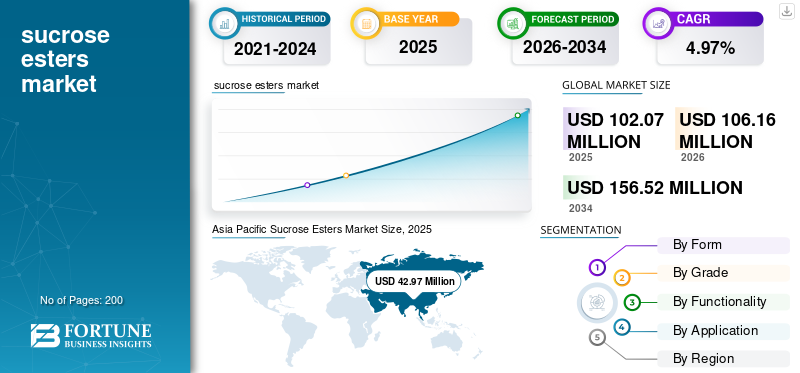
The global sucrose esters market size was valued at USD 102.07 million in 2025. The market is projected to grow from USD 106.16 million in 2026 to USD 156.52 million by 2034, exhibiting a CAGR of 4.97% during the forecast period. Asia Pacific dominated the sucrose esters market with a market share of 42.1% in 2025.
Sucrose esters are non-ionic emulsifiers produced through the esterification of sucrose with fatty acids derived from vegetable oils such as palm, coconut, or soybean oil. These ingredients are widely used as food and beverage emulsifiers, stabilizers, and texturizing agents due to their high biodegradability, mild sensory profile, and excellent emulsification properties across oil-water systems. Sucrose esters are extensively applied in bakery products, dairy formulations, beverages, confectionery, cosmetics, and personal care products, and processed convenient foods, where they enhance aeration, control sugar crystallization, improve mouthfeel, and stabilize emulsions.
The global market demand is led by key companies including Mitsubishi Chemical Group Corporation, Dai-Ichi Kogyo Seiyaku Co., Ltd., BASF SE, Palsgaard A/S, and Croda International Plc.
Download Free sample to learn more about this report.
Sucrose Esters Market Key Takeaways
 Market Size & Forecast
- 2025 Market Size: USD 102.07 Million
- 2026 Market Size: USD 106.16 Million
- 2034 Forecast Market Size: USD 156.52 Million
- CAGR: 4.97% from 2026–2034
 Market Share
- Asia Pacific dominated the sucrose esters market with a 42.1% share in 2025.
- The food grade segment led the market with a value of USD 72.93 million in 2025.
- The food & beverages segment held the largest share, valued at USD 70.61 million in 2025.
 Key Regional Highlights
Asia Pacific
Asia Pacific led the global market, valued at USD 42.97 million in 2025 and projected to reach USD 66.85 million by 2034.
North America
North America was valued at USD 22.30 million in 2025 and is expected to reach USD 35.97 million by 2034.
Europe
Europe accounted for USD 27.00 million in 2025 and is projected to grow to USD 40.60 million by 2034.
U.S.
The market was valued at approximately USD 18.37 million in 2025.
Japan
Growing food manufacturing activities and demand for specialty emulsifiers are supporting market growth.
Read More

Sucrose Esters Market Trends
Increasing Adoption of Natural and Clean-Label Emulsifiers to Shape Industry Trends
Food manufacturers are increasingly replacing synthetic emulsifiers with biodegradable and plant-derived alternatives such as sucrose esters. These emulsifiers offer multifunctionality, including emulsification, aeration, and stabilization while maintaining neutral flavor profiles. Rising demand for clean-label products and regulatory scrutiny on synthetic additives have encouraged food processors to adopt sucrose ester-based formulations across bakery, dairy, and confectionery products.
- Research published in Frontiers in Nutrition (2023) indicates that consumers increasingly check ingredient lists and prefer foods with shorter ingredient statements and familiar components, a core principle of the clean-label trend. The study highlights that ingredient transparency significantly influences purchasing decisions in processed foods.
MARKET DYNAMICS
Market Drivers
Download Free sample to learn more about this report.
Expanding Global Processed Food Production and Emulsifier Demand to Support Market Growth
The expansion of global processed food production is a major factor driving the sucrose esters market growth, as these compounds are widely used as food emulsifiers. As urbanization, changing lifestyles, and rising disposable incomes increase the consumption of convenience and packaged foods, food manufacturers are producing larger volumes of products such as bakery goods, dairy items, beverages, sauces, and ready-to-eat meals. These processed foods require emulsifiers to maintain stable mixtures of oil and water, improve texture, enhance mouthfeel, and provide texture stability and shelf life.
- According to the Food and Agriculture Organization (FAO), global exports of processed food products (including prepared foods, beverages, dairy products, and processed fruits and vegetables) exceeded USD 1.5 trillion in 2023, reflecting the large scale of processed food consumption and international trade.
Market Restraints
Stringent Food Additive Regulations and Approval Processes to Restrict Market Expansion
Sucrose esters are regulated as food additives in many jurisdictions and require compliance with strict safety, purity, and dosage standards established by regulatory authorities such as the European Food Safety Authority (EFSA), U.S. FDA, and Codex Alimentarius. These regulatory frameworks impose limits on acceptable daily intake levels and permitted usage concentrations in food products, which can increase compliance costs and extend approval timelines for new formulations.
Manufacturers entering new markets must meet region-specific regulatory approvals, which can slow product commercialization and increase R&D expenditure for ingredient suppliers.
- For instance, sucrose fatty acid esters are regulated under food additive code E473 in the European Union, requiring strict purity standards and usage limits across bakery, dairy, and confectionery applications.
Market Opportunities
Expansion of Plant-Based and Low-Fat Food Formulations to Create Market Opportunities
The rapid expansion of plant-based food products such as dairy alternatives, meat substitutes, and vegan bakery products further drives the demand for sucrose esters. These emulsifiers help stabilize plant-protein formulations, improve mouthfeel, and maintain fat dispersion in low-fat and plant-based systems.
Sucrose esters are particularly effective in oil-in-water emulsions, making them suitable for plant-based beverages, dairy alternatives, and vegan desserts where traditional emulsifiers may not perform efficiently.
- According to the Good Food Institute (GFI), global retail sales of plant-based foods exceeded USD 29 billion in 2023, highlighting the rapid expansion of plant-derived food categories requiring functional emulsifiers.
SEGMENTATION ANALYSIS
By Grade
Food Grade Segment Dominated the Market Due to Extensive Use in Processed Foods
Based on grade, the market is segmented into food grade, pharma grade, and industrial grade.
The food grade segment dominated the global market, valued at USD 72.93 million in 2025, accounting for the largest sucrose esters market share due to widespread use in bakery products, dairy formulations, confectionery, and beverages, where sucrose esters function as emulsifiers, stabilizers, and aeration agents. Strong demand from large-scale processed food manufacturing and clean-label ingredient formulations continues to support this segment’s dominance.
The pharma grade segment is projected to grow at the fastest CAGR of 6.16% during the forecast period.
To know how our report can help streamline your business, Speak to Analyst
By Form
Powder Segment Dominated Due to Its Ease of Handling
Based on form, the market is segmented into powder, liquid, and pellet/granules.
The powder form segment dominated the global market, valued at USD 67.68 million in 2025, driven by its ease of handling, longer shelf life, and compatibility with dry ingredient formulations in bakery and confectionery applications. Powdered sucrose esters also allow precise dosage in industrial food processing lines.
The liquid segment is projected to grow at the fastest CAGR of 6.23% during the forecast period, due to increasing use in beverage emulsification and liquid formulation systems across the food and cosmetic industries.
By Functionality
Emulsification Segment Dominated Due to Core Functional Role in Food Systems
Based on functionality, the market is segmented into aeration, antimicrobial property, controlled sugar crystallization, emulsification, and protein & starch interaction.
The emulsification segment dominated the global market, valued at USD 44.24 million in 2025, as sucrose esters are widely used to stabilize oil-in-water emulsions in bakery, dairy, and beverage formulations. Their high hydrophilic-lipophilic balance (HLB) values make them effective emulsifiers in low-fat and complex food systems.
The antimicrobial property segment is projected to grow at the fastest CAGR of 6.77% from 2026 to 2034, supported by increasing research on the product as food preservation agents capable of inhibiting microbial growth in processed foods.
By Application
Food & Beverages Segment Dominated Due to Extensive Use in Bakery and Dairy Products
Based on application, the market is segmented into food & beverages, cosmetics & personal care, pharmaceuticals, detergents & cleaners, and others.
The food & beverages segment dominated the market, valued at USD 70.61 million in 2025, supported by large-scale use of sucrose esters in bakery aeration, dairy stabilization, beverage emulsification, and confectionery crystallization control. Within the segment, bakery applications accounted for USD 18.33 million in 2025, as sucrose esters improve dough stability, crumb softness, and shelf life of baked goods.
The pharmaceuticals segment is projected to grow at the fastest CAGR of 5.69% from 2026 to 2034, owing to the rising adoption of the product in drug formulations, emulsified medicines, and controlled-release delivery systems.
Sucrose Esters Market Regional Outlook
Regionally, the market is studied across North America, Europe, Asia Pacific, South America, and the Middle East & Africa.
North America
Asia Pacific Sucrose Esters Market Size, 2025 (USD Million)
To get more information on the regional analysis of this market, Download Free sample
North America was valued at USD 22.30 million in 2025 and is projected to reach USD 35.97 million by 2034, growing at a CAGR of 5.56% during the forecast period. Growth is driven by strong processed food manufacturing, increasing demand for clean-label emulsifiers, and expansion of plant-based and low-fat food formulations requiring stable emulsification systems.
U.S. Sucrose Esters Market
The U.S. dominates the region, valued at approximately USD 18.37 million in 2025, supported by large-scale bakery and dairy industries and growing demand for biodegradable surfactants in personal care products.
Europe
Europe accounted for USD 27.00 million in 2025 and is projected to reach USD 40.60 million by 2034, registering a CAGR of 4.74% during the study period (2026-2034). The region benefits from strict food additive regulations favoring safe emulsifiers such as sucrose esters (E473), along with strong bakery and confectionery industries.
Germany Sucrose Esters Market
Germany leads the European market with a value of approximately USD 6.08 million in 2025, supported by its large food processing sector and growing demand for functional food ingredients.
U.K. Sucrose Esters Market
The U.K. market was valued at approximately USD 3.97 million in 2025, driven by bakery product innovation and demand for emulsifier systems in processed food formulations.
Asia Pacific
Asia Pacific was valued at USD 42.97 million in 2025, dominating the global market, and is projected to reach USD 66.85 million by 2034, growing at a CAGR of 5.14% during the study period (2026-2034). Growth is supported by expanding food manufacturing industries in China, Japan, South Korea, and India, along with strong production capacity for specialty emulsifiers.
China Sucrose Esters Market
China represents the largest market in the Asia Pacific, valued at approximately USD 20.59 million in 2025, supported by rapid growth in processed food manufacturing and increasing domestic emulsifier production.
South America and the Middle East & Africa
South America reached USD 6.76 million in 2025 and is projected to grow to USD 9.30 million by 2034, registering a CAGR of 3.70% (2026–2034). Expansion of the bakery and dairy industries in Brazil and Argentina supports regional demand.
The Middle East & Africa market was valued at USD 3.03 million in 2025 and is projected to reach USD 3.80 million by 2034, expanding at a CAGR of 2.60% during the study period (2026-2034), driven by increasing adoption of emulsifiers in processed food manufacturing and growing packaged food consumption.
South Africa Sucrose Esters Market
South Africa represents the largest sucrose esters market within Sub-Saharan Africa due to its developed food processing industry and expanding bakery production sector.
COMPETITIVE LANDSCAPE
Key Industry Players
Key Players Focus on Expanding Sucrose Ester Grades to Serve Diverse Industries
The global sucrose esters market is moderately consolidated, with a limited number of specialty chemical and food ingredient manufacturers dominating global supply. Leading companies focus on expanding sucrose ester grades with varying hydrophilic-lipophilic balance (HLB) levels to serve diverse food, cosmetic, and pharmaceutical formulations. Strategic investments in biotechnology, sustainable raw materials, and global distribution networks are strengthening competitive positioning.
Key Players in the Sucrose Esters Market
|
Rank |
Company Name |
|
1 |
Mitsubishi Chemical Group Corporation |
|
2 |
Dai-Ichi Kogyo Seiyaku Co., Ltd. |
|
3 |
BASF SE |
|
4 |
Palsgaard A/S |
|
5 |
Croda International Plc |
List of Key Sucrose Esters Companies Profiled
- Mitsubishi Chemical Group Corporation (Japan)
- Dai-Ichi Kogyo Seiyaku Co., Ltd. (Japan)
- BASF SE (Germany)
- Palsgaard A/S (Denmark)
- Croda International Plc (U.K.)
- Stearinerie Dubois (France)
- Sisterna B.V. (Netherlands)
- Evonik Industries AG (Germany)
- Zhejiang Synose Tech Co., Ltd. (China)
- Hangzhou GengYang Chemical Materials Co., Ltd. (China)
KEY INDUSTRY DEVELOPMENTS
- January 2026: DKS Co. Ltd., a Japanese firm listed on TSE Prime (4461), achieved halal certification for its sucrose esters products, such as the DK ESTER and SISTERNA series. These are manufactured at the company's Shiga Plant and target industries, including food and personal care.
- September 2025: Ester Industries, through its joint venture ELITe with Canada's Loop Industries, has secured land near Surat in Gujarat for India's first large-scale chemical recycling plant focused on polyester textile waste. This aligns with global trends in chemical recycling, similar to DKS Co. Ltd.'s recent halal-certified sucrose esters for food applications, emphasizing compliance and innovation in functional materials.
- November 2024: Nagase Viita launched SUCROSE SG as a high-purity, low-endotoxin sucrose excipient for biopharmaceuticals. SUCROSE SG is part of the SOLBIOTE™ portfolio, expanding alongside TREHALOSE SG and MALTOSE PH to stabilize biopharmaceuticals such as antibody drugs and mRNA vaccines in lipid nanoparticles (LNPs). It is a transparent crystalline powder with high water solubility, serving as a non-reducing carbohydrate cryoprotectant during freezing and storage.
- March 2024: Mitsubishi Chemical Group (MCG) expanded its sugar ester emulsifier production at the Kyushu Plant in Kitakyushu City, Fukuoka Prefecture, Japan, to address rising global demand for high-quality food products. The new line, with a capacity of 1,100 metric tons per year, began construction in January 2024 and is set to start operations in March 2026.
REPORT COVERAGE
The global sucrose esters market industry report analyzes the market in depth and highlights crucial aspects such as global market trends, market dynamics, prominent companies, investment in research and development, and end-use. Besides this, the report also provides insights into the global market analysis and highlights significant industry developments.
Request for Customization to gain extensive market insights.
Report Scope & Segmentation
| ATTRIBUTE | DETAILS |
| Study Period | 2021-2034 |
| Base Year | 2025 |
| Estimated Year | 2026 |
| Forecast Period | 2026-2034 |
| Historical Period | 2021-2024 |
| Growth Rate | CAGR of 4.97% from 2026 to 2034 |
| Unit | Value (USD Million) |
|
Segmentation |
By Form
|
|
By Grade
|
|
|
By Functionality
|
|
|
By Application
|
|
|
By Region
|
Frequently Asked Questions
Fortune Business Insights says that the global market was valued at USD 102.07 million in 2025 and is anticipated to reach USD 156.52 million by 2034.
At a CAGR of 4.97%, the global market will exhibit steady growth over the forecast period.
By grade, the food grade segment led the market.
Asia Pacific held the largest market share in 2025.
Expanding global processed food production and emulsifier demand are key factors driving the market.
Mitsubishi Chemical Group Corporation, Dai-Ichi Kogyo Seiyaku Co., Ltd., BASF SE, Palsgaard A/S, and Croda International Plc. are the leading players in the market.
Increasing adoption of natural and clean-label emulsifiers is the key market trend.



- 2021-2034
- 2025
- 2021-2024
- 200
-
(Offer valid till 15th Oct 2026)
Get 30-60 hrs Free Customization
Expand Regional and Country Coverage, Segments Analysis, Company Profiles, Competitive Benchmarking, and End-user Insights.



















Related Reports
-
US +1 833 909 2966 ( Toll Free )
-
Get In Touch With Us