 Download Free Sample



Get a Quote
Receive a tailored pricing based on your needs.
- Choose license type
- Multiple user options
- Custom scope & coverage
- Fast turnaround
"Designing Growth Strategies is in our DNA"
 Listen to Audio Version
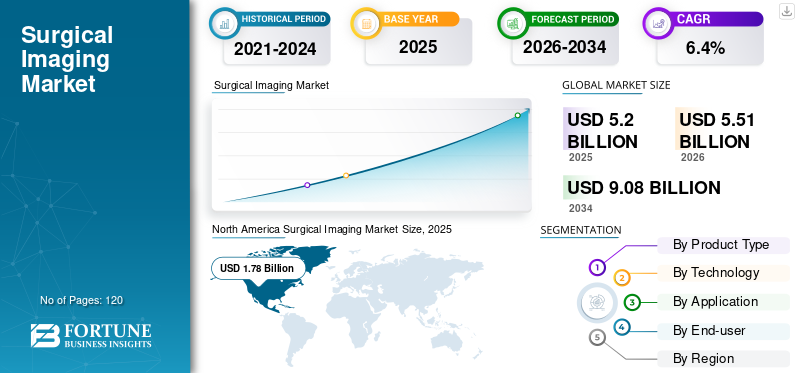
The global surgical imaging market size was valued at USD 5.20 billion in 2025 and is projected to grow from USD 5.51 billion in 2026 to USD 9.08 billion by 2034, exhibiting a CAGR of 6.4% during the forecast period. North America dominated the global surgical imaging market with a market share of 34.23% in 2025.
The surgical imaging includes intraoperative imaging systems such as mobile and fixed C-arms, fluoroscopy units, hybrid OR solutions, and increasingly 3D & CBCT platforms that provide real-time visualization during surgery. The market’s growth is attributed to the rising demand for advanced technologies coupled with increasing shift of preference toward minimally invasive surgeries. Moreover, the market players are focusing on continuous upgradations in systems with flat-panel detectors, higher power generators, AI-supported image processing and dose optimization features to improve safety and workflow.
The market is dominated by major players, including GE HealthCare, Siemens Healthineers, Philips Healthcare, and Medtronic, among others. These players are involved in innovations and strategic initiatives to expand their market reach.
Download Free sample to learn more about this report.
 Market Size & Forecast
 Market Share
 Key Regional Highlights
North America
North America led the global market in 2025 with revenue of USD 1.78 billion, supported by strong adoption of advanced surgical imaging technologies.
Europe
Europe is projected to reach USD 1.38 billion by 2026, expanding at a CAGR of 5.6% during the forecast period.
Asia Pacific
Asia Pacific is expected to attain USD 1.63 billion by 2026, driven by increasing healthcare investments and rising surgical procedure volumes.
U.S.
The surgical imaging market is estimated to reach USD 1.16 billion by 2026, maintaining its position as a key contributor to regional growth.
Japan
The market is expected to witness steady growth, supported by increasing demand for advanced imaging systems and expanding healthcare infrastructure.
Read More

Growing Burden of Complex Surgeries and Shift to Minimally Invasive Care Boost Market Growth
The global surgical imaging market growth is primarily driven by the rising volume of surgical procedures such as orthopedic, spine, neuro, and cardiovascular. Moreover, rising shift toward minimally invasive techniques that require precise intraoperative guidance is also projected to accelerate market growth. Surgeons increasingly rely on real-time fluoroscopy and cone-beam CT to confirm implant placement, reduce revisions and shorten hospital stays.
Cautious Adoption of Implant-Based POP Repair Techniques May Deter Market Growth
A key restraint for the surgical imaging market is the high upfront cost of advanced C-arms, hybrid OR imaging systems, and associated infrastructure. Many mid-size hospitals and outpatient centers continue to extend the life of legacy image-intensifier C-arms or purchase refurbished mini-C-arms rather than invest in premium flat-panel or robotic systems. In addition, companies such as Mini C Arm LLC, which refurbishes systems from leading brands and offers them to clinics and surgery centers, illustrate how cost pressure fuels a sizeable secondary market. This dynamic can delay replacement cycles and slow penetration of cutting-edge 3D and motorized systems, particularly in cost-sensitive regions.
Growing Demand for AI-based and Patient Centric Systems to Provide Lucrative Growth Opportunities
The demand for advanced and intelligent tools is rising. As these systems enable workflow automation along with comprehensive analysis, the demand for such technologies is extensively rising. Moreover, healthcare facilities are seeking systems that not only capture images but also guide positioning, standardize protocols, integrate with navigation or robotics and support data-driven decision making. In addition, such systems play a prominent role in streamlining the overall operations along with multiple functionalities.
Operational Complexity, Staffing Gaps and Integration Barriers to Pose Challenge for Market Growth
Despite strong innovation, providers face challenges around staffing, training and IT/OR integration. Advanced C-arms require skilled radiographers or OR staff to manage positioning, dose settings and 3D acquisitions, which can be difficult in environments already affected by workforce shortages.
Rapid Transition from Legacy to Flat-panel, Motorized, and 3D Systems
A notable trend in the surgical imaging market is the transition from conventional image intensifier C-arms to flat-panel detector platforms, motorized C-arms and 3D/CBCT systems that enhance intraoperative control. Moreover, market players are launching compact systems with larger flat-panel detectors, as observed in Ziehm Imaging’s IGZO flat-panel technology. Simultaneously, advanced systems such as GE HealthCare’s OEC 3D and Siemens’ CIARTIC Move bring 3D volumes and automated positioning to routine spine and trauma workflows.
Download Free sample to learn more about this report.
Fluoroscopy–based Surgical Imaging Systems Lead with their Extensive Range of Applications
Based on product type, the market is classified into fluoroscopy–based surgical imaging systems, CT scanner, MRI systems, ultrasound systems, and others.
To know how our report can help streamline your business, Speak to Analyst
The fluoroscopy–based surgical imaging systems segment accounted for the largest global surgical imaging market share in 2025 due to its versatility across orthopedic, trauma, cardiovascular, urology and pain management procedures. In addition, continual technological improvements coupled with advancements in flat panel technologies are also estimated to boost segment growth.
The MRI systems segment is expected to grow at a CAGR of 8.7% during the forecast period.
Superior Functionalities Offered by 2D Technologies Across Modalities Assists their Top Position
Based on technology, the market is sub-segmented into 2D imaging systems, 3D imaging systems, AI-enabled imaging & navigation integration, and others.
By technology, the 2D imaging systems segment accounted for the largest share in 2025 due to its extensive availability, adoption, and superior functionalities. Moreover, most mobile C-arms installed worldwide provide high-quality 2D fluoroscopy that is sufficient for fracture fixation, joint replacement and hardware verification at a lower cost. In 2026, the segment is set to hold 62.7% market share.
The AI-enabled imaging & navigation integration segment is projected to grow at a CAGR of 7.5% during the forecast period.
Considerable Prevalence of Orthopedic Conditions to Drive the Segment Growth
Based on application, the market is segmented into orthopedic & trauma surgery, gastrointestinal & abdominal surgery, neurosurgery, cardiovascular & thoracic surgery, and others.
In 2025, the orthopedic & trauma surgery was the leading application in the global market as it is directly associated with the utilization of fluoroscopy and MRI technologies for assessment of fractures and joint reconstructions. In addition, rising incidence of osteoporosis-related fractures, sports injuries and high-energy trauma are projected to offer substantial opportunity for market growth. Furthermore, the segment is set to hold a 49.5% market share in 2026.
The neurosurgery segment is projected to grow at a CAGR of 7.2% during the forecast period.
Hospitals is the Leading End-user Owing to Availability of Advanced Infrastructure and Substantial Surgical Volumes
Based on end-user, the market is segmented into hospitals, specialty clinics, and others.
In 2025, the hospitals segment dominated and is anticipated to hold a 58.6% surgical imaging market share in terms of end-user. Hospitals lead because most surgical procedures take place in these settings. In addition, these facilities are equipped with intelligent and advanced instruments, which enables streamlining of surgical procedure.
The specialty clinics segment is projected to grow at a CAGR of 7.1% during the forecast period.
By geography, the market is categorized into North America, Europe, Asia Pacific, Latin America, and the Middle East & Africa.
North America Surgical Imaging Market Size, 2025 (USD Billion) To get more information on the regional analysis of this market, Download Free sample
North America’s market size in in 2024 was at USD 1.69 billion and maintained its leading share in 2025 by accounting USD 1.78 billion. The region’s growth is favored by rising prevalence of chronic conditions, substantial surgical volumes, and introduction of advanced technologies. In 2026, the U.S. market is estimated to reach USD 1.16 billion.
Europe and Asia Pacific are projected to experience notable growth during the forecast period. Europe’s projected growth rate for the forecast period is 5.6% while capturing a revenue of USD 1.38 billion in 2026. The region’s robust growth is due to the presence of major players in Germany, the U.K., and France, which will capture a revenue of USD 0.31 billion, USD 0.22 billion, and USD 0.18 billion respectively in 2026.
Asia Pacific is estimated to reach USD 1.63 billion in 2026 and secure third position as in 2026, India and China are estimated to attain USD 0.36 billion and USD 0.54 billion respectively.
The Latin America and the Middle East & Africa are expected to showcase moderate growth. Latin America’s market size in 2026 is expected to hit USD 0.33 billion favored by the increasing awareness of surgical care in the region. In the Middle East & Africa, the GCC is set to reach USD 0.10 billion iy 2026.
Focus on Product Launches and Approval to Strengthen the Position of Key Players
In 2025, major players such as GE HealthCare, Siemens Healthineers, Philips Healthcare, Medtronic, and others accounted for the largest surgical imaging market share with focus on innovations and other strategic initiatives, including partnerships, acquisitions, and collaborations.
Other prominent companies, such Canon Medical Systems, Ziehm Imaging, Shimadzu Corporation, and Samsung NeuroLogica are focused on increasing product supply to emerging countries, which is expected to help them gain a significant market share.
Request for Customization to gain extensive market insights.
|
ATTRIBUTE |
DETAILS |
|
Study Period |
2021-2034 |
|
Base Year |
2025 |
|
Estimated Year |
2026 |
|
Forecast Period |
2026-2034 |
|
Historical Period |
2021-2024 |
|
Growth Rate |
CAGR of 6.4% from 2026-2034 |
|
Unit |
Value (USD Billion) |
|
Segmentation |
By Product Type, Technology, Application, Application, End-user, and Region |
|
By Product Type |
· Fluoroscopy–based Surgical Imaging Systems · CT Scanner · MRI Systems · Ultrasound Systems · Others |
|
By Technology |
· 2D Imaging Systems · 3D Imaging Systems · AI-Enabled Imaging & Navigation Integration · Others |
|
By Application |
· Orthopedic & Trauma Surgery · Gastrointestinal & Abdominal Surgery · Neurosurgery · Cardiovascular & Thoracic Surgery · Others |
|
By End-user |
· Hospitals · Specialty Clinics · Others |
|
By Geography |
· North America (By Product Type, Technology, Application, End-user, and Country) o U.S. (By Product Type) o Canada (By Product Type) · Europe (By Product Type, Technology, Application, End-user, and Country/Sub-region) o Germany (By Product Type) o U.K. (By Product Type) o France (By Product Type) o Spain (By Product Type) o Italy (By Product Type) o Scandinavia (By Product Type) o Rest of Europe (By Product Type) · Asia Pacific (By Product Type, Technology, Application, End-user, and Country/Sub-region) o China (By Product Type) o Japan (By Product Type) o India (By Product Type) o Australia (By Product Type) o Southeast Asia (By Product Type) o Rest of Asia Pacific (By Product Type) · Latin America (By Size, Procedure, End-user, and Country/Sub-region) o Brazil (By Product Type) o Mexico (By Product Type) o Rest of Latin America (By Product Type) · Middle East & Africa (By Product Type, Technology, Application, End-user, and Country/Sub-region) o GCC (By Product Type) o South Africa (By Product Type) o Rest of the Middle East & Africa (By Product Type) |
Fortune Business Insights says that the global market value stood at USD 5.20 billion in 2025 and is projected to reach USD 9.08 billion by 2034.
In 2025, North Americas market value stood at USD 1.78 billion.
The market is expected to exhibit a CAGR of 6.4% during the forecast period.
The fluoroscopy–based surgical imaging systems segment led the market by product type.
The key factors driving the market are the increasing number of surgical procedures and technological advancements.
GE HealthCare, Siemens Healthineers, Philips Healthcare, and Medtronic are some of the prominent players in the market.
North America dominated the market in 2025 in terms of market share.

Get 30-60 hrs Free Customization
Expand Regional and Country Coverage, Segments Analysis, Company Profiles, Competitive Benchmarking, and End-user Insights.













.webp)






Related Reports
Get In Touch With Us
US +1 833 909 2966 ( Toll Free )
Receive a tailored pricing based on your needs.
Discuss your questions with our industry experts.
Have questions? Get quick answers before you purchase.

