Sustainable Finance Market Size, Share and Industry Analysis, By Investment Type (ESG Integration, Sustainable bonds, Climate Funds, and Others), By Industry (Energy & Power, Transport, Infrastructure, Land Use and Resources, Water, Waste, Clean Technology, Education, and Others), and Regional Forecast, 2026-2034
 Download Free Sample
KEY MARKET INSIGHTS
 Listen to Audio Version
The global sustainable finance market size was valued at $6.33 trillion in 2025 and is projected to grow from $7.23 trillion in 2026 to $33.85 trillion by 2034, exhibiting a compound annual growth rate of 21.30% during the forecast period. Europe dominated the sustainable finance market with a market share of 35.80% in 2025.
Sustainable finance is a financial service that integrates sustainability and environmental, social, and governance (ESG) considerations into financial decisions to generate long-term value for investors and society. The financial model aims to improve companies' processes and financial institutions. It is an important tool that manages climate and other sustainability goals, addresses risks, and meets society's expectations for a sustainable economy. Further, global incentives, including the Canada Growth Fund, IRA, and the EU Green Deal, invigorated corporate climate plans, contributing to green capex and sustainable green bonds. Major financial firms such as BlackRock, Goldman Sachs, and others are actively introducing funds designed to cater to investors ready to invest in sustainability indices and funds.
The COVID-19 pandemic instigated capital investments across the global climate and sustainability sectors. However, the role of the sustainable debt market shifted from supporting recovery to financing investment and growth in sustainability. The pandemic has given rise to new financial investment strategies and norms essential in allocating capital for the transition to finance and sustainability.
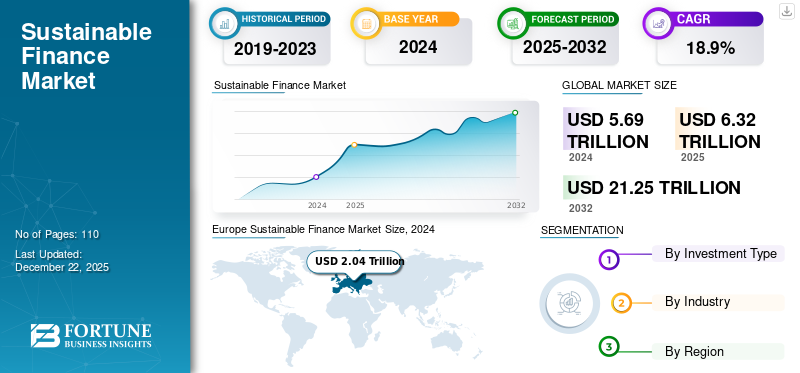
Download Free sample to learn more about this report.
Sustainable Finance Market Key Takeaways
 Market Size & Forecast
- 2025 Market Size: USD 6.33 Trillion
- 2026 Market Size: USD 7.23 Trillion
- 2034 Forecast Market Size: USD 33.85 Trillion
- CAGR: 21.30% from 2026–2034
 Market Share
- Europe dominated the sustainable finance market with a 35.80% share in 2025.
- The ESG integration segment is projected to account for a 37.13% share in 2026.
- The energy & power segment is projected to hold a 19.54% share in 2026.
 Key Regional Highlights
Asia Pacific
Asia Pacific accounted for USD 1.85 trillion in 2025 and is expected to reach USD 2.16 trillion in 2026.
North America
North America generated USD 1.67 trillion in 2025 and is projected to reach USD 1.88 trillion in 2026.
Europe
Europe generated USD 2.26 trillion in 2025 and is projected to reach USD 2.59 trillion in 2026.
U.S.
The sustainable finance market is projected to reach USD 1.37 trillion in 2026.
Japan
The sustainable finance market is projected to reach USD 0.29 trillion in 2026.
Read More

Impact of Tariffs on the Sustainable Finance Market
Strict Regulations and Complex Tax Regimes Hinder Capital Flow
Tariffs in the short term don’t influence investment in sustainability, while capital allocation could be significantly lower in 2025 compared to 2024. Trade isolationism and stringent regulatory frameworks impact major investments in sustainability and ESG. The strict tax regimes and investment restrictions across developed economies could hinder capital flow and investor participation. However, multilateral efforts to harmonize ESG investing standards, such as the International Platform on Sustainable Finance (IPSF), aim to reduce barriers to sustainable investing.
Sustainable Finance Market Trends
Financial Innovation in Transparency for Sustainability Risks Drives Future Trends
World supply chain dynamics are changing rapidly, creating ample opportunities for investors and asset management firms seeking sustainable growth for their investments. The investing market requires new innovative financial instruments to address various sustainability issues that provide an attractive return on risk profile and offer exceptionally high ESG impact. Post-pandemic, sustainable investing has become mainstream and vital for the financial markets and their participants. The market has a large pool of green bonds and securities across all ESG portfolios; thus, there is transparency in returns monitoring through apps and online platforms. These innovative strategies aim to deliver high returns for investors, boosting sustainable finance market growth during the forecast period.
- For instance, in April 2025, Franklin Templeton announced the launch of the Franklin S&P 500 ETF and World Screened ETF targeted at European investors, aiming at enhanced ESG and carbon footprint tracking for its U.S. and global equity benchmarks.
Sustainable Finance Market Dynamics
Market Drivers
Demand for Green Bonds and Climate Sustainability Funds Drives Market Growth
The thematic bond market has grown exponentially post-pandemic, shaping modern investment criteria, especially among investors seeking high-risk returns from responsible investments in various modern financial tools. Green and social bonds are a few climate-themed investments aiming to deliver environmental and financial benefits. The capital collected is primarily allocated to transition efforts, renewable energy projects, solar and wind technology, and other sustainable agriculture practices. International guidelines support the demand for modern financial bonds and sustainability-linked investment and loan markets, and they ensure the integrity of green bonds as per the International Capital Market Association (ICMA). This demand shift will expand the sustainable finance market size in the long term.
- For instance, in April 2025, China’s Ministry of Finance (MOF) launched a new sovereign green bond, with the aim of raising USD 824 million for multiple projects to achieve environmental objectives, including climate change adaptation, natural resource protection, and biodiversity conservation.
Market Restraints
Greenwashing Concerns Diminish Sustainable Finance Growth in Short Term
The market faces major challenges from global restrictive norms, and investment standards are getting stricter. The new norms introduced by developed and developing economies focus on implementing strict rules for funds termed ESG, transition, and sustainability, which create hindrances. There are also greenwashing concerns, where financial products mislead investors and hinder trust and market credibility. In addition, new policies and norms, notably Bill C-59 in Canada and the EU, have been introduced to label regulations for sustainable bonds and funds to prevent greenwashing and create a clean fund market. A partial alignment of investors to these greenwashed funds creates a short-term hindrance but long-term progressive growth.
Market Opportunities
Sustainable Bonds and ESG Transition Efforts Drive Opportunities in Emerging Markets
The emerging economies, including China, Japan, South Korea, Africa, Brazil, and India, shape the global investment market. Developing countries, from the U.K. to the U.S., are critical markets in ensuring sustainability goals and meeting global norms. The market sees a great opportunity for investors in transition bonds that meet global renewable energy transition goals. The opportunity in this region grew by almost 43% in the long term, influenced by sustainability bonds and sustainability-linked bonds. Investors have strategically allocated major investments for a stable social and environmental future. Beyond traditional financial bonds, sustainable bonds in emerging countries deliver fruitful returns and economic growth. They address the knowledge gap in sustainable finance and propel adoption in emerging markets.
- For instance, according to the United Nations Development Programme (UNDP), the total value of potential impact opportunity investments is around USD 26 trillion in publicly traded equities and bonds, and USD 5 trillion in private markets.
Sustainable Finance Market Segmentation Analysis
By Investment Type
Emphasis on ESG Investing for Economic Growth Drives Investment
The market is divided by investment type into ESG integration, sustainable bonds, climate funds, and others (bonds, etc.).
ESG integration is a dominant segment driven by rising investor emphasis on bonds and investments that focus on delivering finance facilities for the ESG transition across emerging and developed markets, with a share of 37.13% in 2026. The market provides lucrative growth opportunities for investors who seek returns and financial benefits, driving investment. Investors are signaling a growing interest in future financial tools and funds, including sustainable bonds, climate funds, and other energy funds. This will further expand the sustainable finance market share progressively in the long term.
To know how our report can help streamline your business, Speak to Analyst
By Industry
Focus on Sustainable Energy Dominates Utilities Investing Segment
The segment is divided into energy & power, transport, infrastructure, land use and resources, water, waste, clean technology, education, and others (healthcare, etc.).
The energy & power sector is a dominant segment driven by the growing adoption of renewable energy, including wind, solar, and other renewable sources, with a share of 19.54% in 2026. Investors are focusing on providing sustainable debt to emerging economies through green and sustainable bonds, which are benefiting the market. Infrastructure and water sustainability goals are progressively growing segments, actively leveraging sustainable corporate debt and bonds in developing and developed economies across the globe. Clean technology, waste, transport, and other segments are also steadily growing, driven by active investor trust in social and corporate sustainable bonds.
Sustainable Finance Market Regional Outlook
Europe
Europe Sustainable Finance Market Size, 2025 (USD Trillion)
To get more information on the regional analysis of this market, Download Free sample
In 2025, Europe represented USD 2.26 trillion, accounting for 35.80% of the worldwide market, and is projected to grow to USD 2.59 trillion in 2026. Europe dominates the regional market with a 35.80% share in sustainable finance, driven by investors' growing interest in the EU-classified system. The initiative encourages the development of a coherent and ESG-compliant framework that delivers consistent returns from sustainable bonds.
Germany is the largest country in the Europe region regarding share, driven by a larger investment share in Sustainable Finance Disclosure Regulations (SFDR)-labelled funds. The funds are allocated to reorient capital toward a sustainable economy and tackle the climate crisis. The U.K. market is projected to reach USD 0.56 trillion by 2026, while the German market is projected to reach USD 0.91 trillion by 2026.
Download Free sample to learn more about this report.
Asia Pacific
The Asia Pacific market generated USD 1.85 trillion in 2025, representing 29.20% of the global market, and is expected to reach USD 2.16 trillion in 2026. Asia Pacific is the fastest-growing region owing to the presence of major emerging economies enrolling in and implementing the sustainable banking and finance network (SBFN) framework. The market was shaped by policy coherence, a focus on climate financing, integrating ESG factors, and the growth of sustainable finance networks. The Japan market is projected to reach USD 0.29 trillion by 2026, the China market is projected to reach USD 1.42 trillion by 2026, and the India market is projected to reach USD 0.19 trillion by 2026.
North America
North America recorded a market size of USD 1.67 trillion in 2025, capturing 26.40% of the global market share, and is projected to reach USD 1.88 trillion in 2026. The North American market is steadily growing, driven by investors' interest in sustainable finance and the debt benefits of market growth. However, the North America market remained flat in 2023 owing to a decline in investment in ESG and strict greenwashing directives.
The U.S. sustainable finance market is significantly driven by green bonds and has remained flat in the short term, owing to the imposition of economic laws and tariffs. The U.S. market is projected to reach USD 1.37 trillion by 2026.
Latin America
Latin America is a moderately growing market with a large pool of investors focusing on sustainable finance options. Emerging countries such as Brazil and Mexico are present in this region, which delivers notable future expansion opportunities for sustainable investors.
Middle East and Africa
Middle East & Africa accounted for USD 0.36 trillion in 2025, representing 5.60% of the global market share, and is projected to reach USD 0.39 trillion in 2026. The Middle East and Africa are significantly growing regions with countries including the GCC and South Africa focusing on enlarging their investment and fund portfolios.
Sustainable Finance Market Competitive Landscape
Key Industry Players
ESG Integration and Greenwash Funds Expand Key Players' Market Reach
Globally, greenwashing initiatives and strict norms have created a clean sustainable finance funds market driven by the active funds of key asset managers and investment players, aiming to connect sustainable finance to key sustainability goals, ESG integration, and climate risks. All these initiatives and strategies expand the market reach of key players.
Long List of Companies Studied (including but not limited to)
- BlackRock (U.S.)
- Goldman Sachs (U.S.)
- Bank of America (U.S.)
- Bloomberg (U.S.)
- Morgan Stanley (U.S.)
- Vanguard (U.S.)
- State Street Global Advisors (U.S.)
- JP Morgan Chase (U.S.)
- UBS Group (Switzerland)
- Robeco (Netherlands)
- BNP Paribas (France)
- Deutsche Bank (Germany)
- HSBC Holdings (U.K.)
- ING Group (Netherlands)
- Citigroup (U.S.)
- Wells Fargo (U.S.)
- Standard Chartered (U.K.)
- DBS Group (Singapore)
- Societe Generale (France)
- Nordea Bank (Sweden)
Sustainable Finance Market Key Industry Developments
- April 2025: China’s Ministry of Finance debuted the first-ever green sovereign bond. The money raised by the bond will support projects related to clean transportation, recycling, and marine conservation. It supports national green development strategies and attracts international investment in sustainability projects.
- April 2025: Goldman Sachs Alternative has launched G-PE in its ‘G-Series’ suite of open-ended equity traded funds. The fund has many flagship strategies, including buyout, growth scenarios, and co-investment. The investment strategies span infrastructure, private sector, real estate, and private credit.
- March 2025: Goldman Sachs, a prominent asset management and investing firm, announced the creation of a new biodiversity fund to allow investors to seek portfolio exposure to biodiversity conservation and remediation. The EU-listed funds allow investors to invest in bonds with revenue supporting the Sustainable Development Goals (SDGs).
- January 2025: The World Bank has announced a five-year USD 1.08 billion sustainable development bond. The bond will attract orders from 70+ investors, with strong interest from banks, asset managers, development banks, and central banks. It offers a 4.35% fixed annual rate to support ESG projects.
- October 2024: U.K. Asset manager M&G and Zurich's impact investing unit, responsAbility Investment, announced the launch of Sustainable Solutions Bond Strategy, a new fund aimed at investing in investment-grade corporate bonds contributing to a series of environmental and social objectives.
Sustainable Finance Market Report Coverage
The sustainable finance report provides impact investment market sizing and detailed market analysis. It focuses on key aspects such as leading companies, investment, and services. It also offers insights into market trends and highlights key industry developments. In addition to the factors above, the report encompasses several factors that contributed to the market's growth in recent years.
Request for Customization to gain extensive market insights.
Report Scope & Segmentation
|
ATTRIBUTE |
DETAILS |
|
Study Period |
2021-2034 |
|
Base Year |
2025 |
|
Estimated Year |
2026 |
|
Forecast Period |
2026-2034 |
|
Historical Period |
2021-2024 |
|
Growth Rate |
CAGR of 21.30% from 2026 to 2034 |
|
Unit |
Value (USD Trillion) |
|
Segmentation |
By Investment Type
By Industry
By Region
|
|
Companies Profiled in the Report |
BlackRock (U.S.), Goldman Sachs (U.S.), Bank of America (U.S.), Bloomberg (U.S.), Morgan Stanley (U.S.), Vanguard (U.S.), State Street Global Advisors (U.S.), JP Morgan Chase (U.S.), UBS Group (Switzerland), and BNP Paribas (France). |
Frequently Asked Questions
The market is projected to reach USD 33.85 trillion by 2034.
In 2025, the market was valued at USD 6.33 trillion.
The market is projected to grow at a CAGR of 21.30% during the forecast period.
The ESG integration is expected to lead the market.
Demand for green bonds and climate sustainability funds drives market growth.
The top players in the market are BlackRock, Goldman Sachs, Bank of America, Bloomberg, Morgan Stanley, Vanguard, State Street Global Advisors, JP Morgan Chase, UBS Group, and BNP Paribas.
The Europe region is expected to hold the highest market share.
The energy & power sector is expected to grow with the highest CAGR during the forecast period.



- 2021-2034
- 2025
- 2021-2024
- 110
Get 30-60 hrs Free Customization
Expand Regional and Country Coverage, Segments Analysis, Company Profiles, Competitive Benchmarking, and End-user Insights.













-
US +1 833 909 2966 ( Toll Free )
-
Get In Touch With Us