Taxi Market Size, Share & Industry Analysis, By Vehicle Type (Hatchbacks, Sedans, SUVs, and Others), By Propulsion Type (ICE, Electric, and Hybrid), By Ownership Model (Individual Owner-Operators and Fleet-Owned Taxis), and Regional Forecasts, 2026-2034
 Download Free Sample
(Offer valid till 15th Oct 2026)

Taxi Market Size and Future Outlook
 Listen to Audio Version
The taxi market size was valued at USD 96.31 billion in 2025 and is projected to grow from USD 102.77 billion in 2026 to USD 166.43 billion by 2034, exhibiting a CAGR of 6.2% during the forecast period. Asia Pacific dominated the taxi market with a market share of 36.47% in 2025.
The market represents a vital component of the broader public transport ecosystem, offering flexible and on-demand mobility solutions across urban and semi-urban areas. The taxi industry includes both traditional taxi services such as street hailing and dispatch-based rides, as well as modern ride hailing services enabled through ride hailing apps and ride hailing platforms. The market has evolved significantly with the integration of technological advancements, including GPS tracking, digital payments, and real-time ride matching.
Rising urbanization, increasing population density, and demand for convenient mobility solutions continue to drive market expansion. Additionally, the shift toward electric vehicle adoption is gradually transforming fleet structures, particularly in regions with supportive regulatory frameworks.
Cost efficiency remains a critical factor influencing taxi operators, as fuel prices, maintenance, and labor significantly impact operating costs. At the same time, competition from ride sharing and digital mobility platforms has pushed operators to modernize their offerings and improve customer experience.
Looking ahead, the market is expected to grow steadily, supported by increasing smartphone penetration and the expansion of ride hailing platforms into emerging economies. Sustainability initiatives and integration with multimodal transport systems will further shape market growth.
Key players such as Uber Technologies Inc. and regional fleet operators are actively investing in electrification, digital platforms, and strategic partnerships to strengthen their market share and maintain competitiveness in the evolving landscape.
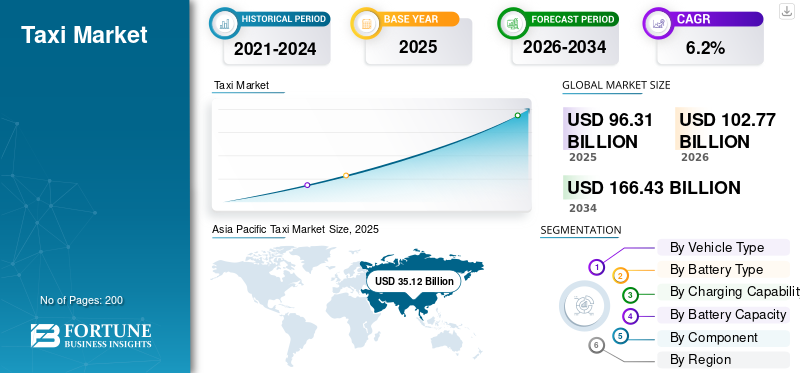
Download Free sample to learn more about this report.
Taxi Market Key Takeaways
 Market Size & Forecast
- 2025 Market Size: USD 96.31 Billion
- 2026 Market Size: USD 102.77 Billion
- 2034 Forecast Market Size: USD 166.43 Billion
- CAGR: 6.2% from 2026–2034
 Market Share
- Asia Pacific dominated the taxi market with a 36.47% share in 2025.
- The SUVs segment is expected to register steady growth during the forecast period.
- The electric segment is projected to grow at the highest CAGR of 16.2% during the forecast period.
 Key Regional Highlights
Asia Pacific
Asia Pacific generated USD 35.12 billion in 2025.
North America
North America is projected to reach USD 13.34 billion in 2026, growing at a 5.7% CAGR.
Europe
Europe is projected to reach USD 24.37 billion in 2026.
U.S.
The taxi market generated USD 5.38 billion in 2025.
Japan
Growing urban mobility demand and increasing adoption of digital taxi booking platforms continue to support taxi market growth.
Read More

TAXI MARKET TRENDS
Integration of Ride-Hailing Platforms with Traditional Taxi Services Accelerates Market Growth
The integration of traditional taxi services with ride hailing apps is a key trend shaping the market. Hybrid models combining street hailing and digital bookings are improving service efficiency and expanding customer reach. This convergence enhances market share for operators adapting to digital ecosystems.
- For instance, in September 2024, several European taxi operators partnered with mobility apps to integrate booking systems, improving accessibility and operational efficiency.
Download Free sample to learn more about this report.
MARKET DRIVERS
Rising Urbanization and Demand for On-Demand Mobility Boosts Market Growth
Rapid urbanization and increasing demand for flexible transportation are driving the taxi market growth. Consumers prefer app based bookings and instant ride access offered by ride hailing platforms, improving convenience and reducing wait times. These factors significantly expand the customer base and enhance utilization rates for taxi operators, thereby increasing revenue potential and strengthening overall market growth.
- For instance, in March 2024, the World Bank highlighted rising urban population trends increasing demand for on-demand mobility services, supporting growth in ride hailing services globally.
MARKET RESTRAINTS
High Operating Costs and Regulatory Pressures Limits Market Expansion
Increasing fuel prices, vehicle maintenance, and labor expenses are raising operating costs for taxi operators, limiting profitability. Additionally, strict regulatory frameworks in several countries impose licensing and compliance requirements, slowing market expansion. These factors create barriers for new entrants and reduce margins for existing players in the taxi industry.
- For instance, in January 2024, Transport for London tightened licensing rules for private hire vehicles, increasing compliance costs for operators and impacting profitability.
MARKET OPPORTUNITIES
Electrification of Taxi Fleets Creates Long-Term Market Growth Opportunities
The transition toward electric vehicle adoption presents a major opportunity for the market. Lower fuel costs and government incentives help reduce operating costs, encouraging fleet electrification. This shift supports sustainability goals and enhances long-term profitability for taxi operators, particularly in urban markets.
- For instance, in September 2024, New York City announced plans to electrify its taxi fleet, promoting EV adoption among drivers and reducing emissions.
MARKET CHALLENGES
Intense Competition from Ride-Sharing Platforms Challenges Traditional Operators
The rise of ride sharing and digital mobility platforms poses a major challenge to traditional taxi operators. Competitive pricing, convenience, and advanced technology offered by ride hailing platforms reduce demand for conventional services. This forces operators to invest heavily in upgrades, increasing financial pressure.
- For instance, in February 2026, multiple taxi unions protested against ride-hailing dominance, citing declining revenues due to platform-based competition.
Segmentation Analysis
By Vehicle Type
Sedans Segment Dominate Due to Optimal Cost-Comfort Balance
On the basis of vehicle type, the market is segmented into hatchbacks, sedans, SUVs and others.
Sedans dominate the market due to their balance of comfort, fuel efficiency, and passenger capacity. They provide better ride quality than hatchbacks and lower operating costs compared to SUVs, making them ideal for daily commuting and ride hailing services. Their versatility supports both premium and standard segments, strengthening their market share.
- For instance, in June 2025, Toyota updated the JPN Taxi, adding safety and usability improvements to Japan’s purpose-built taxi model, reinforcing the continued relevance of sedan-like taxi architecture in professional fleets.
SUVs segment is expected to grow at a CAGR of 7.0% over the forecast period.
To know how our report can help streamline your business, Speak to Analyst
By Propulsion Type
ICE Vehicles Segment Dominate Due to Established Fuel Infrastructure
On the basis of propulsion type, the market is segmented into ICE, electric and hybrid.
ICE vehicles dominate due to widespread fuel infrastructure and lower upfront costs compared to electric vehicle alternatives. Many taxi operators prefer ICE vehicles for reliability and ease of maintenance, especially in developing regions. This ensures continued dominance despite growing electrification trends.
- For instance, in 2024, England’s taxi and private hire vehicle statistics continued tracking fuel type across taxis and PHVs, showing that the market is transitioning, but conventional powertrains still form the backbone of active fleets.
Electric segment is expected to grow at a CAGR of 16.2% over the forecast period.
By Ownership Model
Individual Owner-Operators Segment Leads Due to Low Entry Barriers
On the basis of ownership model, the market is segmented into individual owner-operators and fleet-owned taxis.
Individual owner-operators held the largest taxi market share due to lower capital requirements and flexible working models. Many drivers prefer independent operations or platform-based work through ride hailing apps, enabling higher income flexibility. This model supports widespread adoption across developing and developed regions.
- For instance, in January 2024, Uber publicly responded to the U.S. Department of Labor’s worker-classification rule, underscoring how central independent-driver participation remains to platform-based taxi and ride-hailing activity.
Fleet-owned taxis segment is expected to grow at a CAGR of 8.7% over the forecast period.
Taxi Market Regional Outlook
By geography, the market is categorized into North America, Europe, Asia Pacific, Latin America and Middle East & Africa.
Asia Pacific
Asia Pacific Taxi Market Size, 2025 (USD Billion)
To get more information on the regional analysis of this market, Download Free sample
Asia Pacific held the dominant share in 2025, valuing at USD 35.12 billion, and also maintained the leading share in 2024, with USD 32.83 billion. The region dominates the global market due to large urban populations, increasing smartphone penetration, and rapid adoption of ride hailing platforms. Countries including China and India drive demand through high usage of app based bookings and expanding urban mobility needs. Strong government support for electric vehicle adoption also contributes to growth. The region’s diverse taxi industry structure, including both traditional taxi services and digital platforms, ensures sustained dominance.
- For instance, in June 2025, China’s Ministry of Transport published its 2024 transport statistical bulletin, continuing to track city passenger transport including cruising taxis and online ride-hailing, underlining the sheer scale of the Chinese urban taxi ecosystem.
China Taxi Market
China’s market is projected to be one of the largest globally, and its 2025 revenue reached at USD 11.69 billion, representing roughly 12.1% of the market.
India Taxi Market
India market in 2025 was at USD 5.78 billion, accounting for roughly 6.0% of global revenues.
Europe
Europe is estimated to reach USD 24.37 billion in 2026 and secure the position of the second-largest region in the market. Europe’s market growth is supported by strict regulatory frameworks and sustainability initiatives promoting electric vehicle adoption. Integration of ride hailing services with traditional fleets enhances efficiency and service reach.
Germany Taxi Market
Germany market in 2025 was at USD 2.03 billion, accounting for roughly 2.1% of the global revenues.
U.K. Taxi Market
U.K. market in 2025 reached at USD 8.01 billion, accounting for roughly 8.3% of global sales.
North America
North America is projected to record a growth rate of 5.7% in the coming years, and reach a valuation of USD 13.34 billion by 2026. North America’s market growth is driven by widespread adoption of ride hailing apps and advanced technological advancements. The U.S. leads the region, with strong presence of Uber Technologies and other platforms. Increasing EV adoption and premium services further support growth.
U.S. Taxi Market
Based on North America’s strong contribution, the U.S. market reached at USD 5.38 billion in 2025, representing roughly 5.6% of market.
Latin America
Latin America’s growth is fueled by rising urbanization and demand for affordable public transport alternatives. Expansion of ride hailing platforms and increasing smartphone usage are key growth drivers of the regional market.
Middle East & Africa
Middle East & Africa market growth is driven by fleet expansion and rising demand for premium mobility services. Increasing adoption of ride sharing and digital platforms is enhancing service accessibility across the region.
COMPETITIVE LANDSCAPE
Key Industry Players
Strategic Platform Expansion and Fleet Modernization Drives Market Competition
The competitive landscape of the market is characterized by intense competition between traditional taxi operators and technology-driven ride hailing platforms. Companies are increasingly focusing on digital transformation, fleet electrification, and expansion of app based bookings to gain a competitive edge. The rise of ride hailing apps has significantly reshaped the taxi industry, forcing traditional players to adopt similar technologies.
Major players such as Uber Technologies, Lyft, and regional platforms are investing heavily in AI-driven dispatch systems, dynamic pricing models, and customer engagement tools. At the same time, traditional operators are forming alliances and upgrading fleets to remain relevant. Regulatory compliance also plays a key role, as companies must align with evolving regulatory frameworks across different regions.
Fleet modernization, including the adoption of electric vehicle fleets, is another critical strategy adopted by key players. Companies are also diversifying services, integrating ride sharing options, and enhancing driver incentives to improve retention. Partnerships with automotive OEMs and financial institutions are enabling easier fleet expansion and lower operating costs.
LIST OF KEY TAXI COMPANIES PROFILED
- Uber Technologies Inc. (U.S.)
- Lyft Inc. (U.S.)
- DiDi Global Inc. (China)
- Grab Holdings Ltd. (Singapore)
- Bolt Technology OÜ (Estonia)
- Ola Cabs (India)
- Free Now (Germany)
- Gett Inc. (U.K.)
- Careem (UAE)
- Yandex Taxi (Russia)
- Cabify (Spain)
- Curb Mobility (U.S.)
- Addison Lee (U.K.)
- Gojek (Indonesia)
- Maxim (Russia)
KEY INDUSTRY DEVELOPMENTS
- April 2026: Uber published its latest electrification update, highlighting continued progress on zero-emission and hybrid use across trips in major markets.
- March 2026: Grab and WeRide officially launched Singapore’s first autonomous public ride service in Punggol, marking a major step toward autonomous taxi deployment in urban mobility.
- January 2026: Grab partnered with GAC to accelerate EV adoption across Southeast Asia’s ride-hailing and taxi fleets. The collaboration focuses on improving driver access to electric vehicles and infrastructure, supporting Grab’s broader electrification strategy across multiple SEA markets, where demand for sustainable mobility solutions is rapidly increasing.
- November 2025: Lyft partnered with Curb to integrate licensed taxis into its platform, expanding ride availability across U.S. cities. The move enables thousands of taxi drivers to access Lyft’s rider base, improving trip efficiency while strengthening Lyft’s supply network through large-scale driver onboarding and platform integration.
- June 2025: Toyota partially upgraded the JPN Taxi, adding features such as a blind-spot monitor and enhanced pre-crash safety functions for professional taxi use.
- April 2025: Volvo Trucks announced it had delivered more than 5,000 battery-electric trucks across 50 countries. The milestone showed that heavy-duty electric truck adoption is moving beyond pilot stage and into broader commercial deployment across regions and use cases.
- March 2025: Uber and bp pulse expanded charging support for drivers, with London already seeing more than 15% of Uber miles driven fully electric.
REPORT COVERAGE
The taxi market analysis provides an in-depth study of market size & forecast by all the market segments included in the report. It includes details on the market dynamics and market trends expected to drive the market in the forecast period. It offers information on the technological advancements, new product launches, key industry developments, and details on partnerships, mergers & acquisitions. The research report also encompasses detailed competitive landscape with information on the market share and profiles of key operating players.
Request for Customization to gain extensive market insights.
Report Scope & Segmentation
| ATTRIBUTE | DETAILS |
| Study Period | 2021-2034 |
| Base Year | 2025 |
| Estimated Year | 2026 |
| Forecast Period | 2026-2034 |
| Historical Period | 2021-2024 |
| Growth Rate | CAGR of 6.2% from 2026-2034 |
| Unit | Value (USD Billion) |
| Segmentation | By Vehicle Type, Propulsion Type, Ownership Model and Region |
| By Vehicle Type |
|
| By Propulsion Type |
|
| By Ownership Model |
|
| By Geography |
|
Frequently Asked Questions
Fortune Business Insights says that the global market value stood at USD 96.31 billion in 2025 and is projected to reach USD 166.43 billion by 2034.
In 2025, Asia Pacific’s market value stood at USD 35.12 billion.
The market is expected to exhibit a CAGR of 6.2% during the forecast period.
Sedans segment led the market by vehicle type.
Rising urbanization and demand for on-demand mobility is driving the global market.
Uber Technologies Inc., Lyft Inc., DiDi Global Inc. and Grab Holdings Ltd. are some of the top players in the market.
Asia Pacific dominated the market in 2025.



- 2021-2034
- 2025
- 2021-2024
- 200
-
(Offer valid till 15th Oct 2026)
Get 30-60 hrs Free Customization
Expand Regional and Country Coverage, Segments Analysis, Company Profiles, Competitive Benchmarking, and End-user Insights.




















Related Reports
-
US +1 833 909 2966 ( Toll Free )
-
Get In Touch With Us