Tobacco Products Market Size, Share & Industry Analysis, By Product Type (Traditional Tobacco Products [Cigarettes, Cigars, Pipe Tobacco, Roll your own (RYO) Tobacco, and Others] and Next Generation Products [E-Cigarettes, Heated Tobacco Products, Nicotine Pouches, Snus, and Others]), and Regional Forecast, 2026-2034
 Download Free Sample
(Offer valid till 15th Oct 2026)

KEY MARKET INSIGHTS
 Listen to Audio Version
The global tobacco products market size was valued at USD 1,058.20 billion in 2025 and is projected to grow from USD 1,096.82 billion in 2026 to USD 1,284.78 billion by 2034, exhibiting a compound annual growth rate (CAGR) of 2% during the forecast period. Asia Pacific dominated the tobacco products market with a market share of 49.11% in 2025.
People consume tobacco for stress relief and instant relaxation. Such products vary in contents, forms, and method of intake, including cigarettes, cigars, and smokeless options. The increasing awareness of the benefits associated with less addictive and reduced-risk products (RRP) containing a relatively lower percentage of nicotine and a higher percentage of added flavoring and additive ingredients is driving the global market growth. In addition, shifting consumers' preferences from low-cost chewing tobacco items to premium-based flavored ones boosted the product demand worldwide.
The global market is characterized by leading players, including Philip Morris Products S.A., British American Tobacco plc., Japan Tobacco Inc., Imperial Brands plc., and ITC Limited. These players significantly focus on investing in R&D activities to introduce newer innovative products in the market. For instance, in March 2024, British American Tobacco p.l.c. opened its innovation facility at its R&D headquarters in Southampton, U.K. The new USD 30 million (approx.) facility helps the company strengthen its reduced-risk products portfolio.
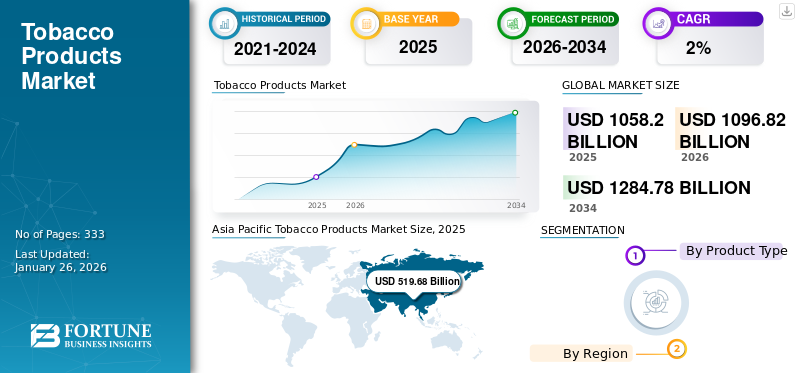
Download Free sample to learn more about this report.
Tobacco Products Market KEY TAKEAWAYS
 Global Market Size & Forecast
- 2025 Market Size: USD 1,058.20 billion
- 2026 Market Size: USD 1,096.82 billion
- 2034 Forecast Market Size: USD 1,284.78 billion
- CAGR: 2% from 2026–2034
 Market Share
- Asia Pacific dominated the tobacco products market with a 49.11% share in 2025.
- The traditional tobacco products segment accounted for the largest market share of 92.14% in 2026.
- The cigars sub-segment is projected to grow at a CAGR of 1.75% during 2026–2034.
 Key Regional Highlights
Asia Pacific
Asia Pacific reached USD 519.68 billion in 2025, driven by high cigarette consumption and growing demand for flavored nicotine products.
North America
North America reached USD 200.65 billion in 2025, supported by rising adoption of e-cigarettes and reduced-risk tobacco products.
Europe
Europe reached USD 250.08 billion in 2025, driven by increasing demand for alternative tobacco products and strong brand promotion.
U.S.
The U.S. market is projected to reach USD 180.53 billion by 2026, fueled by growing adoption of e-cigarettes and heated tobacco products.
Japan
Japan is projected to reach USD 35.76 billion by 2026, supported by steady demand for traditional and next-generation tobacco products.
Read More

Tobacco Products Market Trends
Emerging Demand for Next-generation Products (NGPs) to Aid Market Development
Increased investments in research and development by tobacco companies have led to the introduction of innovative products that cater to changing consumer preferences. For instance, advancements in vapor technology and flavor options make NGPs more attractive, particularly to younger demographics who are more likely to experiment with these alternatives. Additionally, as consumers become more educated about the risks associated with smoking, there is a notable shift in perception toward NGPs, further fueling its market growth.
- For instance, in November 2022, Philip Morris International (PMI) launched a new product called BONDS by IQOS, a heat-not-burn tobacco device aimed at accelerating the transition toward smoke-free alternatives. This launch aligns with PMI's broader strategy to replace traditional cigarettes with innovative, science-based products.
- Asia Pacific witnessed tobacco products market growth from USD 519.68 billion in 2025 to USD 541.25 billion in 2026.
Download Free sample to learn more about this report.
MARKET DYNAMICS
Market Drivers
Rising Number of Disposable Income Among Women to Drive Product Sales
Recent studies by Cancer Research U.K. (CRUK), published in April 2024, indicate an increase in smoking rates among younger women, particularly those from more advantaged social groups. In the U.K., for instance, the proportion of women aged 18 to 45 who smoke rose from 12% to 15% between 2013 and 2023, with a notable shift toward hand-rolled cigarettes. This demographic shift suggests that as more women begin or continue smoking into adulthood, the overall market expands.
Moreover, increased disposable income among women and changing social norms have contributed to the rising prevalence of smoking within the female population. As women gain greater financial independence and autonomy, they are increasingly engaging in behaviors traditionally associated with male smokers. Economic transitions and globalization have further weakened cultural constraints on female smoking, leading to increased market growth opportunities.
Increasing Usage of Nicotine Products to Spur Market Expansion
Youngsters are exposed to marketing for nicotine products through various channels, including social media and retail environments. This exposure contributes to increased interest and usage of various types of nicotine products among youth, further intensifying global tobacco products market growth. According to the U.S. Department of Health and Human Services, the nicotine product usage rate among 12th-grade American youngsters reached almost 24.8% in 2022.
Market Restraints
Bans on E-cigarette Sales in Several Countries to Hinder Market Growth
Regulatory authorities in various countries have imposed a ban on the sales and imports of nicotine items to reduce tobacco consumption. The prohibition of e-cigarette sales in several countries, including Brazil, Argentina, Thailand, Bhutan, India, Egypt, Iran, Iraq, Jordan, and many others, has posed significant challenges to market growth. E-cigarettes have attracted a different demographic, particularly younger users who might not have otherwise engaged with tobacco items. These bans limit the potential for the tobacco industry to access this emerging customer base, leading to a less diverse and more constrained market.
Market Opportunities
Growing Popularity of Flavored Nicotine Products to Fuel Market Growth
The introduction of a wide range of flavors and customizable devices has enhanced the appeal of tobacco consumables. This variety attracts new users and encourages existing smokers to switch from traditional cigarettes to innovative alternatives. The demand for flavored products is particularly strong among younger consumers, which further boosts market growth.
Product innovation allows companies to penetrate emerging markets where the demand for alternative nicotine delivery systems is rising. As social norms shift toward acceptance of vaping and HTPs, companies can capitalize on new revenue streams in these regions.
- For instance, in July 2023, Japan Tobacco Inc. (JT) launched a new infused tobacco vapor device called “with 2” under its new brand, ‘with.’ The “with 2” device utilizes JT’s unique infused technology, generating vapor as an atomized liquid passes through a capsule containing granulated tobacco. This design allows for immediate vapor production upon inhalation, eliminating the need for waiting.
Market Challenges
Rising Health Concerns to Challenge Market Growth
The increasing prevalence of tobacco consumption and rising health concerns over the excessive use of nicotine-based products are expected to pose challenges to key players in their global business expansion efforts. In addition, regulatory pressures, including advertising restrictions, higher excise taxes, and stringent policies related to the sales and imports of tobacco consumables, are creating substantial barriers to market growth across many countries.
Impact of COVID-19
Increased awareness of the health complications associated with excessive consumption of tobacco items, including weakened immunity and increased vulnerability to infections such as COVID-19, led to a decline in tobacco product usage across many countries. Tobacco items were considered as non-essential goods by the governments in many countries. Limited consumers' accessibility to non-essential goods negatively impacted the consumption of such products during the pandemic.
SEGMENTATION ANALYSIS
By Product Type
To know how our report can help streamline your business, Speak to Analyst
Higher Smokers’ Consumption of Cigarettes Result in Traditional Products Segment to Lead Market
By product type, the global tobacco products market is segmented into traditional tobacco products and next generation products.
The traditional tobacco products segment is expected to lead the market, contributing 92.14% globally in 2026, due to the higher consumption of traditional cigarettes and cigar products across many countries. The higher consumption of such products is attributed to various factors, including nicotine addiction, widespread advertising, ease of access, and ingrained social norms associated with cigarette smoking. In addition, consistent smokers’ purchases of cigars and cigarettes to get instant stress relief after product usage uplifts segmental revenue growth.
The traditional segment covers the analysis of various products, including cigarettes, cigars, pipe tobacco, roll-your-own (RYO) tobacco, and others. Within the traditional tobacco products segment, cigarettes are projected to grow at the fastest rate during the forecast period of 2026-2034. The cigarette segment is forecasted to exhibit the highest market share of 85.39% in 2025, followed by cigars and roll-your-own products (RYO). Increasing consumers' accessibility to premium-based cigarettes with organic flavors & natural ingredients and addiction-free tobacco labeling support the demand for cigarettes globally.
Cigars sub-segment is slated to grow at a CAGR of 1.75% during 2026-2034. Cigars of unique aroma flavors of mint, menthol, and chocolate are increasingly popular among youngsters across many countries. Advancements in the development of tobacco pipes of sustainable wooden materials and premium-based accessories coupled with rising consumer demand for high-quality handcrafted tobacco pipes of exceptional designs drive pipe tobacco segmental revenue growth globally. Roll-your-own products are available at affordable prices compared to traditional cigarettes and pipe tobacco items. Rising demand for affordable, handmade Roll-your-own (RYO) products for middle-income and lower-income consumers supports the segmental growth.
Others segment covering the analysis of various products, including raw tobacco leaves and chewing leaf tobacco items of plug or twist forms, is slated to grow at the third fastest growing during 2025-2032. The increasing number of betel leaf stores offering premium-based twisted raw tobacco leaves with added flavors of aromatic spices, herbs, menthol, saffron, silver flakes, and sandalwood oils support the product demand globally.
The next generation products segment is slated to grow at the fastest rate during 2026-2034. Next generation products segment is further sub-segmented into e-cigarettes, heated tobacco products, nicotine pouches, snus, and others. Next-generation products are the reduced-risk tobacco items that lower the potential risks of addiction to traditional tobacco items by eliminating burning & hazardous chemicals exposure, enabling safer and tobacco consumption. The rising number of smokers preferring harmless next-generation tobacco consumables to quit smoking addiction drives the next-generation product segmental growth. In addition, increasing consumers' accessibility to the e-liquids and vapes of innovative flavored ingredients skyrocketed segmental revenue growth worldwide.
The e-cigarettes segment exhibited a second-leading global market share under the next-generation products segment in 2024. The e-cigarettes segment is slated to grow at the third fastest-growing rate during 2026-2034. The increasing number of e-cigarette users preferring innovative e-vapes of celebrity-endorsed brands mainly accelerates e-cigarette segmental revenue growth.
The heated tobacco products segment exhibited a major market share in 2024 and is slated to grow at the fastest rate during the forecast period of 2026-2034. Increasing acceptance of heated tobacco sticks and devices as an alternative to traditional cigarette smoking options mainly drives segmental revenue growth across many countries.
The nicotine pouches segment exhibited a third-leading market share and is slated to grow at the second fastest-growing rate during the forecast period of 2026-2034. Consistent brands’ promotional efforts of the nicotine pouches on social media sites and applications, including TikTok and Facebook, increase the product demand, driving the nicotine pouches segmental growth.
- For instance, Philip Morris’s ZYN brand launched a TikTok social media campaign to promote its nicotine pouches, achieving a 700 million follower base on a similar platform.
The snus segment is slated to grow at a steady rate during 2026-2034. Increasing consumer demand for the snus of different flavors, including ice, menthol, fruit, mojito, jalapeño lime, vanilla or coffee, etc., supports product sales across many countries.
Others segment covers the tobacco products market analysis of various products, including herbal cigarettes, orbs, sticks, strips, hookahs, dokha, and other forms of dissolvable. Increasing consumers’ accessibility to the diverse range of tobacco items and manufacturers’ production of diverse tobacco product ranges drive others segmental growth.
Tobacco Products Market Regional Outlook
Geographically, the global market is segmented into North America, Europe, Asia Pacific, South America, and Middle East & Africa.
Asia Pacific
Asia Pacific Tobacco Products Market Size, 2025 (USD Billion)
To get more information on the regional analysis of this market, Download Free sample
Asia Pacific recorded a market size of USD 519.68 billion in 2025, capturing 49.11% of the global market share, and is projected to reach USD 541.25 billion in 2026.
The prevalence of cigarette consumption and growing awareness regarding the availability of nicotine items of different flavors, including mint, chocolate, cinnamon, and menthol, increased market sizes across China, India, and Southeast Asia. In addition, the rising number of betel leaf shops and convenience stores offering premium-based nicotine items supports market growth across these countries. The increasing popularity of slim-sized flavored e-cigarettes among consumers accelerates product sales in China and Southeast Asia. The market in China is estimated to be USD 280.33 billion in 2026. The Japan market is projected to reach USD 35.76 billion by 2026.
The India’s market size is foreseen to be valued at USD 95.03 billion in 2026 and France’s likely to be USD 34.85 billion in 2025.
- According to the Global Action to End Smoking Organization, as of 2022, almost 291.0 million people (11.6 million females and 279.2 million males) are smokers in China.
To know how our report can help streamline your business, Speak to Analyst
North America
In 2025, North America generated USD 200.65 billion, contributing 18.96% to global market revenue, and is projected to grow to USD 207.76 billion in 2026. In North America, the rising adoption of reduced-risk tobacco items, including e-cigarettes and heated tobacco products, among youngsters in the U.S. and Canada accelerates market growth. In addition, the growing number of women consuming cigars and pipe products in Mexico and the U.S. supports the future development of the region’s market. The U.S. market is likely to hit USD 180.53 billion in 2026.
- According to the American Lung Association (ALA), the percentage of American women aged 26 years and above consuming cigars increased from 1.0% of the total population in 2002 to 1.6% in 2022. In addition, more than 825,000 American children started using e-cigarettes in 2022.
- In 2022, the most common type of e-cigarettes consumed in America is disposable type (54%), followed by pre-filled or cartridges or refillable pods (25%).
Europe
The Europe market accounted for USD 250.08 billion in 2025, representing 23.63% of the global industry, and is expected to reach USD 257.28 billion in 2026. Evolving consumer preferences for alternatives to traditional cigarettes, including e-cigarettes, cigars, and roll-your-own (RYO) products available in different flavors and fragrances, are accelerating increased product demand across many countries in Europe. In addition, consistent advertising and promotional efforts by manufacturers of smoke-free nicotine products are strengthening brand visibility and supporting product sales growth throughout the region. The market in U.K. is estimated to be USD 46.67 billion in 2026.
The Germany’s market size is foreseen to be valued at USD 33.79 billion in 2026 and France’s likely to be USD 59.40 billion in 2025.
- For instance, in October 2023, TACJA, a global smokeless tobacco products brand, launched innovative nicotine pouches in the U.K., Sweden, and Switzerland markets. The brand promotes its pouches as offering a lasting flavor experience of up to 30 minutes per use, appealing to consumers seeking convenient and flavorful alternatives.
South America and Middle East & Africa
The Middle East & Africa market generated USD 57.73 billion in 2025, representing 5.46% of the global market landscape, and is expected to reach USD 59.83 billion in 2026. The market in South America reached USD 30.05 billion in 2025, representing 2.84% of total market revenue, and is projected to reach USD 30.71 billion in 2026. South America region is to be anticipated the fourth-largest market with USD 200.65 billion in 2025. In Brazil and Argentina, increasing taxes on nicotine products, plain packaging, product advertisement bans, and adherence to maintaining a smoke-free environment significantly regulate the usage of smoked items and promote the usage of smoke-free products for consumers who need to quit smoking. The growing trend for quitting cigarette smoking habits by consuming heat-burn nicotine items, including nicotine pouches, loose leaves, and others, drives market growth in South America.
Considerable smoking prevalence and strong consumer demand for cigarettes in Turkey, Egypt, Saudi Arabia, and South Africa have contributed significantly to product revenue generation in these countries. However, increasing awareness regarding the availability of alternatives to smoking products, including flavored dokhas, water pipes, and herbs or spice-based powered items, is accelerating market diversification and growth across the Middle Eastern region. The UAE market is anticipated to hold USD 1.40 billion in 2025.
- According to the World Health Organization (WHO), the smoking rate in the Middle East is expected to reduce from 33.3% in 2020 to 31.0% by 2025. However, the consumption of next-generation items, including e-cigarettes, heated-tobacco products (HTPs), and nicotine pouches, is expected to increase in recent years.
COMPETITIVE LANDSCAPE
Key Industry Players
Key Players Focus on Introducing Flavored Products to Strengthen Their Market Positions
Philip Morris International Inc., British American Tobacco plc, Altria Group, Inc., and other players are focused on launching innovative taste and flavor-based reduced-risk items to build their presence in the international markets. These ongoing efforts are aimed at strengthening their competitive positioning. For instance, in March 2023, Altria Group, Inc. introduced two new nicotine items: On Plus and Swic. Swic’s tobacco products include tobacco-filled capsules, which are heated to a certain temperature to cater to individuals preferring heated nicotine items. On Plus is a tobacco-based nicotine pouch and an extension of the company’s modern oral nicotine collection.
Major Players in the Tobacco Products Market
To know how our report can help streamline your business, Speak to Analyst
Philip Morris International Inc., British American Tobacco plc, and Altria Group, Inc. are a few of the leading players in the global market. The global market is extremely fragmented, with the top 5 players accounting for 13.60% of the global market share in 2024.
List of Key Tobacco Product Companies Profiled
- Philip Morris Products S.A. (U.S.)
- Altria Group, Inc. (U.S.)
- British American Tobacco plc. (U.K.)
- Japan Tobacco Inc. (Japan)
- Imperial Brands plc. (U.K.)
- ITC Limited (India)
- PT Hanjaya Mandala Sampoerna Tbk (Indonesia)
- PT Perusahaan Rokok Tjap Gudang Garam Tbk (Indonesia)
- KT&G Corporation (South Korea)
- China National Tobacco Corporation (China)
KEY INDUSTRY DEVELOPMENTS
- December 2024- Philip Morris International (PMI) announced the development of affordable next-generation products (NGPs) aimed at the African market. This initiative is driven by the recognition that the smoke-free market in Africa is still in its early stages, and there is a significant demand for cost-effective alternatives among price-sensitive consumers.
- September 2024- British American Tobacco (BAT) launched a significant global initiative aimed at creating a "Smokeless World." This initiative, unveiled during the company's first Transformation Forum in London, features the Omni™ platform, which serves as an evidence-based resource to facilitate discussions around Tobacco Harm Reduction (THR).
- November 2024- Imperial Brands launched a new cigarette brand called Paramount, specifically designed for adult smokers seeking exceptional value without compromising quality. The cigarettes feature premium, full-flavor Virginia sun-ripened tobacco, aligning with consumer preferences, as over 90% of cigarettes sold in the U.K. are Virginia blends, and 83% are full-flavor.
- August 2024- VFLY, a new e-cigarette brand from Sikary, partnered with Somone (VFLY Korea) to launch an innovative product called the VFLY C1 in South Korea. The VFLY C1 is designed to enhance user satisfaction and convenience. It features three adjustable modes—ULTRA, RICH, and TASTY, allowing users to customize their vaping experience.
- July 2024- Philip Morris International (PMI) announced a collaboration with KT&G, a leading South Korean tobacco and nicotine product manufacturer, to work on U.S. regulatory submissions for KT&G's new heat-not-burn products. This partnership follows a prior agreement that grants PMI exclusive rights to commercialize KT&G's smoke-free products outside South Korea. The companies signed a memorandum of understanding to facilitate their joint efforts in preparing Pre-Market Tobacco Product Applications (PMTAs) for KT&G's selected heat-not-burn products, which will be submitted to the U.S. Food and Drug Administration (FDA).
INVESTMENT ANALYSIS AND OPPORTUNITIES
Key market players significantly focus on investing in the R&D activities of reduced-risk nicotine items to cater to the changing consumer preferences about the products. For instance, from 2023 to 2025, Japan Tobacco Inc. planned to invest USD 2.0 billion (Yen 300 Billion) to produce next-generation RRP products. Furthermore, these companies invest in building production capacities to increase their product supply rate across the global markets. For instance, in September 2024, Philip Morris International (PMI) invested USD 800 million to install a new production factory of Zyn nicotine pouch factory in Aurora, Colorado, U.S.
REPORT COVERAGE
The market report analysis includes in-depth market-related information, highlighting crucial aspects such as prominent companies and product types. In addition, the global report on the tobacco products market provides competitive analysis and strategic recommendation-related information to support informed decision-making. Besides this, the market research report delivers insights into market trends for smoking items and highlights significant product developments in the industry.
Request for Customization to gain extensive market insights.
Report Scope & Segmentation
|
ATTRIBUTE |
DETAILS |
|
Study Period |
2021-2034 |
|
Base Year |
2025 |
|
Estimated Year |
2026 |
|
Forecast Period |
2026-2034 |
|
Historical Period |
2021-2024 |
|
Growth Rate |
CAGR of 2% from 2026 to 2034 |
|
Unit |
Value (USD billion) |
|
Segmentation |
By Product Type
|
|
By Region
|
Frequently Asked Questions
Fortune Business Insights says the worldwide market was USD 1,058.20 billion in 2025 and is anticipated to reach USD 1,284.78 billion by 2034.
In 2025, the market value stood at USD 1,058.20 billion.
The global market is forecasted to grow at a CAGR of 2% during 2026-2034.
By product type, the traditional products segment dominated the market in 2025.
The rising number of disposable income among women is a crucial factor driving global market growth.
Philip Morris International Inc., British American Tobacco plc, and Altria Group, Inc. are the leading companies operating in the global market.
Asia Pacific dominated the global market in 2025.
The growing popularity of flavored nicotine items will create newer market growth opportunities.



- 2021-2034
- 2025
- 2021-2024
- 333
-
(Offer valid till 15th Oct 2026)
Get 30-60 hrs Free Customization
Expand Regional and Country Coverage, Segments Analysis, Company Profiles, Competitive Benchmarking, and End-user Insights.



















-
US +1 833 909 2966 ( Toll Free )
-
Get In Touch With Us