Tofu Market Size, Share & Industry Analysis, By Type (Fresh and Processed), By Flavor (Flavored and Non-Flavored), By Nature (Organic and Conventional), By Distribution Channel (Supermarkets/Hypermarkets, Convenience Stores, Specialty Stores, Online Retail Stores, and Others), By Product Type (Silken Tofu, Firm Tofu, Super Firm Tofu, and Others), and Regional Forecast, 2026-2034
 Download Free Sample
(Offer valid till 15th Oct 2026)

Tofu Market Overview
 Listen to Audio Version
The global tofu market size was valued at USD 6,929.17 million in 2025. The market is projected to grow from USD 7,317.90 million in 2026 to USD 13,810.81 million by 2034, exhibiting a CAGR of 8.26% during the forecast period. Asia Pacific dominated the tofu market with a market share of 84.26% in 2025.
Tofu, a soy-based protein product, has emerged as a cornerstone of plant-based nutrition owing to its health benefits, such as high protein content, a shift toward plant-based diets, affordability, and versatility across cuisines. Increasing consumer shift toward vegetarian, vegan, and flexitarian diets has significantly contributed to its mainstream adoption. Additionally, tofu is widely utilized across retail, foodservice, online platforms, and industrial applications, including ready meals, meat analogues, and functional foods.
Market expansion is being driven by rising health awareness, increasing lactose intolerance prevalence, and sustainability concerns associated with animal protein production. Furthermore, innovations in flavored tofu, texture enhancement, and value-added tofu products are strengthening consumer acceptance across Western markets.
The global demand is led by key companies, including House Foods Group Inc., Pulmuone Co., Ltd., Morinaga Nutritional Foods Inc., Vitasoy International Holdings Ltd., and Hain Celestial Group Inc., with competition centered around product diversification, branding, and expansion into emerging plant-based categories.
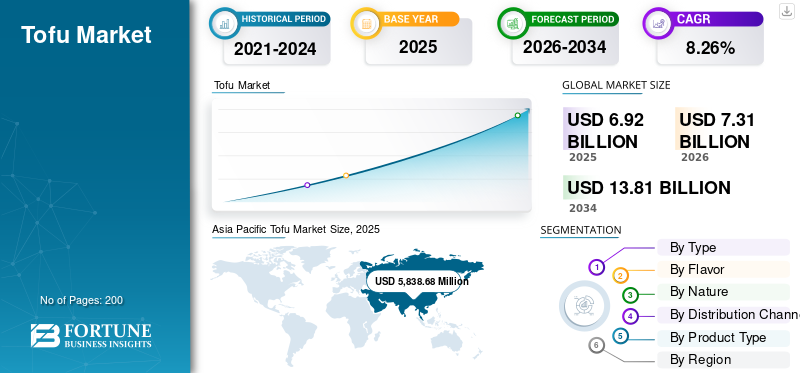
Download Free sample to learn more about this report.
Tofu Market Key Takeaways
 Global Market Size & Forecast
- 2025 Market Size: USD 6,929.17 million
- 2026 Market Size: USD 7,317.90 million
- 2034 Forecast Market Size: USD 13,810.81 million
- CAGR: 8.26% from 2026–2034
 Market Share
- Asia Pacific dominated the tofu market with an 84.26% share in 2025.
- The processed segment is expected to witness strong growth at a CAGR of 9.88% from 2026–2034.
- The flavored segment is projected to grow at a CAGR of 8.70% during the forecast period.
 Key Regional Highlights
Asia Pacific
Asia Pacific dominated the global tofu market, valued at USD 5,838.68 million in 2025, and is projected to reach USD 10,994.79 million by 2034.
North America
North America was valued at USD 210.59 million in 2025 and is projected to reach USD 584.20 million by 2034, registering a CAGR of 12.23%.
Europe
Europe was valued at USD 535.73 million in 2025 and is expected to reach USD 1,223.64 million by 2034, growing at a CAGR of 9.90%.
U.S.
U.S. The U.S. dominated the North American tofu market, valued at approximately USD 179.54 million in 2025.
Japan
Japan Japan was valued at USD 1,112.81 million in 2025, supported by high per capita tofu consumption and strong demand for premium and specialty tofu products.
Read More

Tofu Market Trends
Shift Toward Value-Added, Ready-to-Cook, and Functional Tofu is a Key Industry Trend
The market is undergoing a structural shift from traditional staple consumption toward value-added and convenience-oriented formats. Manufacturers are increasingly launching marinated, smoked, pre-seasoned, high-protein, and fortified tofu variants to cater to evolving consumer preferences, particularly in Western markets where taste and ease of preparation are critical adoption barriers. Functional tofu products enriched with calcium, probiotics, and vitamins are also gaining traction, positioning the product beyond a traditional protein source into the broader functional foods category.
Innovations in texture engineering, such as “meat-like” firm tofu and high-density tofu, are further bridging the gap between plant-based and conventional protein products.
For instance, in March 2026, Pulmuone showcased K-food staples and plant-based products at Natural Products Expo West 2026 in Anaheim, with a strong emphasis on tofu and kimchi. The company also highlighted innovations such as soy milk noodles, plant-based meat, dumplings, and fried rice.
Download Free sample to learn more about this report.
MARKET DYNAMICS
Market Drivers
Rising Adoption of Plant-Based Diets and Protein-rich Alternatives to Support Market Growth
The increasing adoption of plant-based diets is significantly influencing the global market, as consumers increasingly seek sustainable and protein-rich alternatives to animal-based products. Tofu is being widely recognized for its nutritional profile, including essential amino acids, low-fat content, and cholesterol-free properties.
Manufacturers are expanding their portfolios with flavored, ready-to-cook, and fortified tofu products to cater to evolving consumer preferences. Additionally, the product is increasingly being incorporated into Western cuisines, including burgers, snacks, and ready meals, thereby expanding its consumption base beyond traditional Asian markets.
- According to the Good Food Institute, in 2024, 59% of U.S. households purchased plant-based foods, maintaining a stable, high-penetration rate, with a 79% repeat purchase rate.
Market Restraints
Strict Labeling Requirements to Limit Market Expansion
Soy is recognized as one of the major food allergens in several regulatory frameworks, including those established by the Food and Drug Administration (FDA) and European Food Safety Authority (EFSA). This classification creates strict labeling requirements and limits consumption among sensitive populations. Additionally, misconceptions related to soy, particularly regarding phytoestrogens and hormonal effects, have led to cautious consumer behavior in certain markets.
Although scientific evidence largely supports the safety of moderate soy consumption, misinformation and lack of consumer education continue to hinder tofu market growth.
- Regulatory bodies such as the Food and Drug Administration (FDA) classify soy as a top 8 allergen, requiring mandatory labeling across packaged food products.
Market Opportunities
Technological Advancements to Unlock Several Growth Opportunities
Technological advancements in tofu processing, preservation, and packaging are creating significant growth opportunities in the market by enabling the development of shelf-stable, frozen, and export-ready tofu products, thereby expanding the market reach beyond traditional consumption regions. Historically, tofu consumption has been geographically concentrated in Asia due to its perishability and dependence on cold-chain logistics. However, innovations in aseptic packaging, ultra-high temperature (UHT) processing, vacuum sealing, and freezing technologies are transforming tofu into a globally tradable commodity.
- The World Bank estimated that cold-chain infrastructure gaps still affect over 40% of food distribution in developing regions, reinforcing the importance of ambient-stable food solutions such as shelf-stable tofu.
SEGMENTATION ANALYSIS
By Type
Fresh Segment Dominated the Market as it Remains Deeply Embedded in Traditional Dietary Patterns
Based on type, the market is segmented into fresh and processed.
The fresh segment dominated the global tofu market share, reaching USD 5,617.46 million in 2025, as it remains deeply embedded in traditional dietary patterns, particularly across the Asia Pacific. Fresh tofu is extensively consumed in countries such as China, Japan, South Korea, and Southeast Asia, where it is considered a staple protein source and is incorporated into a wide variety of everyday dishes, including soups, stir-fries, and hotpots.
The processed segment is expected to grow at a CAGR of 9.88% from 2026 to 2034, supported by increasing demand for flavored, ready-to-eat, and shelf-stable tofu products in North America and Europe.
To know how our report can help streamline your business, Speak to Analyst
By Flavor
Non-Flavored Segment Dominated the Market Due to its Widespread Consumption Across Traditional Asian Cuisines
Based on flavor, the market is divided into flavored and non-flavored.
The non-flavored segment dominated the global market, reaching USD 5,468.85 million in 2025, driven by its widespread consumption across traditional Asian cuisines where tofu is used as a staple ingredient. Its neutral taste allows it to be incorporated across a wide range of dishes, including soups, stir-fries, curries, and hotpots, making it highly versatile for both household and foodservice applications. Additionally, non-flavored tofu is preferred by consumers seeking minimally processed and clean-label food options, further supporting its dominant position.
The flavored segment is expected to grow at a CAGR of 8.70% during the forecast period, supported by increasing consumer demand for ready-to-cook and value-added food products.
Nature
Conventional Segment Dominated the Market Due to its Affordability and Large-Scale Industrial Production
Based on nature, the market is divided into conventional and organic.
The conventional segment dominated the market, reaching USD 5,971.57 million in 2025, primarily due to its affordability, widespread availability, and large-scale industrial production. Conventional tofu is produced using standard soybean cultivation methods, enabling cost efficiencies and making it accessible to a broader consumer base, particularly in price-sensitive markets across Asia and emerging economies. Its strong presence across both traditional retail and foodservice channels further reinforces its dominance.
The organic segment is projected to grow at a CAGR of 10.37% during the forecast period, driven by rising consumer preference for organic, non-GMO, and sustainably produced food products.
By Distribution Channel
Supermarkets/Hypermarkets Segment Led the Market Due to Strong Retail Penetration
Based on distribution channel, the market is divided into supermarkets/hypermarkets, convenience stores, specialty stores, online retail stores, and others.
The supermarkets/hypermarkets segment dominated the market, accounting for USD 3,025.28 million in 2025, supported by strong retail infrastructure, wide product assortment, and high consumer footfall. These stores offer a variety of tofu products, including fresh, flavored, organic, and packaged variants, enabling consumers to compare and choose products conveniently. Additionally, the availability of refrigeration facilities supports the storage and display of fresh tofu, further strengthening this segment.
The online retail stores segment is expected to grow at a CAGR of 11.83% during the study period, driven by increasing digital adoption, the convenience of home delivery, and the expansion of direct-to-consumer channels.
By Product Type
Firm Tofu Segment Dominated the Market Due to Its Balanced Texture Across Cooking Applications
Based on product type, the market is divided into silken tofu, firm tofu, super firm tofu, and others.
The firm tofu segment dominated the market, reaching USD 2,714.89 million in 2025, owing to its balanced texture and versatility across a wide range of culinary applications. Its ability to retain shape during grilling, frying, and baking makes it suitable for both traditional dishes and modern plant-based recipes. Additionally, firm tofu is widely used as a meat substitute, particularly in Western markets, further supporting its dominance.
The super firm tofu segment is projected to grow at a CAGR of 10.82% (2026–2034), driven by rising demand for plant-based proteins.
Tofu Market Regional Outlook
Regionally, the market is studied across North America, Europe, Asia Pacific, South America, and the Middle East & Africa.
North America
Asia Pacific Tofu Market Size, 2025 (USD Million)
To get more information on the regional analysis of this market, Download Free sample
North America was valued at USD 210.59 million in 2025 and is projected to reach USD 584.20 million by 2034, growing at a CAGR of 12.23%. Growth is driven by increasing adoption of vegan diets, rising health awareness, and strong expansion of plant-based product offerings.
U.S. Tofu Market
The U.S. dominates the North American market, valued at approximately USD 179.54 million in 2025, supported by growing plant-based food consumption and increasing availability of tofu-based ready meals. The market benefits from strong retail distribution and innovation in flavored and processed tofu products.
Europe
Europe was valued at USD 535.73 million in 2025 and is projected to reach USD 1,223.64 million by 2034, registering a CAGR of 9.90%. The region is driven by a rising vegan and vegetarian population, sustainability concerns, and increasing demand for alternative protein sources.
Germany Tofu Market
Germany was valued at approximately USD 94.77 million in 2025. The growth is due to strong demand for organic and plant-based foods, supported by well-developed retail networks.
U.K. Tofu Market
The U.K. market was valued at approximately USD 88.72 million in 2025, driven by increasing consumption of meat alternatives and ready-to-eat tofu products.
Asia Pacific
Asia Pacific dominated the global market, valued at USD 5,838.68 million in 2025, and is projected to reach USD 10,994.79 million by 2034, growing at a CAGR of 7.58%. The region benefits from traditional consumption patterns, high soybean availability, and established tofu production infrastructure.
China Tofu Market
China dominated the regional market, valued at approximately USD 2,306.86 million in 2025, supported by large-scale production, high domestic consumption, and strong integration of the product in daily diets.
Japan Tofu Market
Japan was valued at USD 1,112.81 million in 2025 and remains a mature market with high per capita tofu consumption and strong demand for premium and specialty tofu products.
South America and the Middle East & Africa
South America was valued at USD 226.69 million in 2025 and is projected to reach USD 595.25 million by 2034, growing at a CAGR of 11.57%. Growth is driven by increasing health awareness and expanding plant-based food adoption.
The Middle East & Africa market was valued at USD 117.48 million in 2025 and is projected to reach USD 412.94 million by 2034, expanding at a CAGR of 15.04%, the fastest globally. Growth is driven by rising urbanization, increasing health awareness, and expanding retail infrastructure.
Brazil Tofu Market
Brazil dominates the South American market, valued at approximately USD 138.78 million in 2025, supported by a growing vegan population and increasing availability of soy-based products.
COMPETITIVE LANDSCAPE
Key Industry Players
Key Players Focus on Investments to Cater to Evolving Consumer Preferences
The global tofu market is moderately fragmented, with key players focusing on expanding product portfolios, enhancing distribution networks, and developing value-added tofu products. Companies are investing in flavored tofu, ready-to-eat formats, and fortified variants to cater to evolving consumer preferences.
Key Players in the Tofu Market
|
Rank |
Company Name |
|
1 |
Hain Celestial Group Inc. |
|
2 |
Vitasoy International Holdings Ltd. |
|
3 |
Morinaga Nutritional Foods Inc. |
|
4 |
Pulmuone Co., Ltd. |
|
5 |
House Foods Group Inc. |
List of Key Tofu Companies Profiled
- House Foods Group Inc. (Japan)
- Pulmuone Co., Ltd. (South Korea)
- Morinaga Nutritional Foods Inc. (Japan)
- Vitasoy International Holdings Ltd. (Hong Kong)
- Hain Celestial Group Inc. (U.S.)
- Eden Foods Inc. (U.S.)
- Sunrise Soya Foods (Canada)
- Kikkoman Corporation (Japan)
- Invigorate Foods Pvt. Ltd. (India)
- Amy’s Kitchen Inc. (U.S.)
KEY INDUSTRY DEVELOPMENTS
- March 2026: LuxSoy recently launched Luxembourg's first fully organic tofu, produced entirely within the country. This artisanal product emphasizes sustainability through local sourcing and short transport routes. It's made from organic soybeans grown at the "An Dudel" farm in Sprinkange by farmer Luc Emering, then processed by LuxSoy in Givenich.
- September 2025: Clearspring launched a single-serve 200g pack of its award-winning Organic Japanese Silken Tofu. This silken tofu matches the quality of Clearspring's original 300g version, made in Japan with Shikoku mountain water and just three ingredients: organic soybeans, water, and nigari.
- July 2025: Hodo, the U.S. plant‑based tofu and foods brand, has launched a new line of Lightly Fried Tofu in three globally inspired flavors: Chili Crisp, Golden Turmeric, and Gochujang. The product is positioned as a ready‑to‑eat, protein‑rich option that taps into the growing demand for bold Asian‑style flavors and “GLP‑1 friendly,” nutrient‑dense foods.
- June 2025: Vivera, one of the leading plant-based brands, launched pre-frozen firm tofu to simplify preparation and capitalize on a popular TikTok trend of freezing tofu for better texture and marinade absorption. The pre-freezing process creates a firmer, spongier texture akin to feta cheese, allowing marinades to penetrate in just five minutes for quick cooking methods such as stir-frying, grilling, or air-frying.
- December 2024: The Tofoo Co launched four new tofu‑based products as part of its latest lineup, aimed at expanding its “added‑value” range and attracting new consumers to try tofu around the New Year and Veganuary 2025. The range includes a soy, ginger, and garlic Stir Fry Block, Italian-style Veggie Balls, Sweet Chili Cubes, and Tofu Dippers, aiming to make tofu more accessible.
REPORT COVERAGE
The global tofu market industry report analyzes the market in depth and highlights crucial aspects such as market trends, market dynamics, supply chains, prominent companies, investment in research and development, and end-use. Besides this, the report also provides insights into the global market analysis and highlights significant industry developments.
Request for Customization to gain extensive market insights.
Report Scope & Segmentation
| ATTRIBUTE | DETAILS |
| Study Period | 2021-2034 |
| Base Year | 2025 |
| Estimated Year | 2026 |
| Forecast Period | 2026-2034 |
| Historical Period | 2021-2024 |
| Growth Rate | CAGR of 8.26% from 2026 to 2034 |
| Unit | Value (USD Million) |
|
Segmentation |
By Type
|
|
By Flavor
|
|
|
By Nature
|
|
|
By Distribution Channel
|
|
|
By Product Type
|
|
|
By Region
|
Frequently Asked Questions
Fortune Business Insights says that the global market was valued at USD 6,929.17 million in 2025 and is anticipated to reach USD 13,810.81 million by 2034.
At a CAGR of 8.26%, the global market will exhibit steady growth over the forecast period.
By nature, the conventional segment led the market.
Asia Pacific held the largest market share in 2025.
Rising adoption of plant-based diets and protein-rich alternatives is a key factor driving the market.
House Foods Group Inc., Pulmuone Co., Ltd., Morinaga Nutritional Foods Inc., Vitasoy International Holdings Ltd., and Hain Celestial Group Inc. are the leading players in the market.
Shift toward value-added, ready-to-cook, and functional tofu is a key industry trend.



- 2021-2034
- 2025
- 2021-2024
- 200
-
(Offer valid till 15th Oct 2026)
Get 30-60 hrs Free Customization
Expand Regional and Country Coverage, Segments Analysis, Company Profiles, Competitive Benchmarking, and End-user Insights.




















Related Reports
-
US +1 833 909 2966 ( Toll Free )
-
Get In Touch With Us