Toluene Diisocyanate Market Size, Share & Industry Analysis, By Application (Flexible PU Foam, Coatings, Adhesives & Sealants, Elastomers, and Others), and Regional Forecast, 2026-2034
 Download Free Sample
TOLUENE DIISOCYANATE MARKET SIZE AND FUTURE OUTLOOK
 Listen to Audio Version
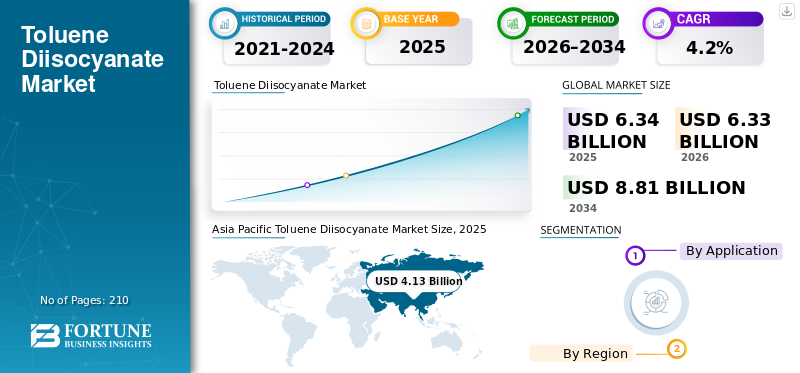
The global toluene diisocyanate market size was USD 6.34 billion in 2025. The market is projected to grow from USD 6.33 billion in 2026 to USD 8.81 billion by 2034 at a CAGR of 4.2% during the forecast period. Asia Pacific dominated the toluene diisocyanate market with a market share of 65.14% in 2025.
Toluene diisocyanate (TDI) is an aromatic diisocyanate used primarily as a key raw material in the production of polyurethane materials, particularly flexible polyurethane foams. It reacts with polyols to form lightweight, elastic, and durable polymers used across comfort and industrial applications. The major demand driver for TDI is flexible polyurethane foam, especially for furniture, bedding, and automotive seating, where TDI-based systems offer superior softness, resilience, and cost efficiency. The rising urbanization, housing demand, and growth in mattress and upholstered furniture consumption continue to support global TDI demand. Wanhua Chemical, BASF SE, Covestro, and Dow are the major players operating in the market.
Download Free sample to learn more about this report.
TOLUENE DIISOCYANATE MARKET Key Takeaways
 Market Size & Forecast
- 2025 Market Size: USD 6.34 Billion
- 2026 Market Size: USD 6.33 Billion
- 2034 Forecast Market Size: USD 8.81 Billion
- CAGR: 4.2% from 2026–2034
 Market Share
- Asia Pacific dominated the toluene diisocyanate market with a 65.14% share in 2025.
- The flexible PU foam segment accounted for the largest share by application.
- The adhesives & sealants segment is projected to grow at a 4.8% CAGR during the forecast period.
 Key Regional Highlights
Asia Pacific
Asia Pacific generated USD 4.13 billion, accounting for 65.14% of the global market in 2025.
North America
North America remained a stable regional market, supported by demand from bedding, furniture, and automotive seating applications.
Europe
Europe maintained a diversified market driven by flexible PU foam, adhesives & sealants, and coatings.
U.S.
The market reached approximately USD 0.51 billion in 2025.
Japan
The market reached approximately USD 0.33 billion in 2025.
Read More

TOLUENE DIISOCYANATE MARKET TRENDS
Flexible Foam Dominance Drives Steady but Uneven Product Demand Growth
A key trend shaping the global market is the continued dominance of flexible polyurethane foam, which accounts for the majority of product consumption worldwide. Demand is closely tied to furniture, bedding, and automotive seating markets, making TDI structurally linked to consumer spending and housing cycles. Asia Pacific, particularly China and India, is emerging as the growth engine due to rapid urbanization and expanding middle-class consumption, while Europe and Japan remain mature and slow-growing. At the same time, capacity rationalization in high-cost regions and scale-driven production in Asia Pacific are reshaping global trade flows and competitive dynamics.
Download Free sample to learn more about this report.
MARKET DYNAMICS
MARKET DRIVERS
Rising Urbanization and Comfort Demand to Drive Market Growth
The primary demand driver for TDI is the growth in flexible polyurethane foam usage driven by urban housing expansion, rising disposable incomes, and increased demand for mattresses, upholstered furniture, and automotive interiors. Consumers’ preference for comfort, durability, and affordability supports sustained TDI demand, particularly in developing economies. Automotive seating demand also provides stable support, especially in emerging markets where vehicle ownership is rising. These structural drivers help offset slower growth in mature regions, positioning TDI as a volume-driven, replacement-oriented chemical with long-term relevance despite modest global growth rates.
MARKET RESTRAINTS
Regulatory Pressure and Health Concerns Constrain to Restrain Market Growth
A major restraint for the market is stringent environmental, health, and safety regulations associated with isocyanate handling and exposure. TDI is classified as a respiratory sensitizer, leading to tighter occupational exposure limits, higher compliance costs, and more complex handling requirements, particularly in Europe and North America. These factors discourage smaller converters, increase operating costs, and in some cases accelerate substitution toward alternative chemistries such as MDI. Regulatory uncertainty and compliance investments continue to cap demand growth and reduce flexibility for producers and downstream users.
MARKET OPPORTUNITIES
Downstream Polyurethane Expansion in Emerging Markets Creates New TDI Opportunities
A significant opportunity for the TDI industry lies in the expansion of downstream polyurethane manufacturing in emerging markets, especially in Asia, the Middle East, and parts of Latin America. Growing investments in furniture, bedding, construction, and automotive interiors are increasing local demand for TDI-based systems. In addition, process improvements, energy-efficiency upgrades, and development of lower-emission production routes can enhance competitiveness and sustainability credentials. Producers that align capacity, logistics, and technical support with fast-growing downstream hubs are well positioned to capture incremental demand.
MARKET CHALLENGES
Substitution Risk and Cost Volatility Intensify Competitive Pressure on Market Growth
The key challenge faced by the market is rising substitution pressure combined with feedstock and energy cost volatility. MDI-based polyurethane systems are increasingly used in certain foam and CASE applications due to easier handling and regulatory advantages. At the same time, fluctuations in toluene, energy, and utility costs, especially in Europe, compress margins and reduce cost competitiveness. Managing this challenge requires disciplined capacity utilization, strong customer relationships, and continued optimization of production efficiency to defend TDI’s position in a highly competitive polyurethane landscape.
SEGMENTATION ANALYSIS
By Application
To know how our report can help streamline your business, Speak to Analyst
Rising Comfort-Oriented Housing and Furniture to Fuel TDI Consumption in Flexible PU Foam
Based on the application, the market is segmented into flexible PU foam, coatings, adhesives & sealants, elastomers and others.
The flexible PU foam segment is anticipated to hold the dominant share during the forecast period. The primary factor driving TDI demand in flexible polyurethane foam is the rapid growth in housing, bedding, and upholstered furniture consumption, particularly in emerging economies. Urbanization, rising disposable incomes, and changing lifestyles are increasing demand for mattresses, sofas, and automotive seating that prioritize comfort, durability, and affordability. TDI-based foam systems offer superior softness and resilience at competitive cost, making them the preferred choice for high-volume applications and sustaining toluene diisocyanate market growth.
Demand for TDI in adhesives & sealants is driven by expanding construction activity and the shift toward lightweight, high-performance bonding solutions. Polyurethane adhesives and sealants enable strong adhesion, flexibility, and durability across diverse substrates, supporting modern building practices, automotive sector, and footwear manufacturing. Growth in infrastructure, renovation, and industrial production, especially in Asia Pacific and Latin America, continues to accelerate adoption of TDI-based adhesive systems. Further, the adhesives & sealants segment is anticipated to rise with a CAGR of 4.8% over the forecast period.
TOLUENE DIISOCYANATE MARKET REGIONAL OUTLOOK
By region, the market is segmented into North America, Europe, Asia Pacific, Latin America, and the Middle East & Africa.
Asia Pacific
Asia Pacific Toluene Diisocyanate Market Size, 2025 (USD Billion)
To get more information on the regional analysis of this market, Download Free sample
The Asia Pacific region is expected to dominate the market during the forecast period, recording a value of USD 4.13 billion in 2025. Growth is driven by flexible polyurethane foam used in furniture, bedding, and automotive seating. Rapid urbanization, rising middle-class incomes, and expanding housing markets in China, India, and Southeast Asia fuel large-scale foam production. Adhesives & sealants provide growing secondary support as construction, infrastructure, and footwear manufacturing expand. Coatings and elastomers remain smaller but emerging segments. The scale of downstream polyurethane manufacturing makes Asia Pacific the global demand engine for toluene diisocyanate.
Japan Toluene Diisocyanate Market
Japan’s market size reached approximately USD 0.33 billion in 2025, equivalent to around 5.2% of global market sales.
China Toluene Diisocyanate Market
China’s market size is projected to be one of the largest worldwide, with 2025 revenues at around USD 2.50 billion, representing roughly 39.4% of global market sales.
India Toluene Diisocyanate Market
India’s market reached approximately USD 0.46 billion in 2025, equivalent to around 7.3% of global market sales.
North America
In North America, TDI demand is primarily driven by flexible polyurethane foam, supported by steady replacement demand in bedding, furniture, and automotive seating. While population growth is modest, frequent mattress replacement cycles and resilient automotive interiors demand sustain baseline consumption. Adhesives & sealants provide secondary support, particularly in construction, renovation, and industrial assembly, where polyurethane systems are favored for durability and flexibility. Coatings and elastomers remain niche, while regulatory pressures limit rapid expansion, positioning North America as a stable but mature market for toluene diisocyanate.
U.S. Toluene Diisocyanate Market
The U.S. market size analytically approximated at around USD 0.51 billion in 2025, accounting for roughly 8.0% of global market sales.
Europe
In Europe, flexible PU foam remains the largest TDI application, but demand growth is increasingly supported by adhesives & sealants and coatings used in construction, refurbishment, and industrial applications. Strict building standards, energy-efficient renovation, and infrastructure maintenance support polyurethane-based sealants and coatings. Foam demand is relatively mature due to slower housing growth and demographic trends, while elastomers contribute selectively in industrial uses. Regulatory constraints and cost pressures temper overall growth, making Europe a low-growth but application-diversified market.
U.K. Toluene Diisocyanate Market
U.K.’s market value reached approximately USD 0.16 billion in 2025, equivalent to around 2.5% of global market sales.
Germany Toluene Diisocyanate Market
Germany’s market size reached approximately USD 0.29 billion in 2025, equivalent to around 4.6% of global market sales.
Latin America
In Latin America, product demand is driven primarily by flexible PU foam used in mattresses, furniture, and consumer comfort products, supported by housing development and improving living standards. Adhesives & sealants represent a growing secondary driver, linked to construction activity, infrastructure projects, and footwear manufacturing. While coatings and elastomers remain limited, gradual industrialization supports selective growth. Import dependence and economic volatility constrain rapid expansion, but demographic growth and urban development provide a positive medium-term outlook for TDI consumption, driving market growth in tandem.
Brazil Toluene Diisocyanate Market
Brazil’s market reached approximately USD 0.15 billion in 2025, equivalent to around 2.4% of global market sales.
Middle East & Africa
In the Middle East & Africa, flexible PU foam drives TDI demand through furniture, bedding, and insulation-related applications tied to urbanization. However, adhesives & sealants play an increasingly important supporting role, particularly in large-scale construction, infrastructure, and commercial building projects. Coatings contribute selectively in protective and industrial uses, while elastomers remain niche. The growth is concentrated in Gulf countries and key African markets, where infrastructure investment and housing development supports rising polyurethane demand from a small base.
Saudi Arabia Toluene Diisocyanate Market
Saudi Arabia’s market reached approximately USD 0.06 billion in 2025, equivalent to around 0.9% of global market sales.
COMPETITIVE LANDSCAPE
Key Industry Players
Scale, Safety, and Cost Leadership Concentrate Global TDI Capacity among a Handful of Producers
The global TDI industry is highly consolidated and capital intensive, characterized by a small number of large, integrated producers with strong feedstock access, advanced safety systems, and global supply networks. Competition is driven by cost leadership, scale, operating reliability, and regulatory compliance, as TDI production involves hazardous phosgene-based processes with high barriers to entry. Asia Pacific has emerged as the center of capacity and marginal supply, while Europe and Japan face rationalization pressures due to higher costs. The top global producers include Wanhua Chemical, BASF, Covestro, and Dow which together account for a majority of global toluene diisocyanate market share and influence global pricing dynamics.
LIST OF KEY TOLUENE DIISOCYANATE COMPANIES PROFILED
- BASF (Germany)
- BorsodChem (Hungary)
- Covestro AG (Germany)
- Dow (U.S.)
- GNFC Ltd. (India)
- Hanwha Solutions Chemical Division Corporation (South Korea)
- Mitsui Chemicals, Inc. (Japan)
- OCI COMPANY Ltd (South Korea)
- SABIC (Saudi Arabia)
- Wanhua Chemical Group Co., Ltd. (China)
REPORT COVERAGE
The global TDI industry report provides a detailed analysis of the market. It focuses on key aspects such as profiles of leading companies, product types, and leading applications of the product. Besides this, it offers insights into the analysis of key market trends and highlights key industry developments. In addition to the aforementioned factors, it encompasses several factors that have contributed to the growth of the market over recent years.
Request for Customization to gain extensive market insights.
Report Scope & Segmentation
| ATTRIBUTE |
DETAILS |
| Study Period | 2021-2034 |
| Base Year | 2025 |
| Estimated Year | 2026 |
| Forecast Period | 2026-2034 |
| Historical Period | 2021-2024 |
| Unit | Volume (Kiloton); Value (USD Billion) |
| Growth Rate | CAGR of 4.2% during 2026-2034 |
| Segmentation | By Application, and Region |
| By Application |
|
| By Region |
|
Frequently Asked Questions
Fortune Business Insights says that the global market size was USD 6.34 billion in 2025 and is projected to record a valuation of USD 8.81 billion by 2034.
In 2025, Asia Pacific stood at USD 4.13 billion.
Registering a CAGR of 4.2%, the market will exhibit steady growth during the forecast period.
The flexible PU foam application is expected to lead this market during the forecast period.
The rising urbanization and comfort demand to drive market growth.
Wanhua Chemical, BASF, Covestro, and Dow are the major players operating in the market.
Asia Pacific dominated the market in terms of share in 2025.
The flexible foam dominance drives steady but uneven product demand creating market growth opportunities.



- 2021-2034
- 2025
- 2021-2024
- 210
Get 30-60 hrs Free Customization
Expand Regional and Country Coverage, Segments Analysis, Company Profiles, Competitive Benchmarking, and End-user Insights.


















Related Reports
-
US +1 833 909 2966 ( Toll Free )
-
Get In Touch With Us