Trade Credit Insurance Market Size, Share & Industry Analysis, By Coverage (Whole Turnover Coverage and Single Buyer Coverage), By Insured's Company Size (SMEs and Large Enterprises), By Vertical (Manufacturing, Retail, Food & Beverages, Automotive, IT & Telecom, and Others (Energy, Etc.)), and Regional Forecast, 2026-2034
 Download Free Sample
Trade Credit Insurance Market Insights (2026-2034)
 Listen to Audio Version
The global trade credit insurance market size was valued at USD 12.62 billion in 2025 and is projected to grow from USD 13.69 billion in 2026 to USD 29.18 billion by 2034, exhibiting a CAGR of 9.90% during the forecast period. North America dominated the trade credit insurance market with a market share of 39.93% in 2025.
The global trade credit insurance market is becoming a more strategic component of corporate risk management as businesses carry substantial receivables across increasingly uncertain trading environments. Trade credit insurance protects companies against defined losses arising from customer insolvency, protracted default, and other covered payment failures. Its role is expanding beyond indemnification toward buyer monitoring, credit intelligence, collections, and working-capital support.
The underlying market is substantial. The International Credit Insurance & Surety Association (ICISA) reported that its members covered nearly USD 3 trillion of trade receivables, representing about 95% of the global private credit insurance business. This exposure measure should not be interpreted as premium revenue, but it demonstrates the scale of commercial credit supported by the industry.
Trade credit insurance market size is influenced by business-to-business trade volumes, payment terms, insolvency conditions, premium rates, and corporate risk appetite. Published revenue estimates vary because market definitions differ. Institutional analysis should therefore prioritize consistent scope and methodology rather than treating individual forecasts as directly comparable.
Large enterprises remain important buyers because they manage diversified receivables portfolios and significant counterparty concentrations. SMEs represent an important expansion opportunity as digital distribution and simplified underwriting reduce barriers to adoption. Insurance can also strengthen financing structures by improving visibility around receivables quality and counterparty risk.
Trade credit insurance (TCI) protects businesses from the risk of non-payment by customers for goods or services supplied on credit. It provides compensation to the seller for a percentage of the outstanding debt if a customer becomes insolvent or defaults on a payment.
The market is experiencing growth due to several factors such as increasing economic uncertainty, globalization, the growth of small and medium-sized enterprises (SMEs), and technological advancements. TCI protects businesses against the risk of non-payment by customers, which supports greater financial stability and confidence in commercial transactions.
The main participants in the market include Allianz Trade, Atradius N.V., Coface, American International Group, Zurich, Chubb, and QBE Insurance Group Limited.
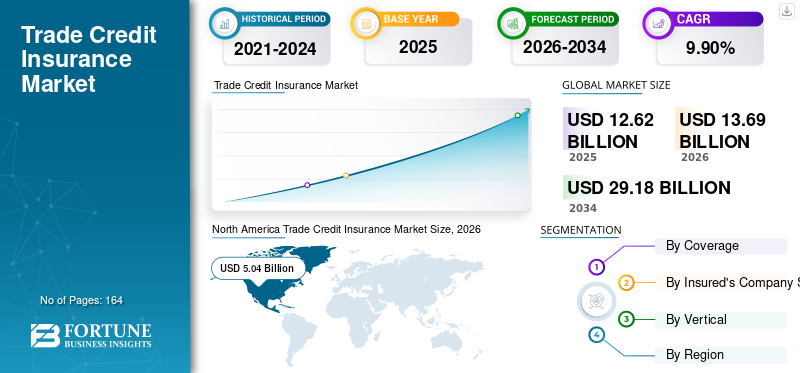
Download Free sample to learn more about this report.
TRADE CREDIT INSURANCE MARKET KEY TAKEAWAYS
 Global Market Size & Forecast
- 2025 Market Size: USD 12.62 billion
- 2026 Market Size: USD 13.69 billion
- 2034 Forecast Market Size: USD 29.18 billion
- CAGR: 9.90% from 2026–2034
 Market Share
- North America dominated the market with a 39.93% share in 2025.
- The Manufacturing segment held the largest market share in 2025.
- The Retail segment represents another major end-use industry for trade credit insurance.
 Key Regional Highlights
North America
North America reached USD 4.65 billion in 2025 and is projected to reach USD 5.04 billion in 2026, supported by strong bank integration, dense broker networks, and high adoption among mid-to-large corporates.
Europe
Europe projected to reach USD 3.58 billion by 2026, driven by increasing business insolvencies, heightened credit-risk awareness, technological adoption, and favorable government initiatives.
Asia Pacific
Asia Pacific projected to reach USD 3.09 billion by 2026, supported by SME digitization, expanding export activity, and increasing capacity from export credit agencies.
U.S.
The market is expected to reach USD 3.73 billion in 2025, driven by rising domestic and international trade, significant export activity, and increasing insolvencies.
Japan
Japan growth is supported by its mature trade credit insurance environment, sophisticated manufacturing sector, export activity, and increasing emphasis on managing counterparty exposure across domestic and international receivables portfolios.
Read More

Impact of Gen AI
Gen AI Reshapes the Market by Transforming Risk Assessment and Claims Management
Generative AI is reshaping the trade credit insurance sector by transforming risk assessment and claims management. Advanced GenAI models constantly evaluate the massive volumes of structured and unstructured data available from financial statements and trade flows to global news to identify early warning indicators of buyer distress and credit risk in general. By monitoring proactively, insurers are able to enhance underwriting decision processes and maintain portfolio performance. In the claim management process, GenAI automates verification, documentation, and manages case triage, all with ideally significant reductions in settlement turnaround time. By increasing accuracy, transparency, and operational efficiency will assist insurers in modernizing the claim process and allowing for faster, data-driven, and more reliable credit risk protection.
MARKET DYNAMICS
Market Drivers
Download Free sample to learn more about this report.
Rising Payment Defaults and Global Trade Volatility Drive Market Growth
The trade credit insurance market growth is driven by rising payment defaults and increasing volatility in global trade. As companies experience increasing insolvency risks, disruptions in the supply chain, and geopolitical uncertainties, protecting accounts receivable has become a pressing need.
Trade credit insurance allows companies to reduce non-payment risks, protect working capital, and ensure liquidity. Furthermore, insurers have improved their risk assessment systems and customizable coverage solutions to spur greater uptake. With its ability to provide stability during challenging conditions and provide access to trade finance, trade credit insurance is becoming a critical tool to sustain business confidence and the resiliency of global trade.
Another primary driver of the trade credit insurance market is the increasing financial exposure embedded in business-to-business payment terms. Suppliers effectively finance customers between delivery and collection, creating receivables risk that can weaken liquidity when payment is delayed or interrupted. Allianz Trade reported that global cash conversion cycles remained structurally elevated in 2025, reaching 67 days.
Elevated insolvency risk strengthens the economic case for protection. Allianz Trade forecasts global business insolvencies to increase by 6% in 2026, following a similar increase in 2025. Persistent insolvency pressure increases demand for counterparty monitoring and receivables protection.
Cross-border trade provides another structural demand pool. Exporters face differences in payment practices, insolvency procedures, enforcement environments, and geopolitical exposure. Credit insurance can combine indemnification with buyer assessment and collection capabilities, supporting controlled expansion into unfamiliar markets.
Working-capital management is becoming a more important purchasing consideration. Companies are holding additional inventory to strengthen supply resilience, while longer cash cycles increase financing requirements. Insurance can help companies protect receivables without materially reducing commercial credit availability.
Market Restraints
Volatile Loss Ratios and Limited SME Awareness to Hinder Market Growth
Volatile loss ratios and limited awareness among small and medium-sized enterprises (SMEs) remain key restraints in the trade credit insurance industry. During periods of economic slowdown, rising defaults and fluctuating claim frequencies strain insurer profitability, prompting stricter underwriting and higher premiums. This volatility discourages risk appetite and limits market expansion. At the same time, many SMEs lack awareness of trade credit insurance benefits or perceive it as an unnecessary expense, restricting adoption. Addressing these challenges through targeted education, simplified products, and flexible pricing models will be critical to enhancing market penetration and ensuring sustainable industry growth.
The trade credit insurance market faces constraints that limit adoption despite elevated commercial credit risk. Premium affordability remains a consideration for smaller companies with limited receivables volumes or highly fragmented customer bases. For some SMEs, internal credit controls and selective customer screening may appear more economical than comprehensive insurance.
Underwriting complexity is another structural limitation. Insurers must evaluate buyer financial strength, payment behavior, sector exposure, country conditions, concentration risk, and potential contagion across connected supply chains. Rapid changes in credit conditions can make historical financial information less predictive.
Coverage availability can also tighten when risk deteriorates sharply. Insurers may reduce credit limits, introduce exclusions, or reassess country exposures when insolvency expectations rise. This can create tension between policyholders seeking greater protection and insurers protecting portfolio quality.
Claims concentration represents a significant risk for providers. A major corporate failure can affect numerous suppliers simultaneously, creating correlated losses rather than isolated claims. Effective portfolio diversification and disciplined underwriting are therefore central to insurer profitability.
Market Opportunities
Growing ECA–Private Insurer Partnerships Create Major Opportunity for Market Growth
The growing collaboration between export credit agencies (ECAs) and private insurers presents a significant opportunity for the trade credit insurance market. These partnerships combine public institutions’ risk mitigation frameworks with private insurers’ underwriting expertise and agility, enhancing overall market capacity and resilience.
Joint initiatives improve access to credit insurance solutions in emerging markets, high-risk regions, and among SMEs traditionally underserved by commercial insurers. By facilitating greater risk-sharing, expanding coverage scope, and promoting trade finance availability, ECA–private insurer alliances are unlocking new avenues for market growth, portfolio diversification, and sustainable global trade development.
The trade credit insurance market presents a particularly strong opportunity in the SME segment, where receivables concentration can materially affect liquidity. Smaller companies often lack dedicated credit-risk teams and sophisticated buyer-monitoring infrastructure. Insurers that simplify onboarding, automate credit decisions, and integrate coverage with accounting platforms can reduce the administrative barrier to adoption. Allianz Trade already positions digital tools and API connectivity as part of its SME and financial-institution offering.
Cross-border expansion represents another opportunity. Exporters entering unfamiliar markets need counterparty intelligence, collection expertise, and protection against commercial and selected political risks. Atradius offers both whole-turnover and single-risk structures, allowing coverage to be tailored to concentrated international exposures.
A further opportunity lies in embedded trade credit solutions. Connecting insurers with enterprise resource planning, treasury, invoicing, and B2B commerce platforms can place credit decisions directly within commercial workflows. This model could expand distribution while lowering servicing costs.
Market Trends
Shift from Stand-Alone TCI to Bank-Embedded Cover Represents a Major Trend
The shift from standalone policies to bank-embedded coverage models is a significant trend influencing the trade credit insurance market. In order to offer complete security for funded receivables, financial institutions are progressively including trade credit insurance into their supply chain finance, invoice discounting, and factoring solutions.
Lender confidence is increased, credit availability is improved, and risk management is streamlined with this integrated strategy. By incorporating coverage into financial products, banks provide more accessibility and convenience to their customers, especially SMEs. By encouraging cooperation between lenders and insurers, the approach promotes innovation, operational effectiveness, and a more robust trade finance ecosystem.
The trade credit insurance market is shifting from conventional indemnification toward continuous credit-risk management. Insurers increasingly combine policy protection with buyer intelligence, automated monitoring, collections, and portfolio analytics. This reflects a broader change in corporate procurement, where finance teams increasingly expect insurance providers to support earlier intervention rather than only compensate losses after default.
Artificial intelligence is becoming a meaningful underwriting capability. Atradius reported in 2026 that more than 70% of its credit-limit applications were processed automatically using proprietary artificial intelligence and machine-learning models. Its systems also scan large volumes of external information for early signals of negative events affecting buyers, sectors, or countries.
Integration with corporate systems is another important direction. Atradius identifies application programming interfaces (APIs) connecting insurers with enterprise resource planning and treasury systems as increasingly important for automated credit-limit requests, buyer assessments, and policy administration. This reduces manual intervention and improves the operating economics of smaller accounts.
The SME segment is consequently becoming more strategically important. Smaller businesses increasingly require faster decisions, simpler onboarding, and coverage that can adapt to changing trading relationships. Atradius expects artificial intelligence to support more automated SME solutions, potentially lowering distribution and servicing costs.
Market Segmentation Analysis
By Coverage
Portfolio-Wide Protection Boosts Whole Turnover Coverage Segment Growth
Based on the coverage, the market is segmented into whole turnover coverage and single buyer coverage.
Whole Turnover Coverage
The whole turnover coverage segment held the largest revenue share of USD 8.24 billion in the overall global market in the year 2024. The revenue is driven by its portfolio-wide protection that lenders prefer for factoring/SCF/securitizations, spreading risk across many buyers with lower admin costs.
Whole turnover coverage remains the core structure for businesses with broad customer portfolios and recurring credit sales. The policy generally protects receivables across an agreed portfolio rather than isolating individual transactions. This structure allows insurers to diversify exposures across multiple buyers, sectors, and geographies while giving policyholders comprehensive protection.
The economic rationale extends beyond loss indemnification. Companies can maintain consistent credit terms across customers while transferring a defined portion of default risk to the insurer. This becomes particularly valuable when receivables represent a material component of working capital.
Whole turnover policies also create a stronger information relationship between insurer and policyholder. Insurers continuously assess buyer quality, establish credit limits, monitor payment behavior, and adjust exposure when risk changes. The resulting credit intelligence can influence sales decisions and internal credit-control processes.
For large enterprises, whole turnover structures are particularly relevant because customer portfolios may span multiple countries and industries. A diversified policy can therefore provide centralized risk governance while reducing the need for separate arrangements across individual markets.
The structure also supports more efficient underwriting. Risk is distributed across a portfolio rather than concentrated in a single counterparty. This can improve pricing economics when the underlying debtor base is sufficiently diversified.
Single Buyer Coverage
Single buyer coverage holds the highest CAGR of 12.0% in the global market. The growth is mainly due to the rising project and commodity deals plus “top-up” needs on concentrated counterparties and longer tenors. Single buyer coverage addresses a different risk profile. It is designed for companies where exposure is concentrated around a strategically important customer, transaction, or relationship. The structure can be particularly relevant when one buyer represents a significant proportion of annual revenue or when a specific transaction creates disproportionate counterparty exposure.
Exporters may use single buyer protection when entering a new market without wanting to insure their entire debtor portfolio. It can also support project-based transactions where the creditworthiness of one counterparty determines the economics of the engagement.
The underwriting process is inherently more concentrated. Insurers must conduct deeper analysis of the selected buyer because portfolio diversification provides less protection against adverse outcomes. Financial strength, payment history, ownership structure, sector conditions, jurisdiction, and contractual terms therefore become important underwriting variables.
Single buyer structures can also address opportunities that do not fit conventional whole-turnover programs. Etihad Credit Insurance, for example, offers both whole turnover and single risk insurance alongside other trade-related protection structures.
By Insured's Company Size
Large Enterprise Segment Dominates Market Owing to Bank-Driven Requirements
Based on insured's company size, the market is divided into SMEs and large enterprises.
Large Enterprises
The large enterprise segment dominates the trade credit insurance market share of USD 7.00 billion. The segment continues to generate the major revenue due to bank-driven requirements that translate into higher insured turnover and premiums.
Large enterprises remain the principal buyers of sophisticated trade credit insurance because they manage substantial receivables portfolios across multiple customers and jurisdictions. Their purchasing decisions are generally driven by portfolio risk, balance-sheet objectives, financing requirements, and global credit governance rather than simple premium minimization.
Multinational companies frequently require coordinated policies covering multiple subsidiaries and markets. This creates demand for centralized reporting, consistent underwriting standards, multinational policy structures, and integrated claims management.
Large enterprises also place greater emphasis on insurer financial strength and global service capacity. The ability to monitor hundreds or thousands of buyers can be more important than the lowest headline premium. Proprietary commercial databases, local collection networks, and regional underwriting expertise therefore create meaningful competitive advantages.
Working-capital optimization is becoming increasingly important. Companies can use insured receivables within broader treasury strategies while maintaining commercial flexibility. Allianz Trade explicitly positions trade credit insurance for medium, large, and global businesses, including organizations operating across multiple countries.
SMEs
SMEs hold the highest CAGR of 10.9% in the global market. The segment’s growth is mainly due to digital onboarding via brokers/fintech, embedded cover in receivables finance, and ECA support expanding awareness and affordability. Small and medium-sized enterprises represent an important expansion opportunity for the trade credit insurance market. SMEs frequently operate with thinner liquidity buffers and greater customer concentration than diversified multinational corporations. A single significant payment failure can therefore create a disproportionate impact on working capital.
Adoption has historically been constrained by limited awareness, perceived complexity, and the cost of maintaining insurance administration. Digital distribution is beginning to address these barriers. Simplified applications, automated buyer assessment, and integrated credit-monitoring tools can reduce the operational burden associated with policy administration.
The value proposition is particularly strong for exporters and businesses selling on open-account terms. Insurance can allow an SME to extend credit while protecting a defined portion of receivables against covered default. It can also strengthen discussions with lenders when insured receivables form part of working-capital financing arrangements.
SME demand is not uniform. Businesses with highly concentrated customer portfolios may prefer targeted coverage, while companies with many recurring buyers may benefit from whole turnover structures. Sector exposure also matters because insurers price risk according to buyer quality, payment terms, industry conditions, and geographic exposure.
By Vertical
To know how our report can help streamline your business, Speak to Analyst
Largest B2B Receivables Pools Augment the Manufacturing Segment Growth
Based on the vertical, the market is divided into manufacturing, retail, food & beverages, automotive, IT & telecom, and others (energy, etc.).
Manufacturing
The manufacturing segment accounted for the largest market share at USD 2.78 billion in 2024 and continues to generate the highest revenues since they possess the largest B2B receivables pools (chemicals, machinery, metals, electronics) and export-intensive, longer credit terms.
Manufacturing represents a core demand vertical because producers frequently sell equipment, components, materials, and finished goods on credit. Payment cycles can be extended, while supply-chain relationships may involve multiple tiers of customers and distributors.
The sector's risk profile is cyclical. Demand contractions can quickly weaken buyer liquidity, particularly among smaller manufacturers operating with high inventory and financing costs. Trade credit insurance can protect suppliers while allowing them to maintain commercial relationships during weaker demand periods.
Retail
Retail generates demand through supplier relationships, distributors, wholesalers, and franchise networks. Payment risk can increase when consumer demand weakens, inventory turns deteriorate, or financing costs rise.
Retail-related underwriting requires close attention to cash conversion, leverage, inventory management, and customer concentration. Suppliers may face significant exposure when a large retailer experiences financial stress.
Trade credit insurance can help suppliers maintain credit terms while protecting against defined buyer default. This is particularly valuable where retailers exert substantial bargaining power over payment periods.
Food & Beverages
Food & beverages represent the largest CAGR at 12.8% in the global market. Food & beverages are growing faster primarily due to buyer concentration (large retailers/foodservice) increasing bad-debt sensitivity and TCI penetration.
Food and beverage companies operate across extensive distribution networks involving producers, wholesalers, retailers, and food-service businesses. The resulting receivables exposure creates a natural demand pool for credit insurance.
The sector is sensitive to input-cost inflation, commodity prices, consumer demand, and retailer concentration. Insurers must therefore monitor both buyer-specific and sector-wide risk indicators.
For exporters, agricultural and food-product suppliers also face country-specific payment and trade risks. Coverage combined with buyer intelligence can support international expansion while limiting exposure to unexpected non-payment.
Automotive
Automotive supply chains create particularly complex credit exposures because manufacturers, tier-one suppliers, tier-two suppliers, and distributors operate through tightly interconnected relationships. Financial stress at one major participant can propagate across multiple suppliers.
The transition toward electric vehicles, changing production footprints, and restructuring among suppliers are altering traditional risk patterns. Insurers increasingly need granular sector intelligence to distinguish temporary liquidity pressure from structural deterioration.
Automotive suppliers can use trade credit insurance to protect receivables while maintaining relationships with strategic customers. This can become important when suppliers face substantial tooling, inventory, and capacity commitments.
IT & Telecom
IT and telecom companies increasingly generate trade credit exposure through enterprise software, hardware distribution, managed services, infrastructure projects, and channel partnerships. Long contractual cycles can create significant receivable balances.
The sector's risk characteristics differ from manufacturing. Insurers must consider customer concentration, contract structures, recurring revenue quality, project execution, and technology-sector financing conditions.
Regional Insights
Geographically, the market is segmented into North America, Europe, Asia Pacific, South America, and Middle East & Africa.
North America Trade Credit Insurance Market Analysis
North America Trade Credit Insurance Market Size, 2026 (USD Billion)
To get more information on the regional analysis of this market, Download Free sample
The North American region is currently leading the global market. The region held a market value of USD 4.65 billion and USD 5.04 billion in 2025 and 2026, respectively. Components driving growth include deep bank integration of TCI (factoring/SCF/securitizations), dense broker networks, and high adoption by mid-to-large corporates. The market is served by major global players and provides essential risk mitigation for businesses across various sectors, protecting them from non-payment by customers. The U.S. is at the forefront of the North American market, with expected revenue of USD 3.73 billion in 2025 driven by rising domestic and international trade and increasing insolvencies.
North America remains a mature trade credit insurance market, supported by sophisticated commercial insurance infrastructure, deep capital markets, and extensive business-to-business trade. Demand is reinforced by corporate focus on receivables protection, working-capital efficiency, and counterparty monitoring. Cross-border supply chains and elevated insolvency uncertainty continue encouraging companies to transfer selected credit risks while retaining commercial flexibility across domestic and international customer portfolios.
United States Trade Credit Insurance Market
The United States represents the region's principal demand center, supported by a large corporate sector, extensive wholesale networks, and significant export activity. Large enterprises remain important policyholders, while SMEs offer additional penetration potential. Insurers increasingly emphasize digital underwriting, buyer intelligence, and portfolio monitoring. Demand is also linked to financing structures where insured receivables support stronger working-capital management and lender confidence.
Europe Trade Credit Insurance Market Analysis
The European market is substantially growing and is likely to contribute to a revenue share of USD 3.58 billion in 2026. The region’s growth is owing to increasing business insolvencies and heightened awareness of credit risks. This growth is further supported by technological adoption and favorable government initiatives. The U.K. and Germany are some of the leading contributors to the growth in the market, with the required revenue stake of USD 0.76 billion and USD 1.01 billion in 2026, and France contributed USD 0.40 billion in 2025.
Europe remains a leading trade credit insurance market because of its mature insurance ecosystem, dense cross-border trade relationships, and established credit-management practices. Germany, France, the United Kingdom, and other major economies support substantial demand. Persistent insolvency concerns, export exposure, and complex supply chains reinforce adoption. Regional insurers also benefit from extensive buyer databases and established collection networks.
Germany Trade Credit Insurance Market
Germany represents one of Europe's most important trade credit insurance markets, reflecting its manufacturing base, export orientation, and extensive supplier networks. Automotive, machinery, chemicals, and industrial companies generate substantial receivables exposure. Demand is supported by the need to manage counterparty risk across international markets. Economic uncertainty and supply-chain restructuring are encouraging companies to reassess credit limits and customer concentrations.
United Kingdom Trade Credit Insurance Market
The United Kingdom maintains a developed trade credit insurance market supported by financial services expertise, international commerce, and a substantial SME population. Exporters and distributors increasingly use credit insurance to manage customer default risk across complex trading relationships. Digital underwriting and automated credit monitoring are improving accessibility, while insurers continue integrating coverage with broader working-capital and receivables-management strategies.
Asia-Pacific Trade Credit Insurance Market Analysis
The Asia Pacific region is expanding considerably. The market size is expected to value at USD 3.09 billion in 2026, driven by SME digitization and widening ECA capacity (e.g., Sinosure, NEXI, K-Sure, EFA) supporting cross-border trade. The growth is further attributable to regional economic expansion, increased trade volumes, and rising business insolvencies.
India and China are major contributors to the market growth with an expected revenue share of USD 0.7 billion and USD 0.68 billion, respectively by 2026.
Asia-Pacific is expected to deliver strong trade credit insurance market growth as manufacturing, exports, intra-regional commerce, and corporate credit activity expand. Adoption remains uneven across countries, creating significant penetration opportunities. China, Japan, South Korea, Australia, and Southeast Asian economies present distinct risk profiles. Increasing supply-chain diversification and greater attention to receivables protection are supporting broader adoption among large enterprises and SMEs.
Japan Trade Credit Insurance Market
Japan has a mature trade credit insurance environment supported by sophisticated manufacturers, trading companies, and established corporate risk-management practices. Demand is influenced by export activity, supplier relationships, and aging corporate structures. Companies increasingly emphasize continuity of customer relationships while controlling counterparty exposure. Established insurer networks and detailed commercial information support disciplined underwriting across domestic and international receivables portfolios.
China Trade Credit Insurance Market
China represents a significant long-term opportunity for trade credit insurance because of its extensive manufacturing ecosystem and large domestic and export-oriented business base. Demand is supported by supply-chain restructuring, international expansion, and growing attention to receivables risk. Adoption varies considerably by company size and sector. Export-oriented manufacturers and trading companies provide particularly relevant opportunities for specialized credit protection.
Latin America and Middle East & Africa Trade Credit Insurance Market Analysis
The markets of South America and the Middle East & Africa are growing, with an expected share of USD 0.69 billion and USD 1.2 billion, respectively, in 2025. The region’s growth is attributable to increasing business insolvencies, expanding international trade, and rising demand for risk management solutions. GCC countries are predicted to have a market share of USD 0.53 billion by 2025.
Latin America offers developing trade credit insurance opportunities across manufacturing, commodities, retail, food, and export-oriented industries. Currency volatility, uneven insolvency frameworks, and cross-border payment risks increase the value of professional credit-risk management. Adoption remains below mature European markets, leaving room for expansion. Insurers with strong local collection capabilities and country-level underwriting expertise are better positioned to manage regional complexity.
The Middle East and Africa market remains comparatively underpenetrated but offers opportunities through infrastructure investment, energy trade, manufacturing expansion, and international commerce. Political risk, payment complexity, and varying insolvency regimes influence underwriting. Export credit agencies, banks, brokers, and private insurers can support market development by combining credit protection with trade-finance and receivables-management solutions.
Trade Credit Insurance Industry Competitive Landscape
Key Players Focus On Partnerships and Acquisitions to Lead the Industry
The key players in the industry include Allianz Trade, Atradius N.V., Coface, American International Group, Zurich, Chubb, QBE Insurance Group Limited, Aon Plc, Credento, Howden Insurance Brokers LLC, Allianz Saudi Fransi, AXA XL, and Markel Corporation. These leading firms use strategies such as mergers and acquisitions, technological integration (AI, data analytics), and offering specialized solutions for multinational corporations and SMEs. They focus on adapting to global trade shifts, providing real-time risk analysis, simplifying policy management, and leveraging market expertise to mitigate client risks and grow their market share.
The trade credit insurance market is concentrated among a small group of global specialists with extensive buyer databases, multinational underwriting networks, and established claims infrastructure. Competitive advantage increasingly depends on the ability to combine financial strength with granular commercial intelligence and responsive risk management.
The market remains relatively concentrated. Coface reported that Allianz Trade, Atradius, and Coface collectively represented approximately 60% of the global credit insurance market in 2024. This concentration reflects the importance of accumulated buyer data, international collections infrastructure, capital resources, and long-standing corporate relationships.
Artificial intelligence is becoming an additional differentiator. Atradius reported in 2026 that more than 70% of its credit-limit applications were processed automatically using artificial intelligence and machine-learning models. Partnerships are also expanding across banks, brokers, fintech platforms, and trade-finance providers. These relationships can improve distribution while embedding credit protection closer to corporate receivables workflows.
The competitive outlook favors insurers capable of maintaining underwriting quality while lowering servicing costs. Large providers retain structural advantages in data and geographic coverage, while smaller firms can compete through specialization, local expertise, and faster decision-making. Over time, technology-enabled underwriting and portfolio diversification should become increasingly important determinants of trade credit insurance market share.
KEY TRADE CREDIT INSURANCE COMPANIES PROFILED
- Allianz Trade (France)
- Atradius N.V. (Netherlands)
- Coface (France)
- American International Group (U.S.)
- Zurich (Switzerland)
- Chubb (Switzerland)
- QBE Insurance Group Limited (Australia)
- Aon Plc (U.K.)
- Credento (Belgium)
- Howden Insurance Brokers LLC (U.K.)
- Allianz Saudi Fransi (Saudi Arabia)
- AXA XL (France)
- Markel Corporation (U.S.)
Latest Trade Credit Insurance Industry Developments
- September 2025- Abu Dhabi National Insurance Company (ADNIC), a leading regional multi-line insurance provider, and Allianz Trade, the global leader in trade credit insurance, announced the establishment of a long-term strategic partnership. This collaboration marks a major milestone in expanding access to Trade Credit Insurance solutions (TCIS) for businesses across the UAE.
- July 2025- DUAL Europe is expanding its specialty lines across the continent with the launch of its Trade Credit Insurance business, with capacity provided by Axeria, a Pan-European carrier.
- July 2025: Atradius received “in principle” approval from Lloyd’s to establish Atradius Syndicate 1864, targeting commencement of underwriting from January 2026. The strategic purpose was to expand Atradius’ capacity and strengthen its proposition for financial-sector clients facing trade credit exposures. Capabilities involved included Lloyd’s underwriting infrastructure, trade credit risk assessment, portfolio diversification, and Atradius’ established credit-information network covering approximately 200 million companies.
- July 2025: Coface continued its strategic investment program while expanding its data capabilities alongside trade credit insurance operations. The company reported 1.7% growth in trade credit insurance revenue and identified its data strategy as a priority, including strengthened information governance. The strategic purpose was to improve credit-risk intelligence and support underwriting quality. Capabilities involved included business information, data governance, credit analytics, and integrated risk-management services.
- June 2026: Allianz Trade partnered with Mastercard to extend trade credit insurance capabilities through its Allianz Trade pay solution for issuers operating in the travel industry. The strategic purpose was to provide additional protection within B2B travel-payment transactions while integrating credit-risk management into payment workflows. Capabilities involved included trade credit insurance, B2B payment infrastructure, automated transaction processes, and Mastercard’s payments ecosystem.
REPORT COVERAGE
The global report provides a detailed analysis of the market and focuses on key aspects such as prominent companies, deployment modes, types, and end users of the product. Besides this, it offers insights into the trade credit insurance market trends and highlights key industry developments and market share analysis for key companies. In addition to the aforementioned factors, the report encompasses several factors that have contributed to the growth of the market over recent years.
Request for Customization to gain extensive market insights.
Report Scope & Segmentation
| ATTRIBUTE | DETAILS |
| Study Period | 2021-2034 |
| Base Year | 2025 |
| Estimated Year | 2026 |
| Forecast Period | 2026-2034 |
| Growth Rate | CAGR of 9.90% from 2026-2034 |
| Historical Period | 2021-2024 |
| Unit | Value (USD Billion) |
| Segmentation | By Coverage, Insured's Company Size, Vertical, and Region |
| By Coverage |
|
| By Insured's Company Size |
|
| By Vertical |
|
| By Region |
|
Frequently Asked Questions
Fortune Business Insights says that the global market stood at USD 12.62 billion in 2025 and is projected to reach USD 29.18 billion by 2034.
The market is expected to exhibit steady growth at a CAGR of 9.90% during the forecast period.
Rising payment defaults and global trade volatility is speeding up the market growth.
Allianze Trade, Atradius N.V., Coface, American International Group, Zurich, Chubb, QBE Insurance Group Limited are some of the top players in the market.
The North America region held the largest market share.
North America was valued at USD 4.65 billion in 2025.



- 2021-2034
- 2025
- 2021-2024
- 164
Get 30-60 hrs Free Customization
Expand Regional and Country Coverage, Segments Analysis, Company Profiles, Competitive Benchmarking, and End-user Insights.













-
US +1 833 909 2966 ( Toll Free )
-
Get In Touch With Us