 Download Free Sample



Get a Quote
Receive a tailored pricing based on your needs.
- Choose license type
- Multiple user options
- Custom scope & coverage
- Fast turnaround
"Designing Growth Strategies is in our DNA"
 Listen to Audio Version
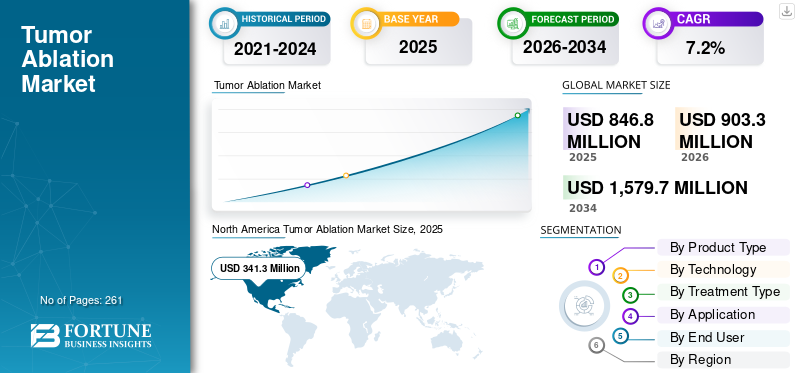
The global tumor ablation market size was valued at USD 846.8 million in 2025 and is projected to grow from USD 903.3 million in 2026 to USD 1,579.7 million by 2034, exhibiting a CAGR of 7.2% during the forecast period. North America dominated the global tumor ablation market with a market share of 40.3% in 2025.
Tumor ablation is a minimally invasive procedure that is used in the treatment of tumors of the liver, bone, kidney, and other organs. The increasing prevalence of chronic conditions, such as various types of cancers, is resulting in a growing patient pool for tumor ablation procedures globally. The increasing number of patients and the advantages associated with this therapy, such as shorter recovery periods, reduced pain, shorter hospital stay, and various other advantages, are further augmenting the demand for these procedures, thereby supporting the adoption rate in the market.
For instance, according to the 2025 statistics published by the American Cancer Society (ACS), it was reported that approximately 2.0 million people are estimated to have occurred in the U.S.
Moreover, the increasing technological advancements are also a crucial factor supporting the growing adoption rate of image-guided ablation systems. This, along with increasing research and development activities among prominent companies such as Medtronic, Johnson & Johnson Services, Inc., and others, is anticipated to support the market growth.
Download Free sample to learn more about this report.
 Market Size & Forecast
 Market Share
 Key Regional Highlights
North America
North America led the market with a value of USD 341.3 million and a 40.3% share in 2025.
Europe
Europe is projected to reach USD 287.8 million in 2026, growing at a CAGR of 7.1% during the forecast period.
Asia Pacific
Asia Pacific is expected to attain a market size of USD 203.3 million in 2026, supported by expanding interventional radiology capabilities.
U.S.
The market is estimated to reach USD 328.4 million in 2026, driven by rising cancer incidence and increasing ablation procedures.
Japan
Growing adoption of minimally invasive cancer treatment technologies is supporting market expansion.
Read More

Increasing Prevalence of Cancer to Drive Market Growth
The growing prevalence of various forms of cancer, such as lung cancer, liver cancer, and others, is increasing the patient pool for cancer globally. The growing patient pool and benefits of minimally invasive therapies are supporting the demand for these procedures among the patients, consequently boosting the adoption rate of these products in the market.
For instance, according to data published by the World Health Organization (WHO) in 2022, approximately 20 million new cases of cancer were reported globally that year.
Moreover, the rising aging population is another key factor contributing to the growing prevalence of chronic conditions among patients, thereby fueling the global demand for these products. An increasing number of patients present with localized tumors or are medically ineligible for major surgery, often favor minimally invasive procedures such as cryoablation and others. Therefore, the factors mentioned above, along with the growing focus of major players towards R&D initiatives to develop and introduce novel products, are expected to drive the adoption rate, thereby supporting the global tumor ablation market growth.
High Cost Associated with Advanced Products & Procedures to Hinder the Market Growth
There is a growing demand for these tumor ablation technologies due to their advantages, including minimally invasive procedures and others. However, the high cost associated with the technologically advanced products and procedures is anticipated to hamper the adoption rate for these therapies, especially in developing countries such as India, China, South Africa, and others.
The increasing technological advancements in these devices, including disposable probes and imaging integration in microwave ablation, irreversible electroporation, and others, are resulting in elevated costs of these products in the market. Furthermore, these ablation procedures require multimodality imaging support, including MRI, CT, and others, which increases the procedure cost for patients.
Along with this, limited reimbursement policies make it challenging for the small healthcare facilities to equip these advanced devices, especially in emerging nations. Additionally, reimbursement delays for newer non-thermal technologies, including histotripsy, irreversible electroporation, and others, limit the number of procedures in developed nations.
For instance, according to data published by Medijourney in 2025, the cost of ablation therapy ranges from USD 2,500 to USD 5,500.
Therefore, less developed healthcare infrastructure, shortage of specialized interventional radiologists, maintenance expenses, coupled with inadequate reimbursement policies, are expected to limit the adoption rate of these products in the market.
Technological Advancements in Ablation Systems to Create Lucrative Opportunities
There is a growing focus on the incorporation of technological advancements in these ablation devices in the market. The technology advancements, including imaging integration, automation, and energy delivery, are improving safety, procedural precision, and treatment outcomes across multiple cancer types.
These technologically advanced devices enable efficacy in targeting tumors among patients, further driving the demand for these treatment options in the market. This, along with, growing focus of prominent players towards receiving product approvals for these products, is expected to drive the adoption rate for these products in the market.
In October 2023, HistoSonics received the marketing authorization from the U.S. FDA for its Edison System and novel histotripsy therapy platforms in the U.S.
Limited Access to these Procedures in Emerging Countries to Limit the Market Growth
There is an increasing emphasis on strategies among national organizations to raise awareness about ablation therapy among the patient population. However, despite the growing prevalence of cancer across emerging nations, the availability of technologically advanced cryoablation, microwave ablation, irreversible electroporation, and others remains concentrated in clinical settings in these countries.
Limited number of clinical settings, availability of specialized imaging infrastructure, skilled healthcare professionals, among others, are some of the additional factors resulting in limited procedural volumes among patients, especially in emerging countries, including China, Brazil, among others.
For instance, according to 2025 data published by the International Trade Administration (ITA), it was reported that there are 7,309 hospitals in Brazil.
Other Prominent Challenges:
Shifting Preference towards Minimally-Invasive Therapies to Fuel Product Demand
There is a growing preference towards minimally invasive procedures for the treatment of various organ tumors among patients. The advantages associated with these minimally invasive procedures are fewer complications, shorter hospital stays, faster recovery, reduced trauma, and others, are resulting in their growing preference. The key players are focusing on technologies that provide safety and precision in ablation procedures among the patient population.
This shift is fueling the demand for these procedures, such as microwave ablation, cryoablation, and others, owing to improved control and reduced complications across various forms of cancer among patients. This, coupled with the integration of artificial intelligence and data analytics, is further anticipated to fuel the adoption of tumor ablation devices in clinical settings globally.
For instance, according to a 2025 study published by Nature, it was reported that about 80.4% chose laser ablation over conventional surgery, and transoral endoscopic lobectomy for solitary nodule thyroid treatment among 204 patients in the U.S.
Other Prominent Trends:
Download Free sample to learn more about this report.
Increasing Product Launches Led to Accessories Segment Dominance
Based on product type, the market is classified into instruments and accessories.
The accessories segment accounted for the largest share in 2025. The growth is due to the high risk of tumor recurrence among the patient population, resulting in an increasing number of ablation procedures globally. This, along with the growing focus of prominent companies towards research and development activities to launch innovative products, is further anticipated to contribute to the segmental growth.
The instruments segment is expected to grow at a CAGR of 7.2% over the forecast period.
To know how our report can help streamline your business, Speak to Analyst
Focus of Companies to Receive Product Approvals Drives the Dominance of Microwave Ablation Segment
Based on technology, the market is categorized into radiofrequency ablation, microwave ablation, cryoablation, high-intensity focused ultrasound, and others.
The microwave ablation segment dominated the market in 2025. In 2026, the segment is anticipated to dominate with a 34.9% share. The dominant share is attributed to the increasing number of microwave ablation procedures, whichdrives demand for these products in the market. This, along with the increasing focus of prominent players in receiving product approvals for ablation products, is likely to contribute to the segmental growth in the market.
The high-intensity focused ultrasound segment is expected to grow at a CAGR of 9.6% over the forecast period.
Percutaneous Segment Takes the Leading Position Due to High Prevalance of Different Types of Cancer
On the basis of treatment type, the market is segmented into surgical, laparoscopic, and percutaneous.
The percutaneous segment dominated the global market in 2025. By application, the percutaneous segment held the share of 68.1% in 2025. The growth is primarily owing to the increasing prevalence of lung cancer, liver cancer, among others, resulting in a growing number of percutaneous procedures.
The segment of surgical is set to flourish with a growth rate of 6.3% across the forecast period.
Increasing Number of Cases of Liver Cancer Led to Its Dominance
Based on application, the market is segmented into lung cancer, liver cancer, kidney cancer, and others.
The liver cancer segment dominated the global market in 2025. By application, the liver cancer segment held the share of 40.0% in 2025. The growth is due to the growing prevalence of various forms of cancer, including liver cancer and others, resulting in increasing demand for ablation products globally.
For instance, according to 2022 statistics published by the World Cancer Research Fund, about 367,657 new liver cancer cases were reported in China.
The segment of kidney cancer is set to flourish with a growth rate of 6.7% across the forecast period.
Growth in the Number of Hospitals & Clinics Has Propelled its Primary Position in the Segement
Based on end user, the market is segmented into hospitals & clinics, cancer care centers, and others.
The hospitals & clinics segment dominated the market in 2025. The increasing prevalence of chronic conditions, the growing number of ablation procedures, and the expanding number of hospitals & clinics are some of the major factors contributing to the growth of the segment in the market. Furthermore, the segment is set to hold a 67.2% share in 2026.
For instance, according to 2025 statistics published by the American Hospital Association (AHA), it was reported that there are about 6,093 hospitals in the U.S.
In addition, cancer care centers' end users are projected to grow at a CAGR of 7.7% during the study period.
Based on region, the market has been studied across North America, Europe, Asia Pacific, Latin America, and the Middle East & Africa.
North America Tumor Ablation Market Size, 2025 (USD Million)
To get more information on the regional analysis of this market, Download Free sample
The North America market held the dominant share in 2024, valued at USD 319.5 million, and also took the leading share in 2025 with USD 341.3 million. The dominance of the region is owing to certain factors, such as increasing prevalence of various forms of cancer, increasing ablation procedure volumes, robust healthcare infrastructure, adequate reimbursement policies, and growing product launches among the prominent players, among others. In 2026, the U.S. market is estimated to reach USD 328.4 million.
For instance, according to 2025 data published by the World Cancer Research Fund, about 43,492 new liver cancer cases were reported in the U.S.
Europe and the Asia Pacific markets, are expected to witness considerable growth in the forecast period. During the study period, the European region is projected to record a growth rate of 7.1% and reach the valuation of USD 287.8 million in 2026. This is due to the growing prevalence of cancer, growing adoption of minimally invasive procedures, increased access to advanced tumor therapies, and improving healthcare facilities in the region. Backed by these factors, countries such as the U.K. are expected to record the valuation of USD 43.7 million, Germany to record USD 54.1 million, and France to record USD 43.9 million in 2026.
After Europe, the Asia Pacific tumor ablation market is estimated to reach USD 203.3 million in 2026 and secure the position of the third-largest region in the market. In the region, India is estimated to reach USD 22.3 million while China is estimated to reach USD 96.7 million in 2026. China and India are expanding their interventional radiology capabilities, further contributing significantly to regional growth of Asia Pacific.
Over the forecast period, the Latin America and Middle East & Africa regions are expected to witness moderate growth in this market. The Latin America market in 2026 is set to record USD 29.9 million as its valuation. The growing prevalence of cancer, the development of healthcare infrastructure, and growing adoption of novel tumor ablation techniques, including radiofrequency and microwave ablation, are anticipated to fuel product adoption in these regions. In the Middle East & Africa, GCC is set to attain the value of USD 9.7 million in 2026.
Increasing Number of Product Launches Among the Key Companies to Contribute to Their Dominance
A technologically advanced product portfolio of advanced products, coupled with a strong geographical presence globally, is one of the vital factors supporting the dominance of these players in the market. Medtronic, Johnson & Johnson Services, Inc., and Boston Scientific Corporation are prominent players in the market in 2025. Moreover, the increasing focus of key players on acquisitions and collaborations among other players to enhance their brand presence is likely to support the global tumor ablation market share.
For instance, in October 2025, Medtronic collaborated with Techsomed Ltd. to combine Techsomed’s BioTraceIO360 software with Medtronic’s Emprint microwave ablation system for image-guided ablation therapy.
Other key players, including AngioDynamics, are also growing in the market, primarily due to their increasing number of product launches to strengthen their brand presence.
The market report provides a detailed global tumor ablation market analysis and focuses on key aspects such as leading companies, product type, technology, treatment type, application, and end user. Besides this, the global report offers insights into the market growth trends and highlights key industry developments. In addition to the aforementioned factors, the report encompasses several factors that have contributed to the growth and advancement of the market over recent years.
Request for Customization to gain extensive market insights.
| Global Tumor Ablation Market Scope | |
| Study Period | 2021-2034 |
| Base Year | 2025 |
| Forecast Period | 2026-2034 |
| Historical Period | 2021-2024 |
| Growth Rate | CAGR of 7.2% from 2026-2034 |
| Unit | Value (USD Million) |
| Segmentation |
By Product Type
By Technology
By Treatment Type
By Application
By End User
By Region
|
Fortune Business Insights says that the global market size was USD 846.8 million in 2025 and is projected to reach USD 1,579.7 million by 2034.
In 2025, the North America regional market value stood at USD 341.3 million.
Growing at a CAGR of 7.2%, the market will exhibit steady growth over the forecast period.
By product type, the accessories segment is the leading segment in this market.
The introduction of novel tumor ablation systems is one of the major factors driving the market's growth.
Medtronic and Johnson & Johnson Services, Inc., are the major players in the global market.
North America dominated the market share in 2025.

Get 30-60 hrs Free Customization
Expand Regional and Country Coverage, Segments Analysis, Company Profiles, Competitive Benchmarking, and End-user Insights.













.webp)






Get In Touch With Us
US +1 833 909 2966 ( Toll Free )
Receive a tailored pricing based on your needs.
Discuss your questions with our industry experts.
Have questions? Get quick answers before you purchase.

