Turf Protection Market Size, Share & Industry Analysis, By Product Type (Pest Protection, Stress Protection, and Scarification), By Mode of Application (Foliar, Soil, and Seed), By Solution Type (Chemical, Biological, and Mechanical), By Application (Sports and Recreational), and Regional Forecast, 2026-2034
 Download Free Sample
(Offer valid till 15th Oct 2026)

Turf Protection Market Size & Industry Overview
 Listen to Audio Version
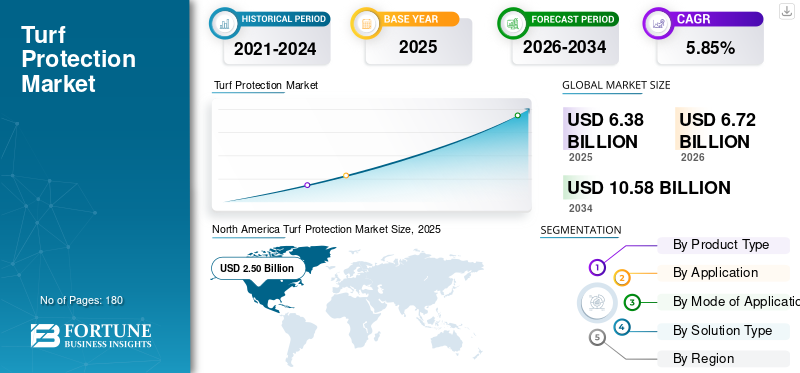
The global turf protection market size was valued at USD 6.38 billion in 2025 and is projected to grow from USD 6.72 billion in 2026 to USD 10.58 billion by 2034, exhibiting a CAGR of 5.85% during the forecast period. North America dominated the turf protection market with a market share of 39.18% in 2025.
Turf protection means using chemical, biological, mechanical, and agronomic methods to keep natural turfgrass healthy, durable, attractive, and playable on golf courses, sports stadiums, parks, commercial areas, and home lawns. These products control pests, support root growth, manage moisture, and make turf stronger. The market is growing rapidly as professional sports organizations, golf facilities, municipalities, and commercial property developers are investing heavily in high-quality turf infrastructure that requires year-round maintenance under increasingly unpredictable climatic conditions.
Companies such as Syngenta AG, Bayer AG, BASF SE, and Corteva Agriscience, among others are some of the major players operating in this market. New product launch and acquisition are the key strategies which are boosting product sales and supporting the market growth.
Download Free sample to learn more about this report.
Turf Protection Market Key Takeaways
 Global Market Size & Forecast
- 2025 Market Size: USD 6.38 Billion
- 2026 Market Size: USD 6.72 Billion
- 2034 Forecast Market Size: USD 10.58 Billion
- CAGR: 5.85% from 2026–2034
 Market Share
- North America dominated the turf protection market with a 39.18% share in 2025.
- The sports segment is a major application, projected to grow at a 5.60% CAGR during the forecast period.
- The stress protection category is a key segment, expected to expand at a 5.70% CAGR during the forecast period.
 Key Regional Highlights
North America
North America to Led the global market with a value of USD 2.50 billion in 2025, driven by sports turf management, golf course maintenance, and landscaping investments.
Asia Pacific
Asia Pacific Reached USD 1.54 billion in 2025, supported by growing investments in sports infrastructure and green spaces.
Europe
The market was valued at USD 1.52 billion in 2025, driven by demand for sustainable turf maintenance solutions.
U.S.
The market reached USD 2.23 billion in 2025, supported by strong demand from golf courses and sports facilities.
Japan
The market reached approximately USD 0.35 billion in 2025, accounting for roughly 4.52% of global market revenue.
Read More

TURF PROTECTION MARKET TRENDS
Integrated Sustainable Turf Management Continues to Reshape Product Innovation and Application Practices
Turf managers now use a mix of biological controls, precise irrigation, soil health practices, and targeted chemicals to lower environmental impact and keep turf performing well. Another big trend is the rise of smart turf management tools, including AI-powered irrigation, remote turf diagnostics, GPS-guided sprayers, and moisture-sensing sensors. Sports stadiums are increasingly using hybrid turf systems that blend natural grass with synthetic materials to extend turf life under heavy use. Manufacturers are also developing turf protection products that boost disease resistance, help plants absorb nutrients, handle stress better, and retain water more efficiently, further supporting turf management practices.
MARKET DYNAMICS
MARKET DRIVERS
Download Free sample to learn more about this report.
Rising Sports Infrastructure and Climate Stress are Driving Demand for Advanced Turf Protection Solutions
The market is growing due to increasing investment in professional sports facilities, new golf courses, and commercial landscaping projects that require high-quality turf. Frequent turf diseases, pest problems, and climate issues such as drought, heat, and uneven rainfall are raising demand for products such as fungicides, insecticides, soil conditioners, and turf growth regulators. Operators of sports stadiums and managers of golf courses are focusing on advanced turf protection to keep surfaces durable, attractive, and safe for players, even under heavy use. New technologies such as precision irrigation, sensor-based turf monitoring, and improved turf management are making turf care more efficient and encouraging the use of specialized biological and chemical protection products.
MARKET RESTRAINTS
Chemical Use Restrictions and High Maintenance Costs Limiting Conventional Turf Protection Adoption
Stringent environmental regulations on pesticide and chemical usage remain a major restraint affecting the market. Regulatory agencies particularly in Europe and North America are increasingly restricting active ingredients associated with groundwater contamination, biodiversity risks, and harmful ecological impact, forcing manufacturers to reformulate products and increase compliance costs. High maintenance costs are another major challenge for premium turf management systems. In developing regions, limited technical know-how and slower adoption of advanced turf management methods also hinders turf protection market growth.
MARKET OPPORTUNITIES
Shift Toward Biological and Water-Efficient Solutions Creating Growth Potential for Turf Protection Products
The market presents strong opportunities as the transition toward sustainable, biologically derived turf management solutions continues to grow in golf courses, sports fields and residential areas. Increasing demand for eco-friendly fungicides, microbial soil enhancers, organic biostimulants, and water-efficient turf treatments is creating new growth avenues for manufacturers. Growing urban landscaping growth in the Asia Pacific and the Middle East is driving demand for advanced turf protection products that keep turf healthy in hot, dry conditions. Precision turf management technologies have the opportunity to integrate IoT-enabled moisture sensors, drone-based turf monitoring, and automated nutrient delivery systems.
Segmentation Analysis
By Application
Expansion of Recreational Landscaping and High-Maintenance Green Spaces is Driving the Dominance of Recreational Applications
Based on the application, the market is bifurcated into sports and recreational.
The recreational segment accounted for the largest market share in 2025. The growth is due to the large-scale global presence of public parks, golf courses, residential lawns, commercial landscapes, resorts, recreational grounds, and municipal green spaces requiring continuous turf maintenance throughout the year. These places need frequent use of fungicides, herbicides, soil conditioners, wetting agents, and nutrient products to keep the turf looking good, dense, and strong in different weather.
Sports is another major segment, amounting to 5.60% CAGR during the forecast period. Sports applications have the second-largest market share. This is as stadiums, cricket grounds, football fields, baseball parks, and training facilities need specialized turf protection to keep players safe, maintain turf strength, and ensure a consistent playing surface.
By Product Type
Increasing Pest Infestations and Turf Disease Pressure Driving Dominance of Pest Protection Products in the Market
The market is segmented by product type into pest protection, stress protection, and scarification.
The pest protection segment led the global market in 2025. These products accounted for the largest turf protection market share as turfgrass surfaces are highly vulnerable to continuous infestations by insects, weeds, fungal pathogens, and soil-borne pests, which directly damage turf density, root health, and visual quality. Golf courses, sports fields, commercial landscapes, and lawns need regular use of fungicides, herbicides, insecticides, and nematicides to keep turf playable.
Stress protection is another major category, witnessing a CAGR of 5.70% during the forecast period. Stress protection products hold the second-largest market share as environmental stress conditions, such as drought, salinity, heat, frost, and excessive foot traffic, increasingly affect turf performance and durability. Many people use products such as biostimulants, wetting agents, soil conditioners, and turf growth regulators to help roots grow better, retain soil moisture, and make turf stronger in tough conditions.
By Mode of Application
Need for Long-Term Root Health Management and Efficient Turf Conditioning is Driving Soil Segment Dominance
The market is segmented by mode of application into foliar, soil, and seed.
The soil application segment led the global market in 2025, and accounted for the largest market share in turf protection. The growth is driven by the segment’s ability to deliver direct treatment to the turf root zone, where nutrient absorption, moisture regulation, microbial activity, and several turf diseases occur. Turf managers last longer, strengthen roots, make turf denser, and improve stress tolerance. Golf courses, sports fields, and recreational areas are increasingly using soil treatment programs to address compaction, water infiltration, salinity, and root-borne fungal infections. These issues directly affect turf quality and durability.
The foliar application segment accounted for the second-largest market share in 2025 and is expected to register a long term growth rate of 6.05% CAGR during the forecast period. It allows rapid absorption and quick correction of visible turf stress, nutrient deficiencies, fungal problems, and pest issues. Turf managers often use foliar sprays to quickly control diseases and improve turf appearance, especially on stadiums and golf greens where rapid recovery is important.
To know how our report can help streamline your business, Speak to Analyst
By Solution Type
Need for Rapid and Large-Scale Turf Disease Control Driving Dominance of Chemical Solutions in the Market
The market is segmented, by solution type into chemical, biological, and mechanical.
The chemical solutions segment led the global market in 2025. The segment held the largest share of the market as they quickly and effectively controlled turf diseases, weeds, insects, and soil-borne pathogens in large commercial and recreational areas. Professional sports fields, golf courses, and city landscapes need turf that is aesthetically appealing and performs well. Chemical solutions are preferred as they help prevent quick turf damage from fungi, pests, and weeds.
The mechanical application segment accounted for the second-largest market share in 2025 and is expected to register a long-term growth rate of 5.82% CAGR during the forecast period. Turf managers are increasingly using aeration equipment, dethatching systems, turf rollers, and mowing technologies to boost soil oxygen, help roots grow, improve drainage, and keep surfaces even, while reducing chemical use.
Turf Protection Market Regional Outlook
By region, the market is categorized into Europe, North America, Asia Pacific, South America, and the Middle East & Africa.
North America
North America Turf Protection Market Size, 2025 (USD Billion)
To get more information on the regional analysis of this market, Download Free sample
The market in North America reached USD 2.50 billion in 2025 and is the leading region across the globe. Intensive sports turf management, golf course maintenance, and increased investment in landscaping are driving the North American market growth. The U.S. leads the region in demand for products which are widely used in stadiums, parks, and sports facilities. Climate changes, such as longer droughts and unpredictable rainfall, are increasing demand for advanced turf protection chemicals that help grass survive drought and resist disease. Canada is experiencing increasing demand for cold-resistant turf protection solutions in golf courses and municipal landscaping.
U.S. Turf Protection Market
In 2025, the U.S. market reached USD 2.23 billion. The market is highly developed due to extensive golf course infrastructure, professional sports leagues, and large-scale commercial landscaping activities. Demand is strongest for fungicides, herbicides, insecticides, and stress-protection products used across golf greens, stadiums, municipal parks, and residential lawns. In addition, investment in hybrid turf systems for NFL, MLB, and collegiate sports facilities continues to support demand for specialized turf maintenance technologies.
Asia Pacific
The Asia Pacific market was valued at USD 1.54 billion in 2025. The market in this region is growing rapidly as cities expand, sports facilities increase, and more money is invested in high-end landscaping projects. China, Japan, Australia, and India are leading markets where demand for turf control is increasing across golf courses, cricket stadiums, football fields, and commercial real estate. In China, government-supported urban greening initiatives and preparation for international sporting events are increasing the adoption of advanced turf disease management and soil conditioning products. In India, the expansion of premium residential landscaping and sports academy infrastructure is driving demand for cost-effective fungicides and turf nutrient solutions. Manufacturers in the region are also launching more biological turf protection products to meet rising environmental concerns and stricter pesticide rules.
India Turf Protection Market
The Indian market size in 2025 was around USD 0.18 billion, accounting for roughly 2.86% of the global market revenues.
China Turf Protection Market
China’s market in 2025 was valued at around USD 0.29 billion, representing roughly 4.19% of global market share. China’s market is expanding rapidly due to urban greening initiatives, growth in sports infrastructure, and increasing investment in premium landscaping projects. Government-led urban beautification programs and development of football training facilities are driving demand for fungicides, soil conditioners, and turf growth regulators.
Japan Turf Protection Market
The Japan market in 2025 reached around USD 0.35 billion, accounting for roughly 4.52% of global market revenues.
Europe
The European market value reached USD 1.52 billion in 2025. Europe represents a regulation-intensive market characterized by strong demand for environmentally compliant turf management solutions. Countries such as the U.K., Germany, France, and the Netherlands are major markets due to extensive golf tourism, football stadium infrastructure, and urban landscaping projects. Strict EU rules on chemical pesticides are speeding up the shift to biological fungicides, organic soil enhancers, and integrated turf management systems.
Germany Turf Protection Market
The market in Germany in 2025 reached around USD 0.19 billion, representing roughly 3.04% of global market revenues. Germany represents a sustainability-focused market supported by strong golf tourism, football stadium maintenance, and urban landscaping investments.
U.K. Turf Protection Market
The U.K. market demand reached approximately USD 0.26 billion in 2025, equivalent to around 4.13% of global market sales. The market is strongly influenced by football stadium maintenance, golf course management, and widespread recreational landscaping activities.
South America and Middle East & Africa
Over the forecast period, South America is expected to experience significant growth in this market and recorded USD 0.39 billion in 2025. The market in this region is growing steadily and Brazil is the largest market in the region, driven by the need for regular upkeep of football stadiums and the growing use of professional turf management in city recreation areas. Challenges such as high humidity and fungal problems are increasing the demand for fungicides, turf growth regulators, and soil aeration products. The Middle East & Africa region recorded USD 1.54 billion in 2025. Extreme weather, more investment in sports facilities, and a growing interest in high-quality landscaping in cities are shaping the market in this region. The Gulf countries, especially the UAE and Saudi Arabia, are key markets due to major golf course projects, luxury hotel landscaping, and new facilities for international sports events.
UAE Turf Protection Market
The UAE market is set to grow at a CAGR of 6.19% during the forecast period. The market in the UAE is growing as more investment is directed toward luxury golf courses, sports facilities, hotel landscaping, and smart city projects.
COMPETITIVE LANDSCAPE
Key Industry Players
New Product Launch for High-Performance Turf Maintenance Management Intensifying Competition
The turf protection market is very competitive wherein several global agrochemical companies, turf management specialists, biological solution providers, and precision irrigation firms are all competing for market share. Prominent companies such as Syngenta, Bayer, BASF, Corteva, FMC Corporation, and Nufarm are known for their wide product ranges which can be easily integrated into integrated pest management programs. Companies supply fungicides, herbicides, insecticides, wetting agents, and plant growth regulators for golf courses, stadiums, and commercial landscaping. Strategic acquisitions of biological product developers and precision turf technology firms are accelerating innovation and boosting product launch.
LIST OF KEY TURF PROTECTION COMPANIES PROFILED
- Syngenta AG (Switzerland)
- Bayer AG (Germany)
- BASF SE (Germany)
- Corteva Agriscience (U.S.)
- FMC Corporation (U.S.)
- Nufarm limited (Australia)
- UPL Limited (India)
- The Andersons, Inc. (U.S.)
- Nutrien Ltd. (Canada)
- SDS Biotech K.K. (Japan)
KEY INDUSTRY DEVELOPMENTS
- April 2026: GrassRoots Turf, a leading lawn care provider, launched NoSkeetoz, a specialized brand dedicated toward professional mosquito, flea, and tick control services.
- January 2025: FMC Corporation launched Durentis insecticide which helps to control turf pests in lawns and golf courses.
- April 2024: Leading artificial grass solution provider TenCate Grass acquired Midwest Sport and Turf Systems (MWSTS) for sports and outdoor living.
- July 2023: Syngenta launched a new turf protection product named exoGEM in the market. The product helps to protect golf courses using advanced formulation technology.
- October 2022: Cinven acquired Bayer AG’S Environmental Science Professional business for USD 2.6 billion. This acquisition helped Cinven expand its product portfolio in the turf protection areas.
REPORT COVERAGE
The global turf protection market research provides an in-depth study of market sizes & forecast by all the market segments included in the report. The market analysis includes details on the market dynamics and market trends expected to drive the market forecast. It offers information on the technological advancements, new product launches, industry developments, and details on partnerships, mergers & acquisitions. The industry also encompasses detailed competitive landscape with information on the market segmentation, market share and profiles of key operating players.
Request for Customization to gain extensive market insights.
Report Scope & Segmentation
| ATTRIBUTE | DETAILS |
| Study Period | 2021-2034 |
| Base Year | 2025 |
| Estimated Year | 2026 |
| Forecast Period | 2026-2034 |
| Historical Period | 2021-2024 |
| Growth Rate | CAGR of 5.85% from 2026-2034 |
| Unit | Value (USD Billion) |
| Segmentation | By Product Type, By Application, By Mode of Application, By Solution Type, and Region |
| By Product Type |
|
| By Mode of Application |
|
| By Solution Type |
|
| By Application |
|
| By Region |
|
Frequently Asked Questions
Fortune Business Insights says that the global market value stood at USD 6.38 billion in 2025 and is projected to reach USD 10.58 billion by 2034.
In 2025, the market value stood at USD 2.50 billion.
The market is expected to exhibit a CAGR of 5.85% during the forecast period.
By application, the recreational segment led the global market in 2025.
Rising sports infrastructure and climate stress are increasing demand for advanced turf protection solutions.
Syngenta AG, Bayer AG, BASF SE, and Corteva Agriscience are a few of the players in the market.
North America held the largest market share in 2025.
Integrated sustainable turf management reshaping product innovation and application practices.


- 2021-2034
- 2025
- 2021-2024
- 180
-
(Offer valid till 15th Oct 2026)
Get 30-60 hrs Free Customization
Expand Regional and Country Coverage, Segments Analysis, Company Profiles, Competitive Benchmarking, and End-user Insights.














Related Reports
-
US +1 833 909 2966 ( Toll Free )
-
Get In Touch With Us