Two-Wheeler Immobilizer Market Size, Share & Industry Analysis, By Technology Type (Transponder-Based Immobilizer, RFID-Based Immobilizer, Smart Key/Passive Keyless Entry (PKE) Immobilizer, and Biometric Immobilizer), By Vehicle Type (Scooters, Motorcycles, Mopeds, and Electric Two-Wheelers), By Sales Channel (OEM and Aftermarket), By Propulsion Type (ICE and Electric), and Regional Forecast, 2026–2034
 Download Free Sample
(Offer valid till 31st Oct 2026)

Two-Wheeler Immobilizer Market Size and Future Outlook
 Listen to Audio Version
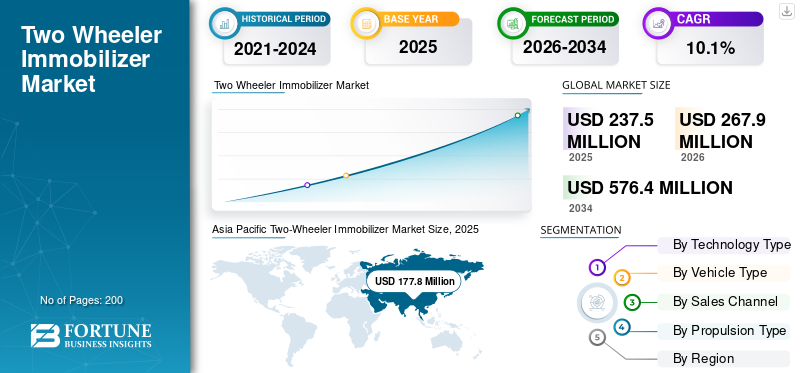
The global two-wheeler immobilizer market size was valued at USD 237.5 million in 2025. The market is projected to grow from USD 267.9 million in 2026 to USD 576.4 million by 2034, with a CAGR of 10.1% over the forecast period. Asia Pacific dominated the two-wheeler immobilizer market with a market share of 74.86% in 2025.
A two-wheeler immobilizer is an electronic anti-theft vehicle system used in motorcycles, scooters, mopeds, and electric two-wheelers to prevent unauthorized starting or operation. It authenticates the rider through a transponder key, RFID tag, smart key, biometric input, or digital signal before enabling the ignition, ECU, starter relay, motor controller, or battery-linked control functions. Rising two-wheeler theft risk, growing smart-key adoption, higher electronic content in scooters and motorcycles, and rapid electric two-wheeler penetration are supporting the demand for immobilizers. OEMs are integrating security with ignition systems, vehicle access control, telematics, and mobile apps. At the same time, aftermarket demand remains strong in theft-prone and cost-sensitive markets where factory-fitted immobilizers are still limited.
Major players include Robert Bosch GmbH, Continental AG, DENSO Corporation, FORVIA HELLA, and Tokai Rika Co., Ltd. Suppliers are shifting from basic lock-and-key systems toward encrypted transponder keys, passive keyless entry, smart access modules, connected immobilizers, and EV controller-linked security systems for OEM and aftermarket channels.
Download Free sample to learn more about this report.
Two Wheeler Immobilizer Market Key Takeaways
 Global Market Size & Forecast
- 2025 Market Size: USD 237.5 million
- 2026 Market Size: USD 267.9 million
- 2034 Forecast Market Size: USD 576.4 million
- CAGR: 10.1% from 2026–2034
 Market Share
- Asia Pacific dominated the two-wheeler immobilizer market with a 74.86% share in 2025.
- The biometric immobilizer segment is projected to grow at a CAGR of 14.8% during the forecast period.
- The aftermarket segment is projected to grow at a CAGR of 11.4% during the forecast period.
 Key Regional Highlights
Asia Pacific
Asia Pacific led the global market with a valuation of USD 177.8 million, driven by high motorcycle and scooter production and growing adoption of smart security systems.
Europe
Europe remains a mature, high-value market, supported by strong OEM integration of electronic security systems and increasing electric two-wheeler adoption.
North America
North America maintains a steady market position, driven by premium motorcycles, aftermarket security demand, and advanced theft-prevention technologies.
U.S.
The market is estimated to reach USD 8.7 million in 2026, supported by premium motorcycles and aftermarket security installations.
Japan
The market is estimated to generate USD 27.7 million in 2026, driven by advanced OEM technology and strong domestic supplier capabilities.
Read More

TWO-WHEELER IMMOBILIZER MARKET TRENDS
Smart Key and Connected Access Features Accelerate Product Demand
Smart-key and connected access features are increasingly shifting two-wheeler immobilizers from basic anti-theft devices to integrated convenience and two-wheeler security systems. Premium scooters and motorcycles are adopting keyless start, answer-back, remote unlock, encrypted authentication, and smart access functions that improve both user experience and theft protection. This trend is strongest in urban scooters, premium motorcycles, and electric two-wheelers, where buyers value convenience, digital connectivity, and brand differentiation. Suppliers also benefit as smart-key systems carry a higher annual selling price (ASP) than basic remote or transponder immobilizers. For instance, in April 2024, Yamaha launched the AEROX 155 Version S in India with smart-key technology, keyless ignition, answer-back, unlock, and immobilizer functions, specifically highlighting convenience and protection against unauthorized access or theft.
MARKET DYNAMICS
MARKET DRIVERS
Download Free sample to learn more about this report.
Rising Incidence of Motorcycle Theft Fuels Market Growth
Two-wheeler theft remains a strong demand catalyst as motorcycles and scooters are easier to move, hide, dismantle, and resell than larger vehicles. In dense urban markets, delivery fleets, commuter motorcycles, and premium scooters face higher exposure in public parking areas, pushing owners toward OEM or aftermarket immobilizers. The driver is especially relevant in markets where low-cost two-wheelers are sold without advanced factory-fitted electronic immobilizer technology, creating retrofit demand for RFID, remote cut-off, alarm-integrated, and GPS/GSM immobilizer kits.
MARKET RESTRAINTS
High Cost Sensitivity in the Entry-Level Segments to Restrain Market Growth
Price-sensitive commuter motorcycles, low-cost scooters, and mopeds limit universal immobilizer adoption, especially across Asia Pacific, Africa, and South America. Many buyers prioritize fuel economy, financing, service cost, and vehicle affordability over advanced electronic anti-theft features. OEMs, therefore, often reserve smart keys, RFID, or transponder immobilizers for higher trims, premium scooters, export models, or electric variants. In contrast, base variants continue to rely on mechanical locks or simpler security arrangements. This slows market penetration despite the strong need for motorcycle theft prevention. For instance, in November 2024, Honda described the Activa as its best-selling motorcycle globally and in India, selling about 2.5 million units annually, while its connected electric Activa e received advanced features such as RoadSync Duo and H-Smart key technology.
MARKET OPPORTUNITIES
Expansion of Electric Two-Wheelers to Boost Industry Growth
Electric two-wheelers create a major opportunity as immobilization can be integrated beyond ignition locksets into the motor controller, battery management system, vehicle control unit, telematics, smartphone app, and cloud platform. Unlike ICE models, EVs support advanced features such as remote lock/unlock, geofencing, battery disablement, theft alerts, live tracking, and over-the-air security upgrades. This transforms the immobilizer from standalone hardware components into connected security functions, improving recurring software and service opportunities for suppliers. For instance, in January 2025, Bosch eBike Systems introduced Battery Lock at CES 2025, enabling batteries to be digitally locked through the eBike Flow app and making stolen batteries or the eBike system unusable when inserted in another compatible eBike.
MARKET CHALLENGES
Rising Reliability and Cybersecurity Requirements Hinder Industry Expansion
As immobilizers become connected, app-based, and controller-linked, technical complexity increases for OEMs and suppliers. Systems must work reliably across smart keys, smartphones, telematics units, ECUs, VCUs, BMS platforms, batteries, and regional communication standards. Any failure in authentication, app access, battery locking, or cloud communication can affect rider convenience and brand trust. In addition, cybersecurity has become more important as digital keys and connected immobilizers must prevent cloning, unauthorized unlocking, spoofing, or hacking. For instance, in January 2025, Bosch noted that its Battery Lock solution uses the eBike Flow app, Kiox displays, digital keys, and over-the-air installation, showing how modern theft protection depends on coordinated software, hardware, connectivity, and user identity management.
Segmentation Analysis
By Technology Type
Transponder-Based Immobilizer Segment Leads due to its Proven Reliability and Cost-Effectiveness
Based on technology type, the market is segmented into transponder-based immobilizer, RFID-based immobilizer, smart key/Passive Keyless Entry (PKE) immobilizer, and biometric immobilizer.
The transponder-based immobilizers segment dominates the market due to its proven reliability, lower cost than smart-key systems, and compatibility with ICE motorcycles and scooters. The system verifies a coded chip in the key before enabling the ECU, ignition, or fuel control systems, making it suitable for OEM fitment in mid-range and premium two-wheelers.
The biometric immobilizer segment is projected to grow at a CAGR of 14.8% over the forecast period.
For instance, in December 2024, Honda Motorcycle Aftersales highlighted HISS as a dedicated motorcycle indicator, supporting continued OEM use of coded immobilizer systems.
By Sales Channel
Increasing Factory Integration of Immobilizers Strengthens OEM Segment Growth
Based on sales channel, the market is segmented into OEM and aftermarket.
The OEM segment dominates the market, as immobilizers are increasingly integrated during vehicle production with keyless ignition systems, ECUs, smart keys, locksets, motor controllers, and vehicle control units. Factory-fitted systems offer better reliability, warranty coverage, design compatibility, and lower per-unit cost than retrofit installations. OEM adoption is strongest in premium motorcycles, smart scooters, and connected electric two-wheelers, while the aftermarket remains important for older and low-cost vehicles.
The aftermarket segment is projected to grow at a CAGR of 11.4% over the forecast period.
By Vehicle Type
Higher Theft Risk and Vehicle Value Boosts Motorcycles Segment Growth
Based on vehicle type, the market is segmented into scooters, motorcycles, mopeds, and electric two-wheelers.
The motorcycles segment dominates the market as they account for the largest share of global two-wheeler demand across commuter, sport, touring, premium, and delivery-use categories. Higher vehicle value, theft exposure, and wider ECU-based engine control make motorcycles more suitable for transponder and smart-key immobilizer fitment than low-cost mopeds. Premium motorcycles also support the integration of higher-value immobilizer systems.
The electric two-wheelers segment is projected to grow at a CAGR of 10.0% over the forecast period. According to Hero MotorCorp, in April 2025, the company reported FY2025 sales of 5,476,495 motorcycles compared to 422,692 scooters, confirming the continued dominance of motorcycles in overall sales volume.
To know how our report can help streamline your business, Speak to Analyst
By Propulsion Type
Large Installed Base of ICE Two-Wheelers Boost ICE Segment Growth
Based on propulsion type, the market is segmented into ICE and electric.
ICE dominates the market, as petrol-powered motorcycles and scooters still represent the majority of two-wheeler sales in Asia Pacific, South America, and Africa. Immobilizers in ICE vehicles are typically linked to ignition, starter relay, fuel injection, fuel pump, or ECU operation, making them practical for both OEM integration and aftermarket retrofitting. The segment benefits from huge existing fleets and continuing commuter motorcycle demand.
The electric segment is projected to grow at a CAGR of 13.6% over the forecast period.
For instance, in November 2025, Yamaha launched the AEROX E and EC-06 electric scooter models in India, supporting faster electric two-wheeler security adoption.
TWO-WHEELER IMMOBILIZER MARKET REGIONAL OUTLOOK
By geography, the market is categorized into Europe, North America, Asia Pacific, South America, and the Middle East & Africa.
NORTH AMERICA
Asia Pacific Two-Wheeler Immobilizer Market Size, 2025 (USD Million)
To get more information on the regional analysis of this market, Download Free sample
North America holds a steady position in the global market, supported by premium motorcycles, touring bikes, higher vehicle values, and strong aftermarket security adoption. Transponder-based immobilizers, smart-key systems, GPS-enabled security modules, and theft-prevention upgrades mainly drive demand for the product. The region benefits from higher consumer spending on vehicle protection and rising electronic content in motorcycles and scooters. Although overall two-wheeler volumes remain lower than in the Asia Pacific, higher ASP and stronger preference for advanced security systems support market expansion.
U.S. TWO-WHEELER IMMOBILIZER MARKET
The U.S. market is estimated to reach USD 8.7 million in 2026, supported by premium motorcycles, leisure bikes, touring models, and aftermarket security installations. Rising theft-prevention awareness, higher motorcycle ownership value, and adoption of transponder, smart-key, GPS/GSM, and remote immobilizer systems continue to strengthen the country’s contribution within North America.
EUROPE
Europe represents a mature and high-value market, supported by strong adoption of factory-fitted electronic security systems, premium motorcycles, maxi-scooters, and urban commuting scooters. The region benefits from established OEM integration of transponder-based and smart-key immobilizers, along with aftermarket demand for tracking and alarm-linked security systems. Countries such as the U.K., Germany, France, Italy, and Spain support regional demand through higher & smart vehicle security expectations, theft-prevention requirements, and growing electric two-wheeler adoption across urban mobility applications.
U.K. TWO-WHEELER IMMOBILIZER MARKET
The U.K. market is estimated to reach USD 6.3 million in 2026, supported by motorcycle theft-prevention demand, insurance-linked security expectations, and the adoption of electronic immobilizers in scooters and motorcycles. Urban riders, premium bike owners, and aftermarket tracking or immobilization system users continue to support growth across the country.
GERMANY TWO-WHEELER IMMOBILIZER MARKET
Germany accounts for 20.7% of the European market, supported by premium motorcycle ownership, strong OEM technology adoption, and factory-fitted electronic security systems. Demand is concentrated across motorcycles, maxi-scooters, and connected electric two-wheelers, where buyers prioritize reliability, advanced access control, smart-key systems, and integrated anti-theft protection.
ASIA PACIFIC
Asia Pacific holds the largest two-wheeler immobilizer market share, supported by massive motorcycle and scooter volumes across China, India, Japan, Indonesia, Vietnam, Thailand, and other commuter-heavy economies. Demand is expanding through smart scooters, premium motorcycles, electric two-wheelers, connected mobility, and theft-prevention needs in dense urban markets. While ASPs remain lower due to cost-sensitive vehicle categories, rising smart-key adoption, app-based EV security, GPS/GSM tracking, and controller-linked immobilization continue to improve revenue potential across the region.
CHINA TWO-WHEELER IMMOBILIZER MARKET
China accounts for 56.4% of the Asia Pacific market, supported by large electric scooter production, connected vehicle platforms, and smart mobility adoption. Demand is driven by app-based access, smart-key systems, motor-controller-linked immobilization, and fleet automotive security solutions, especially across urban electric scooters and digitally integrated two-wheeler platforms.
INDIA TWO-WHEELER IMMOBILIZER MARKET
India is projected to register a CAGR of 13.1% during the forecast period, supported by expanding electric scooter sales, premium motorcycle adoption, smart-key scooters, and rising aftermarket anti-theft demand. Large commuter motorcycle volumes create a broad future installation base, while urban theft concerns and increasing OEM fitment in higher variants continue to support market development.
JAPAN TWO-WHEELER IMMOBILIZER MARKET
Japan is estimated to generate USD 27.7 million in 2026, supported by advanced OEM technology, premium scooters, motorcycles, and strong domestic supplier capabilities. Demand is driven by transponder-based immobilizers, RFID authentication, passive keyless entry, and factory-integrated smart access systems, reflecting the country’s higher electronic content per vehicle and mature security adoption.
SOUTH AMERICA
South America shows steady growth in the market, supported by motorcycle-based commuting, delivery applications, urban theft concerns, and expanding aftermarket security demand. Brazil, Colombia, Argentina, Chile, and Peru contribute to regional adoption through alarm-linked immobilizers, RFID systems, GPS/GSM tracking, and remote cut-off devices. OEM fitment remains comparatively lower than in Europe and North America. However, the aftermarket channel plays a significant role due to the large existing motorcycle fleet and the rising need for affordable anti-theft protection.
BRAZIL TWO-WHEELER IMMOBILIZER MARKET
Brazil accounts for 64.3% of the South American market, supported by its large motorcycle fleet, commuter demand, and strong delivery-based two-wheeler usage. Theft-prevention needs are driving the installation of aftermarket immobilizers, alarm systems, GPS/GSM, and remote cut-off installations, while gradual adoption of OEM immobilizers in mid-range and premium motorcycles continues to support two-wheeler immobilizer market growth.
MIDDLE EAST & AFRICA
The Middle East & Africa are developing gradually in the market, supported by premium motorcycle demand in GCC countries and commuter motorcycle usage across African markets. Price sensitivity limits widespread OEM fitment, but urban delivery fleets, motorcycle taxi operations, GPS/GSM security devices, and electric two-wheeler pilots are driving adoption. Demand is strongest where higher-value motorcycles, fleet-managed scooters, and connected mobility platforms require theft prevention, vehicle tracking, and remote immobilization capabilities.
UAE TWO-WHEELER IMMOBILIZER MARKET
The UAE is projected to expand at a CAGR of 19.8% during the forecast period, supported by premium motorcycles, delivery fleets, electric scooters, and connected urban mobility applications. Demand is driven by smart-key systems, GPS/GSM immobilizers, app-based access, and fleet security platforms, reflecting higher acceptance of advanced vehicle protection technologies across high-value two-wheeler users.
COMPETITIVE LANDSCAPE
Key Industry Players
Major Players are Integrating EV Controller-Based Immobilization to Gain Competitive Edge
The two-wheeler immobilizer market is moderately fragmented, with global Tier-1 suppliers, two-wheeler lockset specialists, access-control technology providers, and aftermarket security brands competing across OEM and retrofit channels. Key players such as Bosch, Continental, Denso, FORVIA HELLA, and Tokai Rika. System compete through transponder keys, RFID authentication, smart-key/PKE systems, immobilizer ECUs, locksets, and connected anti-theft modules. Companies are integrating encrypted key management, passive entry/passive start, app-linked access, and EV controller-based immobilization to gain a competitive edge. OEM partnerships, localized production, cost-efficient smart-key development, and aftermarket Sales Channels help suppliers address both premium and price-sensitive two-wheeler markets. For instance, in March 2024, Spark Minda achieved production of its one-millionth two-wheeler smart keyless system for India and global markets, reinforcing supplier competition in secure smart-access technologies.
LIST OF KEY TWO-WHEELER IMMOBILIZER COMPANIES PROFILED
- Robert Bosch GmbH (Germany)
- Continental AG (Germany)
- DENSO Corporation (Japan)
- FORVIA HELLA (Germany)
- Valeo SA (France)
- Tokai Rika Co., Ltd. (Japan)
- Asahi Denso Co., Ltd. (Japan)
- Minebea AccessSolutions Inc. (Japan)
- Marquardt GmbH (Germany)
- Minda Corporation Limited (India)
- Uno Minda Limited (India)
- Steelmate Co., Ltd. (China)
- Scorpion Automotive Ltd. (U.K.)
- Datatool (U.K.)
- Meta System S.p.A. (Italy)
KEY INDUSTRY DEVELOPMENTS
- February 2026: OBDSTAR announced motorcycle/e-moto software upgrades, adding Yamaha V33.50 support for vehicle models up to October 2025, including support for the EV control unit, motor control unit, battery management system, BCM, and smart-beam-related functions. This strengthens the relevance of diagnostic and immobilizer programming for connected motorcycles and electric two-wheelers.
- February 2026: Yamaha launched the EC-06 electric scooter in India, marking its entry into the country’s electric two-wheeler market. The model was developed through Yamaha’s collaboration with River, supporting future demand for EV-linked access control, digital security, smart-key functions, and controller-based immobilization in premium electric scooters.
- August 2025: Autoshop Vietnam released SmartFi2 and Remap PC software version 1.0.1, adding support for T5 Piaggio/Vespa transponder chip programming and Smartkey ON/OFF functionality. The update is relevant to motorcycle immobilizer service networks, enabling workshops to manage smart-key and transponder-based two-wheeler security functions.
- July 2025: Minda Corporation collaborated with Qualcomm Technologies to develop smart cockpit solutions using the Snapdragon Cockpit Platform. Although focused on cockpit domain controllers, the partnership strengthens Minda’s connected two-wheeler electronics capabilities for OEMs, supporting future integration of displays, cloud connectivity, user identity, access authorization, and software-defined vehicle security systems.
- January 2025: Spark Minda showcased its Bharat Mobility Global Expo pavilion, including the Tanto two-wheeler concept with BLE-enabled keyless systems, electronic seat and glove box actuators, and a digital cluster. The display reinforced the supplier's focus on connected access, electronic locking, and integrated rider-control components for future two-wheelers.
REPORT COVERAGE
The global two-wheeler immobilizer market report provides an in-depth study of the market size & forecast across all market segments included in the report. It contains details on market research dynamics and trends expected to drive the market during the forecast period. It offers information on rapid technological advancements, new product launches, key industry developments, strategic partnerships, mergers & acquisitions. The market forecast provides a comprehensive competitive landscape, including the most significant global market shares, emerging opportunities, and profiles of key players.
Request for Customization to gain extensive market insights.
Report Scope & Segmentation
| ATTRIBUTE | DETAILS |
| Study Period | 2021-2034 |
| Base Year | 2025 |
| Estimated Year | 2026 |
| Forecast Period | 2026-2034 |
| Historical Period | 2021-2024 |
| Growth Rate | CAGR of 10.1% from 2026 to 2034 |
| Unit | Value (USD Million) |
| Segmentation | By Technology Type, By Vehicle Type, By Sales Channel, By Propulsion Type, and By Region |
| By Technology Type |
|
| By Sales Channel |
|
| By Vehicle Type |
|
| By Propulsion Type |
|
| By Geography |
|
Frequently Asked Questions
Fortune Business Insights says that the global market value stood at USD 237.5 million in 2025 and is projected to reach USD 576.4 million by 2034.
In 2025, the Asia Pacific market value stood at USD 177.8 million.
The market is expected to grow at a CAGR of 10.1% from 2026 to 2034.
The OEM segment leads the market by sales channel.
Rising two-wheeler theft risk, growing smart-key adoption, higher electronic content in scooters and motorcycles, and rapid electric two-wheeler penetration are the key factors driving the market.
Key market players include Robert Bosch GmbH, Continental AG, DENSO Corporation, FORVIA HELLA, and Tokai Rika Co., Ltd.
The Asia Pacific region accounted for the largest share of the market in 2025.
North America, Europe, Asia Pacific, South America, and Middle East & Africa.



- 2021-2034
- 2025
- 2021-2024
- 200
-
(Offer valid till 31st Oct 2026)
Get 30-60 hrs Free Customization
Expand Regional and Country Coverage, Segments Analysis, Company Profiles, Competitive Benchmarking, and End-user Insights.




















-
US +1 833 909 2966 ( Toll Free )
-
Get In Touch With Us