Two Wheeler Tire Market Size, Share & Industry Analysis, By Two-Wheeler Type (Scooter, Motorcycle (Standard, Sports, Cruiser, Touring, and Others), and Moped), By Tire Type (Radial and Bias), By Propulsion (ICE (Less than 600 cc and 600 cc & More) and Electric), By Sales Channel (OEM and Aftermarket), and Regional Forecast, 2026–2034
 Download Free Sample
(Offer valid till 15th Oct 2026)

Two Wheeler Tire Market Size and Future Outlook
 Listen to Audio Version
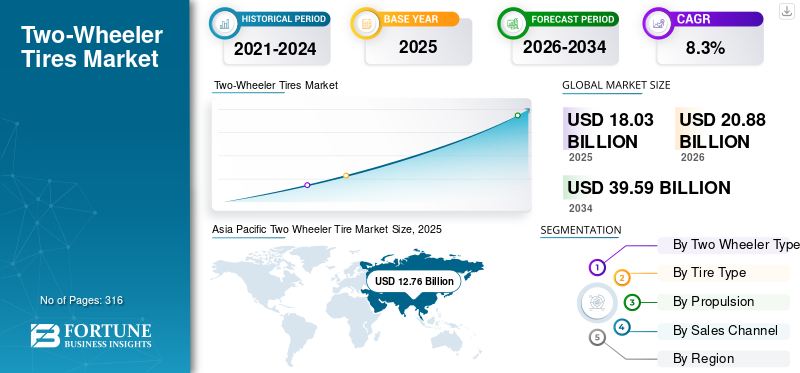
The two wheeler tire market size was valued at USD 18.03 billion in 2025. The market is projected to grow from USD 20.88 billion in 2026 to USD 39.59 billion by 2034, with a CAGR of 8.3% over the forecast period. Asia Pacific dominated the two wheeler tire market with a market share of 70.77% in 2025.
Two-wheeler tires are specialized rubber components designed to provide traction, stability, and safety for motorcycles, scooters, and mopeds. These tires are engineered to handle diverse road conditions, support varying loads, and ensure optimal performance through tread patterns, rubber compounds, and structural reinforcements.
The market growth is supported by rising motorcycle and scooter ownership, expanding urban mobility needs, increasing adoption of electric two-wheelers, and strong replacement tire demand. Growing e-commerce delivery fleets, motorcycle tourism, and premium motorcycle sales are further increasing tire consumption. Technological advancements such as radial construction, silica-rich compounds, and EV-specific tire designs are also supporting market expansion.
Leading companies, including Michelin, Bridgestone Corporation, Pirelli& C. S.p.A., Continental AG, and Cheng Shin/Maxxis, are focusing on premium radial tires, EV-compatible products, sustainable materials, and advanced compound technologies. The market is shifting toward high-performance, longer-lasting, and environmentally sustainable tires. At the same time, manufacturers continue to strengthen OEM partnerships and expand production capacities across regions including Asia Pacific to meet growing demand.
Download Free sample to learn more about this report.
Two-Wheeler Tires Market Key Takeaways
 Global Market Size & Forecast
- 2025 Market Size: USD 18.03 billion
- 2026 Market Size: USD 20.88 billion
- 2034 Forecast Market Size: USD 39.59 billion
- CAGR: 8.3% (2026–2034)
 Market Share
- Asia Pacific dominated the market with a 70.77% share in 2025.
- The radial segment dominates the market and is projected to grow at a 10.0% CAGR during the forecast period.
- The electric segment is expected to register the fastest growth, expanding at a 13.4% CAGR during the forecast period.
 Key Regional Highlights
Asia Pacific
Asia Pacific held the largest regional market share in 2025 and is expected to maintain its leading position during the forecast period.
North America
North America is projected to witness steady growth, driven by rising demand for premium, touring.
Europe
Europe is expected to witness steady growth, supported by increasing motorcycle tourism, premium motorcycle ownership, rising adoption of electric scooters.
U.S.
U.S. market is projected to reach USD 0.46 billion by 2026.
Japan
Japan market is projected to reach USD 0.42 billion by 2026.
Read More

TWO WHEELER TIRE MARKET TRENDS
Racing-Derived Innovations in Mainstream Two-Wheeler Tire Manufacturing is Emerging Market Trend
Tire manufacturers are increasingly utilizing professional racing environments as real-world testing platforms to develop advanced tire compounds, tread patterns, carcass structures, and performance-enhancing technologies that can later be incorporated into mass-market products. Motorsports provide an ideal environment for evaluating tire behavior under extreme acceleration, braking, cornering, temperature fluctuations, and surface conditions, enabling manufacturers to accelerate innovation and product validation. As a result, technologies once limited to professional racing applications are gradually becoming available in premium and mid-range replacement tires used by everyday riders.
This trend is particularly evident among leading manufacturers such as Michelin, Pirelli, Bridgestone, Continental, and Dunlop, all of which maintain strong connections with international motorcycle racing championships. Through participation in MotoGP, World Superbike (WorldSBK), Endurance World Championship (EWC), motocross championships, rally racing, and other competitive events, these companies continuously collect performance data that supports product development. The transfer of racing technologies into commercial products allows manufacturers to improve grip performance, wet-weather handling, tread durability, heat management, and rider safety while simultaneously strengthening brand credibility.
MARKET DYNAMICS
MARKET DRIVERS
Download Free sample to learn more about this report.
Expansion of Global Two-Wheeler Vehicle Parc and Rising Replacement Tire Consumption Drives Market Expansion
The continuous expansion of the two-wheeler vehicle parc remains a major factor supporting two wheeler tire market growth. Unlike passenger vehicles, motorcycles and scooters experience significantly higher tire replacement frequency due to direct road contact, exposure to uneven road surfaces, variable load conditions, intensive braking, and frequent urban commuting. Every new motorcycle or scooter sold today becomes a recurring source of replacement tire demand over its operational lifespan.
As a result, tire manufacturers benefit not only from Original-Equipment (OE) fitments supplied to vehicle manufacturers but also from a substantially larger, more profitable replacement market. This dynamic is particularly important in emerging economies, where two-wheelers are the primary mode of personal transportation due to affordability, fuel efficiency, and ease of maneuvering in congested urban environments.
Rapid urbanization, rising population density, and inadequate public transportation infrastructure in many developing countries continue to encourage the adoption of motorcycles and scooters. In the Asia Pacific, which accounts for the majority of global motorcycle ownership, two-wheelers are widely used for daily commuting, food delivery, courier services, ride-sharing, and rural mobility. Consequently, higher vehicle type utilization leads to accelerated tire wear, increasing replacement cycles and supporting steady aftermarket demand as rise in demand for two wheelers. Additionally, the growth of e-commerce and app-based delivery services has significantly increased daily mileage for motorcycles, leading to tires requiring more frequent replacement than those used for personal transportation alone.
MARKET RESTRAINTS
Volatility in Natural Rubber and Raw Material Prices Affects Market Expansion
The market remains highly dependent on raw materials, particularly natural rubber, synthetic rubber, carbon black, steel bead wire, textile cords, processing chemicals, and energy inputs. Among these materials, natural rubber plays a particularly critical role as it directly influences tire elasticity, traction, durability, heat resistance, and overall performance characteristics. Since natural rubber constitutes a significant portion of motorcycle tire manufacturing costs, fluctuations in rubber prices can substantially affect production economics and profit margins across the industry. This challenge is especially significant for manufacturers operating in highly competitive commuter motorcycle sectors where consumers are extremely price-sensitive and tire producers often have limited ability to pass cost increase directly to end users.
Natural rubber production is concentrated in a relatively small number of countries, including Thailand, Indonesia, Vietnam, Malaysia, and India. Consequently, adverse weather conditions, disease outbreaks affecting rubber plantations, labor shortages, geopolitical developments, export restrictions, and supply chain disruptions can rapidly influence global rubber availability and pricing. In addition, fluctuations in crude oil prices affect synthetic rubber costs, further complicating tire manufacturers' operations. Rising freight charges, energy costs, and logistics expenses can further compound cost pressures throughout the supply chain.
MARKET OPPORTUNITIES
Rapid Expansion of Electric Two-Wheelers Creates Demand for EV-Specific Tire Solutions
The rapid adoption of electric motorcycles and electric scooters is creating a significant growth opportunity for tire manufacturers worldwide. Unlike conventional Internal Combustion Engine (ICE) two-wheelers, electric two wheelers possess unique operational characteristics that require specially engineered tire solutions. Electric vehicles typically deliver instant torque, carry additional battery weight, operate extensively in stop-and-go urban environments, and emphasize energy efficiency. These characteristics create demand for tires with enhanced load-bearing capacity, optimized tread compounds, improved durability, low rolling resistance, reduced noise levels, and superior wet-weather performance.
As governments around the world continue to promote vehicle electrification through incentives, emissions-reduction targets, and urban mobility policies, electric two-wheelers are becoming increasingly popular across Asia Pacific, Europe, and parts of Latin America. The shift is particularly evident in countries such as India, China, Vietnam, Indonesia, and several European nations, where electric scooters and motorcycles are emerging as cost effective and environmentally friendly transportation alternatives. Each new electric two-wheeler entering the market represents a future stream of replacement tire demand, creating long-term growth opportunities for tire manufacturers.
MARKET CHALLENGES
Increasing Regulatory, Sustainability, and Supply Chain Traceability Requirements Challenges Market Development
The market is facing growing challenges associated with sustainability regulations, responsible sourcing requirements, and supply chain traceability obligations. Modern tire manufacturing relies heavily on natural rubber, synthetic rubber, carbon black, chemicals, steel components, and textile reinforcements sourced through complex international supply networks. As governments, regulators, investors, and consumers focus on environmental responsibility, tire manufacturers are increasingly required to demonstrate that raw materials are sourced ethically and legally, and that they do not contribute to deforestation or environmental degradation. Meeting these requirements is becoming more difficult due to the fragmented nature of global rubber supply chains.
Natural rubber supply chains often involve thousands of smallholder farmers, traders, processors, exporters, and intermediaries before materials reach tire production facilities. Tracking the origin of rubber across such a fragmented network requires extensive data collection, supplier verification, geolocation mapping, documentation systems, and compliance audits. Large multinational tire manufacturers possess greater resources to implement these systems, but smaller and regional manufacturers may face substantial financial and operational burdens. As a result, compliance requirements can increase administrative costs and create barriers for smaller market participants.
Segmentation Analysis
By Two Wheeler Type
Expanding Motorcycle Fleet Strengthens Motorcycle Tire Segment Growth
Based on the two-wheeler type, the market is segmented into scooters, motorcycles, and mopeds.
The motorcycle segment dominates the market owing to its large installed base, extensive use for daily commuting, commercial transportation, delivery services, and recreational riding. Motorcycles account for the majority of two-wheeler ownership across Asia Pacific, Latin America, and Africa, generating substantial OEM and replacement tire demand. Rising adoption of premium motorcycles, surging disposable incomes, growing adventure-touring activities, and increasing motorcycle usage in emerging economies continue to support segment growth.
The scooter segment is projected to grow at a CAGR of 9.0% over the forecast period, driven by urban mobility trends and expanding adoption of electric scooters. In January 2025, Honda Motor Co. announced that global motorcycle sales are expected to reach approximately 20.2 million units, reinforcing long-term demand for motorcycle tires.
To know how our report can help streamline your business, Speak to Analyst
By Tire Type
Superior Performance Characteristics Drive Radial Tire Segment Leadership
Based on tire type, the market is segmented into radial and bias.
The radial segment dominates the market and is projected to grow at a 10.0% CAGR over the forecast period, making it the fastest-growing tire category. Radial tires offer superior grip, heat dissipation, fuel efficiency, ride comfort, durability, and high-speed stability compared to conventional tubeless tires, bias tires. Increasing adoption of premium motorcycles, electric two-wheelers, sports bikes, and touring motorcycles is accelerating radial tire demand globally. Manufacturers continue investing in silica-rich compounds, multi-compound tread technologies, and EV-specific tire designs to enhance performance. For instance, in November 2024, Continental announced the expansion of its motorcycle tire manufacturing capabilities in Thailand to support growing global demand for radial motorcycle tires.
The bias segment holds a significant market presence, particularly in commuter motorcycles, mopeds, and entry-level scooters. Bias tires remain preferred in cost-sensitive markets due to their affordability, durability, ease of maintenance, and suitability for a wide range of road conditions.
By Propulsion
Growing Mobility Requirements Support Internal Combustion Engine Segment Dominance
Based on propulsion, the market is segmented into ICE and electric.
The ICE segment held the largest two wheeler tire market share due to the vast installed base of gasoline-powered motorcycles and scooters worldwide. Strong vehicle ownership across India, Indonesia, Vietnam, Thailand, Brazil, and several African nations continues to generate substantial replacement tire demand. ICE-powered motorcycles remain the preferred mobility solution in many developing regions due to affordability, increasing disposable income group, infrastructure availability, and operational convenience. Manufacturers continue introducing advanced tire technologies specifically designed for commuter and premium ICE motorcycles.
The electric segment is projected to grow at a CAGR of 13.4% over the forecast period, supported by accelerating electrification trends. In January 2026, the Indonesian Motorcycle Industry Association (AISI) reported motorcycle sales of approximately 6.41 million units in 2025, highlighting the large ICE vehicle base that supports tire demand.
By Sales Channel
Expanding Replacement Cycles Strengthen Aftermarket Segment Leadership
Based on sales channel, the market is segmented into OEM and aftermarket.
The aftermarket segment dominates the market and is projected to grow at 8.8% CAGR over the forecast period. The segment benefits from recurring tire replacement requirements, increasing vehicle utilization, expanding delivery fleets, and growing consumer focus on safety and performance. Since tires experience wear throughout their service life, replacement demand substantially exceeds OEM fitment demand. The growing global motorcycle parc and rising average vehicle usage continue to support strong aftermarket sales.
The OEM segment continues to play a critical role in market development by supplying tires directly to motorcycle and scooter manufacturers during vehicle production.
TWO WHEELER TIRE MARKET REGIONAL OUTLOOK
By geography, the market is categorized into Europe, North America, Asia Pacific, and Rest of the World.
North America
Asia Pacific Two Wheeler Tire Market Size, 2025 (USD Billion)
To get more information on the regional analysis of this market, Download Free sample
North America market growth is primarily driven by rising demand for premium, touring, and adventure motorcycles, as well as recreational riding activities. The region exhibits strong replacement tire demand due to high annual vehicle utilization and consumer preferences for premium radial tires. Tire manufacturers continue introducing high-performance products with improved grip, durability, and wet-weather performance. The North America market also benefits from growing adoption of electric motorcycles and expanding aftermarket distribution networks.
U.S. Two Wheeler Tire Market
The U.S. market accounted for USD 0.46 billion in 2026, representing the largest share of North American market. This demand is supported by strong ownership of touring, cruiser, adventure, and premium motorcycles. Consumers increasingly prefer high-performance radial tires that offer enhanced durability, ride comfort, and handling. Growing recreational riding culture, expanding power sports activities, and rising replacement tire demand continue to strengthen the country's leading position in North America.
Europe
Growth is supported by increasing motorcycle tourism, premium motorcycle ownership, rising adoption of electric scooters, and stringent vehicle safety standards. The region has a strong preference for radial tires, premium tire technologies, and environmentally sustainable products. Leading manufacturers such as Michelin, Pirelli, Continental, and Mitas continue investing in innovation and OEM partnerships, supporting both OEM and replacement tire demand across regional market.
U.K. Two Wheeler Tire Market
The U.K. market reached USD 0.19 billion in the two wheeler tires in 2026 and remains one of Europe's key two-wheeler tire markets. Growth is supported by rising motorcycle commuting, increasing scooter adoption in urban areas, and strong participation in leisure riding activities. Demand for premium touring and sport motorcycle tires continues to increase as riders prioritize safety, durability, and year-round riding performance.
Germany Two Wheeler Tire Market
Germany accounted for 19.2% of the European market in 2026, making it one of the region's largest contributors. The country benefits from a strong premium motorcycle parc, high motorcycle touring activity, and the presence of leading motorcycle OEMs and tire manufacturers. Demand remains particularly strong for sport-touring, adventure, and high-performance radial tires used across both OEM and replacement channels.
Asia Pacific
The region dominates the global market due to its massive motorcycle and scooter population, high vehicle production volumes, expanding urbanization, and increasing personal mobility requirements. Asia Pacific is also the world's largest manufacturing hub for motorcycles and tires. Strong replacement demand, growing delivery fleets, and rapid adoption of electric two-wheelers continue to support sustained market expansion across major economies.
China Two Wheeler Tire Market
China accounted for 32.9% of the Asia Pacific market in 2026, making it the dominant country within the region. The country benefits from extensive two-wheeler production capacity, significant adoption of electric scooters, and a well-established tire manufacturing ecosystem. Rising demand for electric mobility, urban transportation solutions, and replacement tires continues to strengthen China's leadership position in the regional market.
India Two Wheeler Tire Market
The Indian market is projected to grow at a CAGR of 10.0% over the forecast period, making it one of the fastest-growing country markets globally. Growth is driven by rising motorcycle ownership, expanding delivery and logistics services, increased rural mobility, and accelerating adoption of electric two-wheelers. The country also serves as a major manufacturing and export hub for leading tire companies, including MRF, CEAT, TVS Eurogrip, Apollo Tyres, and JK Tyre.
Japan Two Wheeler Tire Market
The Japan market was valued at USD 0.42 billion in 2026 and remains a significant premium motorcycle tire market. Demand is supported by strong adoption of high performance motorcycles, advanced tire technologies, and premium replacement products. The presence of major motorcycle OEMs and tire manufacturers, such as Bridgestone and Sumitomo Rubber, further underscores Japan's importance in the market.
Rest of the World
Growth of rest of the world region is driven by increasing motorcycle adoption across Latin America, the Middle East & Africa, where two-wheelers offer affordable, efficient transportation. Expanding urban populations, growing delivery services, and rising demand for low-cost mobility solutions continue to support tire consumption. Manufacturers are expanding regional distribution networks and strengthening aftermarket presence to capitalize on growing replacement demand.
The Latin American market is projected to grow at a CAGR of 8.3% over the forecast period, outperforming the broader Rest of the World region. This growth is supported by increasing motorcycle ownership in Brazil, Colombia, Argentina, and other developing economies. Motorcycles serve as essential transportation and income-generating assets, driving strong demand for both OEM and replacement tires, particularly in the commuter and utility motorcycle segments.
COMPETITIVE LANDSCAPE
Key Industry Players
Premium Tire Technologies, OEM Partnerships, and Global Manufacturing Expansion Define Competitive Landscape
The two wheeler tires market is moderately consolidated, with a group of established international manufacturers controlling a significant share of premium motorcycle, scooter, radial tire, and OEM fitment segments. Similarly, numerous regional players compete in high-volume commuter and replacement markets. Leading companies, including Michelin, Bridgestone Corporation, Pirelli& C. S.p.A., Continental AG, Cheng Shin/Maxxis, Sumitomo Rubber Industries Ltd., MRF Limited, TVS Eurogrip, and CEAT Limited, compete through advanced tire technologies, extensive product portfolios, strong OEM relationships, and broad distribution networks. To strengthen their competitive position, manufacturers are increasingly investing in silica-rich compounds, multi-compound tread designs, EV-specific tire technologies, sustainable materials, and smart manufacturing capabilities. Strategic OEM partnerships, production capacity expansions, motorsport participation, and the development of a global aftermarket network continue to differentiate market leaders. Companies are also focusing on regional manufacturing localization and supply-chain optimization to improve cost competitiveness and responsiveness to evolving consumer requirements across both mature and emerging two-wheeler markets. In November 2024, Continental announced the expansion of motorcycle tire production capabilities in Thailand to support growing global demand and strengthen its international manufacturing footprint.
LIST OF KEY TWO-WHEELER TIRES COMPANIES PROFILED
- Bridgestone Corporation (Japan)
- The Goodyear Tire & Rubber Company (U.S.)
- Continental AG (Germany)
- Michelin (France)
- Pirelli & C. S.p.A. (Italy)
- Apollo Tyres Ltd. (India)
- Sumitomo Rubber Industries Ltd. (Japan)
- Yokohama Rubber Co., Ltd. (Japan)
- Cheng Shin/Maxxis (Taiwan)
- CEAT Limited (India)
- MRF Limited (India)
- TVS Eurogrip (India)
- JK Tyre & Industries Ltd. (India)
- Asian Tyre Factory (ATF) (India)
- Shinko Group (South Korea)
KEY INDUSTRY DEVELOPMENTS
- May 2026: Bridgestone India expanded its premium retail network by opening two new Bridgestone Select Stores in Guwahati, Assam. The outlets provide tire sales, fitment, wheel alignment, balancing, and customer support services, strengthening the company’s reach in Northeast India and enhancing accessibility to premium tire products.
- February 2026: CST Tyres extended its partnership with the CFMOTO Thunder Racing Team for the FIA-FIM World Rally-Raid Championship. The collaboration supports CST’s motorcycle tire development program through competitive rally testing while strengthening brand visibility within international off-road motorcycle racing.
- January 2026: Michelin announced the new MICHELIN Anakee Adventure 2 trail motorcycle tire. The company said it would be available worldwide from January 2026 and positioned it as the flagship of its Trail range, alongside Road 6, Anakee Road, and Anakee Wild.
- October 2025: Continental introduced the ContiSportAttack 5 supersport motorcycle tire, developed for racetrack performance and road use. The tire offers rapid warm-up, strong grip, cornering stability, and precise steering, with market availability planned from the first quarter of 2026.
- June 2025: TVS Eurogrip continued as technical partner for the PETRONAS TVS India One Make Championship for the seventh consecutive year. Eurogrip tires were fitted to race-tuned TVS Apache motorcycles under motorsport conditions to support tire performance validation and product development.
REPORT COVERAGE
The two wheeler tire market growth report provides an in-depth study of the market size & forecast across all market segments included in the report. It contains details on market research dynamics and trends expected to drive the market during the forecast period. It offers information on rapid technological advancements, new product launches, key industry developments, strategic partnerships, mergers & acquisitions. The market forecast provides a comprehensive competitive landscape, including the most significant global market shares, emerging opportunities, and profiles of key players.
Request for Customization to gain extensive market insights.
Report Scope & Segmentation
| ATTRIBUTE | DETAILS |
| Study Period | 2021-2034 |
| Base Year | 2025 |
| Estimated Year | 2026 |
| Forecast Period | 2026-2034 |
| Historical Period | 2021-2024 |
| Growth Rate | CAGR of 8.3%from 2026 to 2034 |
| Unit | Value (USD billion) Volume (Thousand Units) |
| Segmentation | By Two Wheeler Type, By Tire Type, By Propulsion, By Sales Channel, and By region. |
| By Two Wheeler Type |
|
| By Tire Type |
|
| By Propulsion |
|
| By Sales Channel |
|
| By Region |
|
Frequently Asked Questions
Fortune Business Insights says that the global market value stood at USD 18.03 billion in 2025 and is projected to reach USD 39.59 billion by 2034.
In 2025, the Asia Pacific market value stood at USD 12.76 billion.
The market is expected to grow at a CAGR of 8.3% during the forecast period of 2026 - 2034.
The aftermarket segment led the market by sales channel type.
Rising motorcycle and scooter ownership, expanding urban mobility needs, increasing adoption of electric two-wheelers, and strong replacement tire demand are driving market momentum.
Key major players include Michelin, Bridgestone Corporation, Pirelli & C.S.p.A., Continental AG, and Cheng Shin/Maxxis.
Asia Pacific accounted for the largest share of the market.
North America, Europe, Asia Pacific, and the rest of the world.



- 2021-2034
- 2025
- 2021-2024
- 316
-
(Offer valid till 15th Oct 2026)
Get 30-60 hrs Free Customization
Expand Regional and Country Coverage, Segments Analysis, Company Profiles, Competitive Benchmarking, and End-user Insights.




















-
US +1 833 909 2966 ( Toll Free )
-
Get In Touch With Us