Ultrafiltration Market Size, Share & Industry Analysis, By Type (Polymeric, Ceramic), By Module (Tubular, Plate and Frame), By Application (Industrial Treatment), By Region, and Regional Forecast, 2026-2034
 Download Free Sample
Ultrafiltration Market Overview
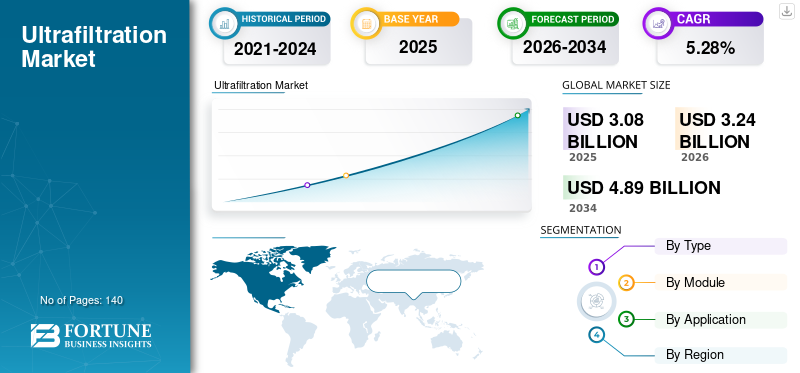
The ultrafiltration market size was valued at USD 3.08 billion in 2025. The market is projected to grow from USD 3.24 billion in 2026 to USD 4.89 billion by 2034, exhibiting a CAGR of 5.28% during the forecast period.

The ultrafiltration market is expanding steadily due to rising adoption of advanced membrane filtration systems across industrial water treatment, food processing, pharmaceuticals, biotechnology, and municipal wastewater applications. Ultrafiltration technology is widely used for removing suspended solids, bacteria, viruses, colloids, and high-molecular-weight substances from liquids while maintaining operational efficiency. Increasing emphasis on water reuse, stricter environmental regulations, and demand for sustainable filtration systems are strengthening the Ultrafiltration industry analysis across developed and emerging economies. Industrial operators are increasingly integrating automated ultrafiltration modules into manufacturing facilities to reduce operational downtime and improve process reliability. The ultrafiltration market report also highlights growing integration of smart monitoring systems, modular filtration infrastructure, and high-performance polymeric membranes.
The USA ultrafiltration market is witnessing strong demand from industrial treatment plants, semiconductor manufacturing facilities, food and beverage processors, and pharmaceutical manufacturers. Water scarcity concerns and regulatory pressure related to wastewater discharge are accelerating deployment of ultrafiltration systems across municipalities and industrial clusters in the United States. The country is also experiencing higher investments in decentralized water treatment infrastructure and membrane-based purification technologies. Advanced membrane research initiatives and modernization of aging water infrastructure are contributing to strong ultrafiltration market growth in the USA. Industrial treatment remains a major application area as companies seek efficient purification solutions with reduced chemical usage and improved operational sustainability.
Download Free sample to learn more about this report.
Ultrafiltration Market Key Takeaways
 Global Market Size & Forecast
- 2025 Market Size: USD 3.08 Billion
- 2026 Market Size: USD 3.24 Billion
- 2034 Forecast Market Size: USD 4.89 Billion
- CAGR: 5.28% from 2026-2034
 Market Share
- Asia-Pacific dominated with a revenue share of 36% in 2025.
- Polymeric membranes accounted for approximately 68% of the market share.
- Industrial treatment applications held approximately 58% of the market share.
 Key Regional Highlights
Asia-Pacific
Asia-Pacific led the market with a 36% share, supported by expanding industrialization and investments in wastewater treatment infrastructure.
North America
North America accounted for 31% of the market, driven by rising demand for advanced water treatment and recycling solutions.
Europe
Europe held a 27% share, supported by strong pharmaceutical, food processing, and industrial treatment sectors.
U.S.
The U.S. market is supported by increasing investments in industrial wastewater treatment and water reuse technologies.
Japan
Japan accounted for 24% of the Asia-Pacific market, supported by advanced industrial purification and ceramic membrane adoption.
Read More

Ultrafiltration Market Latest trends
The ultrafiltration market trends indicate a growing transition toward energy-efficient membrane technologies and intelligent filtration systems capable of real-time performance monitoring. Industrial facilities are increasingly replacing conventional filtration methods with ultrafiltration membranes because of their lower maintenance requirements and enhanced separation efficiency. Smart membrane systems integrated with digital sensors and predictive maintenance platforms are becoming increasingly popular in industrial water treatment applications. Manufacturers are also focusing on membrane durability, fouling resistance, and improved throughput to support large-scale industrial operations.
Download Free sample to learn more about this report.
Another important trend in the ultrafiltration market analysis is the increasing use of ceramic membranes in harsh industrial environments such as chemical processing and mining. Ceramic ultrafiltration systems offer improved thermal stability and chemical resistance, making them suitable for high-temperature operations. In addition, the food and beverage sector is increasingly adopting ultrafiltration technology for dairy concentration, beverage clarification, and protein separation applications. Sustainability initiatives and circular water economy programs are also encouraging wastewater recycling projects, creating strong demand for modular ultrafiltration solutions. Emerging economies are investing heavily in municipal water treatment infrastructure, supporting long-term ultrafiltration market opportunities for membrane manufacturers and system integrators.
Ultrafiltration Market Dynamics
DRIVER
Increasing Demand for Advanced Industrial Water Treatment Solutions
The primary driver supporting ultrafiltration market growth is the increasing demand for advanced industrial water treatment systems capable of delivering high purification efficiency with reduced environmental impact. Industrial sectors including pharmaceuticals, power generation, food processing, chemicals, electronics, and mining are facing stricter wastewater discharge standards, creating substantial demand for membrane-based filtration technologies. Ultrafiltration systems provide effective removal of bacteria, suspended solids, and organic contaminants while reducing chemical treatment dependency. This operational advantage is accelerating adoption across manufacturing facilities and municipal treatment plants.
The Ultrafiltration industry report indicates that industrial operators are prioritizing water reuse and sustainable manufacturing practices to reduce operational costs and improve environmental compliance. Ultrafiltration systems are increasingly integrated into zero-liquid-discharge facilities and advanced wastewater recycling plants. Governments are also supporting water infrastructure modernization programs, particularly in urban regions facing freshwater scarcity. In addition, the rising requirement for purified process water in pharmaceutical and semiconductor manufacturing is contributing significantly to ultrafiltration market Demand. Manufacturers are introducing automated membrane cleaning systems and advanced monitoring technologies that improve membrane lifespan and operational reliability, further strengthening market expansion.
RESTRAINT
High Installation and Membrane Replacement Costs
One of the major restraints affecting the ultrafiltration market is the relatively high capital investment associated with membrane filtration systems. Advanced ultrafiltration units require specialized infrastructure, automated monitoring systems, pressure vessels, pumps, and pretreatment components, increasing overall installation costs for industrial users. Small and medium-scale industries often face financial limitations when adopting sophisticated ultrafiltration systems, especially in developing economies where budget constraints remain significant.
Another challenge within the ultrafiltration market analysis is membrane fouling and periodic replacement requirements. Membranes exposed to high contaminant concentrations may experience clogging, reduced permeability, and operational inefficiencies over time. Frequent cleaning and maintenance procedures can increase operational expenditures and downtime for industrial facilities. Ceramic membranes offer improved durability but involve higher procurement costs compared to polymeric alternatives. Additionally, industries using older conventional filtration systems may hesitate to shift toward ultrafiltration due to integration complexity and employee training requirements. These cost-related concerns continue to restrain adoption rates in price-sensitive markets despite strong long-term operational benefits.
OPPORTUNITY
Expansion of Wastewater Recycling and Reuse Projects
The expansion of wastewater recycling and industrial water reuse initiatives presents substantial ultrafiltration market opportunities across global regions. Governments and industrial organizations are investing in sustainable water management infrastructure to address rising freshwater scarcity and increasing environmental concerns. Ultrafiltration systems play a critical role in wastewater recovery processes by enabling effective contaminant separation and improved water quality for reuse applications. Industrial facilities are increasingly adopting closed-loop water management systems that integrate ultrafiltration technologies to reduce freshwater dependency.
The ultrafiltration market forecast indicates rising opportunities in sectors such as desalination pretreatment, pharmaceutical processing, food manufacturing, and biotechnology. Municipal treatment authorities are also implementing advanced membrane filtration systems to improve drinking water quality and comply with stricter health standards. In emerging economies, rapid urbanization and industrialization are generating significant demand for decentralized water treatment systems. Technological innovations in membrane materials, anti-fouling coatings, and automated monitoring platforms are further creating opportunities for product differentiation. Increasing investments in smart cities and industrial infrastructure modernization programs are expected to generate long-term demand for scalable ultrafiltration solutions.
CHALLENGE
Operational Complexity and Membrane Fouling Issues
Operational complexity remains a significant challenge within the ultrafiltration market. Membrane-based systems require continuous monitoring of pressure, flow rate, temperature, and contaminant levels to maintain filtration efficiency. Industrial facilities operating under variable feedwater conditions may experience inconsistent membrane performance, requiring skilled technical personnel for process optimization. Inadequate pretreatment systems can also increase membrane fouling rates and reduce overall operational efficiency.
Membrane fouling continues to represent a major technical challenge in the Ultrafiltration industry analysis. Organic matter accumulation, microbial growth, scaling, and particulate deposition can decrease membrane permeability and increase energy consumption. Cleaning procedures involving chemicals and backwashing may improve performance temporarily but can also affect membrane lifespan over extended operational periods. Industrial users often face difficulties balancing operational costs with filtration efficiency. Furthermore, fluctuating raw material prices for membrane manufacturing and supply chain disruptions may impact production costs for ultrafiltration equipment manufacturers. These operational and technical challenges are encouraging companies to invest heavily in membrane research, predictive maintenance technologies, and next-generation anti-fouling materials.
Ultrafiltration Market Segmentation
By Type
Polymeric membranes dominate the ultrafiltration market share with approximately 68% contribution due to their cost-effectiveness, flexibility, and broad industrial compatibility. These membranes are widely used in municipal water treatment, food processing, biotechnology, pharmaceuticals, and industrial wastewater treatment applications. Polymeric ultrafiltration membranes are commonly manufactured using materials such as polysulfone, polyethersulfone, and polyvinylidene fluoride. Their lightweight structure and scalable manufacturing capabilities make them suitable for large-volume industrial deployments. The ultrafiltration market research report highlights increasing demand for polymeric membranes because of their lower installation costs and improved operational efficiency. Manufacturers are focusing on advanced polymer formulations with enhanced fouling resistance and longer membrane life. Polymeric membranes are also gaining traction in dairy processing, beverage clarification, and pharmaceutical filtration due to their ability to deliver consistent separation performance. Their compatibility with automated filtration systems and modular treatment infrastructure supports widespread adoption across industrial and municipal treatment facilities. North America and Asia-Pacific remain major markets for polymeric ultrafiltration systems due to ongoing investments in industrial water infrastructure.
Ceramic membranes account for nearly 32% of the ultrafiltration market Size and are gaining popularity in demanding industrial applications requiring high thermal stability and chemical resistance. These membranes are manufactured using materials such as alumina, zirconia, and titania, making them highly durable under aggressive operating conditions. Ceramic ultrafiltration systems are increasingly deployed in chemical processing, mining, oil and gas, and high-temperature wastewater treatment operations. The ultrafiltration market Insights indicate that ceramic membranes are preferred in applications where long operational lifespan and resistance to harsh chemicals are critical. Although ceramic membranes involve higher initial investment costs, their extended service life and reduced replacement frequency provide long-term economic advantages for industrial users. Technological advancements are improving membrane pore uniformity, filtration efficiency, and cleaning compatibility, supporting broader adoption across industrial treatment facilities. Growing emphasis on sustainable wastewater recycling and zero-liquid-discharge systems is also contributing to increased deployment of ceramic ultrafiltration technologies. Europe and Japan are among the leading regions adopting advanced ceramic membrane solutions for industrial purification applications.
By Module
Tubular ultrafiltration modules hold approximately 44% of the ultrafiltration market share due to their strong suitability for high-solid-content industrial streams and challenging wastewater applications. These modules feature large flow channels that reduce clogging risks and enable effective handling of viscous fluids. Industries such as food processing, mining, pulp and paper, and chemical manufacturing commonly use tubular ultrafiltration systems because of their operational reliability under difficult processing conditions. The ultrafiltration market outlook indicates that tubular systems are increasingly preferred for industrial wastewater recycling projects where feedwater quality fluctuates significantly. Their robust construction allows effective operation under high pressure and elevated contaminant concentrations. Manufacturers are improving tubular membrane designs with advanced cleaning systems and automated pressure controls to enhance operational efficiency. Tubular modules also support higher cross-flow velocity, reducing membrane fouling and extending operational lifespan. Industrial treatment facilities continue to invest in tubular ultrafiltration systems to improve wastewater recovery rates and achieve environmental compliance objectives.
Plate and frame ultrafiltration modules represent around 26% of the ultrafiltration market Size and are widely adopted in applications requiring compact filtration systems and easier membrane replacement. These modules are designed with stacked membrane plates that allow efficient cleaning and maintenance procedures. Plate and frame systems are commonly used in biotechnology, pharmaceutical processing, dairy concentration, and specialty chemical filtration. The ultrafiltration market analysis demonstrates growing demand for plate and frame systems because of their modular configuration and operational flexibility. These modules are particularly suitable for industries requiring precise separation and product recovery processes. Their compact footprint makes them attractive for facilities with limited installation space. Manufacturers are introducing improved gasket materials and membrane support structures to increase durability and reduce operational leakage risks. Food and beverage manufacturers are increasingly adopting plate and frame ultrafiltration systems for protein concentration and beverage clarification applications. Europe remains a significant market for these modules due to strong pharmaceutical and dairy processing industries.
By Application
Industrial treatment applications contribute nearly 58% of the ultrafiltration market share, making this segment the largest application category globally. Industrial facilities are increasingly deploying ultrafiltration systems to treat wastewater, recover valuable process materials, and reduce freshwater consumption. Sectors including pharmaceuticals, food processing, chemicals, power generation, electronics, and oil and gas rely heavily on ultrafiltration technologies to meet environmental regulations and improve operational sustainability. The Ultrafiltration industry analysis indicates that rising industrialization and stricter wastewater discharge standards are major factors supporting growth in this segment. Industrial treatment facilities are integrating ultrafiltration with reverse osmosis and advanced oxidation systems to improve water quality and support reuse initiatives. Smart monitoring systems, automated cleaning technologies, and energy-efficient membrane designs are improving operational efficiency in industrial treatment plants. Asia-Pacific and North America remain key growth regions due to expanding manufacturing sectors and increasing investment in wastewater recycling infrastructure. Industrial treatment applications are expected to maintain strong dominance within the ultrafiltration market forecast due to rising sustainability commitments from manufacturing companies.
Ultrafiltration Market Regional outlook
North America
North America accounts for approximately 31% of the ultrafiltration market share due to strong investments in advanced water treatment infrastructure, industrial wastewater recycling, and municipal purification projects. The region has a mature industrial base with significant demand from pharmaceuticals, biotechnology, food processing, and semiconductor manufacturing sectors. The United States remains the leading contributor within the region because of extensive industrial treatment requirements and modernization of aging municipal water systems.
The ultrafiltration market report highlights increasing adoption of smart filtration technologies across North America. Industrial facilities are integrating digital monitoring systems and predictive maintenance solutions to improve membrane performance and reduce operational costs. Environmental regulations related to wastewater discharge and water reuse are encouraging wider deployment of ultrafiltration systems. Canada is also experiencing rising demand for membrane filtration technologies in mining and municipal treatment applications. Increasing investment in sustainable water infrastructure and industrial automation continues to support long-term market expansion across the region.
Europe
Europe represents nearly 27% of the ultrafiltration market Size and remains a major regional hub for membrane technology innovation and sustainable water treatment solutions. Strict environmental regulations, advanced industrial infrastructure, and increasing adoption of circular water economy practices are supporting market growth across the region. European countries are prioritizing wastewater reuse and industrial resource optimization, creating strong demand for ultrafiltration systems.
The ultrafiltration market research report indicates that pharmaceutical manufacturing, food processing, and industrial wastewater treatment are key application sectors across Europe. Companies in the region are investing heavily in advanced membrane materials, energy-efficient filtration systems, and digital monitoring technologies. Municipal authorities are also modernizing water treatment facilities to comply with stricter drinking water quality standards. Growing investments in green industrial projects and sustainable manufacturing initiatives are expected to strengthen the European Ultrafiltration industry outlook over the coming years.
Germany Ultrafiltration Market
Germany contributes approximately 29% of the European ultrafiltration market share due to its advanced manufacturing sector and strong industrial wastewater management infrastructure. The country has significant demand for ultrafiltration systems in automotive manufacturing, chemicals, pharmaceuticals, food processing, and industrial engineering applications. German industrial facilities are increasingly integrating membrane filtration systems into sustainable production processes to reduce freshwater consumption and improve environmental compliance.
The Germany ultrafiltration market analysis highlights rising investment in smart water treatment systems and advanced membrane research. German engineering companies are actively developing high-performance ceramic and polymeric membranes with enhanced fouling resistance and operational durability. Municipal treatment authorities are also investing in modernization of wastewater recycling infrastructure to support sustainable urban development. Strong industrial automation capabilities and advanced environmental regulations continue to position Germany as a major innovation center within the global ultrafiltration industry.
United Kingdom Ultrafiltration Market
The United Kingdom accounts for nearly 21% of the European ultrafiltration market share due to increasing investments in municipal water infrastructure and industrial wastewater treatment systems. The country is witnessing growing adoption of membrane filtration technologies in pharmaceuticals, biotechnology, dairy processing, and food manufacturing applications. Water utility companies are upgrading treatment facilities to improve purification efficiency and reduce environmental risks associated with wastewater discharge.
The United Kingdom ultrafiltration market outlook indicates increasing emphasis on decentralized water treatment systems and sustainable industrial practices. research institutions and private companies are collaborating on advanced membrane technologies designed to improve operational efficiency and reduce energy consumption. Industrial treatment facilities across the United Kingdom are also implementing automated monitoring systems to improve membrane maintenance and process reliability. Growing awareness regarding water reuse and stricter environmental compliance requirements are supporting long-term expansion of the ultrafiltration market within the country.
Asia-Pacific
Asia-Pacific holds around 36% of the ultrafiltration market share, making it the fastest-growing regional market globally. Rapid industrialization, urbanization, rising population levels, and increasing water scarcity concerns are driving substantial investments in advanced water treatment infrastructure across the region. Countries such as China, Japan, India, and South Korea are heavily investing in municipal wastewater treatment and industrial purification systems.
The ultrafiltration market forecast for Asia-Pacific remains highly favorable due to strong manufacturing growth and expanding pharmaceutical, food processing, and semiconductor industries. Governments across the region are implementing stricter environmental regulations and supporting wastewater recycling initiatives. Industrial operators are increasingly adopting ultrafiltration systems to improve operational sustainability and reduce freshwater dependency. Rising infrastructure development projects and smart city initiatives are expected to further strengthen market demand across Asia-Pacific.
Japan Ultrafiltration Market
Japan contributes approximately 24% of the Asia-Pacific ultrafiltration market share due to advanced industrial infrastructure and strong adoption of high-performance membrane technologies. Japanese industries prioritize precision filtration systems for semiconductor manufacturing, pharmaceuticals, food processing, and electronics production. The country is known for its advanced membrane research capabilities and innovation in ceramic ultrafiltration technologies.
The Japan ultrafiltration market Insights reveal increasing deployment of automated filtration systems integrated with digital monitoring platforms. Japanese manufacturers are focusing on compact, energy-efficient ultrafiltration solutions suitable for high-purity industrial applications. Municipal treatment authorities are also investing in advanced water recycling systems to address freshwater management concerns. Aging infrastructure modernization and increasing focus on sustainable industrial operations continue to support ultrafiltration market expansion in Japan.
China Ultrafiltration Market
China represents nearly 41% of the Asia-Pacific ultrafiltration market share due to rapid industrialization, extensive manufacturing activity, and substantial investments in wastewater treatment infrastructure. Industrial sectors including chemicals, textiles, power generation, electronics, and food processing are generating strong demand for ultrafiltration systems. Government policies supporting environmental protection and industrial wastewater management are accelerating adoption of membrane filtration technologies across the country.
The China ultrafiltration market report highlights increasing deployment of ultrafiltration systems in municipal treatment projects and industrial recycling facilities. Domestic manufacturers are expanding membrane production capacities and investing in advanced polymeric membrane technologies. Rising urbanization and increasing water scarcity concerns are encouraging large-scale implementation of wastewater reuse projects. China continues to remain one of the most significant growth markets for ultrafiltration system suppliers due to strong industrial infrastructure development and environmental modernization initiatives.
Rest of World
The Rest of World region accounts for approximately 6% of the ultrafiltration market share and includes Latin America, the Middle East, and Africa. These regions are experiencing increasing investments in desalination, municipal water treatment, and industrial wastewater recycling infrastructure. Water scarcity and rapid urban development are key factors driving adoption of membrane filtration systems across several emerging economies.
The ultrafiltration market opportunities within the Rest of World region are supported by government-led infrastructure modernization projects and increasing industrialization. Middle Eastern countries are integrating ultrafiltration systems into desalination pretreatment facilities to improve operational efficiency and water quality. Mining and food processing sectors in Latin America are also adopting membrane filtration technologies for wastewater treatment and resource recovery. Increasing awareness regarding sustainable water management and environmental compliance is expected to support continued ultrafiltration market expansion across these developing regions.
List of Top Ultrafiltration Companies
- Berghof Membrane Technology GmbH (BMT)
- Applied Membranes, Inc.
- PALL CORPORATION
- MERCK KGAA
- 3M
- AECOM
- Trucent
- DuPont
- Genex Utility
- Pentair plc
- FUMATECH BWT GmbH
- Synder Filtration, Inc.
- STERLITECH CORPORATION
Top Two Companies with Highest Market share
- DuPont – 14% market share
- PALL CORPORATION – 11% market share
Investment analysis and opportunities
The ultrafiltration market is attracting strong investment activity due to increasing global demand for sustainable water treatment technologies and industrial purification systems. Public and private organizations are allocating substantial funding toward wastewater recycling infrastructure, desalination pretreatment projects, and advanced industrial filtration systems. Investors are particularly focused on membrane manufacturers developing energy-efficient and anti-fouling membrane technologies capable of reducing operational costs for industrial users.
The ultrafiltration market opportunities are expanding across Asia-Pacific, North America, and the Middle East due to growing water scarcity concerns and rapid industrial development. Venture capital firms and industrial technology companies are supporting research into smart membrane systems integrated with artificial intelligence and predictive maintenance platforms. Industrial sectors such as pharmaceuticals, semiconductors, food processing, and biotechnology are expected to generate long-term investment opportunities for ultrafiltration equipment suppliers. Government incentives supporting sustainable water management and industrial wastewater recycling are also encouraging infrastructure expansion projects. Companies investing in modular treatment systems and decentralized water purification technologies are expected to gain competitive advantages in the evolving ultrafiltration industry.
New Product Development
Innovation remains a major focus area within the ultrafiltration market as manufacturers introduce advanced membrane materials, compact filtration systems, and automated monitoring technologies. Companies are increasingly developing next-generation polymeric membranes with improved permeability, higher fouling resistance, and enhanced operational lifespan. Ceramic membrane manufacturers are also focusing on advanced pore structures and thermal stability improvements for harsh industrial applications.
The ultrafiltration market trends indicate rising adoption of smart filtration systems equipped with sensors and remote monitoring platforms that enable predictive maintenance and operational optimization. Manufacturers are introducing modular ultrafiltration units designed for decentralized water treatment facilities and mobile purification applications. New developments in nanotechnology and membrane surface coatings are improving filtration performance while reducing energy consumption. Several companies are also launching hybrid filtration systems that integrate ultrafiltration with reverse osmosis and biological treatment technologies to improve purification efficiency. Product innovation remains critical for companies seeking differentiation within the highly competitive global ultrafiltration industry.
Five Recent Developments (2023-2025)
- DuPont expanded its advanced ultrafiltration membrane production capacity to support increasing industrial water treatment demand in Asia-Pacific.
- Pentair introduced a modular smart ultrafiltration platform featuring automated monitoring and predictive maintenance capabilities for industrial facilities.
- 3M launched upgraded membrane filtration materials with enhanced fouling resistance for pharmaceutical and biotechnology applications.
- PALL CORPORATION developed advanced ultrafiltration solutions for semiconductor manufacturing and high-purity industrial processing systems.
- Multiple research institutions in Asia collaborated on nano-structured membrane technologies designed to improve wastewater recycling efficiency and reduce industrial energy consumption.
report Coverage of Ultrafiltration Market
The ultrafiltration market report provides comprehensive analysis of industry trends, technological developments, competitive landscape, regional outlook, segmentation analysis, and emerging business opportunities across the global market. The report evaluates key market dynamics influencing adoption of ultrafiltration systems in industrial treatment, municipal water purification, pharmaceuticals, food processing, biotechnology, and chemical manufacturing applications.
Request for Customization to gain extensive market insights.
The ultrafiltration market research report also examines advancements in polymeric and ceramic membrane technologies, operational challenges associated with membrane fouling, and strategic investments in sustainable water infrastructure. Regional analysis covers North America, Europe, Asia-Pacific, and Rest of World markets with country-level insights for Germany, the United Kingdom, Japan, and China. The report includes assessment of leading manufacturers, market share analysis, product development strategies, and industrial investment trends shaping the future of the ultrafiltration industry. Market participants can use the report to evaluate growth opportunities, competitive positioning, supply chain developments, and emerging demand trends within the global ultrafiltration sector.
Frequently Asked Questions
Fortune Business Insights says that the global market value stood at USD 3.07 billion in 2025 and is projected to reach USD 4.89 billion by 2034.
The market is expected to exhibit a CAGR of 5.28% during the forecast period of 2026-2034.
Polymeric membranes were the leading type segment, accounting for approximately 68% of the market share. Their cost-effectiveness, flexibility, and broad industrial compatibility support their dominance.
Key players include DuPont, PALL CORPORATION, Merck KGaA, 3M, AECOM, and Pentair plc.
Major trends include the shift toward energy-efficient smart membrane systems and increasing adoption of ceramic membranes in demanding industrial applications. Asia-Pacific led the market with a 36% regional share.



- 2021-2034
- 2025
- 2021-2024
- 140
-

(Offer valid till 30th Sep 2026)
Get 30-60 hrs Free Customization
Expand Regional and Country Coverage, Segments Analysis, Company Profiles, Competitive Benchmarking, and End-user Insights.








-
US +1 833 909 2966 ( Toll Free )
-
Get In Touch With Us