Ultrasound Image Analysis Software Market Size, Share & Industry Analysis, By Type (Integrated, Standalone), By Product (2D, 3D & 4D, Doppler Imaging), By Application (Orthopedic, Dental, Cardiology), By Region, and Regional Forecast, 2026-2034
 Download Free Sample
Ultrasound Image Analysis Software Market Overview
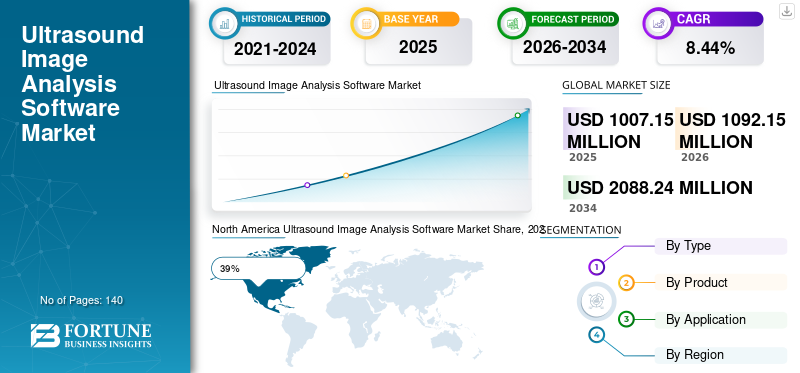
The ultrasound image analysis software market size was valued at USD 1007.15 Million in 2025. The market is projected to grow from USD 1092.15 Million in 2026 to USD 2088.24 Million by 2034, exhibiting a CAGR of 8.44% during the forecast period.

The ultrasound image analysis software market is experiencing strong adoption across healthcare systems due to the increasing need for accurate diagnostic imaging, automated interpretation, workflow optimization, and AI-assisted clinical decision-making. Hospitals, diagnostic imaging centers, specialty clinics, and research institutions are integrating advanced ultrasound image analysis platforms to improve image quality, reduce interpretation variability, and support real-time clinical assessments. The market is also benefiting from growing utilization of cloud-connected imaging ecosystems, machine learning algorithms, and advanced visualization technologies. Rising demand for cardiovascular, obstetric, musculoskeletal, and abdominal imaging continues to support broader implementation of ultrasound image analysis software solutions across healthcare environments.
The United States ultrasound image analysis software market remains a leading contributor to global demand due to widespread healthcare digitization, strong adoption of artificial intelligence technologies, and increasing use of advanced imaging software in hospitals and outpatient diagnostic facilities. Healthcare providers are investing in software platforms capable of automated lesion detection, image enhancement, measurement standardization, and clinical reporting integration. The presence of established imaging technology providers and growing deployment of point-of-care ultrasound systems are further supporting market expansion. Demand remains particularly strong across cardiology, radiology, obstetrics, emergency medicine, and oncology departments seeking enhanced diagnostic efficiency and workflow automation.
Download Free sample to learn more about this report.
Ultrasound Image Analysis Software Market Key Takeaways
 Global Market Size & Forecast
- 2025 Market Size: USD 1,007.15 Million
- 2026 Market Size: USD 1,092.15 Million
- 2034 Forecast Market Size: USD 2,088.24 Million
- CAGR: 8.44% from 2026-2034
 Market Share
- The market in North America dominated with a revenue share of 39% in 2025.
- Integrated software dominated by type with a market share of approximately 62%.
- Cardiology dominated by application with a market share of approximately 31%.
 Key Regional Highlights
North America
North America led the market with a 39% share, supported by advanced healthcare infrastructure and strong adoption of ultrasound imaging technologies.
Europe
Europe accounted for 28% of the market, driven by established diagnostic facilities and increasing adoption of advanced imaging software.
Asia-Pacific
Asia-Pacific held a 25% share, supported by expanding healthcare infrastructure and growing demand for advanced diagnostic solutions.
U.S
The U.S. remains a key market, supported by advanced healthcare infrastructure and strong demand for innovative ultrasound imaging solutions.
Japan
Japan accounted for approximately 24% of the Asia-Pacific market, supported by advanced healthcare technologies and growing adoption of diagnostic imaging software.
Read More

Ultrasound Image Analysis Software Market Latest Trends
Artificial intelligence integration represents one of the most influential ultrasound image analysis software market Trends. Healthcare providers increasingly rely on AI-powered software for image segmentation, anatomical recognition, automated measurements, and diagnostic support. Advanced algorithms are helping clinicians identify abnormalities faster while reducing interpretation inconsistencies. The growing acceptance of deep learning technologies is encouraging vendors to introduce software platforms capable of real-time image optimization and predictive analytics.
Download Free sample to learn more about this report.
Another significant trend in the ultrasound image analysis software industry analysis is the migration toward cloud-based imaging environments. Medical facilities are adopting centralized image management systems that allow remote access, collaborative diagnosis, and seamless integration with electronic health records. Demand for portable ultrasound devices is also accelerating software innovation, encouraging developers to create lightweight applications compatible with mobile and handheld imaging systems. In addition, software vendors are focusing on automated reporting tools, advanced 3D visualization capabilities, and workflow-centric platforms designed to improve productivity while maintaining diagnostic precision.
Ultrasound Image Analysis Software Market Dynamics
DRIVER
Increasing Adoption of Ai-Assisted Diagnostic Imaging
The primary driver influencing ultrasound image analysis software market growth is the rapid integration of artificial intelligence into diagnostic imaging workflows. Healthcare providers face growing pressure to improve diagnostic accuracy while managing increasing patient volumes. AI-enabled ultrasound software helps automate measurements, identify anatomical structures, reduce manual processing requirements, and support clinical decision-making. These capabilities significantly improve efficiency and help reduce variability between operators.
Hospitals and imaging centers are increasingly implementing software solutions that provide real-time analysis, advanced image enhancement, automated reporting, and predictive clinical insights. Rising prevalence of cardiovascular disorders, cancer, liver diseases, and pregnancy-related monitoring requirements further strengthens software demand. The expansion of telemedicine and remote diagnostics has also encouraged healthcare organizations to invest in scalable ultrasound image analysis platforms. These factors continue to create strong demand for sophisticated software solutions across developed and emerging healthcare markets.
RESTRAINT
High Implementation Complexity and Integration Costs
A major restraint affecting the ultrasound image analysis software market outlook is the complexity associated with software deployment and integration. Healthcare institutions often operate diverse imaging infrastructures, making interoperability a significant concern. Integrating advanced ultrasound analysis software with hospital information systems, picture archiving systems, and electronic medical records frequently requires substantial technical expertise and organizational resources.
Many small and mid-sized healthcare facilities face budget limitations that slow adoption of premium software platforms. Staff training requirements further increase deployment challenges because clinicians must adapt to new workflows and software functionalities. Regulatory compliance obligations and cybersecurity requirements also create additional implementation burdens. As healthcare organizations seek secure and interoperable imaging ecosystems, software vendors must continuously invest in compatibility, user training, and data protection capabilities to overcome these barriers.
OPPORTUNITY
Expansion of Cloud-Based and Remote Diagnostic Platforms
One of the most attractive ultrasound image analysis software market opportunities lies in cloud-enabled imaging solutions. Healthcare systems are increasingly prioritizing remote accessibility, centralized image storage, and collaborative clinical workflows. Cloud-based software platforms allow physicians to access ultrasound studies from multiple locations, accelerating diagnostic review and specialist consultations.
Growing demand for tele-ultrasound services is creating additional opportunities for software developers. Emerging markets are investing in digital healthcare infrastructure, enabling broader implementation of cloud-connected diagnostic technologies. Furthermore, increasing use of handheld ultrasound devices requires software capable of supporting mobile diagnostics and remote image interpretation. Vendors offering scalable, AI-powered, and cloud-compatible solutions are expected to benefit from expanding adoption across hospitals, clinics, and community healthcare settings.
CHALLENGE
Data Standardization and Regulatory Compliance Requirements
A significant challenge in the ultrasound image analysis software market is maintaining consistency across diverse imaging systems and healthcare environments. Ultrasound images vary considerably depending on equipment specifications, operator techniques, and patient characteristics. Developing software capable of delivering consistent performance across these variables remains technically demanding.
Regulatory approval processes represent another challenge for software providers. Advanced imaging algorithms, particularly AI-based solutions, require extensive validation before clinical deployment. Vendors must demonstrate reliability, accuracy, and patient safety while complying with evolving healthcare regulations. Additionally, concerns regarding patient data privacy and cybersecurity continue to influence purchasing decisions. Addressing these challenges requires ongoing investment in software validation, security infrastructure, and interoperability standards, increasing development complexity for market participants.
Ultrasound Image Analysis Software Market Segmentation
By Type
Integrated software accounts for approximately 62% of the ultrasound image analysis software market share. These solutions are embedded directly into ultrasound imaging systems or connected enterprise imaging platforms. Healthcare providers prefer integrated solutions because they support seamless workflow management, real-time image processing, and direct interoperability with hospital information systems.
Integrated platforms are widely utilized in large hospitals and diagnostic centers where efficiency and centralized imaging management are critical. Advanced functionalities such as automated measurements, AI-assisted diagnostics, image archiving, and structured reporting further strengthen demand. Healthcare organizations increasingly prioritize integrated software because it reduces workflow disruptions and enhances clinician productivity. As digital imaging ecosystems become more sophisticated, integrated solutions continue to maintain a dominant position within the ultrasound image analysis software market Research Report landscape.
Standalone software represents nearly 38% of the market and serves healthcare providers seeking flexibility and cost-efficient deployment options. These solutions can operate independently of imaging hardware, allowing organizations to analyze ultrasound images acquired from multiple equipment manufacturers.
Standalone platforms are particularly valuable in research facilities, specialty clinics, and smaller diagnostic centers. They often provide advanced image analysis capabilities, customizable reporting tools, and compatibility with external image databases. Demand is increasing as healthcare providers seek vendor-neutral solutions capable of supporting diverse clinical workflows. The ability to upgrade software independently from imaging hardware also makes standalone platforms attractive for organizations aiming to modernize diagnostic capabilities while controlling infrastructure costs.
To know how our report can help streamline your business, Speak to Analyst
By Product
The 2D ultrasound segment holds approximately 45% of the ultrasound image analysis software market size due to its widespread clinical utilization and established diagnostic value. Image analysis software designed for 2D ultrasound systems supports routine examinations across cardiology, obstetrics, abdominal imaging, and musculoskeletal assessments.
Healthcare facilities continue to rely heavily on 2D imaging because of its accessibility, affordability, and diagnostic reliability. Software developers are enhancing these systems through automated measurement tools, image enhancement algorithms, and AI-assisted interpretation capabilities. The growing focus on workflow optimization has encouraged adoption of advanced 2D analysis software that improves efficiency without requiring substantial hardware upgrades.
The 3D and 4D ultrasound segment accounts for approximately 33% of market demand. These advanced imaging technologies provide detailed anatomical visualization and support more comprehensive clinical evaluations. Image analysis software for 3D and 4D systems enables volumetric measurements, anatomical modeling, and enhanced visualization of complex structures.
Obstetrics, gynecology, cardiology, and surgical planning applications are major growth areas for this segment. Healthcare providers increasingly utilize advanced visualization capabilities to improve diagnostic confidence and patient communication. Software innovations focusing on automated reconstruction, AI-assisted segmentation, and real-time rendering continue to strengthen market demand.
Doppler imaging represents nearly 22% of the market and remains essential for evaluating blood flow, vascular conditions, and cardiovascular health. Ultrasound image analysis software developed for Doppler applications provides advanced flow measurement tools, vessel tracking capabilities, and quantitative assessment features.
The increasing prevalence of cardiovascular diseases continues to support demand for Doppler-specific software solutions. Hospitals and specialty cardiac centers rely on these platforms to improve diagnostic accuracy and monitor treatment outcomes. Vendors are introducing AI-enhanced Doppler analysis tools capable of reducing interpretation time while improving measurement consistency.
By Application
Orthopedic applications account for approximately 24% of the ultrasound image analysis software market. Healthcare providers use ultrasound imaging to evaluate soft tissue injuries, tendon disorders, ligament damage, and musculoskeletal abnormalities. Advanced software platforms assist clinicians by providing image enhancement, anatomical tracking, and measurement automation capabilities.
The growing preference for non-invasive diagnostic methods supports continued expansion within orthopedic imaging. Sports medicine clinics and rehabilitation centers increasingly adopt ultrasound image analysis software to improve treatment planning and patient monitoring. Enhanced visualization and workflow efficiency remain major purchasing considerations within this application segment.
Dental applications represent around 19% of market demand. Dental professionals are increasingly adopting ultrasound imaging technologies for periodontal assessments, implant planning, and oral soft tissue evaluations. Image analysis software enables detailed visualization while minimizing patient exposure to ionizing radiation.
Technological advancements are expanding the clinical utility of ultrasound within dentistry. Software solutions offering real-time image enhancement, measurement tools, and diagnostic support capabilities are gaining attention among specialized dental practices. Growing awareness of non-radiative imaging methods further contributes to segment growth.
Cardiology remains the leading application segment with approximately 31% market share. Ultrasound image analysis software plays a critical role in echocardiography, cardiac function assessment, valve analysis, and blood flow evaluation. Advanced software solutions support automated chamber measurements, strain analysis, and real-time diagnostic interpretation.
Rising prevalence of cardiovascular disorders continues to drive substantial demand for sophisticated cardiology imaging platforms. Healthcare providers increasingly utilize AI-assisted software to improve diagnostic accuracy and reduce examination times. Ongoing innovation in cardiac imaging analytics strengthens the position of cardiology as a key revenue-generating application within the Ultrasound Image Analysis Software Industry Report.
Ultrasound Image Analysis Software Market Regional Outlook
North America
North America Ultrasound Image Analysis Software Market Share, 2026 (%)
To get more information on the regional analysis of this market, Download Free sample
North America accounts for approximately 39% of the global ultrasound image analysis software market share. The region benefits from advanced healthcare infrastructure, high adoption of digital imaging technologies, and strong investments in artificial intelligence applications. Healthcare organizations continue to prioritize software platforms that improve diagnostic precision, streamline workflows, and support enterprise imaging strategies.
The region also benefits from the presence of major technology providers and extensive clinical research activity. Hospitals and diagnostic centers increasingly invest in advanced ultrasound software to address growing patient volumes and improve operational efficiency. Demand remains particularly strong across cardiology, radiology, emergency medicine, and oncology departments.
Europe
Europe represents approximately 28% of the ultrasound image analysis software market. Growing healthcare modernization initiatives, increasing utilization of AI-driven diagnostics, and widespread adoption of digital imaging systems support market expansion throughout the region. Healthcare providers are actively investing in software solutions that improve clinical efficiency and diagnostic consistency.
Government support for healthcare digitization and medical technology innovation continues to create favorable conditions for software adoption. Research collaborations between healthcare institutions and technology developers are accelerating development of advanced image analysis capabilities. Strong regulatory frameworks and quality standards further support market growth across European healthcare systems.
Germany Ultrasound Image Analysis Software Market
Germany contributes approximately 29% of the European ultrasound image analysis software market. The country benefits from a highly developed healthcare infrastructure, advanced medical technology ecosystem, and strong commitment to clinical innovation. Hospitals and specialty clinics are increasingly implementing software solutions that improve image interpretation accuracy and workflow performance.
German healthcare providers actively invest in AI-enabled diagnostic platforms capable of supporting cardiology, radiology, and oncology applications. The presence of leading medical technology manufacturers further strengthens domestic software adoption. Increasing focus on digital healthcare transformation and interoperability continues to encourage deployment of advanced ultrasound image analysis solutions throughout the country.
United Kingdom Ultrasound Image Analysis Software Market
The United Kingdom accounts for approximately 22% of the European market. Healthcare organizations across the country are investing in imaging software platforms that improve diagnostic efficiency and support broader healthcare digitization initiatives. Hospitals increasingly utilize advanced ultrasound analysis technologies to address growing demand for rapid and accurate diagnostic services.
Artificial intelligence adoption is gaining momentum across public and private healthcare facilities. Software capable of automating measurements, generating structured reports, and supporting clinical decision-making is attracting substantial interest. Continued investment in healthcare modernization programs and imaging infrastructure upgrades supports long-term demand for ultrasound image analysis solutions.
Asia-Pacific
Asia-Pacific holds approximately 25% of the ultrasound image analysis software market and remains one of the most dynamic regional markets. Expanding healthcare infrastructure, growing patient populations, and increasing demand for advanced diagnostic technologies are driving software adoption across the region.
Healthcare providers are embracing digital imaging platforms to improve accessibility, efficiency, and diagnostic quality. Government initiatives supporting healthcare modernization and medical technology development are creating favorable market conditions. Rising investments in artificial intelligence and telehealth solutions further strengthen demand for advanced ultrasound image analysis software throughout Asia-Pacific.
Japan Ultrasound Image Analysis Software Market
Japan represents approximately 24% of the Asia-Pacific market. The country's aging population and strong focus on advanced healthcare technologies contribute significantly to software adoption. Healthcare institutions increasingly utilize ultrasound image analysis platforms to support cardiovascular, oncological, and preventive healthcare applications.
Japanese medical technology companies continue to invest heavily in imaging innovation and artificial intelligence research. Advanced software solutions capable of improving diagnostic precision and workflow efficiency are widely adopted across hospitals and specialty clinics. Strong research capabilities and established healthcare infrastructure continue to support market development.
China ultrasound image analysis software market
China accounts for approximately 37% of the Asia-Pacific ultrasound image analysis software market. Rapid healthcare infrastructure expansion, increasing diagnostic imaging demand, and strong government support for digital healthcare initiatives are accelerating software adoption. Hospitals are investing in advanced imaging technologies to address rising patient volumes and improve clinical outcomes.
Domestic technology companies are actively developing AI-powered diagnostic platforms tailored to local healthcare requirements. Growing deployment of cloud-based imaging systems and telemedicine services further strengthens demand. Continued investment in healthcare modernization and medical innovation positions China as a key growth market for ultrasound image analysis software solutions.
Rest of World
The Rest of World region accounts for approximately 8% of global market demand. Countries across Latin America, the Middle East, and Africa are gradually expanding healthcare infrastructure and investing in advanced diagnostic technologies. Demand for ultrasound image analysis software is increasing as healthcare providers seek cost-effective solutions that improve diagnostic accuracy.
Growing awareness of early disease detection, expanding healthcare access, and increasing adoption of digital health technologies contribute to market growth. International technology providers are actively pursuing partnerships and distribution agreements to strengthen their regional presence. Government healthcare modernization programs continue to support broader implementation of advanced imaging software platforms.
List of Top Ultrasound Image Analysis Software Companies
- Koninklijke Philips N.V.
- Neusoft Corporation
- CANON MEDICAL SYSTEMS CORPORATION
- Deep Rui Medical (Deepwise)
- Agfa-Gevaert Group
- Bruker
- Siemens Healthineers AG
- MIM Software, Inc.
- ESAOTE SPA
- Infervision
Top Two Companies by Market Share
- Siemens Healthineers AG – 18%
- Koninklijke Philips N.V. – 16%
Investment Analysis and Opportunities
Investment activity in the ultrasound image analysis software market continues to accelerate as healthcare providers seek advanced diagnostic technologies capable of improving efficiency and clinical outcomes. Venture capital firms, healthcare technology investors, and strategic corporate investors are increasingly focusing on AI-powered imaging platforms, cloud-based diagnostic systems, and workflow automation solutions.
Significant opportunities exist within emerging markets where healthcare infrastructure modernization remains a priority. Investors are particularly interested in companies developing scalable software solutions compatible with portable ultrasound systems and telemedicine environments. Partnerships between software developers, imaging equipment manufacturers, and healthcare organizations continue to create new commercialization opportunities. Growing demand for predictive analytics, automated image interpretation, and integrated diagnostic ecosystems further strengthens investment potential throughout the market.
New Product Development
Innovation remains a defining characteristic of the ultrasound image analysis software market. Vendors are introducing next-generation platforms that combine artificial intelligence, machine learning, and advanced visualization technologies. New software products increasingly feature automated lesion detection, image segmentation, workflow optimization, and structured reporting capabilities.
Cloud-native architectures are becoming more common as healthcare providers demand flexible and remotely accessible imaging solutions. Developers are also enhancing compatibility with handheld and point-of-care ultrasound devices. Real-time image processing, predictive analytics, and personalized diagnostic support functions are emerging as key differentiators. Product development efforts increasingly focus on improving user experience while delivering higher levels of diagnostic accuracy and clinical efficiency.
Five Recent Developments (2023–2025)
- Samsung Medison acquired fetal ultrasound AI software company Sonio SAS to strengthen AI-powered ultrasound capabilities in 2024.
- Major ultrasound software vendors expanded cloud-based imaging and remote diagnostic platform offerings across healthcare networks.
- AI-assisted cardiac ultrasound analysis solutions received broader clinical adoption in hospital systems worldwide.
- Several imaging software providers introduced automated measurement and reporting modules for workflow optimization.
- Increased collaboration between imaging equipment manufacturers and AI software developers accelerated integrated platform development.
Report Coverage
The ultrasound image analysis software market report provides detailed evaluation of market dynamics, competitive positioning, technology developments, regional demand patterns, and application-specific opportunities. The study examines software deployment models, product categories, clinical applications, and emerging technology trends influencing future market evolution.
Request for Customization to gain extensive market insights.
The report further analyzes competitive strategies adopted by leading companies, including product innovation, strategic partnerships, acquisitions, and geographic expansion initiatives. Regional assessments highlight market opportunities across North America, Europe, Asia-Pacific, and Rest of World regions. The scope also includes evaluation of investment activity, healthcare digitization trends, artificial intelligence adoption, and evolving customer requirements across hospitals, diagnostic centers, and specialty clinics. The ultrasound image analysis software market Forecast provides actionable insights for investors, manufacturers, distributors, healthcare providers, and technology developers seeking growth opportunities within the industry.
Frequently Asked Questions
Fortune Business Insights says that the global market value stood at USD 1,007.15 million in 2025 and is projected to reach USD 2,088.24 million by 2034.
The market is expected to exhibit a CAGR of 8.44% during the forecast period of 2026-2034.
Cardiology led the application segment with approximately 31% market share, driven by the growing use of ultrasound software for echocardiography, cardiac function assessment, and automated cardiac measurements.
Key players include Siemens Healthineers AG, Koninklijke Philips N.V., Neusoft Corporation, CANON MEDICAL SYSTEMS CORPORATION, Deep Rui Medical (Deepwise), and Agfa-Gevaert Group.
Major trends include increasing AI and deep learning integration and the shift toward cloud-based imaging and remote diagnostics. North America led with approximately 39% market share.



- 2021-2034
- 2025
- 2021-2024
- 140
-

(Offer valid till 15th Oct 2026)
Get 30-60 hrs Free Customization
Expand Regional and Country Coverage, Segments Analysis, Company Profiles, Competitive Benchmarking, and End-user Insights.













.webp)






-
US +1 833 909 2966 ( Toll Free )
-
Get In Touch With Us