Ultraviolet Disinfection Equipment Market Size, Share & Industry Analysis, By Component Type (UV Lamps, Ballasts/Controller Units), By End Use (Municipal, Residential), By Application, By Country, and Regional Forecast, 2026-2034
 Download Free Sample
Ultraviolet Disinfection Equipment Market Size & Overview
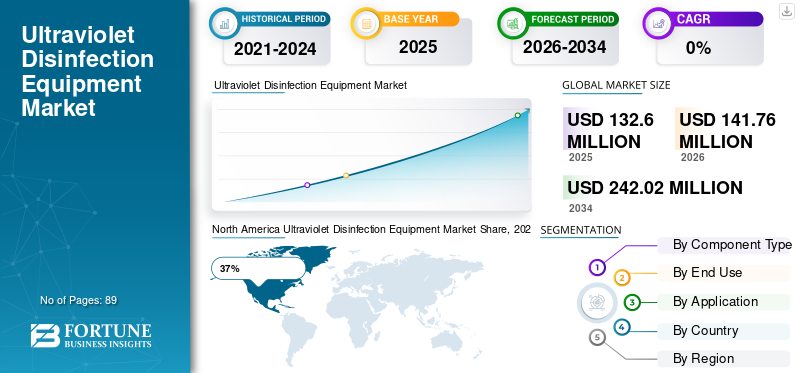
The global ultraviolet disinfection equipment market size was valued at USD 132.59 billion in 2025. The market is projected to grow from USD 141.76 billion in 2026 to USD 242.01 billion by 2034, exhibiting a CAGR of 6.91% during the forecast period.

The global ultraviolet disinfection equipment market is witnessing substantial expansion due to growing awareness regarding safe water treatment, air purification, and industrial sanitation technologies. Ultraviolet disinfection equipment uses UV-C radiation to eliminate harmful microorganisms without chemical additives, making it an environmentally sustainable treatment solution. Industries including healthcare, pharmaceuticals, food processing, municipal water treatment, and commercial infrastructure are rapidly integrating ultraviolet systems into operational processes. The ultraviolet disinfection equipment market report highlights rising demand for compact, energy-efficient, and automated UV systems capable of supporting continuous disinfection operations. Increasing public concern regarding microbial contamination and stricter hygiene regulations are further accelerating ultraviolet disinfection equipment market growth worldwide.
The USA ultraviolet disinfection equipment market continues to demonstrate strong technological adoption across municipal, industrial, healthcare, and residential sectors. Water utilities in the United States are actively modernizing purification facilities with advanced ultraviolet treatment systems to reduce dependence on chemical disinfectants. Healthcare facilities are integrating ultraviolet air sterilization and surface disinfection technologies to improve infection prevention standards. Commercial infrastructure including airports, educational institutions, and office buildings is also investing in UV-based HVAC purification systems. The USA ultraviolet disinfection equipment market analysis indicates rising consumer demand for residential ultraviolet purification units due to increasing awareness regarding water safety, indoor air quality, and sustainable sanitation technologies.
Download Free sample to learn more about this report.
Ultraviolet Disinfection Equipment Market Key Takeaways
 Global Market Size & forecast
- 2025 Market Size: USD 132.59 Billion
- 2026 Market Size: USD 141.76 Billion
- 2034 forecast Market Size: USD 242.01 Billion
- CAGR: 6.91% from 2026-2034
 Market Share
- North America dominated with a 37% market share in 2025.
- UV lamps led by component type with a 69% market share.
- Municipal applications led by end use with a 62% market share.
 Key Regional Highlights
North America
North America held the largest regional share at 37%.
Europe
Europe accounted for 29% of the global market.
Asia-Pacific
Asia-Pacific represented 26% of the global market.
U.S.
The U.S. market is supported by rising investments in water treatment, air purification, and sanitation infrastructure.
Japan
Japan accounted for 22% of the Asia-Pacific market, driven by advanced water treatment and disinfection technologies.
Read More

Ultraviolet Disinfection Equipment Market Latest Trends
The ultraviolet disinfection equipment market trends reveal increasing demand for UV-C LED technology due to its longer operational life, lower maintenance requirements, and reduced energy consumption compared to conventional mercury-based systems. Manufacturers are focusing on smart ultraviolet disinfection equipment integrated with IoT-enabled sensors, digital monitoring platforms, and predictive maintenance capabilities. These innovations are improving system efficiency and reducing operational downtime in municipal and industrial treatment facilities. Compact ultraviolet purification devices are also becoming increasingly popular in residential and small commercial environments where space-efficient and portable solutions are preferred.
Another significant trend shaping the ultraviolet disinfection equipment industry analysis is the rapid deployment of ultraviolet air purification systems in healthcare facilities, transportation hubs, hospitality infrastructure, and commercial buildings. Growing awareness regarding indoor air contamination and airborne pathogens is driving installation of UV-based HVAC sanitation systems. Food processing and pharmaceutical industries are increasingly adopting ultraviolet sterilization technologies for packaging lines, clean rooms, and production environments to maintain strict hygiene standards. The ultraviolet disinfection equipment market forecast further highlights increasing investments in decentralized water treatment infrastructure, particularly in regions experiencing water scarcity and aging municipal sanitation systems.
Download Free sample to learn more about this report.
Ultraviolet Disinfection Equipment Market Dynamics
DRIVER
Increasing Demand for Chemical-Free Disinfection Technologies
The growing preference for environmentally safe and chemical-free sanitation methods is one of the strongest drivers supporting the ultraviolet disinfection equipment market growth. Traditional chlorine-based treatment methods often generate harmful by-products that create environmental and health concerns. Ultraviolet disinfection systems provide an effective alternative by eliminating microorganisms without altering water chemistry or leaving residual contaminants. Municipal water authorities, industrial facilities, and healthcare institutions are increasingly adopting ultraviolet treatment technologies to improve operational sustainability and meet evolving environmental regulations.
The ultraviolet disinfection equipment market insights indicate rising investments in advanced water purification and air sanitation systems across healthcare, food processing, pharmaceutical, and hospitality industries. Public awareness regarding waterborne diseases and airborne contamination has increased significantly, encouraging commercial and residential adoption of ultraviolet purification technologies. Municipal infrastructure modernization projects are further contributing to demand for large-scale ultraviolet reactor systems. Increasing implementation of UV disinfection in wastewater recycling and industrial water reuse applications is also supporting long-term market expansion. These factors collectively strengthen the global ultraviolet disinfection equipment industry report and support consistent technological innovation across the sector.
RESTRAINT
High Operational and Installation Costs
High installation expenses remain a major restraint affecting the size of the ultraviolet disinfection equipment market. Large-scale ultraviolet disinfection infrastructure requires sophisticated reactor chambers, advanced controller systems, monitoring sensors, and specialized maintenance services, increasing overall project costs. Municipalities and industrial facilities with limited budgets may delay adoption due to high upfront capital requirements. Small businesses and residential users in developing economies also face affordability challenges when considering advanced ultraviolet purification systems.
The ultraviolet disinfection equipment market outlook further indicates that operational efficiency can decline if systems are not maintained properly. UV lamps require periodic replacement, and quartz sleeves may accumulate deposits that reduce treatment effectiveness. Water quality issues such as turbidity and suspended particles can also impact ultraviolet penetration and disinfection efficiency. These operational complexities create additional maintenance costs and require trained personnel for system management. Competition from conventional disinfection methods with lower initial investment requirements continues to limit faster adoption in certain regional markets. Manufacturers are therefore under pressure to improve affordability, energy efficiency, and long-term operational reliability.
OPPORTUNITY
Expansion of Decentralized Water Treatment Infrastructure
The growing focus on decentralized water treatment systems presents major opportunities for the ultraviolet disinfection equipment market opportunities segment. Rapid urbanization, population growth, and increasing pressure on aging municipal infrastructure are encouraging governments to invest in compact and localized purification technologies. Ultraviolet disinfection systems are particularly suitable for decentralized applications because they operate efficiently without large chemical storage requirements. Rural communities, educational institutions, healthcare facilities, and residential complexes are increasingly adopting compact ultraviolet systems to improve water safety and sanitation standards.
The ultraviolet disinfection equipment market research report highlights expanding opportunities in industrial water recycling and wastewater reuse applications. Manufacturing sectors are actively investing in sustainable treatment technologies to reduce freshwater dependency and improve environmental compliance. Portable ultraviolet purification devices are also gaining popularity in disaster management operations, military facilities, and temporary infrastructure projects. Technological advancements in solar-powered UV systems and UV-C LED solutions are expected to create new commercial opportunities across developing economies. Increasing awareness regarding sustainability and environmental protection continues to strengthen investment potential within the ultraviolet disinfection equipment industry.
CHALLENGE
Efficiency Limitations in Contaminated Water Environments
One of the primary challenges influencing the ultraviolet disinfection equipment market analysis is reduced system effectiveness in water containing suspended solids, organic matter, or high turbidity levels. Ultraviolet rays require direct exposure to microorganisms for effective disinfection, and contaminated water conditions can block UV penetration. Industrial wastewater streams often require multiple pre-treatment stages before ultraviolet treatment, increasing infrastructure complexity and operational costs. Facilities operating in regions with inconsistent water quality may experience fluctuating disinfection performance.
The ultraviolet disinfection equipment market report also identifies technical and regulatory challenges associated with large-scale deployment. Different countries maintain varying operational standards and certification requirements for ultraviolet treatment systems, creating compliance difficulties for global manufacturers. Inadequate technical expertise and inconsistent electricity infrastructure in developing regions may affect long-term operational reliability. Manufacturers additionally face increasing pressure to transition away from mercury-based lamps toward environmentally sustainable alternatives. Balancing cost efficiency, regulatory compliance, and technological innovation remains a significant challenge for industry participants operating within the global ultraviolet disinfection equipment market.
Ultraviolet Disinfection Equipment Market Segmentation
By Component Type
UV lamps account for approximately 69% of the ultraviolet disinfection equipment market share due to their essential role in water, air, and surface disinfection systems. These lamps emit ultraviolet radiation that destroys microorganisms including bacteria, viruses, and fungi by damaging their genetic structure. Municipal wastewater treatment facilities remain among the largest consumers of UV lamp systems because of increasing demand for chemical-free purification technologies. Healthcare facilities, pharmaceutical production units, and food processing industries are also rapidly expanding usage of ultraviolet lamp-based sanitation infrastructure to improve contamination control.
The ultraviolet disinfection equipment market research report highlights rising adoption of low-pressure and medium-pressure UV lamp technologies based on treatment intensity requirements and operational capacity. Manufacturers are increasingly focusing on energy-efficient amalgam UV lamps capable of providing higher output with lower power consumption. UV lamp demand is also increasing in commercial HVAC purification systems where ultraviolet treatment improves indoor air quality and reduces microbial accumulation. Continuous innovation in lamp durability, compact design, and operational efficiency is strengthening the competitive landscape of the ultraviolet disinfection equipment industry analysis globally.
Ballasts and controller units contribute nearly 31% of the ultraviolet disinfection equipment market size and are critical for maintaining stable operational performance of ultraviolet systems. These components regulate electrical current, monitor lamp intensity, optimize energy consumption, and ensure system reliability. Increasing deployment of automated ultraviolet treatment infrastructure across municipal and industrial facilities is significantly boosting demand for advanced controller technologies. Smart ballast systems equipped with digital interfaces and remote monitoring capabilities are becoming standard features in modern ultraviolet disinfection equipment.
The ultraviolet disinfection equipment market trends indicate increasing demand for intelligent control systems integrated with IoT connectivity and predictive maintenance functions. Facility operators are prioritizing controller units capable of providing real-time operational diagnostics, automated fault detection, and performance analytics. Commercial buildings, hospitals, and transportation infrastructure are increasingly adopting advanced controller technologies to improve efficiency of ultraviolet air purification systems. Manufacturers are also developing compact ballast solutions designed for residential and small commercial purification units where space optimization and simplified installation are critical factors. Continuous advancement in digital control technologies is expected to support long-term growth across this market segment.
To know how our report can help streamline your business, Speak to Analyst
By End Use
Municipal applications represent approximately 62% of the global ultraviolet disinfection equipment market share due to increasing investments in public water treatment and wastewater recycling infrastructure. Municipal authorities worldwide are adopting ultraviolet disinfection technologies to meet strict environmental regulations and improve drinking water safety. Ultraviolet treatment systems effectively eliminate pathogens without generating hazardous chemical by-products, making them highly suitable for large-scale municipal operations. Urban population growth and rising concerns regarding water contamination are further accelerating installation of high-capacity ultraviolet reactor systems.
The ultraviolet disinfection equipment market forecast highlights strong demand for decentralized municipal purification projects, particularly in developing economies facing sanitation challenges. Governments are investing heavily in sustainable water treatment infrastructure capable of supporting long-term environmental goals. Wastewater reuse initiatives and industrial recycling programs are also contributing to increasing municipal adoption of ultraviolet technologies. Smart monitoring systems, automated operational controls, and energy-efficient reactor designs are improving treatment reliability and operational efficiency for municipal utilities. These developments continue to strengthen the municipal segment within the global ultraviolet disinfection equipment industry.
Residential applications account for nearly 38% of the ultraviolet disinfection equipment market outlook due to rising consumer awareness regarding drinking water quality and indoor hygiene standards. Homeowners are increasingly adopting ultraviolet purification systems to eliminate bacteria, viruses, and microorganisms without using chemical disinfectants. Compact point-of-entry and point-of-use ultraviolet devices are becoming popular in urban apartments, suburban homes, and rural communities where water contamination concerns are growing. Increasing demand for environmentally friendly and low-maintenance purification technologies is also supporting residential market expansion.
The ultraviolet disinfection equipment market insights reveal growing interest in smart residential purification systems equipped with automated monitoring functions and energy-efficient UV-C LED technology. Consumers are also investing in ultraviolet air purification systems integrated into household HVAC networks to improve indoor air quality. Rising availability of portable and affordable ultraviolet disinfection devices through online distribution channels is increasing product accessibility across developing regions. Manufacturers are focusing on user-friendly designs, compact installation formats, and enhanced operational reliability to strengthen their position in the residential ultraviolet disinfection equipment market.
Ultraviolet Disinfection Equipment Market Regional Outlook
North America
North America Ultraviolet Disinfection Equipment Market Share, 2026 (%) To get more information on the regional analysis of this market, Download Free sample
North America holds nearly 37% of the global ultraviolet disinfection equipment market share due to advanced municipal infrastructure, strong environmental regulations, and high adoption of sustainable sanitation technologies. The United States and Canada continue to invest heavily in wastewater treatment modernization projects that incorporate ultraviolet disinfection systems for drinking water purification and sewage treatment. Healthcare facilities, pharmaceutical manufacturers, and food processing companies are major users of ultraviolet sterilization technologies throughout the region. Commercial buildings and educational institutions are increasingly integrating UV-based HVAC purification systems to improve indoor environmental quality.
The ultraviolet disinfection equipment market analysis for North America also highlights growing residential demand for compact ultraviolet water purification systems. Consumers are prioritizing chemical-free purification technologies that provide safe drinking water and improved household hygiene. Strong technological innovation and established manufacturing capabilities support regional market leadership. Municipal water recycling initiatives and industrial sustainability programs continue to drive installation of high-capacity ultraviolet systems across the region. North America remains one of the most technologically advanced markets within the global ultraviolet disinfection equipment industry.
Europe
Europe accounts for approximately 29% of the global ultraviolet disinfection equipment market share due to strict environmental policies and increasing focus on sustainable water treatment technologies. European governments are actively replacing chlorine-based purification methods with ultraviolet systems to reduce chemical discharge and improve environmental safety. Municipal wastewater treatment modernization projects are generating significant demand for ultraviolet reactors, digital monitoring systems, and advanced control technologies. Food processing industries and pharmaceutical manufacturers are also major adopters of ultraviolet sterilization systems throughout Europe.
The ultraviolet disinfection equipment market research report indicates rising demand for ultraviolet air purification systems across hospitals, transportation hubs, commercial buildings, and hospitality facilities in Europe. Indoor air quality management has become a major priority for public infrastructure operators and commercial organizations. Industrial recycling initiatives and water reuse programs are further strengthening demand for ultraviolet treatment systems. Continuous innovation in UV-C LED technologies and automated operational controls is supporting long-term market expansion across the European ultraviolet disinfection equipment industry.
Germany Ultraviolet Disinfection Equipment Market
Germany represents nearly 25% of the European ultraviolet disinfection equipment market share due to its strong industrial infrastructure and advanced environmental compliance standards. Municipal utilities across Germany are increasingly deploying ultraviolet systems for wastewater recycling and public drinking water treatment. Industrial sectors including pharmaceuticals, automotive manufacturing, and food processing rely heavily on ultraviolet sanitation technologies to maintain operational hygiene and regulatory compliance. Germany’s engineering capabilities and technological innovation continue to strengthen the country’s position within the ultraviolet disinfection equipment market.
The Germany ultraviolet disinfection equipment market outlook indicates rising adoption of ultraviolet air purification systems in hospitals, research laboratories, commercial offices, and transportation facilities. Growing awareness regarding microbial contamination and indoor air quality management is accelerating demand for advanced UV-C technologies. Residential ultraviolet purification systems are also becoming increasingly popular among consumers seeking chemical-free water treatment solutions. Strong investment in research and development activities supports continuous innovation in energy-efficient ultraviolet reactors and smart monitoring systems throughout Germany.
United Kingdom Ultraviolet Disinfection Equipment Market
The United Kingdom contributes nearly 18% of the European ultraviolet disinfection equipment market share due to increasing investment in sustainable sanitation infrastructure and public health technologies. Municipal water authorities are actively upgrading wastewater treatment facilities with ultraviolet purification systems to improve environmental compliance and reduce chemical dependency. Healthcare institutions and hospitality facilities are deploying ultraviolet air purification technologies to enhance hygiene standards and improve indoor environmental safety. Commercial infrastructure operators are also integrating UV-based HVAC sanitation systems into modern building designs.
The United Kingdom ultraviolet disinfection equipment market trends reveal increasing consumer demand for residential ultraviolet purification systems as awareness regarding water contamination and indoor hygiene continues to rise. Educational institutions, airports, and transportation facilities are investing in ultraviolet air sterilization technologies to support healthier public environments. Manufacturers are introducing compact and energy-efficient UV-C LED products suitable for both residential and commercial applications. Government support for sustainable water management and green infrastructure development continues to create long-term growth opportunities across the United Kingdom ultraviolet disinfection equipment industry.
Asia-Pacific
Asia-Pacific holds approximately 26% of the global ultraviolet disinfection equipment market share and remains one of the fastest expanding regional markets due to rapid urbanization, industrial growth, and increasing investment in sanitation infrastructure. Countries throughout the region are facing rising water contamination concerns, leading governments to strengthen investments in advanced water treatment facilities. Municipal wastewater treatment projects and industrial recycling programs are major contributors to regional ultraviolet equipment demand. Healthcare infrastructure expansion and pharmaceutical manufacturing growth are also supporting increased adoption of ultraviolet sterilization technologies.
The ultraviolet disinfection equipment market forecast for Asia-Pacific indicates rising deployment of decentralized water purification systems in rural communities and developing urban areas. Growing awareness regarding environmental sustainability and public health is encouraging broader use of ultraviolet disinfection technologies in residential, commercial, and industrial sectors. Manufacturers across the region are focusing on cost-effective product development and localized production capabilities to improve market accessibility. Increasing adoption of ultraviolet air purification systems in transportation infrastructure and commercial facilities continues to support regional market expansion.
Japan Ultraviolet Disinfection Equipment Market
Japan accounts for nearly 22% of the Asia-Pacific ultraviolet disinfection equipment market share due to its advanced technological ecosystem and strong focus on environmental sustainability. Municipal treatment facilities across Japan are integrating ultraviolet disinfection technologies into wastewater recycling and drinking water purification systems. The country’s healthcare and electronics manufacturing industries are also major consumers of ultraviolet sterilization equipment due to strict contamination control standards. Compact ultraviolet purification systems are increasingly utilized in residential and commercial environments throughout Japan.
The Japan ultraviolet disinfection equipment market analysis highlights growing innovation in UV-C LED technologies designed for energy-efficient air and water purification applications. Japanese manufacturers are investing heavily in miniaturized ultraviolet devices equipped with smart operational controls and automated monitoring capabilities. Demand for ultraviolet air purification systems is increasing in transportation networks, office buildings, and healthcare facilities where indoor hygiene management is a priority. Continuous technological advancement and environmental awareness continue to strengthen Japan’s position within the global ultraviolet disinfection equipment market.
China Ultraviolet Disinfection Equipment Market
China represents nearly 40% of the Asia-Pacific ultraviolet disinfection equipment market share due to rapid industrialization, urban expansion, and significant investment in water treatment infrastructure. Municipal authorities across China are implementing large-scale ultraviolet disinfection systems in wastewater recycling plants and drinking water treatment facilities to improve environmental sustainability. Industrial sectors including chemicals, pharmaceuticals, food processing, and electronics manufacturing are major users of ultraviolet sanitation technologies throughout the country.
The China ultraviolet disinfection equipment market report indicates strong government support for pollution control programs and sustainable infrastructure development. Domestic manufacturers are rapidly expanding production of ultraviolet lamps, reactor chambers, and smart controller systems to meet increasing market demand. Commercial buildings, transportation hubs, and healthcare institutions are also deploying ultraviolet air purification technologies to improve public hygiene standards. Rising consumer awareness regarding safe drinking water and indoor air quality is further accelerating residential adoption of compact ultraviolet purification devices across China.
Rest of World
The Rest of World segment accounts for nearly 8% of the global ultraviolet disinfection equipment market share due to increasing investment in sanitation infrastructure across Latin America, the Middle East, and Africa. Governments in these regions are focusing on improving water treatment capabilities to address rising concerns regarding waterborne diseases and environmental contamination. Municipal wastewater treatment modernization programs are creating growing demand for ultraviolet purification systems. Healthcare facilities, hospitality operators, and food processing industries are also increasingly adopting ultraviolet disinfection technologies.
The ultraviolet disinfection equipment market opportunities within emerging economies continue to expand as international infrastructure investment and industrial development accelerate. Portable ultraviolet purification devices are gaining popularity in remote communities where centralized treatment infrastructure remains limited. Rising awareness regarding sustainable sanitation technologies and chemical-free disinfection methods is supporting long-term market penetration. Manufacturers are focusing on affordable and energy-efficient product solutions designed for regions with inconsistent power infrastructure and limited technical maintenance capabilities.
List of Top Ultraviolet Disinfection Equipment Companies
- Xylem Inc.
- Trojan Technologies Group ULC.
- Halma PLC
- Calgon Carbon Corp.
- Atlantic Ultraviolet Corp.
- Evoqua Water Technologies LLC
- Atlantium Technologies Ltd.
- Hönle AG
- ENAQUA
- Hitech Ultraviolet Pvt. Ltd.
Top two companies with the highest market share
- Xylem Inc. – 16% market share
- Trojan Technologies Group ULC. – 13% market share
Investment analysis and Opportunities
The ultraviolet disinfection equipment market opportunities segment is attracting substantial investment from municipal authorities, industrial infrastructure developers, and private technology firms. Governments are increasingly allocating funding toward sustainable water treatment systems and advanced wastewater recycling projects to improve environmental safety and public health standards. Large-scale municipal modernization programs are generating strong demand for high-capacity ultraviolet reactor systems, automated monitoring technologies, and energy-efficient disinfection equipment. Private investors are also supporting ultraviolet technology startups focused on UV-C LED development and smart purification platforms.
The ultraviolet disinfection equipment market insights indicate strong investment potential in healthcare sanitation, commercial HVAC purification, decentralized water treatment infrastructure, and residential purification systems. Industrial sectors including pharmaceuticals, food processing, and biotechnology are expanding adoption of ultraviolet sterilization equipment to improve contamination control and operational sustainability. Emerging economies are witnessing increasing infrastructure financing for clean water access and sanitation modernization projects. Manufacturers are actively expanding production capabilities and research activities to strengthen competitiveness within the rapidly evolving ultraviolet disinfection equipment market.
New Product Development
Innovation continues to play a central role in the ultraviolet disinfection equipment market growth as manufacturers focus on developing compact, automated, and environmentally sustainable disinfection technologies. UV-C LED systems are becoming increasingly popular because they offer lower energy consumption, longer operational lifespan, and reduced environmental impact compared to traditional mercury-based ultraviolet lamps. Manufacturers are also introducing intelligent ultraviolet purification systems equipped with remote monitoring capabilities, digital operational analytics, and predictive maintenance functions.
The ultraviolet disinfection equipment market trends additionally highlight growing development of portable ultraviolet disinfection devices designed for residential use, healthcare applications, emergency response operations, and transportation infrastructure. Hybrid purification systems combining ultraviolet treatment with advanced filtration technologies are gaining commercial attention due to enhanced disinfection efficiency. Companies are investing heavily in compact reactor chamber designs, automated sensor integration, and low-maintenance operational systems. Rising focus on sustainable product engineering and smart infrastructure compatibility continues to accelerate technological advancement across the ultraviolet disinfection equipment industry.
Five Recent Developments (2023-2025)
- Xylem Inc. expanded its municipal ultraviolet wastewater treatment product portfolio with enhanced digital monitoring capabilities in 2024.
- Trojan Technologies Group ULC. introduced advanced UV-C systems for pharmaceutical water reuse applications in 2023.
- Halma PLC increased investment in smart ultraviolet environmental monitoring technologies during 2025.
- Atlantium Technologies Ltd. launched upgraded ultraviolet reactor systems designed for food processing sanitation operations in 2024.
- Hönle AG developed compact UV-C LED air purification modules for commercial buildings and healthcare facilities in 2025.
report Coverage of the Ultraviolet Disinfection Equipment Market
The ultraviolet disinfection equipment market report provides extensive analysis of market structure, technological advancements, application trends, competitive landscape, and regional demand patterns. The report evaluates major product segments including UV lamps, controller systems, ballast technologies, municipal treatment infrastructure, and residential purification equipment. It also examines adoption trends across healthcare, pharmaceuticals, food processing, hospitality, industrial manufacturing, and commercial building sectors. Market analysis includes operational trends, regulatory developments, and environmental compliance requirements influencing ultraviolet disinfection equipment demand worldwide.
Request for Customization to gain extensive market insights.
The ultraviolet disinfection equipment market research report further covers strategic developments including product innovation, investment activities, manufacturing expansion, and technology partnerships. Regional analysis evaluates market performance across North America, Europe, Asia-Pacific, and Rest of World while also providing country-level insights for major economies. The report examines supply chain developments, infrastructure modernization initiatives, sustainability programs, and emerging opportunities related to UV-C LED technologies and decentralized purification systems. Continuous innovation in smart monitoring systems and energy-efficient ultraviolet solutions remains a major focus area within the global ultraviolet disinfection equipment market.
Frequently Asked Questions
Fortune Business Insights says that the global market value stood at USD 132.59 billion in 2025 and is projected to reach USD 242.01 billion by 2034.
The market is expected to exhibit a CAGR of 6.91% during the forecast period of 2026-2034.
UV lamps were the leading component type, accounting for approximately 69% of the market, due to their essential role in water, air, and surface disinfection systems.
Key players include Xylem Inc., Trojan Technologies Group ULC., Halma PLC, Calgon Carbon Corp., Atlantic Ultraviolet Corp., and Evoqua Water Technologies LLC.
Major trends include growing adoption of UV-C LED technology and smart IoT-enabled systems, along with increasing use of UV air purification and decentralized water treatment. North America led the market with approximately 37% share.


- 2021-2034
- 2025
- 2021-2024
- 89
-

(Offer valid till 15th Oct 2026)
Get 30-60 hrs Free Customization
Expand Regional and Country Coverage, Segments Analysis, Company Profiles, Competitive Benchmarking, and End-user Insights.






-
US +1 833 909 2966 ( Toll Free )
-
Get In Touch With Us