Upcycled Food Products Market Size, Share & Industry Analysis, By Source (Fruit & Vegetable Waste, Agriculture Waste, and Food Processing Waste), By Distribution Channel (Supermarkets/Hypermarkets, Specialty Stores, Online Sales Channels, and Others), and Regional Forecast, 2026-2034
 Download Free Sample
(Offer valid till 15th Oct 2026)

KEY MARKET INSIGHTS
 Listen to Audio Version
The global upcycled food products market size was valued at USD 41.71 billion in 2025 and is projected to grow from USD 44.68 billion in 2026 to USD 79.51 billion by 2034, exhibiting a CAGR of 7.47% during the forecast period. North America dominated the upcycled food products market with a market share of 55.74% in 2025.
Upcycled products can be defined as food items produced using waste, such as food scraps and by-products of food processing, which are normally discarded. The upcycling process aims to reduce food waste and use these leftover ingredients to create a valuable product. A few of the common by-products include fruit rinds, spent grains, and vegetable peels. Concerning consumption, the demand for upcycled food products is trending in North America, especially due to the rising need for eco-friendly solutions and improved consumer awareness of food waste. The Upcycled Food Association, a non-profit trade organization in the U.S. established in 2019, observed a registration of 236 products by August 2022, developed through waste across the U.S. and Canada. Examples of products created include crackers from brewers' spent grains, pasta made from wasted spaghetti squash, and others.
Innovations in food upcycling techniques and increasing emphasis on sustainable practices promote the market growth.
Renewal Mill, Planetarians, Upcycled Foods Inc., and Matriark Foods are the key players operating in the market.
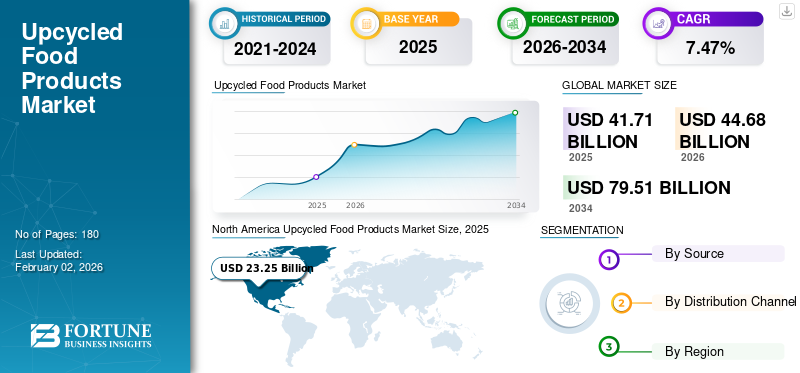
Download Free sample to learn more about this report.
UPCYCLED FOOD PRODUCTS MARKET KEY TAKEAWAYS
 Global Market Size & Forecast
- 2025 Market Size: USD 41.71 billion
- 2026 Market Size: USD 44.68 billion
- 2034 Forecast Market Size: USD 79.51 billion
- CAGR: 7.47% from 2026–2034
 Market Share
- North America dominated the market with a 55.74% share in 2025.
- The Fruit & Vegetable Waste segment is expected to hold the largest market share of 41.47% in 2026.
- The Supermarkets/Hypermarkets segment is expected to hold the largest market share of 48.84% in 2026.
 Key Regional Highlights
North America
The market reached USD 23.25 billion in 2025 and is projected to grow to USD 24.86 billion in 2026.
Asia Pacific
The market reached USD 7.47 billion in 2025 and is projected to grow to USD 8.09 billion in 2026.
Europe
The market reached USD 9.40 billion in 2025 and is projected to grow to USD 10.02 billion in 2026.
U.S.
The market is projected to reach USD 21.54 billion by 2026.
Japan
The market is projected to reach USD 1.30 billion by 2026.
Read More

MARKET DYNAMICS
Market Drivers
Surging Food Waste Enhances Production of Upcycled Products
Food waste is recognized as a main global challenge with substantial economic, social, and environmental impacts. Nearly one-third of the food is lost/wasted annually, contributing to food insecurity, greenhouse gas emissions, and resource depletion. To address such challenges, the government is enforcing initiatives to limit food waste, influencing prominent manufacturers. These food producers utilize active components of by-products to develop valuable items. The upcycled ingredients used are nutritious and provide essential antioxidants, minerals, and fiber, which benefit consumers' health.
Augmented Demand for Sustainable Food Products Supports Market Growth
The rising demand for sustainably produced items is a key driver in the global upcycled products market. Most consumers are conscious of environmental concerns caused due to unethically sourced food and seek products that restrict waste production. Such demands make upcycled food an ideal option for the population. These ingredients are known to be healthy and aid in developing a sustainable alternative. As a result, the improved inclination toward eco-friendly products drives the market's potential.
Market Restraints
Limited Consumer Awareness and Inconsistent Supply of Upcycled Ingredients Impede Market Penetration
One of the crucial challenges faced by food manufacturers is the limited awareness of upcycled products. In the global market, most consumers are unaware or unfamiliar with the notion of upcycled items and may perceive such products as less desirable or inferior. As a result, this limited acceptability of upcycled edibles can impede the global upcycled food products market share.
Irregular supply of by-products is another hurdle in the global industry. The production of upcycled items mainly depends on leftover waste from food processing, which might differ in quality, availability, and quantity. Such variability can hinder the manufacturing process and the finished product's quality.
Market Opportunities
Technological Advancements in Upcycled Item Production Create Growth Opportunities
The utilization of advanced technologies in upcycled food production is focused on strengthening the efficiency and quality of products. One of the main technologies used to manufacture upcycled items is the pulsed electric field (PEF). This technique disrupts tissues and cell membranes to extract essential compounds from leftover food, such as pigments and bioactive compounds. Another technology that is becoming highly popular in this sector is microbe fermentation. In this method, microorganisms such as fungi and bacteria break down by-products of food to develop valuable components such as pigments, antioxidants, and others. Apart from this, extraction techniques, including supercritical carbon dioxide and solvent extraction, and enzymes, are also used for upcycled food production. Advancements in these technologies to optimize the cost will provide opportunities for the upcycled food products market growth.
Market Challenges
Lack of Standardized Regulations and Technology Impacts Industry's Potential
The lack of standardized guidelines is a prime difficulty experienced in the upcycled products industry. Such unregulated regulations make it challenging for food producers to adhere to the labels and regulations of end products. As a result, the above factors can disturb the growing potential of the market.
Constraints in advanced technology are also a notable obstacle in the global market. Upcycling mainly requires advanced and specialized technology, which might be expensive. Thus, this high-cost technology can restrict the scalability of upcycled food products.
UPCYCLED FOOD PRODUCTS MARKET TRENDS
Increasing Inclination Toward Upcycled Certification is Current Trend
The trend of upcycled certification is soaring at a higher pace, reflecting shifting individuals' priorities toward sustainable products. In today's health-conscious era, most consumers are aware of the adverse environmental impact of food waste and seek products that prioritize sustainability. To appeal to consumers, food processing companies are concentrating on introducing upcycled food products with their certificates. Compared to other certification programs, upcycled certification is considered the fastest-growing certification, which helps individuals choose products that utilize food waste ingredients. The "Where Food Comes From Inc.," a third-party food verification firm in the U.S., claims that 568 end products were upcycled certified in 2024, which shows a spike of 17% over the previous year, 2023.
Download Free sample to learn more about this report.
Impact of Tariffs
At the beginning of April 2025, U.S. President Donald Trump announced the news of imposing tariffs on all the end products imported by the U.S. With respect to the upcycled products market, the U.S. is recognized as a dominating consumer of upcycled food. As per the new tariff structure, the U.S. may impose taxes on the imports of upcycled ingredients. This high tariff can boost the price of overall upcycled products, creating hurdles at the supply chain level and for consumers to purchase the food at lower prices. Even though the Tariff Act is on hold for the next few months, it is still predicted to impact the global market substantially.
SEGMENTATION ANALYSIS
By Source
Fruit & Vegetable Waste Led Market Due to Its Wide Availability
On the basis of source, the market is segmented into fruit & vegetable waste, agriculture waste, and food processing waste. The fruit & vegetable waste segment led the market accounting for 41.47% market share in 2026. This category majorly comprises fruits and vegetables that are unfit for human consumption. To minimize the growing risk of food waste, the prominent players are utilizing such fruit & vegetable waste to produce baked goods and confectionery.
Food processing waste emerged as the fastest-growing category with a high CAGR. This segment includes by-products of food processing, such as meat trimmings and vegetable and fruit peels, which are further used for product innovation.
By Distribution Channel
To know how our report can help streamline your business, Speak to Analyst
Supermarkets/Hypermarkets Lead Market Due to Their Easy Accessibility
Based on the distribution channel, the market is divided into supermarkets/hypermarkets, specialty stores, online sales channels, and others. The Supermarkets/hypermarkets segment will account for 48.84% market share in 2026. This channel is recognized as a "one-stop shop" that provides a broad range of upcycled ingredient-based items in various pack sizes. Also, supermarkets are known for affordable prices and offer several discount coupons, particularly for bulk purchasing food products.
Online sales channels are expected to register a high CAGR during the forecast period. The ease of ordering products from home or workplace, and return/exchange benefits, bolster the segment's growth
Upcycled Food Products Market Regional Outlook
Based on region, the market is segmented into North America, Europe, Asia Pacific, and the Rest of the World.
North America
North America Upcycled Food Products Market Size, 2025 (USD Billion)
To get more information on the regional analysis of this market, Download Free sample
The North America market accounted for USD 23.25 billion in 2025, representing 55.74% of the global industry, and is expected to reach USD 24.86 billion in 2026. North America is the leading region and captured a large chunk of share of the global upcycled products market. This growth is backed by well-established innovation infrastructure and robust sustainability policies. Moreover, the rising consumer's willingness to pay extra for ethically sourced products boosts upcycled food sales and expands the North American industry. Among all the North American countries, the U.S. dominated in the region, followed by Canada. The enhanced focus on partnerships between retailers (Kroger and Walmart) with upcycled food brands and the augmented consumer's willingness to try new ingredients-enriched chocolates fuel the region's market growth. The U.S. market is projected to reach USD 21.54 billion by 2026.
Asia Pacific
To know how our report can help streamline your business, Speak to Analyst
In 2025, Asia Pacific represented USD 7.47 billion, accounting for 17.90% of the worldwide market, and is projected to grow to USD 8.09 billion in 2026. Asia Pacific, the fastest-growing region, benefits from the escalated awareness of climate impacts by food waste and growing Government-led regulations on food security and waste management. Furthermore, advancements in upcycling technology and the expansion of prominent upcycled food brands in Asian countries drive product sales. Along with this, increasing prioritization of sustainability amongst younger groups and rising health-consciousness trends enhance the growth. The Japan market is anticipated to reach USD 1.3 billion by 2026, the China market is projected to reach USD 4.66 billion by 2026
Europe
Europe recorded a market size of USD 9.4 billion in 2025, capturing 22.55% of the global market share, and is projected to reach USD 10.02 billion in 2026. Europe is one of the active regions and holds a strong position in the upcycled food market. The growth is driven by several factors, such as stringent food waste laws and consumer inclination toward sustainable items. Moreover, the growing support for fair-trade and organic-certified food items and healthy snacking trends further fuels the demand for upcycled food products. In addition, the increasing involvement of food startups and circular economy mandates supports the growing regional momentum. The UK market is expected to reach USD 2.21 billion by 2026, while the Germany market is projected to reach USD 1.74 billion by 2026.
Rest of the World
rest of the world contributed 3.81% to the global market in 2025, with a valuation of USD 1.59 billion, and is projected to reach USD 1.71 billion in 2026. The rest of the world is at its developing stage and is anticipated to maintain the same pace of growth. The increased awareness of environmentally friendly items and the growing number of health-conscious individuals stimulate the industry's potential.
COMPETITIVE LANDSCAPE
KEY INDUSTRY PLAYERS
Main Players Aim at Product Launches to Improve Profitability
Dominant players operating in the global space include Renewal Mill, Planetarians, Upcycled Foods Inc., and Matriark Foods, among others. All the key players are introducing innovative upcycled food products that cater to consumers' demands. Moreover, the firms are also focusing on partnerships/collaborations to strengthen profitability.
List of Key Upcycled Food Product Companies Profiled
- Matriark Foods (U.S.)
- Renewal Mill (U.S.)
- OISIX RA Daichi (Japan)
- Upcycled Foods Inc. (U.S.)
- ÄIO (Estonia)
- Rootly (Denmark)
- Pluck (Canada)
- Planetarians (U.S.)
- Green Bowl (U.S.)
- Maison Riviera (Canada)
KEY INDUSTRY DEVELOPMENTS
- March 2025: Upcycled Foods, Inc. (UP, Inc.) and Misfits Market launched the retailer's first upcycled bread types for its Odds & Ends private label. The company launched two Upcycled Certified breads featuring ReGrained SuperGrain+ and a mixture of sourdough from bakery ingredient leader Puratos.
- March 2025: Upcycled Foods, Inc. (UP, Inc.) announced the introduction of upcycled whole raisins from wine-grape varieties of California vineyards. The new product is a functional ingredient that improves texture and enhances flavor.
- February 2025: Maison Riviera, a Canada-based dairy company, launched Canada's first drinkable yogurt made from upcycled ingredients and certified UPcycled.
- June 2024: Foodvalley, one of the leading agro-food centers in Europe, launched the UPCycled4Food initiative to make upcycled food products and ingredients the 'new normal.'
- April 2022: Del Monte Foods, Inc. announced that two of its products, Del Monte Gut Love and Boost Me Fruit Infusions, to be Upcycled Certified by the Upcycled Food Association.
REPORT COVERAGE
The market research report analyzes the market in-depth and highlights crucial aspects such as global market trends, market dynamics, and prominent companies. Besides this, the market report also provides insights into the global upcycled food products market trends and highlights significant industry developments.
Request for Customization to gain extensive market insights.
Report Scope & Segmentation
|
ATTRIBUTE |
DETAILS |
|
Study Period |
2021-2034 |
|
Base Year |
2025 |
|
Estimated Year |
2026 |
|
Forecast Period |
2026-2034 |
|
Historical Period |
2021-2024 |
|
Unit |
Value (USD Billion) |
|
Growth Rate |
CAGR of 7.47% from 2026 to 2034 |
|
Segmentation |
By Source
|
|
By Distribution Channel
|
|
|
By Region
|
Frequently Asked Questions
Fortune Business Insights says that the market size was valued at USD 41.71 billion in 2025.
The market is expected to grow at a CAGR of 7.47% during the forecast period (2026-2034).
By source, the fruit & vegetable waste segment led the market.
Surging food waste and augmented demand for sustainable products boost the market's growth.
Renewal Mill, Planetarians, Upcycled Foods Inc., and Matriark Foods are a few of the major players in the market.
The U.S. held the highest share of the global market.



- 2021-2034
- 2025
- 2021-2024
- 180
-
(Offer valid till 15th Oct 2026)
Get 30-60 hrs Free Customization
Expand Regional and Country Coverage, Segments Analysis, Company Profiles, Competitive Benchmarking, and End-user Insights.




















-
US +1 833 909 2966 ( Toll Free )
-
Get In Touch With Us