UV Curable Inks Market Size, Share & Industry Analysis, By Product (Free Radical, Cationic), By Application (Automotive, Medical, Publications, Packaging), By Region, and Regional Forecast, 2026-2034
 Download Free Sample
UV Curable Inks Market Overview
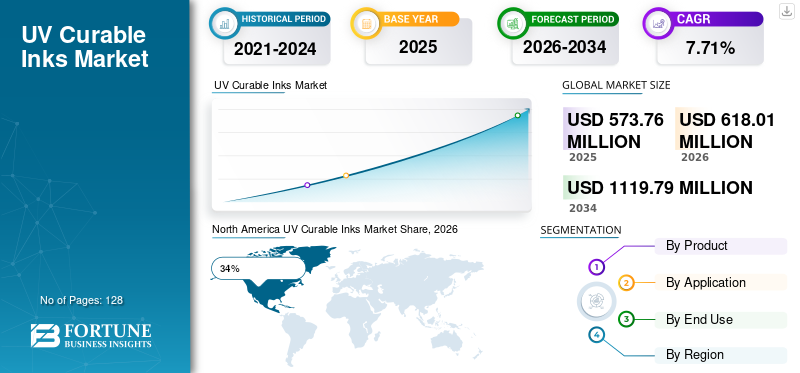
The UV curable inks market size was valued at USD 1.77 billion in 2025. The market is projected to grow from USD 1.88 billion in 2026 to USD 3.02 billion by 2034, exhibiting a CAGR of 6.09% during the forecast period. The market in Asia Pacific dominated with a revenue share of 41% in 2025.

The UV curable inks market includes inks that polymerize rapidly when exposed to ultraviolet radiation, creating durable printed films across paper, plastics, films, metals, glass, ceramics, and other substrates. The market serves packaging, labels, commercial printing, publications, automotive decoration, medical products, industrial printing, signage, and specialty applications. Free radical and cationic formulations are the principal product categories, while UV LED curing is becoming increasingly important for energy-efficient production. Demand is supported by fast curing, low solvent emissions, strong adhesion, high print quality, and suitability for high-speed printing. The UV curable inks market Report therefore remains important for printers, converters, ink manufacturers, equipment suppliers, and packaging companies.
The USA UV curable inks market is supported by established packaging, labeling, commercial printing, industrial decoration, and digital printing industries. Demand is particularly strong where printers require immediate curing, high abrasion resistance, vibrant colors, and compatibility with difficult substrates. Digital UV printing is also expanding applications in signage, personalized products, décor, and direct-to-object printing. The shift toward UV LED curing is encouraging printers to modernize equipment while reducing heat exposure to sensitive substrates. Packaging converters are also showing interest in low-migration and sustainable UV ink systems as regulatory and brand-owner requirements become more demanding.
Download Free sample to learn more about this report.
UV Curable Inks Market Key Takeaways
 Global Market Size & Forecast
- 2025 Market Size: USD 1.77 Billion
- 2026 Market Size: USD 1.88 Billion
- 2034 Forecast Market Size: USD 3.02 Billion
- CAGR: 6.09% from 2026-2034
 Market Share
- The market in Asia-Pacific dominated with a revenue share of 41% in 2025.
- Free Radical UV Curable Inks dominated by product with a market share of approximately 57%.
- Packaging dominated by application with a market share of approximately 55%.
 Key Regional Highlights
Asia-Pacific
Asia-Pacific led the market with a 41% share, supported by expanding printing, packaging, and industrial manufacturing activities.
North America
North America accounted for 26% of the market, driven by demand for advanced printing technologies and sustainable ink solutions.
Europe
Europe held a 24% share, supported by established packaging and printing industries and growing adoption of UV-curable technologies.
U.S
The U.S. remains a key market, supported by strong demand for high-performance printing inks across packaging and industrial applications.
Japan
Japan accounted for approximately 24% of the Asia-Pacific market, supported by advanced printing technologies and strong demand for high-quality packaging solutions.
Read More

UV curable inks market Latest Trends
The latest UV curable inks market Trends center on LED curing, sustainable formulations, low-migration chemistry, digital printing, and higher compatibility with challenging substrates. LED UV systems are increasingly attractive because they provide controlled curing with lower heat than traditional mercury-based systems, supporting printing on heat-sensitive films and specialty materials. Recent industry analysis identifies LED curing as a major portion of UV-cured printing ink demand, while packaging remains a core application because of the need for fast curing and high-quality graphics.
Another important trend is the development of hybrid and water-based UV-curable technologies. Fujifilm introduced AQUAFUZE technology in 2024, combining water-based ink technology with UV-curable chemistry for wide-format applications. The technology is designed to reduce odor, improve substrate compatibility, and provide a thinner, more even ink film while retaining UV curing performance.
Low-migration inks are also becoming increasingly important for food and pharmaceutical packaging. Manufacturers are developing formulations that balance curing speed, adhesion, print quality, and regulatory requirements. UV inkjet technology is simultaneously moving toward lower viscosity formulations, higher nozzle reliability, improved white inks, varnishes, and specialty colors.
Download Free sample to learn more about this report.
UV curable inks market Dynamics
DRIVER
Growing demand for high-speed printing and instant curing
Fast production cycles are a major driver of the UV curable inks market. Conventional solvent or water-based printing processes may require drying stages before subsequent converting, stacking, coating, or handling. UV curing changes this workflow by allowing the printed ink film to polymerize rapidly after exposure to the appropriate ultraviolet energy.
For packaging converters, this can improve production efficiency because printed material can proceed to the next stage with limited waiting time. The benefit is especially valuable in labels, folding cartons, flexible packaging, and specialty industrial printing where production schedules are closely linked to press utilization.
UV inks also provide strong surface performance. Properly cured formulations can offer resistance to abrasion, chemicals, moisture, and handling, making them useful for products that must retain graphic quality throughout distribution and use. These characteristics have supported adoption across industrial labels, product decoration, automotive components, and commercial graphics.
Digital printing is another driver. UV-curable inkjet systems can print directly onto a broad range of rigid and flexible materials, supporting short-run production, customization, variable data, and on-demand manufacturing. The combination of immediate curing and digital workflow flexibility is strengthening the UV curable inks market Outlook among B2B users seeking productivity and reduced setup time.
RESTRAINT
High formulation complexity and raw-material sensitivity
The UV curable inks market faces formulation and raw-material challenges that can increase production complexity. UV inks require carefully balanced combinations of oligomers, monomers, pigments, additives, photoinitiators, and other components. Small formulation changes can influence curing speed, adhesion, flexibility, surface appearance, odor, migration behavior, and printhead performance.
Photoinitiator availability and pricing can also affect manufacturers. Industry analysis identifies photoinitiator supply risks as an issue that suppliers must manage through sourcing strategies and formulation development.
Equipment compatibility creates another limitation. Printers, curing units, printheads, substrates, and ink formulations must operate as an integrated system. A formulation that performs well on one machine may require modification for another printhead or curing configuration.
UV inks can also face adhesion problems on low-energy substrates. Plastics, films, coated materials, and certain metals may require surface treatment, primers, corona treatment, or other adhesion-enhancement methods. This adds process complexity for converters.
Although UV inks offer environmental advantages in certain applications, they are not automatically sustainable in every formulation. Photoinitiator selection, recyclability, odor, migration, and end-of-life compatibility must be evaluated according to the application.
OPPORTUNITY
Expansion of sustainable, LED-compatible, and low-migration UV formulations
Sustainability is creating major UV curable inks market Opportunities. Ink manufacturers are developing products that combine curing efficiency with reduced environmental impact, renewable raw materials, recyclability, and improved regulatory compliance.
LED curing provides a particularly attractive development path. LED systems can operate at controlled wavelengths and lower temperatures, supporting substrates that could be damaged by higher heat. This creates opportunities in flexible packaging, films, labels, plastics, electronics, and specialty industrial printing.
Low-migration formulations offer another opportunity. Food and pharmaceutical packaging requires careful control of substances that could migrate through packaging structures. Ink suppliers that can deliver reliable curing and low-migration performance can strengthen their position with packaging converters.
Water-based UV-curable systems represent another emerging technology. Fujifilm's AQUAFUZE development demonstrates how manufacturers are combining water-based dispersion technology with UV curing to address odor, film thickness, substrate flexibility, and print quality requirements.
Direct-to-object printing also creates opportunities. UV inks can decorate bottles, tubes, promotional products, industrial components, consumer products, and three-dimensional surfaces without traditional labels or transfer processes.
CHALLENGE
Maintaining consistent curing, adhesion, and regulatory performance across substrates
A major challenge in the UV curable inks market is achieving consistent performance across increasingly diverse substrates. Packaging, industrial components, films, plastics, glass, metals, and coated materials can have very different surface properties.
Curing consistency depends on ink chemistry, lamp or LED output, line speed, ink film thickness, pigment loading, substrate characteristics, and equipment configuration. Inadequate curing can cause poor surface hardness, odor, adhesion problems, or downstream processing difficulties.
White and heavily pigmented inks can present additional challenges because pigments can interfere with UV penetration. Manufacturers therefore need formulations that provide high opacity while still achieving reliable curing.
Digital inkjet introduces another layer of complexity. Ink viscosity, surface tension, particle dispersion, and drying stability must be controlled to prevent nozzle blockage and maintain consistent drop placement. Fujifilm's AQUAFUZE development specifically addresses dispersion stability and printhead reliability in water-based UV-curable ink systems.
Regulatory requirements are also becoming more demanding. Packaging applications require careful assessment of migration, raw materials, and end-use conditions. Manufacturers must therefore balance performance, safety, compliance, sustainability, and cost.
UV curable inks market Segmentation
By Product
Free Radical UV Curable Inks account for approximately 57% of the product segment and represent the dominant chemistry because of their broad application range, fast curing behavior, formulation flexibility, and suitability for high-volume printing. Market research identifies free radical inks as the leading product category, supported by applications in packaging, labels, industrial printing, and various digital processes.
Free radical formulations generally use acrylate-based chemistry and respond rapidly to UV exposure. Their versatility makes them suitable for flexographic, offset, screen, and digital printing applications. They can be formulated for different levels of hardness, flexibility, adhesion, gloss, opacity, and chemical resistance.
Packaging is an important demand center because converters require fast curing without extended drying stages. Labels also benefit from durable surfaces that can withstand transportation, handling, moisture, and abrasion.
Free radical inks are increasingly being optimized for UV LED systems. Manufacturers are developing photoinitiator packages and resin systems that respond efficiently to LED wavelengths. This is supporting equipment modernization and improving the commercial attractiveness of LED curing.
Another important area is low-migration packaging. Manufacturers are refining raw-material selection and curing behavior to satisfy demanding packaging applications. Free radical chemistry remains highly competitive because manufacturers can modify formulations for different substrates and performance requirements.
Cationic UV Curable Inks represent approximately 43% of the product segment. Although smaller than free radical systems, cationic formulations provide specialized performance advantages that make them important for demanding applications.
Cationic curing commonly uses epoxy-based chemistry and can provide strong adhesion, low shrinkage, and useful performance on selected substrates. These characteristics make cationic formulations attractive where dimensional stability and substrate bonding are particularly important.
The technology can also provide continued curing after UV exposure through a phenomenon known as dark cure, depending on formulation and application conditions. This characteristic can help achieve deeper conversion in certain systems.
Cationic inks are relevant to specialty packaging, coatings, industrial printing, and applications where adhesion and film properties are more important than the lowest formulation cost.
Their development is also connected to specialized substrates. Manufacturers are investigating formulations that can provide reliable adhesion to plastics, films, metals, and other difficult materials.
The segment has an important role in the UV curable inks market Insights because buyers increasingly require application-specific formulations rather than one general-purpose product. As printers move toward specialty effects, industrial decoration, and high-performance packaging, cationic technologies can support product differentiation.
To know how our report can help streamline your business, Speak to Analyst
By Application
Automotive applications account for approximately 18% of the application segment. UV-curable inks are used for instrument panels, control components, labels, decorative elements, switches, identification marks, and specialty printed parts.
The automotive industry requires excellent resistance to abrasion, chemicals, sunlight, temperature changes, and cleaning agents. UV inks can be formulated to provide durable markings while supporting high-quality graphics.
Digital UV printing is also creating opportunities for customized automotive interiors and small-batch component production. Direct printing can reduce the need for separate labels or decals in selected applications.
Medical applications represent approximately 15% of the application segment. UV inks are used for product identification, device markings, packaging graphics, labels, and specialty printed components.
Medical printing requires careful control of raw materials, adhesion, durability, and regulatory performance. Printed information must remain legible after handling, sterilization, transportation, and exposure to cleaning agents where applicable.
Low-migration formulations and high-precision digital printing are creating additional opportunities. Manufacturers are focusing on reliable curing and consistent print quality for medical products that require traceability and clear identification.
Publications account for approximately 12% of the application segment. UV inks are used selectively in commercial printing, specialty publications, covers, premium brochures, decorative effects, and short-run products.
The strongest opportunity is in value-added printing rather than conventional high-volume publications. UV inks can provide high gloss, tactile effects, dimensional varnishes, and vibrant colors that help premium printed materials differentiate themselves.
Digital UV systems also support customized publications and specialty print products.
Packaging represents approximately 55% of the application segment and is the largest application area. Industry research identifies packaging as the core application for UV-cured printing inks because of the importance of rapid curing, strong print durability, and high-quality graphics.
Folding cartons, labels, flexible packaging, cups, containers, and specialty packaging all create opportunities for UV ink suppliers. Packaging converters increasingly require formulations that support high press speeds while maintaining color consistency and adhesion.
Sustainability is becoming central to packaging ink development. In 2025, Sun Chemical launched SunCure EcoPlast for plastic cup decoration, emphasizing adhesion, rapid curing, low migration, and the ability to wash ink from printed cups during recycling processes.
The company also launched SunCure Advance ECO UV sheetfed inks for folding cartons in 2025, with bio-renewable content and high-speed press compatibility.
UV curable inks market Regional Outlook
North America
North America represents approximately 26% of the UV curable inks market. The region benefits from advanced printing infrastructure, sophisticated packaging converters, strong digital printing adoption, and high demand for specialty industrial graphics.
The United States is the largest market within the region. Packaging, labels, commercial printing, signage, automotive decoration, and industrial applications provide diverse demand. UV inkjet technology is particularly important for short-run and customized production.
North American converters are also investing in LED curing systems and low-migration formulations. Sustainability requirements from brand owners are encouraging suppliers to develop recyclable packaging solutions and inks with improved environmental profiles.
The region has a mature supplier ecosystem covering inks, curing systems, digital printers, printheads, pigments, resins, and workflow software. This ecosystem makes it easier for printers to test and adopt new UV technologies.
Canada also provides opportunities in packaging, industrial printing, labels, and commercial graphics. Mexico is becoming increasingly relevant because of manufacturing growth and its integration with North American supply chains.
Europe
Europe accounts for approximately 24% of the UV curable inks market. The region has a strong packaging and labeling industry, advanced printing technology, and strict environmental and chemical regulations.
European demand is increasingly shaped by sustainability, recyclability, food-contact requirements, and resource efficiency. Ink manufacturers are therefore focusing on low-migration products, LED curing, renewable raw materials, and formulations designed to support recycling.
Germany, Italy, France, the United Kingdom, Spain, and other industrial markets have significant printing and packaging capabilities. European converters are also early adopters of advanced digital and hybrid printing systems.
UV inks are particularly valuable where high productivity and premium print appearance are required. Labels, folding cartons, industrial graphics, and specialty packaging remain important applications.
The region is also a major innovation center for low-energy curing and sustainable ink chemistry. Regulatory pressure creates challenges but also encourages manufacturers to develop differentiated products with stronger environmental and safety profiles.
Germany UV curable inks market
Germany represents approximately 29% of Europe's UV curable inks market. Its strong machinery, automotive, packaging, industrial manufacturing, and printing sectors create broad demand for high-performance inks.
Automotive decoration and industrial printing are particularly relevant because German manufacturers require durable identification, functional graphics, and high-quality surface decoration.
Packaging converters are also investing in efficient printing processes. UV LED curing and digital UV printing provide opportunities to reduce production delays and improve flexibility.
Germany's emphasis on resource efficiency and environmental compliance encourages the development of sustainable ink technologies. Suppliers that can combine regulatory performance with fast curing and strong adhesion have opportunities to expand their customer base.
United Kingdom UV curable inks market
The United Kingdom represents approximately 23% of Europe's UV curable inks market. Packaging, labels, commercial printing, signage, and industrial graphics are key demand areas.
The UK market is increasingly interested in digital printing and sustainable packaging. UV inks can support short production runs, variable graphics, premium effects, and rapid turnaround.
Packaging converters are also looking for low-migration products and formulations that support recycling objectives. This creates opportunities for UV ink suppliers with specialized technical capabilities.
The country's mature service economy supports demand for promotional graphics, customized products, signage, and specialty commercial printing. UV inkjet systems are particularly useful for these applications because they can print directly on rigid and flexible substrates.
Asia-Pacific
Asia Pacific UV Curable Inks Market Share, 2025 (%)
To get more information on the regional analysis of this market, Download Free sample
Asia-Pacific accounts for approximately 41% of the UV curable inks market, making it the leading regional market. Strong packaging production, electronics manufacturing, automotive production, consumer goods manufacturing, and digital printing adoption support regional demand. Current industry analysis similarly identifies Asia-Pacific as the leading geography for UV-curable printing inks.
China is a major production center for packaging, electronics, signage, industrial products, and consumer goods. Japan contributes advanced printing technology and high-value specialty applications. South Korea and Southeast Asian countries are also expanding packaging and industrial printing capabilities.
The region's large manufacturing base creates opportunities for both conventional UV inks and digital UV inkjet products. Equipment manufacturers are increasingly pairing printers with LED curing systems, while ink suppliers are developing formulations for plastics, films, metals, glass, and coated substrates.
Japan UV curable inks market
Japan represents approximately 24% of the Asia-Pacific UV curable inks market. The country has strong expertise in printing technology, electronics, packaging, industrial manufacturing, and specialty materials.
Japanese companies are developing sophisticated UV formulations with improved adhesion, durability, dispersion stability, and environmental performance. Fujifilm's AQUAFUZE technology is an example of Japanese innovation combining water-based and UV-curable ink technology.
The technology addresses applications where users want UV curing benefits while also seeking reduced odor, lower ink film thickness, and compatibility with a broad substrate range.
Japan also has opportunities in electronics, automotive, packaging, labels, and specialty digital printing.
China UV curable inks market
China represents approximately 46% of the Asia-Pacific UV curable inks market. The country's large manufacturing base creates strong demand for packaging, labels, electronics, consumer goods, automotive products, and industrial decoration.
Domestic printing companies are increasingly adopting digital UV technologies for customized production and short-run manufacturing. Conventional UV printing also remains important for high-volume packaging and industrial applications.
Chinese ink manufacturers are expanding product portfolios covering UV offset, UV flexographic, UV screen, and UV inkjet technologies. Competitive pricing and local manufacturing capabilities can support regional penetration.
The country's continued packaging modernization and industrial automation create opportunities for high-speed UV curing and specialized digital inks.
Rest of World
Rest of World accounts for approximately 9% of the UV curable inks market. Latin America, the Middle East, and Africa provide opportunities through packaging expansion, industrialization, signage, commercial printing, and consumer-goods manufacturing.
Brazil and Mexico are important Latin American markets, while Gulf countries provide opportunities associated with packaging, retail graphics, construction-related products, and industrial applications.
UV digital printing is particularly attractive in markets where printers need flexibility without installing multiple conventional processes. Direct-to-object printing also provides opportunities in promotional products and specialty packaging.
The major barriers include equipment investment, technical expertise, availability of specialized inks, and limited access to advanced curing systems. Distributor networks and partnerships with local printing-equipment suppliers can help manufacturers expand market access.
List of Top UV Curable Inks Companies
- Hewlett Packard Company
- Fujifilm Corporation
- Kao Collins Corporation
- Sun Chemical Corporation
- Toyo Ink SC Holdings Co. Ltd.
- INX Digital International Co.
- Siegwerk Druckfarben AG and Co. KGaA
- Agfa-Gevaert Group
- Mimaki Engineering Co. Ltd.
- T and K Toka Co. Ltd.Flint Group
- Roland DGA Corporation
Top Two Companies by Market Share
- Sun Chemical Corporation: 9%
- Fujifilm Corporation: 8%
Investment Analysis and Opportunities
Investment activity in the UV curable inks market is increasingly focused on sustainable chemistry, LED-compatible formulations, digital inkjet, packaging applications, and specialty industrial printing.
Packaging is an especially attractive investment area because converters require inks that provide high-speed curing, low migration, strong adhesion, and recyclability. Sun Chemical's 2025 launches demonstrate this direction, including UV inks for plastic cups and folding cartons.
Digital UV printing provides another investment opportunity. Printers are increasingly seeking short-run flexibility, customization, direct-to-object capability, and reduced setup requirements.
Investments in photoinitiator technology, bio-renewable raw materials, low-odor formulations, and water-based UV systems can also create competitive differentiation. Fujifilm's AQUAFUZE development shows the commercial potential of combining water-based and UV-curable technologies.
B2B investors can also target curing equipment, printheads, pigments, resin systems, ink-management software, and integrated printing platforms. Suppliers that offer complete solutions rather than individual consumables can strengthen customer relationships.
New Product Development
New product development in the UV curable inks market is centered on sustainability, lower odor, higher curing efficiency, substrate flexibility, and compatibility with next-generation printheads.
One important development is water-based UV-curable ink. Fujifilm's AQUAFUZE technology uses stable water dispersion of photopolymers and is designed to combine characteristics of water-based and UV-curable technologies. The company identified applications including wide-format signage and wallpaper.
Low-viscosity UV inkjet formulations are also gaining attention. Sun Chemical presented a low-viscosity UV technology in 2025 designed for printheads such as the Epson i3200, including CMYK, white, and varnish options.
Packaging inks are another major development area. New formulations are being engineered for low migration, high adhesion, rapid curing, and recyclability.
The industry is also developing inks with renewable content. SunCure Advance ECO, launched in 2025, contains 25–30% bio-renewable content and is designed for high-speed folding-carton production.
Five Recent Developments (2023-2025)
- 2024 – Fujifilm develops AQUAFUZE technology: Fujifilm introduced a proprietary technology combining water-based and UV-curable ink technologies for wide-format inkjet applications, targeting improved dispersion stability, substrate compatibility, reduced odor, and lower ink-film thickness.
- 2024 – AQUAFUZE expands UV-curable aqueous printing possibilities: Fujifilm positioned its new technology for applications such as indoor signage and wallpaper and demonstrated the technology at drupa 2024.
- 2025 – Sun Chemical launches SunCure EcoPlast: The company introduced a UV offset ink range for plastic cup decoration featuring high adhesion, fast curing, low migration, and washability designed to support recycling processes.
- 2025 – Sun Chemical launches SunCure Advance ECO: The company introduced UV sheetfed inks for folding cartons, designed for high-speed presses and containing bio-renewable content.
- 2025 – Sun Chemical introduces new low-viscosity UV ink technology: The company showcased low-viscosity UV inks designed for modern inkjet printheads and graphics and UV direct-to-film applications.
Report Coverage of UV curable inks market
The UV curable inks market Report covers product technologies, formulation characteristics, curing systems, printing processes, applications, regional markets, competitive companies, investment activity, new product development, and recent manufacturer developments.
The UV curable inks market Analysis evaluates Free Radical and Cationic formulations, with particular attention to curing performance, adhesion, print quality, substrate compatibility, durability, migration characteristics, and sustainability.
The UV curable inks market Research Report examines applications across automotive, medical, publications, packaging, industrial printing, digital printing, labels, signage, and specialty decoration. It also considers the growing role of UV LED systems, digital inkjet platforms, direct-to-object printing, and hybrid technologies.
The UV Curable Inks Industry Report is designed for ink manufacturers, printing companies, packaging converters, equipment suppliers, chemical producers, brand owners, investors, and technology developers. The UV Curable Inks Industry Analysis evaluates supply-chain conditions, formulation innovation, regulatory requirements, and customer demand.
The UV curable inks market Forecast, UV curable inks market Trends, UV curable inks market Size, UV curable inks market Share, UV curable inks market Growth, UV curable inks market Outlook, UV curable inks market Insights, and UV curable inks market Opportunities are influenced by packaging demand, digital printing adoption, LED curing, sustainability requirements, and specialty substrate applications.
Frequently Asked Questions
Fortune Business Insights states that the global UV Curable Inks Market was valued at USD 1.77 billion in 2025 and is projected to grow from USD 1.88 billion in 2026 to USD 3.02 billion by 2034.
The market is expected to exhibit a CAGR of 6.09% during the forecast period of 2026–2034.
Free Radical UV Curable Inks dominated the product segment with approximately 57% market share. Their broad application range, rapid curing, formulation flexibility, and suitability for packaging, labels, industrial printing, and digital processes support their leading position.
Key companies include Danaher Corporation, Thermo Fisher Scientific, BMG Labtech, PerkinElmer, Promega Corporation, Bio-Rad Laboratories, Lonza, Agilent Technologies, Enzo Life Sciences, and Berthold Technologies.
Major trends include the shift toward UV LED curing, development of sustainable and low-migration formulations, increasing adoption of digital UV printing, and the emergence of water-based UV-curable technologies. Manufacturers are also focusing on high-resolution printing, improved compatibility with difficult substrates, and formulations for food and pharmaceutical packaging.



- 2021-2034
- 2025
- 2021-2024
- 128
-

(Offer valid till 15th Oct 2026)
Get 30-60 hrs Free Customization
Expand Regional and Country Coverage, Segments Analysis, Company Profiles, Competitive Benchmarking, and End-user Insights.


















-
US +1 833 909 2966 ( Toll Free )
-
Get In Touch With Us