VAE Emulsion Market Size, Share & Industry Analysis, By Product (Waterproof, Ordinary), By Application (Adhesives, Re-dispersible Powder, Paints & Coatings, Textile Chemicals), and Regional Forecast, 2026-2034
 Download Free Sample
Vae Emulsion Market Overview
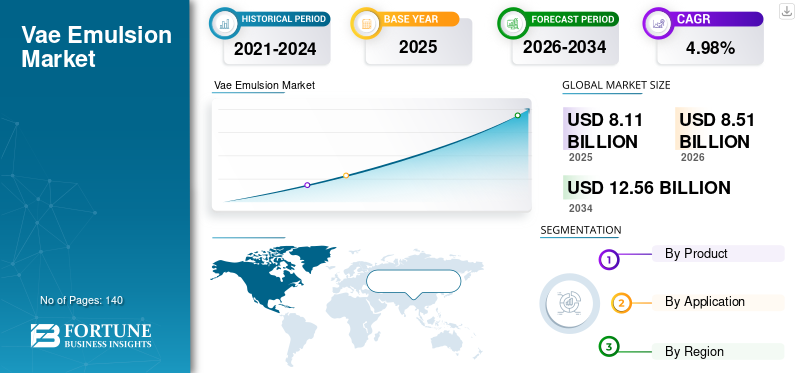
The global VAE emulsion market size was valued at USD 8.10 billion in 2025. The market is projected to grow from USD 8.50 billion in 2026 to USD 12.55 billion by 2034, exhibiting a CAGR of 4.98% during the forecast period.

The VAE emulsion market is witnessing strong expansion due to increasing demand from adhesives, construction chemicals, paints, coatings, and textile applications. Vinyl acetate ethylene emulsions are widely preferred because of their flexibility, low volatile organic compound content, water resistance, and excellent adhesion properties. Manufacturers are increasingly utilizing VAE emulsions in eco-friendly formulations to comply with environmental regulations and industrial sustainability standards. Rising infrastructure activities and growth in construction materials are further supporting market demand. The VAE emulsion market report indicates increasing adoption of advanced polymer technologies to improve product durability, thermal stability, and processing efficiency across industrial manufacturing applications globally.
The United States VAE emulsion market is growing steadily because of rising demand for sustainable construction chemicals, high-performance adhesives, and low-emission coatings. Industrial manufacturers are increasingly replacing solvent-based products with water-based emulsion technologies to meet environmental compliance standards. The U.S. packaging and woodworking industries are major consumers of VAE emulsions due to their strong bonding capabilities and flexibility characteristics. Demand from paints and coatings manufacturers is also expanding because VAE emulsions improve weather resistance and application efficiency. Increasing renovation activities and infrastructure modernization projects across the country continue to support long-term growth opportunities for the VAE emulsion industry report.
Download Free sample to learn more about this report.
Vae Emulsion Market Key Takeaways
 Global Market Size & Forecast
- 2025 Market Size: USD 8.10 Billion
- 2026 Market Size: USD 8.50 Billion
- 2034 Forecast Market Size: USD 12.55 Billion
- CAGR: 4.98% from 2026-2034
 Market Share
- The market in Asia-Pacific dominated with a revenue share of 38% in 2025.
- Waterproof VAE emulsions accounted for approximately 58% of the market share.
- Adhesives accounted for approximately 36% of the market share.
 Key Regional Highlights
Asia-Pacific
Asia-Pacific led the market with a 38% share, supported by expanding construction, packaging, and industrial manufacturing activities.
North America
North America accounted for 26% of the market, driven by demand for sustainable adhesives and low-VOC coatings.
Europe
Europe held a 24% share, supported by environmental regulations and increasing adoption of water-based formulations.
U.S.
The U.S. market is supported by rising demand for sustainable construction materials, adhesives, paints, and coatings.
Japan
Japan accounted for 15% of the Asia-Pacific market, supported by advanced manufacturing and growing demand for high-performance VAE emulsion applications.
Read More

VAE Emulsion Market Latest Trends
The VAE emulsion market trends are increasingly shaped by sustainable manufacturing practices, low-VOC product development, and advanced polymer innovations. Manufacturers are focusing heavily on water-based emulsion technologies due to tightening environmental regulations and rising industrial demand for eco-friendly materials. High-performance VAE emulsions with improved flexibility, moisture resistance, and thermal stability are becoming increasingly popular across adhesives and coatings applications.
Download Free sample to learn more about this report.
Construction chemical manufacturers are integrating advanced VAE formulations into tile adhesives, cement modifiers, and waterproofing compounds to improve durability and bonding performance. In the paints and coatings industry, demand for low-odor and environmentally compliant formulations is accelerating the adoption of VAE emulsions. Textile chemical applications are also expanding due to improved softness and fabric treatment properties provided by modern emulsion technologies. Digital manufacturing systems and automated production lines are helping manufacturers improve consistency and reduce operational waste. Asia-Pacific remains a key production hub because of strong industrial manufacturing capacity and increasing investments in specialty polymer production facilities. The VAE emulsion market analysis also highlights rising research activities focused on bio-based raw materials and recyclable packaging solutions for industrial emulsion products.
VAE Emulsion Market Dynamics
DRIVER
Rising Demand for Eco-Friendly Adhesives and Construction Chemicals
The primary growth driver in the VAE emulsion market is the increasing demand for environmentally sustainable adhesives, paints, and construction materials. Governments across multiple countries are implementing stricter environmental regulations regarding volatile organic compounds and hazardous emissions, encouraging manufacturers to shift toward water-based emulsion technologies. VAE emulsions provide excellent adhesion, flexibility, and water resistance while maintaining low VOC content, making them highly suitable for eco-friendly industrial applications.
Rapid urbanization and infrastructure development are also supporting market expansion. Construction industries increasingly use VAE emulsions in tile adhesives, cement additives, wall putty, and waterproof coatings because of their superior bonding performance and durability. Packaging, woodworking, and paper processing industries are adopting VAE-based adhesives to improve product quality and environmental compliance. The growing preference for sustainable manufacturing technologies among industrial producers is accelerating investments in advanced emulsion production facilities. Additionally, increasing consumer awareness regarding environmentally safe products is encouraging manufacturers to develop low-emission paints, coatings, and adhesives using vinyl acetate ethylene emulsion technologies. The VAE emulsion market forecast indicates strong long-term industrial demand driven by sustainability and infrastructure modernization trends globally.
RESTRAINT
Fluctuating Raw Material Costs and Supply Chain Instability
The VAE emulsion market faces significant restraints due to volatility in raw material prices and supply chain disruptions. Vinyl acetate monomer and ethylene, which are essential raw materials for VAE production, are highly dependent on petrochemical supply chains and crude oil market fluctuations. Changes in feedstock prices directly impact production costs and profitability for emulsion manufacturers.
Supply chain instability and transportation disruptions are also creating operational challenges across global manufacturing networks. Industrial producers often experience delays in raw material procurement, affecting production schedules and customer deliveries. Smaller manufacturers face additional financial pressure because they have limited ability to absorb rising operational costs. Environmental compliance investments and energy-intensive production processes further increase manufacturing expenses. In developing economies, limited awareness regarding advanced water-based emulsion technologies can also slow adoption rates. Competition from alternative polymer emulsions including acrylic and styrene-based systems presents another challenge for VAE manufacturers attempting to maintain market share in highly competitive industrial sectors.
OPPORTUNITY
Expansion of Sustainable Coatings and High-Performance Industrial Applications
The VAE emulsion market opportunities are expanding significantly because of increasing industrial demand for sustainable coatings, advanced adhesives, and specialty construction chemicals. Manufacturers are developing next-generation VAE formulations with enhanced durability, flexibility, and weather resistance to meet evolving customer requirements. Green building initiatives and environmentally certified construction projects are generating strong opportunities for water-based emulsion technologies.
Rapid growth in packaging and paper processing industries is creating additional demand for high-performance adhesive formulations. Textile processing applications are also expanding because VAE emulsions improve softness, wash durability, and printing performance in fabric treatment operations. Emerging economies in Asia-Pacific and Latin America are investing heavily in infrastructure and manufacturing sectors, creating substantial growth opportunities for industrial polymer suppliers. Rising research activities focused on bio-based emulsions and recyclable industrial materials are expected to support future product innovations. The increasing popularity of low-odor interior coatings and eco-friendly architectural paints is further strengthening market opportunities for VAE emulsion manufacturers worldwide.
CHALLENGE
Technical Performance Limitations in Extreme Industrial Environments
One of the major challenges in the VAE emulsion industry analysis is maintaining high technical performance across extreme industrial and environmental conditions. Although VAE emulsions provide excellent flexibility and adhesion, certain applications require enhanced chemical resistance, thermal stability, and long-term durability that may exceed the performance capabilities of standard formulations.
Industrial customers operating in harsh climates and heavy-duty construction environments often demand specialized products with advanced moisture resistance and weather protection. Developing such high-performance formulations requires significant research investments and advanced production technologies. Competition from alternative high-performance polymers also increases pressure on VAE manufacturers to continuously improve product quality and cost efficiency. Regulatory changes regarding chemical safety and environmental impact can further complicate manufacturing operations and product approvals. In addition, maintaining consistent product quality across large-scale industrial production facilities remains a major operational challenge for global VAE emulsion suppliers serving diverse end-use industries.
VAE Emulsion Market Segmentation
By Product
Waterproof VAE emulsions account for approximately 58% of the VAE emulsion market share because of their extensive use in construction chemicals, exterior coatings, waterproof membranes, and high-performance adhesives. These emulsions offer superior moisture resistance, flexibility, and bonding strength, making them suitable for demanding industrial applications. Construction industries increasingly utilize waterproof VAE emulsions in tile adhesives, wall coatings, self-leveling compounds, and cement modification products to improve structural durability and water protection. The growing focus on green building construction and infrastructure modernization is further driving demand for waterproof emulsion technologies. Paint and coating manufacturers are adopting waterproof VAE formulations to develop weather-resistant architectural coatings with low VOC emissions.
Ordinary VAE emulsions hold nearly 42% share of the VAE emulsion market due to their broad applicability across standard adhesives, interior paints, textile chemicals, and paper processing industries. These emulsions are widely preferred for cost-effective industrial formulations that require flexibility, ease of application, and good bonding performance. Packaging manufacturers and woodworking industries extensively use ordinary VAE emulsions for paper laminating and assembly adhesive applications. Interior decorative paints represent another major application area because ordinary VAE emulsions support low-odor and environmentally friendly formulations. Textile processing industries also utilize these emulsions in fabric finishing and coating operations to improve softness and surface quality. Manufacturers are increasingly optimizing ordinary VAE formulations to achieve better processing stability and compatibility with multiple industrial additives.
By Application
Adhesives account for approximately 36% of the VAE emulsion market because VAE technology offers excellent bonding strength, flexibility, and environmental compliance. Packaging, woodworking, paper converting, and furniture manufacturing industries are major consumers of VAE-based adhesives. Water-based adhesive formulations using VAE emulsions are increasingly replacing solvent-based alternatives because of stricter environmental regulations and workplace safety requirements. Construction industries also utilize VAE adhesives extensively in flooring systems, tile bonding, insulation panels, and decorative laminates. Manufacturers are developing high-performance adhesive products with improved moisture resistance and faster curing capabilities to meet industrial demand. Sustainable packaging growth and rising furniture production continue supporting strong adhesive segment expansion globally.
Re-dispersible powder applications represent around 24% share of the VAE emulsion market due to increasing demand from dry-mix construction materials and cement modification products. VAE emulsions are widely used in powder production because they improve flexibility, adhesion, crack resistance, and workability in mortar systems. Tile adhesives, repair mortars, self-leveling compounds, and thermal insulation systems increasingly incorporate re-dispersible powders to improve construction quality and durability. Infrastructure modernization projects and rising commercial construction activities are significantly boosting demand for advanced cement additives using VAE technologies.
Paints and coatings account for nearly 28% of the VAE emulsion market because VAE formulations provide excellent film formation, washability, and low-VOC performance. Architectural coatings, decorative paints, and industrial protective coatings increasingly utilize VAE emulsions to improve durability and environmental sustainability. Demand for water-based paints is rising rapidly due to stricter regulations regarding hazardous emissions and indoor air quality. VAE emulsions help manufacturers produce low-odor coatings with improved application efficiency and weather resistance.
Textile chemicals hold approximately 12% share of the VAE emulsion market due to growing demand for advanced fabric finishing and coating technologies. Textile manufacturers use VAE emulsions in fabric softening, printing binders, nonwoven processing, and coating applications to improve product quality and durability. The apparel and technical textile industries are increasingly adopting environmentally friendly processing chemicals to reduce environmental impact and improve production efficiency. VAE emulsions provide good flexibility and compatibility with textile treatment additives, making them suitable for multiple fabric applications. Growth in industrial textiles and performance fabrics is also creating new opportunities for specialty VAE emulsion formulations.
VAE Emulsion Market Regional Outlook
North America
North America accounts for 26% of the global VAE emulsion market, supported by strong demand from construction, packaging, paints, and industrial adhesive sectors. The region has a strong presence of advanced manufacturing industries that continuously require environmentally friendly polymer emulsions for high-performance applications. Rising renovation and remodeling activities across residential and commercial infrastructure projects are significantly contributing to product consumption. In the United States and Canada, manufacturers are increasingly adopting water-based emulsions because of strict environmental regulations regarding VOC emissions and industrial sustainability standards. The packaging sector is also generating substantial demand for VAE emulsion adhesives due to rapid growth in flexible and recyclable packaging solutions. Additionally, growing investments in green buildings and energy-efficient construction materials are supporting the use of waterproof polymer emulsions in flooring, insulation, and cement modification applications. The region’s advanced research capabilities and strong industrial innovation continue to improve product quality and application efficiency.
Europe
Europe holds 24% share in the global VAE emulsion market due to strong sustainability initiatives and strict environmental regulations across industrial sectors. Demand for eco-friendly coatings, adhesives, and construction chemicals continues to increase throughout the region because of growing emphasis on low-emission manufacturing practices. Countries such as Germany, France, Italy, and the United Kingdom are major consumers of water-based polymer emulsions used in paints, packaging, and infrastructure applications. The region’s mature construction industry is increasingly utilizing VAE emulsion products in tile adhesives, insulation systems, and waterproofing materials for sustainable building projects. European packaging companies are also shifting toward recyclable paper-based packaging solutions that require high-performance water-based adhesives. In addition, automotive, furniture, and textile industries are supporting continuous product demand because of increasing preference for environmentally compliant formulations.
Germany VAE Emulsion Market
Germany contributes 11% of the Europe VAE emulsion market and remains one of the largest regional manufacturing hubs for advanced polymer emulsions. The country has strong demand for advanced polymer emulsions in adhesives, coatings, textile chemicals, and construction materials. Germany’s automotive and engineering industries extensively utilize high-performance water-based adhesives and industrial coatings to meet sustainability and durability requirements. Growing demand for energy-efficient buildings and environmentally friendly construction systems is increasing the adoption of waterproof VAE emulsion products in insulation materials, flooring systems, and cement additives. German manufacturers are focusing strongly on research and technological innovation to develop premium-quality emulsions with enhanced flexibility, bonding strength, and weather resistance. Packaging and furniture industries are also contributing significantly to market growth because of rising preference for recyclable and low-emission materials.
United Kingdom VAE Emulsion Market
The United Kingdom accounts for 22% of the Europe VAE emulsion market, driven by increasing adoption of sustainable construction materials and eco-friendly industrial adhesives. Rising investments in residential renovation and commercial infrastructure modernization are generating strong demand for waterproof construction chemicals and water-based coatings. Packaging manufacturers across the country are increasingly utilizing VAE emulsion adhesives in recyclable paperboard and flexible packaging solutions because of growing environmental awareness and regulatory compliance requirements. The textile and furniture industries are also contributing to product demand through increasing use of environmentally compliant finishing and bonding technologies. Water-based emulsions are replacing solvent-based systems in multiple industrial sectors due to improved safety, reduced emissions, and superior operational efficiency. Industrial coatings manufacturers in the United Kingdom are focusing on durable and weather-resistant formulations suitable for infrastructure and decorative applications.
Asia-Pacific
Asia-Pacific captures 38% of the global VAE emulsion market due to rapid industrialization, urbanization, and large-scale infrastructure development activities. Countries such as China, Japan, India, and South Korea are major contributors to regional market growth because of expanding manufacturing and construction industries. Rising demand for waterproof coatings, tile adhesives, cement modifiers, and industrial paints is significantly increasing consumption of VAE emulsion products throughout the region. Asia-Pacific also benefits from cost-effective manufacturing capabilities and strong raw material supply chains, making it an important production hub for global chemical companies. The packaging sector is witnessing substantial expansion due to rapid growth in e-commerce and consumer goods industries, further driving demand for water-based adhesive formulations. Textile manufacturing industries across the region are utilizing VAE emulsion products in fabric finishing, nonwoven materials, and industrial textile applications. Government investments in smart cities, transportation infrastructure, and sustainable construction projects continue to support long-term market expansion.
Japan VAE Emulsion Market
Japan represents 15% of the Asia-Pacific VAE emulsion market and is characterized by advanced technology adoption and premium-quality manufacturing standards. The country has significant demand for high-performance polymer emulsions in automotive coatings, specialty adhesives, electronics packaging, and precision construction materials. Japanese manufacturers emphasize environmentally sustainable production and low-emission chemical technologies, which is encouraging the widespread adoption of water-based emulsions across industrial sectors. The construction industry is increasingly utilizing VAE emulsion products in earthquake-resistant infrastructure systems and advanced insulation materials. Packaging companies are adopting eco-friendly adhesive formulations to support recyclable and lightweight packaging trends. Textile manufacturers in Japan are also incorporating specialized polymer emulsions into technical fabrics and high-performance textile applications. Research and development activities remain a major strength of the country’s chemical industry, supporting continuous innovation in durability, thermal stability, and flexibility of polymer products.
China VAE Emulsion Market
China holds 21% share of the Asia-Pacific VAE emulsion market because of extensive infrastructure development, industrial expansion, and large-scale manufacturing activities. The country’s booming construction industry is driving substantial demand for waterproof coatings, cement modifiers, tile adhesives, and decorative paints. Government investments in transportation networks, urban housing projects, and industrial infrastructure are supporting continuous growth in VAE emulsion consumption. China also has a rapidly expanding packaging sector fueled by strong e-commerce growth and increasing demand for recyclable packaging materials. Domestic manufacturers are investing heavily in advanced polymer production technologies to improve efficiency and product quality. The textile industry remains another major consumer of VAE emulsion products, particularly in nonwoven fabrics and industrial textile applications. Water-based coatings and adhesives are becoming increasingly popular due to environmental regulations promoting sustainable industrial materials.
Rest of World
The Rest of World region accounts for 12% of the global VAE emulsion market and includes Latin America, the Middle East, and Africa. These regions are witnessing gradual expansion due to increasing industrialization and infrastructure modernization activities. Governments across emerging economies are investing heavily in commercial buildings, transportation systems, and residential construction projects, which is supporting demand for waterproof polymer emulsions and construction chemicals. The growing adoption of environmentally sustainable materials is encouraging manufacturers to shift toward water-based coatings and adhesives in multiple industrial sectors. Packaging industries in these regions are also utilizing VAE emulsion products for recyclable and flexible packaging applications because of rising consumer demand and environmental awareness. Textile manufacturing activities, particularly in parts of Africa and Latin America, are contributing to product demand through fabric finishing and nonwoven applications. In the Middle East, smart city developments and large-scale infrastructure projects are creating opportunities for advanced coatings and adhesive technologies. Foreign investments in chemical manufacturing and industrial production facilities are further supporting regional market growth.
List of Top VAE Emulsion Companies
- Wacker Chemie AG
- Celanese
- DCC
- Vinavil
- The Beijing Eastern Petro-chemical
- Wanwei
- BouLing Chemical Co., Limited
- Sinopec Sichuan Vinylon Works
- Sumika Chemtex Company, Limited
- Shaanxi XuTai Technology Co., Ltd
- Yunnan Zhengbang Technology
Top Two Companies by Market Share
- Wacker Chemie AG – 19% market share
- Celanese – 15% market share
Investment Analysis and Opportunities
The VAE emulsion market insights indicate rising global investments in sustainable polymer technologies, water-based industrial materials, and specialty chemical manufacturing infrastructure. Major chemical companies are expanding production facilities to meet growing demand from construction chemicals, adhesives, paints, and textile industries. Investments in advanced polymer research are helping manufacturers develop improved VAE formulations with enhanced durability, moisture resistance, and thermal stability.
Asia-Pacific continues attracting significant industrial investments because of strong manufacturing ecosystems and rising infrastructure activities. Companies are also investing in environmentally friendly production technologies to comply with global sustainability standards and low-emission regulations. Packaging, automotive coatings, and dry-mix mortar industries present strong growth opportunities for advanced VAE applications. Strategic collaborations between polymer manufacturers and construction chemical producers are supporting product innovation and market expansion. The increasing shift toward green building materials and eco-friendly industrial processing solutions is expected to create long-term investment opportunities within the global VAE emulsion market forecast.
New Product Development
New product development in the VAE emulsion market is focused heavily on sustainable formulations, improved technical performance, and multifunctional industrial applications. Manufacturers are introducing low-VOC waterproof emulsions with enhanced flexibility and weather resistance for advanced construction chemicals and exterior coatings.
Research activities are also targeting improved freeze-thaw stability, faster curing performance, and higher compatibility with industrial additives. Adhesive manufacturers are developing high-strength water-based bonding systems for packaging and woodworking applications. Specialty coating producers are introducing advanced VAE emulsions designed for stain resistance, washability, and improved indoor air quality compliance. Textile chemical companies are developing innovative fabric treatment formulations that improve softness and durability while reducing environmental impact. Bio-based raw material integration and recyclable packaging solutions are emerging as important innovation areas within the VAE emulsion industry report. Automation technologies and digital quality monitoring systems are further supporting consistent product performance and manufacturing efficiency across industrial emulsion production facilities.
Five Recent Developments (2023-2025)
- Celanese expanded specialty emulsion production capacity for construction chemicals in 2024.
- Wacker Chemie AG introduced advanced waterproof VAE formulations for exterior coatings in 2025.
- Vinavil launched eco-friendly low-VOC adhesive emulsions for packaging applications in 2023.
- Sinopec Sichuan Vinylon Works increased industrial polymer manufacturing investments during 2024.
- Wanwei developed high-flexibility VAE emulsions for dry-mix mortar applications in 2025.
Report Coverage of VAE Emulsion Market
The VAE emulsion market research report provides comprehensive analysis of industrial demand, product innovations, sustainability trends, competitive landscape, and application developments across global markets. The report evaluates major product types including waterproof and ordinary VAE emulsions used in adhesives, paints, coatings, re-dispersible powders, and textile chemicals.
Request for Customization to gain extensive market insights.
The study analyzes market dynamics including growth drivers, restraints, opportunities, and technical challenges affecting industrial polymer manufacturers worldwide. Regional outlook coverage includes North America, Europe, Asia-Pacific, and Rest of World markets with detailed country-level analysis for Germany, the United Kingdom, Japan, and China. The report also highlights strategic investments, manufacturing expansions, new product developments, and sustainability initiatives undertaken by leading industry participants. Industrial demand trends, environmental regulations, raw material supply factors, and technological advancements are evaluated to provide detailed business intelligence for stakeholders operating within the global VAE emulsion industry analysis.
Frequently Asked Questions
Fortune Business Insights says that the global market value stood at USD 8.10 billion in 2025 and is projected to reach USD 12.55 billion by 2034.
The market is expected to exhibit a CAGR of 4.98% during the forecast period of 2026-2034.
Waterproof VAE emulsions were the leading product segment, accounting for approximately 58% of the market share, driven by their extensive use in construction chemicals, coatings, waterproof membranes, and adhesives.
Key players include Wacker Chemie AG, Celanese, DCC, Vinavil, The Beijing Eastern Petro-chemical, and Wanwei.
Major trends include growing adoption of sustainable, low-VOC water-based emulsions and advanced polymer technologies for high-performance applications. Asia-Pacific led the market with a 38% share.



- 2021-2034
- 2025
- 2021-2024
- 140
-

(Offer valid till 30th Sep 2026)
Get 30-60 hrs Free Customization
Expand Regional and Country Coverage, Segments Analysis, Company Profiles, Competitive Benchmarking, and End-user Insights.


















-
US +1 833 909 2966 ( Toll Free )
-
Get In Touch With Us