Vanillin Market Size, Share & Industry Analysis, By Product (Synthetic, Bio-based), By Application (Food & Beverage, Fragrance, Pharmaceutical), and Regional Forecast, 2026-2034
 Download Free Sample
Vanillin Market Overview
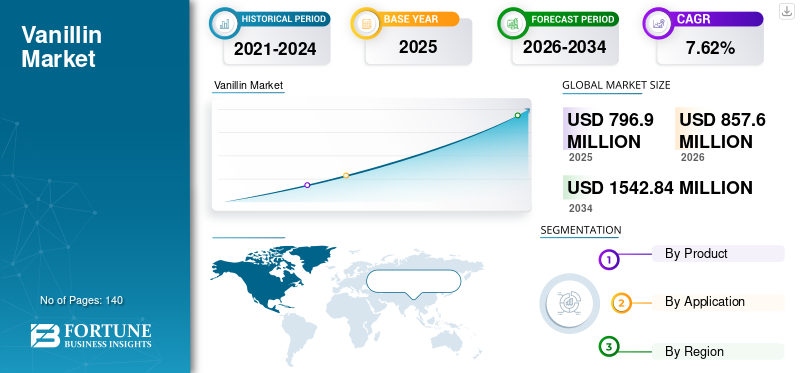
The global vanillin market size was valued at USD 796.90 billion in 2025. The market is projected to grow from USD 857.60 billion in 2026 to USD 1542.84 billion by 2034, exhibiting a CAGR of 7.62% during the forecast period. The market in North America dominated with a revenue share of 34% in 2025.

The vanillin market is a vital segment of the global flavor and fragrance industry, supported by extensive demand from food processing, beverages, confectionery, bakery products, pharmaceuticals, and personal care applications. Vanillin is widely recognized as one of the most utilized flavoring ingredients because of its characteristic vanilla aroma and versatility across industrial applications. The vanillin market Report indicates that manufacturers are increasingly focusing on sustainable production technologies, improved product purity, and bio-based alternatives to address changing consumer preferences. Demand from processed foods, premium bakery products, and functional beverages continues to strengthen market penetration. Growing innovation in flavor enhancement solutions further supports the expansion of the vanillin market across multiple end-use industries.
The United States represents a major contributor to the vanillin market due to its extensive food manufacturing sector and strong consumption of flavored products. The country experiences substantial demand for vanillin in bakery products, dairy items, confectionery, nutritional supplements, and beverage formulations. Food manufacturers increasingly utilize vanillin to improve taste profiles and product differentiation. The presence of advanced flavor technology companies and a well-established processed food industry continues to support market development. Rising interest in clean-label ingredients and naturally sourced flavor compounds is encouraging investments in bio-based vanillin production across the United States.
Download Free sample to learn more about this report.
Vanillin Market Key Takeaways
 Global Market Size & Forecast
- 2025 Market Size: USD 796.90 Billion
- 2026 Market Size: USD 857.60 Billion
- 2034 Forecast Market Size: USD 1,542.84 Billion
- CAGR: 7.62% from 2026-2034
 Market Share
- The market in North America dominated with a revenue share of 34% in 2025.
- Synthetic vanillin accounted for approximately 82% of the market share.
- Food & Beverage accounted for approximately 68% of the market share.
 Key Regional Highlights
North America
North America led the market with a 34% share, supported by strong demand for flavor ingredients across food and beverage applications.
Europe
Europe accounted for 29% of the market, driven by growing demand for premium food products and sustainable flavor ingredients.
Asia-Pacific
Asia-Pacific held a 25% share, supported by expanding food processing and rising consumption of packaged foods.
U.S.
The U.S. market is supported by strong demand for vanillin across food, beverage, fragrance, and pharmaceutical applications.
Japan
Japan accounted for 14% of the Asia-Pacific market, supported by advanced food manufacturing and growing demand for premium flavor ingredients.
Read More

vanillin market Latest Trends
The vanillin market Trends are evolving rapidly as manufacturers adapt to changing consumer preferences and sustainability requirements. One of the most significant trends involves the increasing adoption of bio-based vanillin derived from renewable raw materials. Food and beverage companies are actively seeking natural and environmentally responsible flavor solutions to align with consumer demand for clean-label products. This trend is driving innovation in biotechnology-based production processes and fermentation technologies.
Download Free sample to learn more about this report.
Another important trend identified in the vanillin market Analysis is the growing utilization of vanillin beyond traditional food applications. Fragrance manufacturers are incorporating vanillin into perfumes, cosmetics, skincare products, and household care formulations due to its warm and pleasant aromatic properties. Pharmaceutical companies are also using vanillin in medicinal formulations and nutraceutical products to improve flavor masking and patient acceptance. Advanced manufacturing technologies are helping producers improve product consistency, purity levels, and supply chain efficiency. The vanillin market Research Report also highlights increasing collaborations between ingredient manufacturers and food companies to develop customized flavor solutions.
vanillin market Dynamics
DRIVER
Growing Demand for Flavored Food and Beverage Products
The primary driver supporting vanillin market Growth is the increasing global consumption of flavored food and beverage products. Consumers increasingly seek enhanced taste experiences, encouraging manufacturers to incorporate vanillin into a broad range of products including bakery items, chocolates, dairy products, desserts, and beverages. The ingredient provides a distinctive flavor profile that improves product appeal while maintaining formulation flexibility across multiple applications.
Food manufacturers are investing heavily in product innovation and premiumization strategies, creating sustained demand for flavor ingredients. Vanillin remains one of the most cost-effective flavor compounds available for large-scale industrial use. Rising urbanization, changing dietary preferences, and increasing disposable incomes are contributing to higher consumption of processed and convenience foods containing vanillin. Additionally, expansion of the global confectionery industry and growing demand for ready-to-eat products continue to strengthen the Vanillin Industry Analysis. The ingredient’s versatility and compatibility with numerous formulations make it a preferred choice among manufacturers seeking flavor consistency and product differentiation.
RESTRAINT
Fluctuating Raw Material Availability and Production Complexities
A significant restraint affecting the vanillin market is the fluctuating availability of raw materials required for both synthetic and bio-based production. Variations in feedstock supply, regulatory requirements, and environmental compliance obligations can affect manufacturing operations and production planning. These challenges create uncertainties for manufacturers seeking stable supply chains.
Bio-based vanillin production requires advanced biotechnology processes and specialized infrastructure, resulting in higher operational complexity compared to conventional methods. Manufacturers often face challenges related to scalability, production efficiency, and maintaining consistent quality standards. Furthermore, strict food safety regulations and quality certification requirements increase compliance costs throughout the supply chain. The vanillin market Outlook indicates that producers must continuously invest in process optimization and quality assurance systems to remain competitive. These factors can influence market accessibility, particularly for smaller manufacturers with limited financial and technological resources.
OPPORTUNITY
Expansion of Natural and Bio-Based Vanillin Production
The growing preference for natural ingredients presents substantial opportunities within the vanillin market. Consumers increasingly examine product labels and favor ingredients perceived as natural, sustainable, and environmentally friendly. This trend is encouraging manufacturers to invest in bio-based vanillin production technologies that utilize renewable resources and fermentation processes.
The vanillin market Opportunities are particularly strong within premium food categories, organic products, plant-based foods, and specialty beverages. Manufacturers can differentiate their offerings by incorporating naturally derived flavor ingredients. Advances in biotechnology are improving production efficiency and reducing costs associated with bio-based vanillin manufacturing. Emerging markets are also creating new growth opportunities due to increasing consumption of processed foods and rising awareness regarding ingredient quality. Strategic partnerships between flavor companies and food manufacturers continue to accelerate innovation and commercialization of next-generation vanillin products across global markets.
CHALLENGE
Intense Competition and Pricing Pressure
One of the most prominent challenges in the vanillin market is the highly competitive nature of the industry. Numerous global and regional manufacturers compete on factors such as product quality, production efficiency, pricing, and supply reliability. This competitive environment often creates significant pricing pressure throughout the value chain.
The transition toward sustainable production methods introduces additional challenges because manufacturers must balance environmental objectives with profitability and operational efficiency. Developing and commercializing innovative production technologies requires substantial investments in research, development, and manufacturing infrastructure. Furthermore, changing regulatory frameworks and evolving consumer expectations necessitate continuous product innovation. The Vanillin Industry Report indicates that maintaining consistent product quality while managing production costs remains a critical challenge for market participants seeking long-term growth and market leadership.
vanillin market Segmentation
By Product
Synthetic vanillin accounts for approximately 82% of the vanillin market Share due to its widespread availability, cost efficiency, and suitability for large-scale industrial applications. The ingredient is extensively used across food and beverage manufacturing because it provides a consistent flavor profile while remaining economically viable for high-volume production. Synthetic vanillin is commonly incorporated into bakery products, confectionery, dairy formulations, ice cream, chocolates, and beverage concentrates. The vanillin market Forecast indicates continued demand for synthetic vanillin because of its scalability and established production infrastructure. Manufacturers favor synthetic vanillin for its reliable supply chain and ability to meet strict quality specifications required by food processing companies. Continuous improvements in production technologies are helping manufacturers enhance purity levels and operational efficiency. The segment remains particularly strong in developing economies where affordability and mass-market food production drive purchasing decisions.
Bio-based vanillin represents approximately 18% of the vanillin market Size and is experiencing increasing adoption among premium food manufacturers and clean-label product developers. Produced through biotechnology processes and renewable raw materials, bio-based vanillin aligns with growing consumer preferences for sustainable and naturally sourced ingredients. The vanillin market Insights reveal increasing investment in fermentation-based production technologies designed to improve scalability and cost competitiveness. Food manufacturers are increasingly incorporating bio-based vanillin into organic products, premium beverages, plant-based foods, and specialty confectionery applications. The segment also benefits from growing regulatory support for sustainable manufacturing practices and reduced environmental impact. As biotechnology innovations continue to improve production efficiency, bio-based vanillin is expected to strengthen its position within the global flavor ingredient market.
By Application
The Food & Beverage segment holds approximately 68% of the vanillin market Share, making it the largest application area within the global industry. Vanillin is extensively utilized in bakery products, confectionery, dairy items, chocolates, desserts, flavored beverages, breakfast cereals, and snack foods. Manufacturers rely on vanillin because it provides a rich vanilla flavor profile while enhancing overall product appeal. The ingredient is particularly important in premium food formulations where flavor consistency and consumer satisfaction are critical factors. The vanillin market Analysis indicates that increasing demand for convenience foods, ready-to-eat products, and premium confectionery continues to strengthen consumption across the food and beverage sector. Food companies are investing in innovative product launches featuring enhanced flavor experiences, creating sustained demand for vanillin-based ingredients. Growing urbanization and changing consumer lifestyles are also encouraging higher consumption of processed foods. Additionally, rising demand for plant-based products and functional foods is creating new opportunities for vanillin manufacturers. As food producers continue to focus on product differentiation and sensory enhancement, vanillin remains an essential ingredient supporting long-term growth in this application segment.
The Fragrance segment accounts for approximately 19% of the vanillin market Share and remains an important contributor to overall market development. Vanillin is widely used in perfumes, body sprays, personal care products, skincare formulations, soaps, candles, and household cleaning products because of its warm, sweet, and long-lasting aroma characteristics. Fragrance manufacturers utilize vanillin both as a primary aromatic component and as a blending ingredient that enhances scent complexity. The Vanillin Industry Report highlights increasing demand for premium fragrances and personal care products as a key factor supporting segment growth. Consumers are increasingly seeking sophisticated and distinctive fragrance experiences, encouraging manufacturers to incorporate high-quality aromatic compounds into their formulations. The expansion of the cosmetics industry and increasing spending on beauty and wellness products are also contributing to market expansion. Innovation in fragrance chemistry and product personalization continues to create opportunities for vanillin suppliers. Furthermore, sustainable and bio-based fragrance ingredients are gaining popularity, encouraging additional investments in environmentally responsible vanillin production technologies.
The Pharmaceutical segment represents approximately 13% of the vanillin market Share and continues to expand due to growing utilization in medicinal formulations and nutraceutical products. Vanillin is commonly used as a flavor-masking agent in syrups, chewable tablets, dietary supplements, pediatric medicines, and other oral pharmaceutical products. Its pleasant taste profile helps improve patient compliance and enhances the acceptability of medicinal formulations. The vanillin market Research Report indicates increasing demand from pharmaceutical manufacturers seeking effective flavor enhancement solutions for healthcare products. As global healthcare expenditure rises and pharmaceutical innovation accelerates, demand for high-purity vanillin formulations continues to grow. Nutraceutical products, wellness supplements, and functional health beverages are further supporting segment expansion.
vanillin market Regional Outlook
North America
North America accounts for approximately 34% of the vanillin market Share and remains one of the most mature regions in the global industry. The region benefits from a highly developed food and beverage sector, strong consumer demand for flavored products, and widespread adoption of premium ingredients. Food manufacturers across North America continue to utilize vanillin extensively in confectionery, bakery products, dairy items, and beverage formulations. The region also has a well-established fragrance industry that contributes significantly to overall demand.
Growing interest in natural ingredients and sustainable production methods is encouraging investments in bio-based vanillin technologies throughout North America. Companies are focusing on clean-label product development to align with evolving consumer preferences. The vanillin market Outlook for the region remains positive due to continued innovation in food processing, increasing demand for premium products, and expanding applications in pharmaceuticals and personal care products. Advanced manufacturing infrastructure and strong research capabilities further support market development. Strategic collaborations between ingredient suppliers and consumer goods manufacturers continue to strengthen the region’s competitive position within the global vanillin industry.
Europe
Europe represents approximately 29% of the vanillin market Share and remains a major hub for flavor and fragrance innovation. The region has a strong tradition of food manufacturing excellence and maintains high standards for ingredient quality, sustainability, and product safety. Demand for vanillin is driven by extensive use in confectionery products, bakery applications, dairy formulations, and premium fragrance products.
The vanillin market Growth in Europe is supported by increasing consumer demand for natural and organic products. Manufacturers are investing in biotechnology-based production processes to meet sustainability objectives while maintaining product performance. The fragrance and personal care industries also contribute significantly to regional demand. Regulatory emphasis on environmental responsibility and clean-label formulations continues to encourage innovation throughout the market. European manufacturers are increasingly focusing on value-added products and customized flavor solutions designed to address changing consumer preferences and emerging application requirements.
Germany vanillin market
Germany contributes approximately 27% of Europe’s vanillin market and serves as one of the region’s most important manufacturing and consumption centers. The country possesses a highly developed food processing sector that extensively utilizes vanillin across confectionery, bakery, dairy, and beverage applications. German manufacturers prioritize product quality, innovation, and sustainability, supporting strong demand for both synthetic and bio-based vanillin.
The German vanillin market Analysis highlights increasing interest in clean-label ingredients and environmentally responsible production methods. Food companies are expanding product portfolios featuring natural flavor solutions, creating new opportunities for advanced vanillin manufacturers. Germany’s strong chemical manufacturing expertise and research infrastructure further support innovation within the flavor ingredients industry. Additionally, the country’s personal care and fragrance sectors continue to contribute to market growth through increasing utilization of vanillin in premium aromatic formulations.
United Kingdom vanillin market
The United Kingdom accounts for approximately 11% of Europe’s vanillin market Share and remains a significant consumer of flavor and fragrance ingredients. The country’s food manufacturing sector relies heavily on vanillin for use in bakery products, desserts, confectionery items, beverages, and nutritional products. Consumer demand for indulgent and premium food experiences continues to support market expansion.
The vanillin market Insights for the United Kingdom indicate growing interest in naturally sourced flavor ingredients and sustainable manufacturing practices. Food manufacturers are increasingly responding to consumer expectations regarding transparency and ingredient quality. The fragrance and cosmetics industries also contribute to vanillin demand through product innovation and premiumization strategies. Rising investment in product development and changing consumer preferences continue to create growth opportunities for vanillin suppliers operating within the UK market.
Asia-Pacific
Asia-Pacific holds approximately 25% of the vanillin market Share and is emerging as one of the fastest-expanding regions due to rapid industrialization, increasing food consumption, and growing demand for flavor-enhancing ingredients. The region benefits from a large population base, expanding middle-class consumer segment, and increasing preference for processed and convenience foods. Vanillin is extensively utilized in confectionery products, dairy formulations, bakery goods, beverages, and nutritional supplements across major economies within the region.
The vanillin market Report indicates that food manufacturers in Asia-Pacific are investing heavily in product innovation and premium flavor solutions to address evolving consumer preferences. Growing urbanization and rising disposable incomes continue to increase consumption of packaged foods containing vanillin. The region also benefits from expanding pharmaceutical manufacturing and personal care industries, creating diversified demand across multiple application segments. Governments and private companies are investing in advanced food processing technologies and sustainable ingredient production methods, supporting long-term market development. Increasing adoption of bio-based vanillin and growing awareness regarding natural ingredients are expected to further strengthen the market outlook throughout Asia-Pacific.
Japan vanillin market
Japan accounts for approximately 14% of the Asia-Pacific vanillin market and remains a key market due to its advanced food processing industry and strong consumer preference for premium-quality products. Vanillin is widely used in confectionery, bakery products, dairy desserts, beverages, and nutritional supplements. Japanese manufacturers emphasize product quality, consistency, and innovation, driving demand for high-purity vanillin ingredients.
The Japan vanillin market Analysis highlights increasing demand for premium food products featuring natural and sustainable flavor ingredients. Consumers in Japan are highly conscious of ingredient quality and product authenticity, encouraging manufacturers to invest in advanced flavor technologies. The country’s well-developed pharmaceutical and personal care industries also contribute to vanillin consumption. Research and development activities focused on biotechnology-based production methods continue to support innovation within the market. Additionally, growing demand for functional foods and health-oriented products is creating new opportunities for vanillin suppliers serving Japanese manufacturers.
China vanillin market
China represents approximately 39% of the Asia-Pacific vanillin market Share and serves as one of the largest production and consumption centers globally. The country benefits from a massive food manufacturing industry, expanding consumer goods sector, and strong demand for flavor ingredients across numerous applications. Vanillin is widely incorporated into confectionery, bakery products, beverages, dairy formulations, and pharmaceutical products.
The Vanillin Industry Analysis indicates that China continues to strengthen its position through investments in manufacturing capacity, production efficiency, and export-oriented operations. Rapid urbanization and changing dietary habits are increasing demand for processed and packaged foods, supporting sustained consumption of vanillin. The country is also experiencing growing interest in premium food products and clean-label formulations, encouraging manufacturers to diversify product offerings. Advances in biotechnology and sustainable production technologies are expected to create additional growth opportunities for the Chinese vanillin industry in the coming years.
Rest of World
The Rest of World region accounts for approximately 12% of the vanillin market Share and includes Latin America, the Middle East, and Africa. Although smaller in comparison to North America, Europe, and Asia-Pacific, these markets are experiencing gradual growth due to increasing food processing activities and expanding consumer demand for flavored products. Vanillin consumption is rising across bakery products, confectionery items, dairy products, and beverages as manufacturers seek to enhance product appeal and competitiveness.
The vanillin market Forecast for the Rest of World region remains favorable due to improving economic conditions, expanding retail networks, and increasing investment in food manufacturing infrastructure. Demand for personal care products and fragrances is also contributing to market growth across several emerging economies. Companies are exploring opportunities to introduce innovative flavor solutions and sustainable ingredient options to address evolving consumer preferences. Growing awareness regarding product quality and flavor enhancement is expected to support long-term market development throughout these regions.
List of Top Vanillin Companies
- Apple Flavor & Fragrance Group Co Ltd.
- Camlin Fine Sciences Ltd.
- De Monchy Aromatics
- International Flavors & Fragrances
- Ennloys
- Evolva Holding
- Advanced Biotech
- Omega Ingredients Ltd.
- Comax Flavors
Top Two Companies with Highest Market Share
- International Flavors & Fragrances – 17%
- Camlin Fine Sciences Ltd. – 12%
Investment Analysis and Opportunities
The vanillin market is attracting substantial investment as manufacturers seek to capitalize on increasing demand for flavor ingredients across food, beverage, fragrance, and pharmaceutical industries. Companies are expanding production facilities, enhancing manufacturing efficiency, and investing in advanced technologies designed to improve product quality and sustainability. The growing preference for natural and bio-based ingredients is encouraging significant investment in biotechnology-based vanillin production methods.
The vanillin market Opportunities are particularly strong within premium food categories, clean-label products, organic formulations, and plant-based foods. Investors are increasingly focusing on sustainable production systems that reduce environmental impact while meeting evolving consumer expectations. Strategic partnerships between ingredient manufacturers and food companies are accelerating product innovation and market expansion. Emerging economies also present attractive opportunities due to rising consumption of processed foods and increasing demand for high-quality flavor solutions. Additionally, advancements in fermentation technologies and renewable feedstock utilization are expected to create long-term investment potential across the global vanillin industry.
New Product Development
Innovation remains a critical focus area within the vanillin market as manufacturers strive to meet changing consumer preferences and sustainability requirements. Companies are developing advanced bio-based vanillin solutions derived from renewable feedstocks through biotechnology and fermentation-based production methods. These innovations are designed to provide flavor profiles comparable to conventional vanillin while improving environmental performance. Research activities are increasingly focused on enhancing production efficiency, reducing waste generation, and improving scalability of bio-based manufacturing processes.
The vanillin market Trends indicate growing investment in customized flavor systems that combine vanillin with complementary flavor compounds to create unique sensory experiences. Manufacturers are introducing high-purity vanillin grades specifically designed for premium food, pharmaceutical, and fragrance applications. New product development efforts are also targeting clean-label formulations, organic-certified ingredients, and specialty flavor solutions suitable for plant-based foods and functional beverages. Advanced encapsulation technologies are improving flavor stability and shelf life, allowing vanillin to perform effectively across a broader range of applications.
Five Recent Developments (2023–2025)
- International Flavors & Fragrances expanded its sustainable flavor ingredient portfolio through enhanced natural vanillin production initiatives in 2024.
- Camlin Fine Sciences Ltd. increased vanillin manufacturing capacity to support rising global demand from food and beverage manufacturers in 2023.
- Evolva Holding advanced fermentation-based vanillin technologies aimed at improving sustainability and production efficiency in 2024.
- Apple Flavor & Fragrance Group Co Ltd. introduced new flavor solutions incorporating premium vanillin formulations for processed food applications in 2025.
- Advanced Biotech expanded its portfolio of naturally derived flavor ingredients, including specialty vanillin products, during 2025.
Report Coverage of vanillin market
The vanillin market Report provides a comprehensive evaluation of industry trends, market dynamics, competitive developments, and growth opportunities across major geographic regions. The report examines key market segments including synthetic vanillin and bio-based vanillin while assessing their applications across food and beverage, fragrance, and pharmaceutical industries. Detailed analysis of demand drivers, restraints, opportunities, and challenges offers valuable insights into factors influencing market development.
Request for Customization to gain extensive market insights.
The vanillin market Research Report further evaluates technological advancements, production innovations, sustainability initiatives, and emerging consumer preferences affecting the global industry. Regional assessments cover North America, Europe, Asia-Pacific, and Rest of World markets, along with detailed country-level analysis for Germany, the United Kingdom, Japan, and China. Competitive landscape analysis highlights leading manufacturers, market positioning strategies, product development activities, and investment trends. The report also examines evolving regulatory requirements, supply chain developments, and opportunities associated with bio-based production technologies.
Frequently Asked Questions
Fortune Business Insights says that the global market value stood at USD 796.90 billion in 2025 and is projected to reach USD 1,542.84 billion by 2034.
The market is expected to exhibit a CAGR of 7.62% during the forecast period of 2026-2034.
Synthetic vanillin was the leading product segment, accounting for approximately 82% of the market share, driven by its widespread availability, cost efficiency, and suitability for large-scale industrial applications.
Key players include Apple Flavor & Fragrance Group Co Ltd., Camlin Fine Sciences Ltd., De Monchy Aromatics, International Flavors & Fragrances, Ennloys, and Evolva Holding.
Major trends include increasing adoption of bio-based vanillin and growing use of vanillin in fragrance, cosmetics, pharmaceutical, and nutraceutical applications. North America led the market with a 34% share.



- 2021-2034
- 2025
- 2021-2024
- 140
-

(Offer valid till 30th Sep 2026)
Get 30-60 hrs Free Customization
Expand Regional and Country Coverage, Segments Analysis, Company Profiles, Competitive Benchmarking, and End-user Insights.




















-
US +1 833 909 2966 ( Toll Free )
-
Get In Touch With Us