Vegetable Oil Market Size, Share & Industry Analysis, By Type (Palm Oil, Soybean Oil), By Application, By Distribution Channel, and Regional Forecast, 2026-2034
 Download Free Sample
Vegetable Oil Market Overview
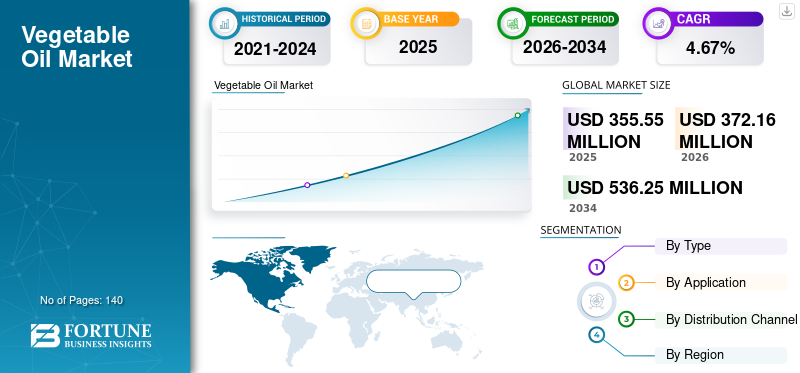
The vegetable oil market size was valued at USD 355.55 million in 2025. The market is projected to grow from USD 372.16 million in 2026 to USD 536.25 million by 2034, exhibiting a CAGR of 4.67% during the forecast period.

The vegetable oil market is witnessing strong global demand due to increasing consumption in food processing, bakery products, snacks, biofuel production, and industrial applications. Vegetable oils such as palm oil, soybean oil, sunflower oil, and canola oil are widely utilized in households, restaurants, and packaged food manufacturing because of their affordability, long shelf life, and cooking versatility. The vegetable oil market report highlights rising demand for healthier edible oil options with lower trans-fat content and improved nutritional profiles. Food manufacturers are increasingly adopting refined vegetable oils in processed foods and ready-to-eat products. vegetable oil market analysis also indicates growing utilization in cosmetics, animal feed, and biodiesel production sectors.
The USA vegetable oil market is expanding steadily due to increasing demand for processed foods, fast-food consumption, and biofuel manufacturing activities. Soybean oil remains one of the most consumed edible oils in the country because of its widespread use in frying applications, packaged food production, and foodservice operations. The vegetable oil industry report identifies rising consumer preference for healthier cooking oils with balanced fatty acid composition. Food processing companies are increasingly investing in refined oil production and sustainable sourcing initiatives. Growing biodiesel production and rising demand from industrial food manufacturing continue supporting the vegetable oil market Outlook across the United States.
Download Free sample to learn more about this report.
Vegetable Oil Market Key Takeaways
 Global Market Size & Forecast
- 2025 Market Size: USD 355.54 Million
- 2026 Market Size: USD 372.16 Million
- 2034 Forecast Market Size: USD 536.25 Million
- CAGR: 4.67% from 2026-2034
 Market Share
- The market in Asia-Pacific dominated with a revenue share of 46% in 2025.
- Palm oil accounted for approximately 43% of the market share.
- Food processing accounted for approximately 69% of the market share.
 Key Regional Highlights
Asia-Pacific led the market with a 46% share, supported by high palm oil consumption and expanding food processing industries.
North America accounted for 24% of the market, driven by strong demand for soybean oil and processed food applications.
Europe held a 21% share, supported by rising demand for sustainable and healthier vegetable oil products.
U.S.
The U.S. market is supported by strong soybean oil consumption across food processing, household cooking, and biodiesel applications.
Japan
Japan accounted for 11% of the Asia-Pacific market, supported by demand for vegetable oils in food processing and cooking applications.
Read More

vegetable oil market Latest Trends
The vegetable oil market trends indicate increasing demand for organic, non-GMO, and cold-pressed vegetable oils among health-conscious consumers and food manufacturers. Consumers are becoming more aware of nutritional value, fatty acid profiles, and clean-label ingredients in edible oils. This trend is encouraging producers to introduce minimally processed vegetable oils with improved vitamin retention and natural antioxidant properties. The vegetable oil market research report highlights rising popularity of sunflower oil, avocado oil, and blended vegetable oils in premium food applications and healthy cooking segments.
Download Free sample to learn more about this report.
Another important trend in the vegetable oil market analysis is the growing utilization of vegetable oils in biodiesel production and renewable energy applications. Governments and industrial sectors are increasingly focusing on sustainable fuel alternatives, which is driving demand for palm oil and soybean oil feedstocks. Foodservice operators and packaged food companies are also adopting high-stability oils suitable for repeated frying and extended shelf-life products. The vegetable oil market growth is further supported by increasing investments in sustainable agriculture, precision oilseed farming, and advanced refining technologies designed to improve oil quality and production efficiency globally.
vegetable oil market Dynamics
DRIVER
Rising Demand for Processed Food and Convenience Products
The primary driver accelerating vegetable oil market growth is the increasing global demand for processed foods, convenience meals, and fast-food products. Vegetable oils are essential ingredients in frying, baking, margarine production, snacks, confectionery, and ready-to-eat foods. Rapid urbanization, changing dietary habits, and growing working populations are significantly increasing consumption of packaged and convenience food products worldwide. Food manufacturers prefer vegetable oils because they provide texture, flavor stability, and cost-effective production benefits across various applications.
The vegetable oil market Forecast is also strengthened by expanding restaurant chains, bakery operations, and foodservice businesses globally. Developing economies are witnessing increasing edible oil consumption due to rising disposable incomes and changing lifestyles. Soybean oil and palm oil remain highly preferred because of their affordability and wide industrial availability. The Vegetable Oil Industry Analysis further highlights increasing demand from biodiesel manufacturing and industrial food processing sectors. Technological advancements in oil refining and processing are improving product quality, shelf life, and nutritional composition, supporting long-term market expansion.
RESTRAINT
Fluctuating Raw Material Prices and Environmental Concerns
One of the major restraints affecting the vegetable oil market is the volatility in raw material prices caused by climate conditions, agricultural disruptions, and geopolitical trade uncertainties. Oilseed crops such as soybean, sunflower, and palm are highly sensitive to weather fluctuations, droughts, and pest infestations. Variations in crop yields directly influence vegetable oil supply chains and pricing stability. Manufacturers often experience operational challenges due to sudden changes in transportation costs and export regulations impacting global trade flows.
The vegetable oil market analysis also identifies increasing environmental concerns regarding deforestation and unsustainable palm oil cultivation practices. Consumers and regulatory authorities are placing greater emphasis on sustainable sourcing and environmentally responsible production methods. Compliance with sustainability certifications and environmental regulations may increase operational expenses for producers. Rising competition from alternative cooking oils and health concerns associated with excessive refined oil consumption may also limit market growth in certain regions. These factors continue influencing production costs and supply chain management across the vegetable oil industry.
OPPORTUNITY
Growth in Biofuel Production and Healthy Oil Alternatives
The increasing adoption of biodiesel and renewable energy solutions presents significant vegetable oil market Opportunities globally. Vegetable oils such as soybean oil and palm oil are widely utilized as feedstocks in biodiesel production because they provide renewable and lower-emission fuel alternatives. Government policies promoting sustainable transportation and carbon emission reduction are creating strong industrial demand for vegetable oils within the energy sector. Biodiesel manufacturers are increasing procurement of refined vegetable oils to support renewable fuel blending programs.
The vegetable oil market Insights also highlight growing opportunities in healthy edible oil products with improved nutritional benefits. Consumers are increasingly demanding oils with lower saturated fat content, higher omega fatty acids, and clean-label positioning. Manufacturers are introducing fortified oils, organic variants, and blended cooking oils targeting health-conscious households and premium foodservice operations. Rising demand for plant-based diets and functional food ingredients is further expanding opportunities within the global vegetable oil industry. Technological advancements in oil extraction and refining processes continue supporting innovation and market diversification.
CHALLENGE
Supply Chain Instability and Quality Standard Compliance
A significant challenge within the vegetable oil market involves maintaining stable supply chains while meeting strict quality and sustainability standards. Global vegetable oil production depends heavily on agricultural output, transportation infrastructure, and international trade conditions. Supply disruptions caused by climate events, export restrictions, or geopolitical tensions can create shortages and pricing instability across global markets. Food manufacturers and distributors require consistent oil quality and uninterrupted supply to maintain production operations efficiently.
The vegetable oil industry report also highlights increasing pressure on manufacturers to comply with food safety regulations, sustainability certifications, and traceability requirements. Producers must continuously monitor refining processes, contamination risks, and storage conditions to ensure product quality and consumer safety. Competition from regional edible oil producers and fluctuations in consumer preferences create additional market uncertainties. Furthermore, balancing affordability with premium-quality oil production remains a major operational challenge for companies competing in the global vegetable oil industry.
vegetable oil market Segmentation
By Type
Palm oil accounts for approximately 43% of the vegetable oil market share because of its high production efficiency, affordability, and extensive utilization in food processing and industrial applications. Palm oil is widely used in frying oils, bakery fats, confectionery products, instant noodles, and processed snacks due to its stability and long shelf life. Food manufacturers prefer palm oil because it offers cost-effective large-scale production capabilities and versatile application potential. The vegetable oil market report highlights increasing demand for refined and sustainable palm oil products across foodservice and packaged food industries. The biodiesel industry also contributes significantly to palm oil consumption, particularly in Asia-Pacific and emerging economies. Manufacturers are increasingly investing in sustainable plantation practices and traceable supply chains to address environmental concerns associated with palm cultivation. Palm oil derivatives are also utilized in cosmetics, detergents, and industrial lubricants. The vegetable oil market trends indicate rising adoption of certified sustainable palm oil products among multinational food manufacturers and retail companies seeking environmentally responsible sourcing practices.
Soybean oil contributes nearly 31% of the vegetable oil market size due to strong consumption in household cooking, processed foods, salad dressings, and biodiesel applications. Soybean oil remains highly popular because of its balanced fatty acid profile, neutral flavor, and wide availability in major agricultural economies. Food processing companies extensively utilize soybean oil in margarine production, frying operations, and packaged food manufacturing. The vegetable oil market analysis highlights increasing demand from fast-food chains and snack manufacturers requiring high-performance frying oils. The biodiesel sector is also creating strong growth opportunities for soybean oil producers, particularly in North America and Latin America. Consumers are increasingly preferring low-trans-fat soybean oil variants with improved nutritional positioning. Agricultural advancements in soybean cultivation and oil extraction technologies are improving production efficiency and product quality. The Vegetable Oil Industry Analysis further indicates growing utilization of soybean oil in animal feed supplements, industrial lubricants, and plant-based food ingredients across multiple industrial sectors.
By Application
Food processing represents approximately 69% of the vegetable oil market share because vegetable oils are essential ingredients in snacks, bakery products, confectionery, sauces, frozen foods, and ready-to-eat meals. Food manufacturers rely heavily on vegetable oils for frying stability, texture enhancement, flavor consistency, and extended shelf life. Increasing urbanization and changing consumer lifestyles are driving demand for processed foods and convenience products globally. The vegetable oil market Forecast indicates strong growth in industrial frying applications and packaged food manufacturing. Foodservice companies and restaurant chains are also increasing procurement of refined vegetable oils suitable for high-temperature cooking and repeated frying operations. Manufacturers are investing in healthier oil formulations with lower saturated fat content and improved nutritional profiles. Demand for specialty blended oils and fortified edible oils is also rising within premium food applications. Technological advancements in refining and packaging are further improving oil quality and distribution efficiency across the food processing industry.
By Distribution Channel
Supermarkets and hypermarkets contribute approximately 52% of the vegetable oil market share because they provide consumers with broad product availability, competitive pricing, and multiple brand options. Consumers prefer purchasing vegetable oils from large retail chains due to convenience and accessibility. Retail stores also support promotional campaigns and bulk purchasing opportunities for household cooking oils and packaged food ingredients. The vegetable oil market analysis indicates increasing shelf space allocation for premium oils, organic variants, and healthy cooking oil products.
Large retail chains are increasingly expanding private-label vegetable oil offerings to improve profit margins and customer loyalty. Packaged vegetable oils with nutritional labeling and sustainable sourcing certifications are gaining popularity among urban consumers. Retailers are also investing in digital inventory management and improved distribution systems to enhance supply chain efficiency. Growing consumer preference for one-stop shopping experiences continues supporting strong market demand through supermarket and hypermarket channels.
vegetable oil market Regional Outlook
North America
North America accounts for approximately 24% of the vegetable oil market share due to high processed food consumption, strong biodiesel production, and advanced food manufacturing infrastructure. The United States dominates regional demand because soybean oil is extensively utilized in food processing, restaurant operations, and renewable fuel applications. Consumers in North America are increasingly preferring healthier cooking oils with lower trans-fat content and improved nutritional benefits. The vegetable oil market Outlook for the region remains strong due to increasing investments in sustainable biodiesel production and advanced oil refining technologies.
Europe
Europe holds nearly 21% of the vegetable oil market share because of rising demand for organic edible oils, strict food quality standards, and increasing renewable fuel adoption. Countries such as Germany, France, Italy, and the United Kingdom are major consumers of sunflower oil, rapeseed oil, and blended vegetable oils. The vegetable oil market analysis highlights increasing focus on sustainable sourcing and environmentally responsible oil production practices across European food industries.
Germany vegetable oil market
Germany contributes approximately 27% of Europe’s vegetable oil market due to strong food manufacturing activities, rising organic food consumption, and increasing biodiesel production. German consumers are increasingly demanding healthier cooking oils with clean-label ingredients and sustainable sourcing certifications. Food manufacturers and restaurant chains are adopting refined vegetable oils with improved frying performance and nutritional value.
The vegetable oil market trends in Germany also indicate increasing utilization of rapeseed oil and sunflower oil in packaged foods and industrial cooking applications. Biodiesel manufacturers continue driving demand for vegetable oil feedstocks due to renewable energy initiatives and carbon reduction targets. Retailers are expanding premium oil product offerings to meet growing consumer demand for functional and organic food ingredients.
United Kingdom vegetable oil market
The United Kingdom accounts for approximately 22% of Europe’s vegetable oil market because of increasing processed food consumption, rising convenience food demand, and growing health awareness among consumers. Supermarkets and foodservice operators are increasingly offering healthier vegetable oil alternatives with reduced saturated fat content. The vegetable oil market research report highlights strong demand for sunflower oil, canola oil, and blended oils in household cooking and restaurant applications.
Food manufacturers in the United Kingdom are investing in sustainable sourcing and advanced oil refining technologies to improve product quality and meet regulatory standards. Demand for plant-based food products and clean-label ingredients continues supporting long-term vegetable oil consumption growth across the country.
Asia-Pacific
Asia-Pacific dominates the vegetable oil market with approximately 46% market share due to high population density, strong palm oil production, and increasing processed food demand. Countries such as China, India, Indonesia, and Malaysia are major producers and consumers of vegetable oils globally. Rapid urbanization and changing dietary habits are significantly increasing edible oil consumption throughout the region. The vegetable oil market Forecast indicates continued expansion in food processing and biodiesel industries across Asia-Pacific.
Japan vegetable oil market
Japan contributes approximately 11% of the Asia-Pacific vegetable oil market because of high demand for premium edible oils, processed food manufacturing, and health-focused cooking products. Japanese consumers prefer vegetable oils with balanced fatty acid profiles and improved nutritional benefits. Food manufacturers extensively utilize soybean oil and canola oil in packaged foods, sauces, and fried products.
The vegetable oil market Insights indicate increasing demand for functional oils and specialty blended oils within Japan’s premium food sector. Restaurant chains and convenience food manufacturers continue investing in high-quality frying oils with extended stability and reduced oxidation properties. Growing health awareness is further influencing demand for cleaner and nutritionally balanced vegetable oil products.
China vegetable oil market
China accounts for approximately 39% of the Asia-Pacific vegetable oil market due to large-scale food manufacturing, rapid urbanization, and rising household edible oil consumption. Soybean oil and palm oil remain highly consumed across packaged food production, restaurant operations, and household cooking applications. The vegetable oil market growth in China is strongly supported by increasing processed food demand and expanding retail distribution networks.
Government food security initiatives and investments in domestic oilseed processing are also contributing to market expansion. Biodiesel manufacturing and industrial food production continue increasing procurement of refined vegetable oils throughout the country. Rising middle-class populations and evolving dietary patterns are expected to sustain long-term growth in China’s vegetable oil industry.
Rest of World
Rest of World represents approximately 9% of the vegetable oil market share due to growing edible oil demand across Latin America, the Middle East, and Africa. Increasing urbanization, improving food distribution infrastructure, and rising packaged food consumption are supporting market growth across emerging economies. Palm oil and soybean oil remain highly preferred because of affordability and industrial availability.
The vegetable oil market Opportunities in these regions are expanding due to rising investments in food processing industries and biodiesel manufacturing. Governments are encouraging agricultural development and domestic oilseed production to improve food security and reduce import dependence. Increasing adoption of modern retail formats and changing dietary habits continue strengthening long-term vegetable oil demand across developing markets.
List of Top Vegetable Oil Companies
- Archer Daniels Midland Company
- Sime Darby Plantation Berhad
- Bunge Limited
- Olam International Limited
- Cargill Incorporated
- Golden Agri-Resources
- Kuala Lumpur Kepong Berhad
- Fuji Oil Holding Inc.
- Wilmar International Limited
- PT Astra Agro Lestari Tbk
Top Two Companies by Market Share
- Wilmar International Limited – 18%
- Cargill Incorporated – 14%
Investment Analysis and Opportunities
The vegetable oil market is attracting substantial investment due to increasing demand from food processing, biodiesel production, and industrial applications. Companies are investing heavily in sustainable oilseed cultivation, advanced refining technologies, and efficient supply chain infrastructure. The vegetable oil market Opportunities are particularly strong in organic edible oils, biofuel feedstocks, and premium healthy cooking oils with enhanced nutritional value.
Manufacturers are also expanding production capacities in Asia-Pacific and Latin America to support rising global demand. Investments in sustainable palm oil certification and environmentally responsible production practices are increasing significantly. The vegetable oil market report highlights growing collaboration between agricultural producers, biodiesel manufacturers, and food processing companies to secure stable supply chains. Technological innovation in oil extraction and packaging is expected to create additional long-term opportunities across global vegetable oil industries.
New Product Development
Manufacturers in the vegetable oil market are increasingly focusing on healthier oil formulations, organic variants, and specialty blended products. Companies are introducing low-trans-fat vegetable oils enriched with omega fatty acids and natural antioxidants to attract health-conscious consumers. Advanced refining technologies are improving oil stability, shelf life, and nutritional retention in processed edible oils.
The vegetable oil market trends also indicate rising development of cold-pressed oils and minimally processed edible oils suitable for premium food applications. Biodiesel manufacturers are investing in next-generation renewable fuel feedstocks derived from vegetable oil processing. Packaging innovation involving recyclable containers and smart labeling systems is further improving product sustainability and consumer convenience. Continuous research into plant-based functional ingredients and enhanced oil extraction methods remains a major focus within the global vegetable oil industry.
Five Recent Developments (2023-2025)
- Major vegetable oil producers expanded sustainable palm oil sourcing initiatives during 2023 to improve environmental compliance and supply chain transparency.
- Several manufacturers introduced high-stability frying oils in 2024 designed for foodservice and industrial food processing applications.
- Biodiesel companies increased investment in soybean oil refining capacity during 2024 to support renewable diesel production programs.
- Food manufacturers launched fortified vegetable oil products enriched with vitamins and omega fatty acids in 2025 to meet rising health-conscious consumer demand.
- Agricultural companies adopted precision farming technologies in 2025 to improve oilseed crop yields and enhance raw material supply stability.
Report Coverage of vegetable oil market
The vegetable oil market report provides comprehensive analysis of industry trends, production technologies, supply chain developments, and regional demand patterns across food, biofuel, and industrial applications. The report covers major product categories including palm oil, soybean oil, sunflower oil, and specialty blended vegetable oils utilized in household cooking, processed foods, and renewable fuel manufacturing.
Request for Customization to gain extensive market insights.
The vegetable oil market analysis within the report evaluates key drivers, restraints, opportunities, and technological advancements influencing global market expansion. Detailed segmentation analysis includes product type, application, distribution channel, and regional consumption patterns. The report further examines sustainable sourcing practices, oil refining innovations, investment trends, and competitive strategies adopted by leading manufacturers. Regional assessments cover North America, Europe, Asia-Pacific, and Rest of World markets with country-level insights for major edible oil-producing and consuming economies.
Frequently Asked Questions
Fortune Business Insights says that the global market value stood at USD 355.55 million in 2025 and is projected to reach USD 536.25 million by 2034.
The market is expected to exhibit a CAGR of 4.67% during the forecast period of 2026-2034.
Palm oil was the leading type segment, accounting for approximately 43% of the market share, driven by its affordability, high production efficiency, and extensive use in food processing and industrial applications.
Key players include Archer Daniels Midland Company, Sime Darby Plantation Berhad, Bunge Limited, Olam International Limited, Cargill Incorporated, and Golden Agri-Resources.
Major trends include rising demand for organic, non-GMO, and cold-pressed oils and increasing utilization of vegetable oils in biodiesel production. Asia-Pacific led the market with a 46% share.



- 2021-2034
- 2025
- 2021-2024
- 140
-

(Offer valid till 30th Sep 2026)
Get 30-60 hrs Free Customization
Expand Regional and Country Coverage, Segments Analysis, Company Profiles, Competitive Benchmarking, and End-user Insights.




















-
US +1 833 909 2966 ( Toll Free )
-
Get In Touch With Us