 Download Free Sample



Get a Quote
Receive a tailored pricing based on your needs.
- Choose license type
- Multiple user options
- Custom scope & coverage
- Fast turnaround
"Designing Growth Strategies is in our DNA"
 Listen to Audio Version
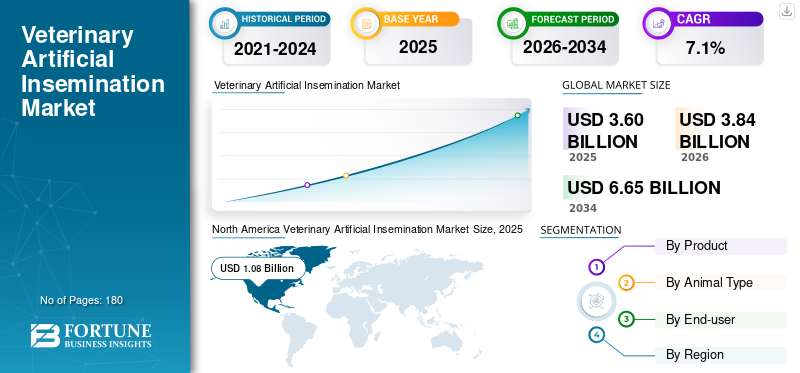
The global veterinary artificial insemination market size was valued at USD 3.60 billion in 2025. The market is projected to grow from USD 3.84 billion in 2026 to USD 6.65 billion by 2034, exhibiting a CAGR of 7.1% during the forecast period. North America dominated the veterinary artificial insemination market with a market share of 30.% in 2025.
Veterinary artificial insemination is the controlled placement of semen into the reproductive tract of livestock or companion animals without natural mating. It is widely used in cattle, swine, equine, sheep, goats, and, increasingly, in canine breeding to improve genetics, manage breeding timing, reduce disease transmission risks, and support higher productivity. The market growth is attributed to rising demand for milk, meat, and high-value animal genetics, along with wider adoption of frozen semen and sex-sorted semen.
Key players in the market include ABS Global, Select Sires Inc., and STgenetics. The dominance of these players is attributed to their focus on advanced reproductive technologies such as sexed semen, cryopreservation, AI catheters, and hormone synchronization tools. Also, they are increasing focus on technician training programs and local insemination support to enhance their market position.
Download Free sample to learn more about this report.
 Global Market Size & Forecast
 Market Share
 Key Regional Highlights
Asia Pacific
Asia Pacific is projected to reach USD 1.01 billion by 2026.
North America
North America generated USD 1.08 billion in 2025, maintaining its leading market position.
Europe
Europe is projected to reach USD 1.02 billion by 2026, registering a 5.3% growth rate during the forecast period.
U.S.
U.S. market is projected to reach USD 1.01 billion by 2026.
Japan
Japan market is projected to reach USD 0.08 billion by 2026.
Read More

Integration of AI With Digital Fertility Monitoring and Decision-Support Tools to Emerge as a Key Trend
Currently, there has been a significant shift from basic insemination services toward integrated reproductive management using ultrasound, fertility analytics, genomic selection, and AI-based decision support. As a result, key market players are launching advanced technologies for artificial insemination to meet the growing demand for precision reproduction solutions. Moreover, researchers are also focused on the introduction of novel technologies to enhance this scenario further.
Download Free sample to learn more about this report.
Rising Use of Sexed Semen and Genetic Improvement Programs to Fuel Market Expansion
Over the past few years, the use of sexed semen and superior genetics has increased globally to improve herd productivity and profitability. Dairy farmers are using sexed semen to generate more female calves from high-performing cows, while beef-on-dairy programs are helping improve calf value. This is expected to boost the strong adoption of reproductive technologies that help producers control offspring sex, improve replacement planning, and increase economic returns. Such a scenario is anticipated to drive the global veterinary artificial insemination market growth.
High Costs and Limited Access to Skilled AI Professionals May Hamper Market Growth
Despite the strong benefits of artificial insemination, the market growth is restrained by the need for trained inseminators, liquid nitrogen storage, accurate heat detection, semen handling infrastructure, and good farm-level management. Moreover, poor timing, low semen quality, incorrect thawing, and inadequate technician skill can reduce conception rates and discourage adoption among small farmers. Furthermore, in several regions, limited access to quality semen and trained personnel is expected to slow adoption even when demand for productivity improvement is high. This is expected to hamper the market growth in the forthcoming years.
Expansion of Sex-Sorted Semen Labs and AI Infrastructure in Emerging Dairy Markets to Create Lucrative Growth Opportunities
In developing regions, governments, cooperatives, and breeding companies are increasingly investing in semen production, sex-sorted semen, and AI coverage, which is expected to create strong opportunities for artificial insemination products.
Such initiatives are expanding access to high-quality germplasm, improving breed development, and supporting milk productivity growth. Similarly, public-private breeding infrastructure models are expected to create new demand for semen straws, AI guns, cryostorage systems, and fertility scanners.
Variable Conception Outcomes and Supply Limitations for Advanced Semen Products to Challenge Market Expansion
In several countries, achieving consistent conception rates across farms, species, and breeds has been challenging as advanced products such as sex-sorted semen may require better timing, healthier animals, precise semen handling, and skilled technicians. Moreover, supply-side limitations are also expected to affect adoption.
Moreover, a parliamentary panel in emerging countries has reportedly witnessed slow progress in the AI program due to limited semen production, limited availability of sex-sorted semen, and a shortage of trained professionals. These issues are further expected to challenge the market expansion, especially in rural areas where cold-chain infrastructure, veterinary access, and farmer awareness are still developing.
Higher Need for Kits & Consumables in Routine Procedures Boosted Segment Growth
Based on product, the market is segmented into equipment, kits & consumables, and others.
The kits & consumables segment accounted for the largest global veterinary artificial insemination market share in 2025. These are single-use or frequently replaced items, making them essential for routine AI procedures across dairy farms, beef farms, swine farms, equine breeding centers, and veterinary clinics. This is expected to support the segment’s growth during the forecast period.
The equipment segment is projected to grow at a 5.9% CAGR during the forecast period.
To know how our report can help streamline your business, Speak to Analyst
Bovine Segment Dominated Due to Increasing Commercial Adoption of Bovine Semen
By animal type, the market is segmented into bovine, swine, ovine & caprine, equine, and others.
The bovine segment accounted for the largest market share in 2025. Bovine insemination has stronger commercial adoption than many other animal categories, as dairy and beef farms operate on a large scale and regularly invest in semen, breeding services, and fertility management. Moreover, the segment is estimated to hold a 53.9% share in 2026.
The swine segment is anticipated to grow at a 6.4% CAGR over the forecast period.
Higher Usage of Artificial Insemination for Planned Breeding by Livestock Farms/Commercial Animal Farms Boosted Segment Growth
On the basis of end-user, the market is segmented into livestock farms/commercial animal farms, animal breeding centers & semen stations, and others.
In 2025, livestock farms/commercial animal farms dominated the market. They are primary users of artificial insemination for herd productivity, planned breeding, and genetic improvement. Moreover, these farms are using AI to reduce dependence on natural mating, lower disease transmission risk, improve breeding control, and increase the number of offspring from superior genetics. Such a scenario is anticipated to fuel demand for artificial insemination in livestock farms/commercial animal farms, propelling the segment’s growth. Furthermore, the segment is set to hold 44.1% share in 2026.
The animal breeding centers & semen stations segment is projected to grow at a 6.7% CAGR during the forecast period.
Based on geography, the market is classified into North America, Europe, Asia Pacific, Latin America, and the Middle East & Africa.
North America Veterinary Artificial Insemination Market Size, 2025 (USD Billion)
To get more information on the regional analysis of this market, Download Free sample
North America accounted for the largest market share, valued at USD 1.01 billion in 2024 and USD 1.08 billion in 2025. The region benefits from the U.S. being both the largest exporter and a strong importer of animal semen, due to its highly developed dairy and beef cattle industries, the strong presence of livestock genetics companies, and advanced semen processing infrastructure.
In 2026, the U.S. is anticipated to reach USD 1.01 billion, accounting for approximately 26.4% of global revenues.
Europe is projected to record a 5.3% growth rate during the forecast period, the second-highest globally, reaching USD 1.02 billion in 2026. Countries such as Germany, France, the Netherlands, the U.K., Italy, and Denmark have well-organized livestock breeding systems and strong demand for high-quality semen, which is anticipated to support their market expansion in the forthcoming years.
The U.K. market is projected to reach USD 0.13 billion in 2026, representing approximately 3.4% of global revenues.
Germany's market is expected to reach USD 0.20 billion in 2026, accounting for approximately 5.3% of global revenues.
In 2026, the Asia Pacific market is projected to reach approximately USD 1.01 billion, making it the third-largest market globally. The growth is due to rising milk and meat consumption, government-backed breed improvement programs, and increasing adoption of sex-sorted semen in India and China.
Japan is projected to generate approximately USD 0.08 billion in revenue in 2026, representing nearly 2.1% of global revenues.
China’s market is anticipated to reach around USD 0.35 billion in 2026, accounting for nearly 9.2% of global revenues.
India’s market is expected to reach approximately USD 0.24 billion in 2026, accounting for around 6.2% of global revenues.
Both Latin America and the Middle East & Africa are anticipated to witness moderate growth. The Latin America market is estimated to reach approximately USD 0.42 billion, and the Middle East & Africa market is set to reach USD 0.23 billion in 2026. Government livestock productivity programs, dairy modernization, and growing beef industries in these regions support the growth.
In 2026, the GCC market is estimated to reach approximately USD 0.17 billion, representing around 2.1% of global revenues.
Strategic Initiatives by Key Players to Improve Their Market Positions
In 2025, ABS Global, Select Sires Inc., and STgenetics held the largest global market share. This share is attributed to a broad dairy and semen portfolio as well as a strong distribution network globally. Moreover, these companies differentiate their products through genetic quality, sex-sorted semen accuracy, and fertility performance.
Other key players are focusing on new product introduction and strategic initiatives to expand geographic reach. Moreover, these companies are moving beyond conventional semen toward premium solutions such as sexed semen and beef-on-dairy genetics, which are expected to enhance their market position in the upcoming years.
The veterinary artificial insemination market report presents a detailed assessment of each market segment, covering the major growth drivers, emerging trends, opportunities, restraints, and challenges shaping the industry. It also provides insights into technological innovations, key industry developments, market share analysis, and comprehensive profiles of leading companies.
Request for Customization to gain extensive market insights.
| ATTRIBUTE | DETAILS |
| Study Period | 2021-2034 |
| Base Year | 2025 |
| Estimated Year | 2026 |
| Forecast Period | 2026-2034 |
| Historical Period | 2021-2024 |
| Growth Rate | CAGR of 7.1% from 2026 to 2034 |
| Unit | Value (USD Billion) |
| Segmentation | By Product, Animal Type, End-user, and Region |
| By Product |
|
| By Animal Type |
|
| By End-user |
|
| By Region |
|
Fortune Business Insights says that the global market value stood at USD 3.60 billion in 2025 and is projected to reach USD 6.65 billion by 2034.
In 2025, the market value in North America stood at USD 1.08 billion.
The market is expected to exhibit a CAGR of 7.1% during the forecast period of 2026-2034.
The kits & consumables segment led the market by product.
The key factors driving the market are the rising use of sexed semen and genetic improvement programs.
ABS Global, Select Sires Inc., and STgenetics are among the prominent players in the market.
North America dominated the market in 2025.

Get 30-60 hrs Free Customization
Expand Regional and Country Coverage, Segments Analysis, Company Profiles, Competitive Benchmarking, and End-user Insights.













.webp)






Related Reports
Get In Touch With Us
US +1 833 909 2966 ( Toll Free )
Receive a tailored pricing based on your needs.
Discuss your questions with our industry experts.
Have questions? Get quick answers before you purchase.

