Voice Communication Control System Market Size, Share & Industry Analysis, By Solution (Hardware, Software, and Services), By Platform (Air, Ground, and Maritime), By Application (Air Traffic Control, Vessel Traffic Control, Strategic Emergency Services, and Others), By End User (Commercial and Defense), and Regional Forecast, 2026-2034
 Download Free Sample
KEY MARKET INSIGHTS
 Listen to Audio Version
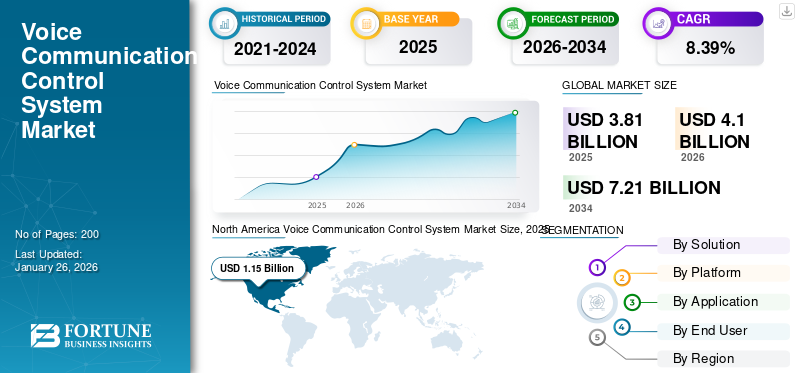
The global voice communication control system market size was valued at USD 3.81 billion in 2025. The market is projected to grow from USD 4.10 billion in 2026 to USD 7.21 billion by 2034, exhibiting a CAGR of 8.39% during the forecast period. North America dominated the voice communication control system market with a market share of 30.22% in 2025.
A VCCS is also referred to as a Voice Communication System (VCS) or Voice Communication Switching System (VCSS). This system is comprised of operational controller units along with radio and telephone switching units. It is an electronic system that enables and manages vocal communication between air traffic control operators on the ground and pilots. A computer oversees this system and provides efficient communication that enhances air traffic management activities.
VCCS systems are engineered with advanced features such as fast reconfiguration, real-time monitoring, dynamic workstation configuration, online re-sectoring, and event logging. These systems are designed to handle both air-ground and ground-ground communications, ensuring efficient and reliable operations in air traffic services units (ATSUs) such as Area Control Centers (ACC), Approach (APP), Towers (TWR), Military (MIL), and Flight Management Positions (FMP). The market is transitioning from analog to digital VoIP systems, which offer improved voice quality, cost efficiency, and interoperability. This shift is driven by standards such as ED-137B, ensuring compliance with international design requirements for ATM operations.
Major players in the Voice Communication Control System market include global technology and defense leaders such as Honeywell International Inc., Thales Group, Northrop Grumman Corporation, L3Harris Technologies, Frequentis AG, Rohde & Schwarz, Leonardo S.p.A., and Indra Sistemas S.A. These companies drive innovation in the sector by developing advanced, secure, and interoperable communication solutions for critical environments like air traffic control, military operations, and public safety. Their offerings often feature integration of new technologies such as AI, cloud-based platforms, and VoIP to enhance reliability, scalability, and operational efficiency.
The COVID-19 had a negative impact on the VCCS market. The temporary halt in commercial aviation activities has led to a decline in air traffic volumes, placing intense pressure on airline operators. Since revenue generation at commercial airports is closely tied to air traffic levels, airline operators were forced to cut costs, including halting the training of air traffic controllers. This has led to a reduced need for voice communication control systems. This effect is confined to the commercial VCCS market and is anticipated to be resolved quickly as the demand for strategic emergency services rises.
Download Free sample to learn more about this report.
Voice Communication Control System Market Key Takeaways
 Global Market Size & Forecast
- 2025 Market Size: USD 3.81 billion
- 2026 Market Size: USD 4.10 billion
- 2034 Forecast Market Size: USD 7.21 billion
- CAGR: 8.39% from 2026–2034
 Market Share
- North America dominated the voice communication control system market with a 30.22% share in 2025.
- The hardware segment is expected to lead the market with a 60.12% share in 2026.
- The air segment is projected to account for 62.08% of the market in 2026.
 Key Regional Highlights
North America
North America generated USD 1.15 billion in 2025 and is projected to reach USD 1.23 billion in 2026.
Europe
Europe accounted for USD 1.09 billion in 2025 and is expected to reach USD 1.17 billion in 2026.
Asia Pacific
Asia Pacific generated USD 0.83 billion in 2025 and is projected to reach USD 0.90 billion in 2026.
U.S.
The market is projected to reach USD 0.91 billion by 2026.
Japan
The market is projected to reach USD 0.15 billion by 2026.
Read More

VOICE COMMUNICATION CONTROL SYSTEM MARKET TRENDS
Transition from Analog to Digital Voice over Internet Protocol (VoIP) Systems to Boost Market Growth
Download Free sample to learn more about this report.
The transition from analog to digital Voice over Internet Protocol (VoIP) in Voice Communication Control Systems (VCCS) is a pivotal shift that is driving market growth. This transition is driven by the need for more efficient, reliable, and cost-effective communication systems in critical sectors such as air traffic management. VoIP-based VCCS enables secure voice and data transmission over IP networks, handling both ground-to-ground and ground-to-air communications seamlessly. The adoption of international standards such as ED-137B ensures interoperability and compliance with global design standards, facilitating communication between air traffic controllers and pilots.
- North America witnessed voice communication control system market growth from USD 1026.8 Million in 2023 to USD 1081 Million in 2024.
Digital VoIP offers several advantages over traditional analog systems, including improved voice quality, cost efficiency, and scalability. The ability to transmit voice as data packets allows for easier storage and sharing of voice data, enhancing operational efficiency. Additionally, VoIP systems provide greater flexibility and can be easily integrated with other digital technologies, providing advanced features such as video conferencing and unified communications. These benefits are driving the adoption of VoIP-based systems in air traffic management, where continuous and reliable communication is critical.
MARKET DYNAMICS
MARKET DRIVERS
Growing Need for Interoperable Voice Communication to Drive Market Growth
Growing technological advancements have led to the heightened acceptance of next-generation voice communication control systems. The application of VoIP in Air Traffic Management (ATM) operations requires standard certification such as ED-136, ED-137, ED-138, and ED-137B. ATM communication elements based on VoIP technology are crafted in accordance with these standards. The fundamental requirements of the VoIP technology-based system are outlined by the European Organization for Civil Aviation Equipment (EUROCAE). This organization includes various recognized entities located around the globe. Among these standards, ED-137B standard plays a crucial role in ensuring interoperable voice communication.
Ongoing voice communication is essential in commercial and military ATM operations as it serves as the vital link between pilots and air traffic controllers. Therefore, the adoption of VoIP VCCS is growing to enable interoperable air traffic management communication. Additionally, the growing volume of air traffic has need a for more efficient ATM operations. Consequently, investments in ATM infrastructure modernization initiatives are increasing. Rising investments are advancing the development of ED-137B certified VCCS systems to meet the demand from air navigation service providers and Air Traffic Control (ATC) service providers.
Increasing Demand for Enhanced Communication Infrastructure to Boost Market Growth
The increasing demand for enhanced communication infrastructure is a significant driver of the growth of the Voice Communication Control System (VCCS) market. This demand is largely driven by the rising volume of air traffic and the need for efficient air traffic management (ATM) systems. According to a report from IATA, Total full-year traffic in 2024 (measured in revenue passenger kilometers or RPKs) increased by 10.4% compared to 2023. This figure was 3. 8% higher than the pre-pandemic levels in 2019. Total capacity, measured in available seat kilometers (ASK), rose by 8.7% in 2024. International full-year traffic in 2024 grew by 13.6% in comparison to 2023, while capacity increased by 12.8%. Meanwhile, domestic full-year traffic for 2024 increased by 5.7%, and capacity grew by 2.5% over the previous year.
This surge in air travel is driving the development of new airports and the expansion of existing ones, particularly in regions such as Asia Pacific. Countries such as India and China are witnessing significant investments in airport infrastructure to meet rising air traffic volumes. The construction of new airports and modernization of existing facilities require advanced communication systems to ensure efficient and safe air traffic management operations.
Furthermore, as air travel increases globally, there is a growing need for advanced communication systems that can handle increased air traffic efficiently and safely. The integration of advanced technologies such as Voice over Internet Protocol (VoIP) and Artificial Intelligence (AI) is crucial for enhancing communication infrastructure, offering improved voice quality, cost efficiency, and scalability.
MARKET RESTRAINTS
Stringent Airport System Design Standards and Safety Norms to Impede Market Growth
Stringent VoIP voice communication system design standards and airport & aircraft safety regulations are expected to hamper market growth during the forecast period. Design standards to develop the VoIP VCS solution used in ATM applications are defined by the European organization for civil aviation equipment (EUROCAE) Working Group 67. This group collaborates with several other organizations such as the U.S. FAA (Federal Aviation Administration), European ANSPs (Air Navigation Service Providers), ATM communication equipment suppliers, and EUROCONTROL. For instance, ICAO's Annex 14 provides guidelines for airport design, emphasizing hazard analysis and the Target Level of Safety (TLS) approach to ensure that airports adhere to safety standards
Therefore, these product design requirements have become global standards for ATMs' voice-over-internet protocol protocol-based systems. Only ED standard certified VoIP VCS products are used to ensure interoperable air traffic control communication. Additionally, stringent airport regulations for ATC towers are expected to hinder voice communication control system market growth.
SEGMENTATION ANALYSIS
By Solution
Hardware Solution Segment to Dominate due to Increase in Demand For High-Tech Hardware Components
Based on solution, the market is segmented into hardware, software, and services.
The hardware segment is expected to lead the market, contributing 60.12% globally in 2026. The significant increase in demand for high-tech hardware components such as antennas, digital switches, consoles, and connectors is the primary driver of this segment’s growth throughout the forecast duration. Moreover, the growing development of multiple remote air traffic control towers is propelling segment growth. These ATC remote towers require sophisticated voice communication technology, specialized equipment, and highly trained controllers to enhance operational efficiency.
Services segment is anticipated to grow at the highest CAGR during the forecast period. As technology continue to evolve rapidly, there is an increasing need for ongoing support and training services to keep users proficient with the latest VCCS systems. This includes training on new features and troubleshooting, which are essential for maintaining operational efficiency.
By Platform
Air Segment Led the Market due to Growing Usage of VCCS in Air Traffic Control Application
Based on platform, the market is divided into air, ground, and maritime.
The air segment will account for 62.08% market share in 2026 & in the base year owing to the growing usage of voice communication control system in air traffic control applications. Moreover, the increased passenger air traffic and increased demand for air traffic management services are major factors responsible for the segment growth during the forecast period. High air traffic volumes are mainly controlled through system or tool integrated into control towers, with digital VCCS playing a crucial role in enabling efficient voice communication between air traffic control operations and pilots.
The ground segment is projected to witness moderate growth during the study period. The ground segment benefits from improved voice communication systems that enhance coordination between ground crews and air traffic controllers. These advancements contribute to better management of aircraft on the ground, reducing delays and improving overall efficiency. Additionally, the use of advanced technologies such as IP-based communication systems in ground operations is driving growth. These systems offer more reliable and efficient communication, which is essential for managing complex ground operations at airports.
By Application
Rising Aircraft Travel Demand is Leading to Air Traffic Control Segment Growth and Dominance
Based on application, the market is divided into air traffic control, vessel traffic control, strategic emergency services, and others.
- The air traffic control segment is expected to account for 79.13% of the market in 2026.
The global rise in air travel is leading to an increase in air traffic, necessitating more efficient and reliable communication systems to ensure safety and operational efficiency. As air travel increases globally, there is a greater need for advanced VCCS to manage the higher volume of flights effectively. This includes systems that can handle increased communication between pilots and air traffic controllers.
The vessel traffic control segment is anticipated to witness significant growth during the study period. The increase in maritime trade and the need for enhanced safety measures are driving the demand for more efficient communication systems in vessel traffic control. Advanced VCCS help in managing vessel movements effectively, reducing the risk of maritime accidents.
To know how our report can help streamline your business, Speak to Analyst
By End User
Commercial Segment Dominated due to Rising Need for Advanced Voice-Controlled Devices
Based on end user, the global market is classified into commercial and defense.
The commercial segment is anticipated to hold a dominant market share of 83.05% in 2026. The need for commercial airplanes is rising globally due to the substantial air traffic. The increasing shipments of commercial aircraft, especially in rapidly expanding regions, have necessitated advanced voice-controlled devices in communication technology that improves the effectiveness of air traffic management operations.
The defense segment is projected to witness moderate growth during the forecast period. Countries such as the U.S., India, and China are increasing defense budgets to modernize military equipment and communication infrastructure. This trend supports the adoption of advanced VCCS for secure and efficient communication in military operations. The development of tactical voice communication systems that offer seamless and secure communication is driving growth in the defense segment. These systems are crucial for military operations, ensuring real-time communication between personnel.
VOICE COMMUNICATION CONTROL SYSTEM MARKET REGIONAL OUTLOOK
The global voice communication control system market has been analyzed across North America, Europe, Asia Pacific, and the rest of the world.
North America
North America Voice Communication Control System Market Size, 2025 (USD Billion)
To get more information on the regional analysis of this market, Download Free sample
The market in North America reached USD 1.15 billion in 2025, representing 30.22% of total market revenue, and is projected to reach USD 1.23 billion in 2026. North America voice communication control system (vccs) holds the largest market share driven by its robust aviation infrastructure and early adoption of advanced technologies. The region's dominance is attributed to the presence of numerous airports in the U.S. and Canada, high military expenditure, and rapid digitization. The U.S. military modernization initiatives and rising defense spending further support market expansion in this region. The U.S. market is projected to reach USD 0.91 billion by 2026.
Europe
Europe contributed approximately USD 1.09 billion to the global market in 2025, accounting for 28.63% share, and is expected to reach USD 1.17 billion in 2026. Europe voice communication control system market holds a substantial market share, primarily due to the presence of key OEM manufacturers such as S.I.T.I. S.p.A., Rohde & Schwarz, and NATS Limited. The region's growth is fueled by continuous investment in upgrading air traffic control systems and a strong focus on modernizing aviation infrastructure. Countries such as Germany and the U.K. are investing significantly in enhancing their communication infrastructure, enhancing market prospects. The UK market is projected to reach USD 0.35 billion by 2026, while the Germany market is projected to reach USD 0.29 billion by 2026.
Asia Pacific
In 2025, the Asia Pacific market stood at USD 0.83 billion, representing 21.73% of global demand, and is projected to grow to USD 0.9 billion in 2026. Asia Pacific is expected to be the fastest-growing region in the voice communication control system market. The growth is attributed to rapid urbanization, expansion of the aviation sector in countries such as China and India, and increasing defense expenditure. China and India are driving market growth due to new airport projects and a growing airline fleet.The Japan market is projected to reach USD 0.15 billion by 2026, the China market is projected to reach USD 0.26 billion by 2026, and the India market is projected to reach USD 0.21 billion by 2026.
Rest of the World
Rest of the World recorded a market size of USD 0.74 billion in 2025, capturing 19.42% of the global market share, and is projected to reach USD 0.79 billion in 2026. During the forecast period, rest of the world will register significant growth in the market due to ongoing infrastructure development and investments in the aviation industry. The market is supported by efforts to modernize existing communication systems, ensuring compatibility along with future aviation growth.
COMPETITIVE LANDSCAPE
KEY INDUSTRY PLAYERS
Key Players Focus on Long-Term Contracts to Achieve Sustainable Market Growth
The competitive landscape of the voice communication control system market is characterized by the presence of key players such as Indra Sistemas, S. A., L3Harris Technologies, Inc. , S. I. T. T. I. S. p. A. , and Frequentis AG. OEM manufacturers are pursuing strategies focused on designing and developing communication products based on VoIP technology to present a diverse array of product offerings. In addition, leading players are concentrating on establishing long-term contracts with air traffic management service providers and airport authorities to secure sustainable market growth. Major players are focusing on delivering cost-effective voice communication solutions to both commercial and defense end users, enhancing their competitive positioning in the market.
LIST OF KEY COMPANIES PROFILED
- ASELSAN A.S. (Turkey)
- Copper chase (U.K.)
- Frequentis AG (Austria)
- Indra Sistemas, S.A. (Spain)
- L3Harris Technologies, Inc. (U.S.)
- MEP (Netherlands)
- NATS Limited (U.K.)
- Northrop Grumman Corporation (U.S.)
- Rohde & Schwarz (Germany)
- S.I.T.T.I. S.p.A. (Italy)
- Saab AB (Sweden)
- Thales Group (France)
KEY INDUSTRY DEVELOPMENTS
- February 2025 -The Ministry of Defence signed a contract worth USD 14.29 Mn with Bharat Electronics Limited for the procurement of 149 Software-Defined Radios (SDRs) for the Indian Armed Forces.
- September 2024 – Vietnam Air Traffic Management Corporation (VATM) signed a contract with SITTI for a new Voice Communication System (VCS) at the Ho Chi Minh Air Traffic Control Centre, valued at about USD 1.73 million.
- February 2024 – Rohde & Schwarz signed a contract with NAV CANADA to supply a "Backup Voice Communication Solution" using the CERTIUM VCS platform for Canadian airspace.
- January 2024 – Rohde & Schwarz successfully deployed its CERTIUM Voice Communications System across Airways New Zealand's Auckland and Christchurch centers under a 15-year contract.
- June 2023 – The Ministry of Transportation awarded SITTI a contract for the supply of Voice Communication Systems (VCS) and ancillary equipment to 19 major airports in Greece. This includes both larger airports such as Thessaloniki and regional airports such as Chios and Kalamata.
REPORT COVERAGE
The voice communication control system market report offers qualitative and quantitative insights into VCCS market trends, along with a detailed analysis of market size & growth rate across various segments. Key insights offered in the report are the adoption of advanced technology, recent industry developments such as partnerships, mergers & acquisitions, Porter’s five forces analysis, business strategies of leading market players, regional analysis.
Request for Customization to gain extensive market insights.
Report Scope & Segmentation
|
ATTRIBUTE |
DETAILS |
|
Study Period |
2021-2034 |
|
Base Year |
2025 |
|
Estimated Year |
2026 |
|
Forecast Period |
2026-2034 |
|
Historical Period |
2021-2024 |
|
Growth Rate |
CAGR of 8.39% from 2026-2034 |
|
Unit |
Value (USD Billion) |
|
Segmentation
|
By Solution
|
|
By Platform
|
|
|
By Application
|
|
|
By End User
|
|
|
By Region
|
Frequently Asked Questions
According to Fortune Business Insights, the global voice communication control system market size was valued at USD 4.10 billion in 2026 and is projected to grow to USD 7.21 billion by 2034.
Registering a CAGR of 8.39%, the market will exhibit steady growth during the forecast period.
The market is driven by rising global air traffic, modernization of air traffic control infrastructure, adoption of VoIP-based VCCS systems, and compliance with international standards like ED-137B for interoperability.
A VCCS typically includes operational controller units, radio and telephone switching units, digital consoles, and a central computer that ensures secure and seamless voice communication for air-ground and ground-ground operations.
VCCS systems are mainly used in air traffic control, military operations, vessel traffic services, and emergency response services, where reliable and real-time voice communication is critical.
VoIP (Voice over Internet Protocol) enables high-quality, cost-effective, and scalable communication, making it ideal for critical applications in aviation, defense, and emergency services. It also supports ED-137B compliance, ensuring global interoperability.
North America dominated the voice communication control system market with a market share of 30.22% in 2025 due to its robust aviation infrastructure, high defense spending, and early adoption of advanced digital communication technologies across airports and military sectors.
Key players include Thales Group, Frequentis AG, Honeywell International Inc., L3Harris Technologies, Northrop Grumman, Rohde & Schwarz, Indra Sistemas, and S.I.T.T.I. S.p.A..
The VCCS market is expected to grow steadily, driven by increased aviation traffic, airport modernization projects, and rising defense communication upgrades, especially in Asia Pacific and Europe.



- 2021-2034
- 2025
- 2021-2024
- 200
Get 30-60 hrs Free Customization
Expand Regional and Country Coverage, Segments Analysis, Company Profiles, Competitive Benchmarking, and End-user Insights.




















Related Reports
-
US +1 833 909 2966 ( Toll Free )
-
Get In Touch With Us