Volatile Organic Compound Gas Sensor Market Size, Share & Industry Analysis, By Technology (Photo-Ionization Detector, Infrared-based detection), By Type, By Application and Regional Forecast, 2026-2034
 Download Free Sample
Volatile Organic Compound Gas Sensor Market Overview
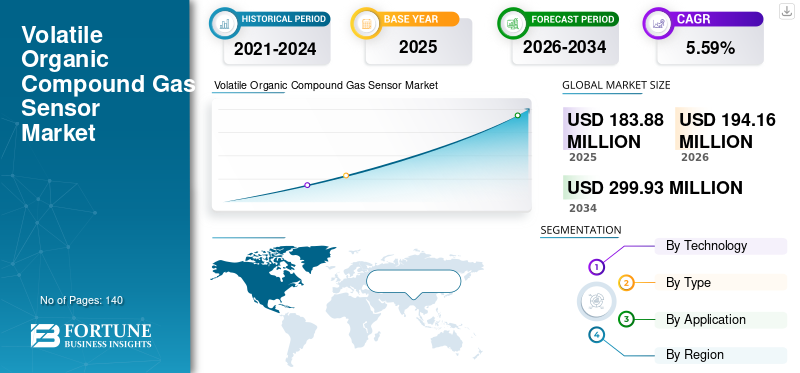
The volatile organic compound gas sensor market size was valued at USD 183.88 million in 2025. The market is projected to grow from USD 194.15 million in 2026 to USD 299.93 million by 2034, exhibiting a CAGR of 5.59% during the forecast period.

The volatile organic compound gas sensor market is expanding significantly due to increasing concerns regarding indoor air quality, industrial safety regulations, and environmental monitoring requirements. Volatile organic compound gas sensors are widely used across manufacturing plants, smart buildings, automotive systems, healthcare facilities, and consumer electronics for real-time air quality monitoring and hazardous gas detection. The volatile organic compound gas sensor market report highlights increasing adoption of IoT-enabled sensing technologies and smart environmental monitoring systems. Growing industrial automation, rising awareness regarding toxic emissions, and stricter workplace safety regulations continue to support volatile organic compound gas sensor market growth. Advancements in miniaturized sensors and wireless monitoring technologies are also strengthening the volatile organic compound gas sensor market outlook globally.
The United States remains a major contributor to the volatile organic compound gas sensor market due to strong industrial infrastructure, environmental regulations, and widespread adoption of smart building technologies. More than 71% of commercial smart buildings in the country now integrate air quality monitoring systems that utilize volatile organic compound gas sensors. The volatile organic compound gas sensor market analysis indicates rising demand from manufacturing plants, semiconductor facilities, and healthcare institutions focused on workplace safety and indoor air quality control. Automotive manufacturers are also integrating VOC sensors into vehicle cabin monitoring systems. Continuous investments in environmental compliance technologies and smart city projects continue to strengthen the Volatile Organic Compound Gas Sensor Industry Report across the United States.
Download Free sample to learn more about this report.
Volatile Organic Compound Gas Sensor Market Key Takeaways
 Global Market Size & Forecast
- 2025 Market Size: USD 183.88 millions
- 2026 Market Size: USD 194.15 millions
- 2034 Forecast Market Size: USD 299.93 millions
- CAGR: 5.59% from 2026–2034
 Market Share
- The market in North America dominated with a revenue share of 39% in 2025.
- Solutions held a 58% market share by offering.
- Smart speakers accounted for a 36% market share by application.
 Key Regional Highlights
North America
North America led the market with a 39% share in 2025.
Europe
Europe accounted for 28% of the global market, supported by growing voice technology adoption.
Asia-Pacific
Asia-Pacific held a 25% market share, driven by expanding digital and smart-device adoption.
U.S
The U.S. is witnessing strong demand for voice interfaces across healthcare, automotive, retail, and enterprise applications.
Japan
Japan accounted for 18% of the Asia-Pacific market, supported by advanced electronics and voice-enabled technology adoption.
Read More

Volatile Organic Compound Gas Sensor Market Latest Trends
The volatile organic compound gas sensor market trends are increasingly influenced by the growing adoption of IoT-enabled environmental monitoring systems and smart air quality management technologies. Manufacturers are introducing compact low-power sensors capable of continuous real-time VOC detection across industrial and commercial applications. The volatile organic compound gas sensor market research report indicates that nearly 64% of newly deployed air quality monitoring systems now include wireless connectivity and cloud-based analytics platforms for remote monitoring and predictive maintenance.
Download Free sample to learn more about this report.
Another major trend in the Volatile Organic Compound Gas Sensor industry analysis is the rising integration of VOC sensing technologies into consumer electronics, wearable devices, and automotive cabin monitoring systems. Semiconductor manufacturers are developing MEMS-based gas sensors with enhanced sensitivity and reduced power consumption for portable applications. Demand for indoor air quality monitoring solutions has increased significantly across educational institutions, healthcare facilities, and residential buildings. The volatile organic compound gas sensor market forecast also reflects increasing investments in AI-powered environmental analytics and multi-gas sensing platforms capable of detecting complex airborne contaminants in real time.
Volatile Organic Compound Gas Sensor Market Dynamics
DRIVER
Increasing Focus On Air Quality Monitoring and Industrial Safety
The rising emphasis on workplace safety and environmental compliance is the primary driver of the volatile organic compound gas sensor market. Governments and regulatory agencies worldwide are implementing stricter air quality standards to reduce harmful emissions and protect worker health. Volatile organic compound gas sensors are increasingly used in industrial plants, laboratories, chemical processing units, and smart buildings for continuous monitoring of toxic airborne compounds. The volatile organic compound gas sensor market insights indicate that more than 58 million industrial air quality sensors are currently operational across manufacturing facilities globally.
Growing awareness regarding indoor air pollution and occupational exposure risks is also accelerating the volatile organic compound gas sensor market growth. Industries including oil and gas, automotive, pharmaceuticals, and electronics manufacturing are investing heavily in advanced gas detection technologies. The volatile organic compound gas sensor market report highlights increasing demand for portable and wireless gas monitoring devices that improve operational safety and compliance monitoring. Rising adoption of smart infrastructure and connected building systems further supports market expansion. Continuous improvements in sensor sensitivity, accuracy, and real-time analytics capabilities continue to strengthen the global Volatile Organic Compound Gas Sensor industry analysis.
RESTRAINT
High Calibration Requirements and Sensor Performance Limitations
The volatile organic compound gas sensor market faces significant restraints due to calibration challenges and limitations in sensor accuracy under complex environmental conditions. Many VOC gas sensors require periodic calibration and maintenance to ensure accurate readings, increasing operational costs for industrial users. Environmental variables such as humidity, temperature fluctuations, and exposure to mixed gases can impact sensor performance and reliability. The volatile organic compound gas sensor market analysis indicates that industries requiring highly precise gas detection often face challenges related to sensor drift and false alarm generation.
Another important restraint is the relatively high cost of advanced VOC sensing technologies, especially for multi-gas monitoring systems integrated with IoT platforms. Small and medium-sized enterprises may hesitate to adopt sophisticated monitoring infrastructure due to budget constraints. The volatile organic compound gas sensor market outlook is also affected by limited standardization across sensing technologies and regulatory certification processes. Competition from alternative air monitoring solutions and the complexity of integrating sensors into legacy industrial systems further restrict market penetration in certain industries.
OPPORTUNITY
Expansion of Smart Buildings and Connected Environmental Monitoring
The rapid expansion of smart building infrastructure presents major opportunities for the volatile organic compound gas sensor market. Commercial facilities, educational institutions, hospitals, and residential complexes are increasingly adopting intelligent air quality monitoring systems to improve occupant safety and energy efficiency. VOC sensors play a critical role in smart HVAC systems by enabling real-time ventilation adjustments based on indoor air quality conditions. The volatile organic compound gas sensor market opportunities are growing significantly as smart city projects continue to expand globally.
Healthcare and automotive sectors are also creating substantial opportunities for advanced gas sensing technologies. More than 46% of next-generation vehicle cabin monitoring systems now incorporate VOC sensing capabilities for passenger safety and comfort enhancement. The volatile organic compound gas sensor market research report highlights increasing investments in wearable air quality monitoring devices and portable industrial safety equipment. Manufacturers are developing AI-integrated sensors capable of predictive analytics and automated environmental risk detection. Continuous advancements in semiconductor manufacturing and MEMS technology are expected to accelerate long-term volatile organic compound gas sensor market growth.
CHALLENGE
Increasing Competition and Technological Complexity
The volatile organic compound gas sensor market faces major challenges due to rapid technological evolution and intense competition among sensor manufacturers. Companies are under continuous pressure to improve sensitivity, reduce power consumption, and enhance sensor lifespan while maintaining competitive pricing. The volatile organic compound gas sensor market analysis shows that rapid innovation cycles often increase development costs and shorten product replacement timelines within the industry.
Another key challenge is ensuring reliable sensor performance across highly variable industrial environments. VOC gases often exist in complex mixtures, making accurate detection and differentiation technically challenging. The Volatile Organic Compound Gas Sensor industry report indicates that more than 37% of industrial users prioritize cross-sensitivity reduction and long-term sensor stability when selecting monitoring systems. In addition, cybersecurity concerns related to connected monitoring systems and cloud-based environmental analytics platforms are becoming increasingly important. Manufacturers must also address regulatory compliance requirements and certification standards across multiple global markets, adding further operational complexity within the volatile organic compound gas sensor market.
Volatile Organic Compound Gas Sensor Market Segmentation
By Technology
Photo-ionization detector technology dominates the volatile organic compound gas sensor market with approximately 57% market share due to its high sensitivity and rapid response capabilities for detecting low concentrations of volatile organic compounds. These sensors are extensively utilized in industrial hygiene, environmental monitoring, hazardous material management, and emergency response applications. The volatile organic compound gas sensor market report highlights increasing demand for portable PID-based devices across oil and gas facilities, chemical manufacturing plants, and laboratories where accurate detection of hazardous gases is essential. Healthcare institutions and semiconductor facilities are also integrating photo-ionization detectors into advanced air quality monitoring systems to maintain safe operational environments. The Photo-Ionization Detector segment is benefiting from technological advancements in miniaturization, battery efficiency, and wireless communication capabilities. More than 61% of portable industrial VOC monitoring systems now utilize PID sensing technology because of its ability to detect a broad range of organic compounds in real time. The volatile organic compound gas sensor market insights indicate rising adoption of cloud-connected PID monitoring platforms capable of remote environmental analytics and predictive maintenance. Growing focus on workplace safety compliance and hazardous exposure prevention continues to support the expansion of the photo-ionization detector segment globally.
Infrared-based detection technology accounts for nearly 43% of the volatile organic compound gas sensor market and is increasingly preferred for applications requiring long-term stability and selective gas detection. Infrared-based VOC sensors are widely used in industrial process monitoring, indoor air quality management, automotive cabin sensing, and smart building ventilation systems. The volatile organic compound gas sensor market analysis highlights growing adoption of infrared sensing technologies due to their non-contact measurement capabilities and lower susceptibility to sensor poisoning compared to alternative technologies. Manufacturers are increasingly integrating infrared-based VOC sensors into IoT-enabled environmental monitoring platforms for continuous real-time analysis. More than 48% of smart commercial building projects now utilize infrared gas sensing systems for automated HVAC optimization and indoor air quality control. The volatile organic compound gas sensor market forecast also indicates increasing use of infrared technologies in healthcare facilities, pharmaceutical manufacturing environments, and food processing plants where stable long-duration monitoring is critical. Continuous innovation in MEMS-based infrared components and low-power optical sensing systems continues to strengthen the position of this segment within the global Volatile Organic Compound Gas Sensor industry report.
By Type
Industrial monitoring represents the largest application segment in the volatile organic compound gas sensor market and accounts for approximately 46% of total market demand. Manufacturing facilities, oil refineries, chemical processing plants, and semiconductor production units increasingly rely on VOC gas sensors to maintain workplace safety and environmental compliance. The volatile organic compound gas sensor market research report highlights growing implementation of automated gas detection systems across hazardous industrial environments where airborne contaminants can pose significant health and operational risks.
Industrial facilities are adopting wireless multi-gas monitoring platforms integrated with centralized control systems to improve operational efficiency and predictive maintenance capabilities. More than 63% of large-scale manufacturing plants now include continuous VOC monitoring infrastructure within their environmental management programs. The volatile organic compound gas sensor market growth is further supported by stricter occupational health regulations and rising investments in industrial automation technologies. Demand for explosion-proof sensors, portable safety devices, and remote environmental analytics platforms continues to strengthen the industrial monitoring segment globally.
By Application
Indoor air quality monitoring accounts for nearly 32% of the volatile organic compound gas sensor market and continues to expand rapidly due to increasing public awareness regarding airborne contaminants in enclosed spaces. Commercial offices, hospitals, educational institutions, residential complexes, and smart buildings are increasingly implementing VOC sensing systems to improve occupant health and comfort. The volatile organic compound gas sensor market trends indicate growing demand for intelligent HVAC systems capable of adjusting airflow automatically based on real-time VOC concentration levels.
The Indoor Air Quality Monitoring segment is also benefiting from rising smart building adoption and energy-efficient infrastructure initiatives. More than 54% of newly developed commercial buildings in major urban areas now incorporate advanced indoor air quality monitoring systems. The volatile organic compound gas sensor market outlook remains positive due to increasing healthcare awareness, urbanization, and demand for connected environmental monitoring platforms. Advancements in compact wireless sensor technology and cloud-based air quality analytics continue to drive innovation within this segment.
Volatile Organic Compound Gas Sensor Market Regional Outlook
North America
North America dominates the volatile organic compound gas sensor market due to strict environmental regulations, advanced industrial infrastructure, and strong adoption of smart building technologies. The region accounts for 38% of global market share and continues to witness substantial investments in industrial safety systems and air quality monitoring infrastructure. Manufacturing plants, healthcare facilities, and commercial buildings across the United States and Canada increasingly utilize connected VOC monitoring platforms to comply with occupational safety standards and environmental regulations.
The volatile organic compound gas sensor market insights indicate growing adoption of IoT-enabled sensing technologies across North American industries. More than 67% of advanced manufacturing facilities in the region utilize continuous VOC monitoring systems integrated with automated environmental management platforms. Increasing smart city development and expansion of green building initiatives continue to support regional market growth.
Europe
Europe represents a major region in the volatile organic compound gas sensor market due to strong environmental sustainability policies and increasing industrial automation. The region accounts for 27% of global market share and continues to experience rising demand for air quality monitoring technologies across industrial, commercial, and residential sectors. Governments across Europe are implementing stringent indoor air quality regulations and emission monitoring standards, driving adoption of advanced VOC sensing systems.
The volatile organic compound gas sensor market research report highlights increasing investments in smart infrastructure and energy-efficient building technologies throughout Europe. More than 58% of newly constructed commercial buildings in major European economies now integrate advanced air quality monitoring systems. Strong focus on workplace safety and environmental compliance continues to strengthen the European volatile organic compound gas sensor market outlook.
Germany's Volatile Organic Compound Gas Sensor Market
Germany remains one of the leading contributors to the European volatile organic compound gas sensor market due to its strong industrial manufacturing base and advanced environmental monitoring infrastructure. Germany accounts for 31% of Europe’s market share and continues to invest heavily in Industry 4.0 technologies and industrial automation systems. Manufacturing plants across automotive, chemicals, and electronics industries increasingly rely on VOC gas sensors for process safety and environmental compliance.
The volatile organic compound gas sensor market analysis for Germany indicates rising demand for connected environmental monitoring systems integrated with industrial IoT platforms. More than 62% of large-scale manufacturing facilities in Germany now operate continuous air quality monitoring infrastructure. Growing adoption of smart factories and energy-efficient commercial buildings continues to support market expansion within the country.
United Kingdom Volatile Organic Compound Gas Sensor Market
The United Kingdom volatile organic compound gas sensor market is expanding steadily due to increasing emphasis on indoor air quality management and environmental sustainability initiatives. The country accounts for 22% of Europe’s market share and continues to witness rising adoption of VOC monitoring technologies across healthcare facilities, educational institutions, and smart commercial buildings. The volatile organic compound gas sensor market trends indicate growing investments in connected building management systems and intelligent HVAC technologies.
Healthcare organizations and research laboratories in the United Kingdom are increasingly implementing advanced air monitoring systems to ensure safe indoor environments. More than 49% of newly developed commercial properties now include integrated VOC sensing infrastructure. Rising awareness regarding occupational safety and urban air pollution continues to strengthen the UK Volatile Organic Compound Gas Sensor industry report.
Asia-Pacific
Asia-Pacific represents the fastest-growing region in the volatile organic compound gas sensor market due to rapid industrialization, expanding manufacturing infrastructure, and increasing environmental awareness. The region accounts for 26% of global market share and continues to witness strong demand for industrial safety and environmental monitoring systems. Governments across Asia-Pacific are introducing stricter emission regulations and workplace safety standards, accelerating adoption of advanced gas sensing technologies.
The volatile organic compound gas sensor market opportunities in Asia-Pacific are supported by rising smart city investments and expanding semiconductor manufacturing industries. More than 52% of newly established industrial plants in major Asian economies now include automated gas monitoring infrastructure. Growing healthcare investments and increasing adoption of smart building technologies continue to support regional market expansion.
Japan Volatile Organic Compound Gas Sensor Market
Japan remains a technologically advanced market for volatile organic compound gas sensors due to strong semiconductor manufacturing capabilities and increasing adoption of smart environmental monitoring systems. Japan accounts for 27% of Asia-Pacific market share and continues to invest heavily in miniaturized MEMS-based gas sensing technologies. Industrial automation and advanced healthcare infrastructure continue to support strong market demand.
The volatile organic compound gas sensor market forecast for Japan highlights increasing integration of VOC sensors into robotics, automotive electronics, and smart consumer devices. More than 59% of advanced electronics manufacturing facilities in Japan utilize real-time environmental monitoring systems. Growing focus on energy efficiency and indoor air quality management continues to strengthen market expansion within the country.
China Volatile Organic Compound Gas Sensor Market
China represents one of the largest growth opportunities in the volatile organic compound gas sensor market due to rapid industrial expansion and increasing environmental monitoring initiatives. China accounts for 41% of Asia-Pacific market share and continues to witness substantial investments in industrial safety systems and smart infrastructure projects. Manufacturing facilities across chemicals, electronics, and automotive industries are increasingly implementing advanced VOC monitoring technologies.
The volatile organic compound gas sensor market outlook in China is strengthened by rising government focus on pollution control and industrial emission reduction. More than 57% of newly developed smart manufacturing facilities now integrate connected environmental monitoring systems. Expanding healthcare infrastructure and increasing urban air quality concerns continue to support strong market demand across China.
Rest of the World
The Rest of World region, including Latin America, the Middle East, and Africa, continues to experience gradual growth in the volatile organic compound gas sensor market due to improving industrial safety awareness and increasing environmental compliance initiatives. The region accounts for 9% of global market share and is witnessing rising investments in smart infrastructure and industrial monitoring technologies.
Healthcare institutions, oil and gas facilities, and commercial buildings across emerging economies are increasingly adopting VOC sensing technologies to improve safety and operational efficiency. More than 38% of newly established industrial facilities in major developing economies now utilize continuous gas monitoring systems. Growing urbanization and environmental sustainability programs continue to support the volatile organic compound gas sensor market forecast across Rest of World regions.
List of Top Volatile Organic Compound Gas Sensor Companies
- Alphasense
- Honeywell International Inc.
- Bosch Sensortec GmbH
- ABB Ltd.
- Siemens AG
- Ion Science Ltd.
- SGX Sensortech
- Renesas Electronics Corporation
- EcoSensors
- Sensirion AG
Top Two Companies by Market Share
- Honeywell International Inc. – 18%
- Siemens AG – 14%
Investment Analysis and Opportunities
The volatile organic compound gas sensor market is attracting strong investment activity due to increasing demand for environmental monitoring, industrial safety systems, and smart building technologies. Manufacturers and industrial operators are investing heavily in connected gas sensing infrastructure integrated with IoT platforms and cloud-based analytics systems. More than 51% of recent industrial automation investments include air quality and hazardous gas monitoring technologies.
The volatile organic compound gas sensor market opportunities are also expanding across healthcare, automotive, and semiconductor industries where precise environmental monitoring is becoming essential. Venture capital firms and technology companies are increasing funding for MEMS-based sensor innovation and AI-driven environmental analytics platforms. The Volatile Organic Compound Gas Sensor industry analysis indicates growing investment in portable monitoring devices, wearable air quality sensors, and smart HVAC integration systems. Increasing global emphasis on sustainability and workplace safety continues to create long-term investment potential across the market.
New Product Development
New product development in the volatile organic compound gas sensor market is focused on improving sensor sensitivity, miniaturization, wireless connectivity, and energy efficiency. Manufacturers are introducing MEMS-based gas sensors with low power consumption designed for portable electronics, smart buildings, and automotive applications. The volatile organic compound gas sensor market trends highlight increasing adoption of AI-powered environmental analytics and cloud-connected monitoring platforms capable of predictive risk assessment.
Companies are also developing multi-gas sensing platforms capable of detecting complex mixtures of airborne contaminants with improved selectivity and response times. More than 45% of recently launched VOC sensors include integrated Bluetooth or Wi-Fi connectivity for real-time remote monitoring applications. The volatile organic compound gas sensor market research report indicates growing innovation in flexible sensing materials, nanotechnology-based detectors, and wearable air quality monitoring systems. Continuous advancements in semiconductor fabrication and IoT integration continue to drive product innovation across the global market.
Five Recent Developments (2023-2025)
- Honeywell International Inc. introduced advanced wireless industrial VOC monitoring systems with cloud analytics integration in 2024.
- Bosch Sensortec GmbH launched miniaturized MEMS-based VOC sensors for smart home and wearable applications in 2023.
- Siemens AG expanded its industrial environmental monitoring portfolio with AI-enabled gas analytics platforms in 2025.
- Renesas Electronics Corporation introduced low-power VOC sensor modules for automotive cabin air quality systems in 2024.
- Sensirion AG developed next-generation indoor air quality sensors with enhanced multi-gas detection capabilities in 2025.
Report Coverage of the Volatile Organic Compound Gas Sensor Market
The volatile organic compound gas sensor market report provides comprehensive analysis of market dynamics, technological advancements, competitive landscape, application trends, and regional demand patterns. The report evaluates the role of VOC sensing technologies in industrial safety, environmental monitoring, healthcare infrastructure, smart buildings, and automotive applications. It includes detailed segmentation analysis by technology, application, and geographic region influencing the volatile organic compound gas sensor market Size.
Request for Customization to gain extensive market insights.
The report coverage also examines investments in semiconductor innovation, IoT integration, AI-based environmental analytics, and connected monitoring platforms. Detailed company profiling, product development analysis, and strategic partnership evaluations are included within the Volatile Organic Compound Gas Sensor industry report. The study further analyzes regulatory frameworks, environmental compliance standards, and emerging growth opportunities across developing economies. Continuous advancements in MEMS technology, portable sensing systems, and real-time environmental monitoring platforms are also extensively covered within the volatile organic compound gas sensor market outlook.
Frequently Asked Questions
Fortune Business Insights says that the global market value stood at USD 183.88 million in 2025 and is projected to reach USD 299.93 million by 2034.
The market is expected to exhibit a CAGR of 5.59% during the forecast period of 2026-2034.
Photo-ionization detector (PID) was the leading technology segment, with approximately 57% market share, driven by its high sensitivity and rapid response in detecting low concentrations of VOCs.
Key players include Alphasense, Honeywell International Inc., Bosch Sensortec GmbH, ABB Ltd., Siemens AG, and Ion Science Ltd.
Major trends include the growing adoption of IoT-enabled environmental monitoring and smart air-quality systems, along with increasing use of miniaturized, low-power, wireless, and AI-enabled VOC sensors. North America leads with 38% of the global market share.



- 2021-2034
- 2025
- 2021-2024
- 140
-

(Offer valid till 30th Sep 2026)
Get 30-60 hrs Free Customization
Expand Regional and Country Coverage, Segments Analysis, Company Profiles, Competitive Benchmarking, and End-user Insights.




















-
US +1 833 909 2966 ( Toll Free )
-
Get In Touch With Us