Warehouse Racking Market Size, Share & Industry Analysis, By Product (Selective Pallet, Drive-in), By Application (Automotive, Food & Beverages), and Regional Forecast, 2026-2034
 Download Free Sample
Warehouse Racking Market Overview
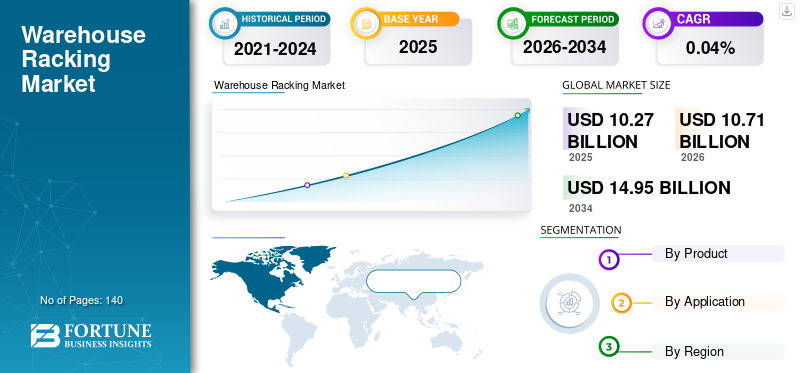
The global warehouse racking market size was valued at USD 10.26 billion in 2025. The market is projected to grow from USD 10.70 billion in 2026 to USD 14.95 billion by 2034, exhibiting a CAGR of 0.04% during the forecast period.

The warehouse racking market is expanding steadily due to increasing demand for organized storage infrastructure across logistics, retail, manufacturing, and e-commerce industries. Warehouse racking systems improve storage density, inventory management, operational efficiency, and warehouse safety within distribution centers and industrial facilities. Rising adoption of automated warehouses and smart material handling technologies is accelerating demand for advanced pallet racking solutions globally. Manufacturers are focusing on high-load-capacity systems, modular rack structures, and space-optimization technologies to support modern warehousing operations. Warehouse racking market analysis indicates strong growth in selective pallet racking and automated storage systems due to increasing warehouse modernization activities and rapid expansion of supply chain infrastructure worldwide.
The USA warehouse racking market remains one of the largest regional contributors due to rapid e-commerce growth and increasing investments in fulfillment centers and logistics infrastructure. More than 58% of large distribution warehouses in the country utilize advanced pallet racking systems to improve inventory storage efficiency and operational productivity. Retail companies and third-party logistics providers are expanding automated warehouse facilities requiring durable and high-capacity racking structures. Rising demand for cold storage warehouses and industrial manufacturing units is further strengthening market penetration. Warehouse racking market research report findings indicate increasing adoption of selective pallet racks and automated retrieval systems across food distribution, automotive logistics, and retail warehousing sectors throughout the United States.
Download Free sample to learn more about this report.
Warehouse Racking Market Key Takeaways
 Global Market Size & Forecast
- 2025 Market Size: USD 10.26 Billion
- 2026 Market Size: USD 10.70 Billion
- 2034 Forecast Market Size: USD 14.95 Billion
- CAGR: 0.04% from 2026–2034
 Market Share
- The market in North America dominated with a revenue share of 35% in 2025.
- Selective pallet racking held a 61% market share by product.
- Food and beverages accounted for a 41% market share by application.
 Key Regional Highlights
North America
North America led the market with a 35% share in 2025.
Asia-Pacific
Asia-Pacific held a 31% market share, supported by expanding logistics and warehousing infrastructure.
Europe
Europe accounted for 26% of the global market, driven by industrial and distribution activities.
U.S
The U.S. is witnessing strong demand for warehouse racking systems due to expanding e-commerce and logistics operations.
Japan
Japan accounted for 27% of the Asia-Pacific market, supported by advanced warehousing and automation technologies.
Read More

Warehouse Racking Market Latest Trends
The warehouse racking market Trends indicate increasing adoption of automated storage and retrieval systems integrated with smart pallet racking technologies. Logistics providers and e-commerce companies are investing heavily in warehouse automation to improve operational speed, inventory visibility, and storage optimization. More than 54% of newly developed fulfillment centers globally are utilizing high-density racking systems combined with robotics and conveyor technologies. Manufacturers are introducing modular warehouse racking solutions that support flexible expansion and multi-level storage applications.
Download Free sample to learn more about this report.
Another significant Warehouse Racking Industry Analysis trend involves rising demand for sustainable and lightweight rack materials with improved load-bearing capacity and corrosion resistance. Cold storage facilities and pharmaceutical warehouses are increasingly deploying galvanized racking systems to maintain durability under low-temperature conditions. Smart warehouse management systems integrated with RFID and IoT technologies are improving inventory tracking and warehouse efficiency. The market is also witnessing growing investment in narrow aisle racking and mobile rack systems designed to maximize warehouse floor utilization. Warehouse racking market forecast studies further indicate strong demand for customized racking structures supporting automated guided vehicles and robotic warehouse operations across global logistics networks.
Warehouse Racking Market Dynamics
DRIVER
Rapid Expansion of E-Commerce and Logistics Infrastructure
The rapid growth of e-commerce operations and logistics infrastructure is a major driver supporting Warehouse racking market growth. More than 67% of global retail supply chains now rely on organized warehousing systems and distribution centers for efficient inventory management and faster product delivery. E-commerce companies are increasing investments in automated fulfillment centers requiring high-density pallet racking and vertical storage systems. Third-party logistics providers are also expanding warehouse capacities to accommodate growing online retail demand and cross-border trade activities. Industrial manufacturing facilities and food distribution companies continue adopting advanced warehouse racking systems to improve operational efficiency and storage optimization. Warehouse racking market insights indicate rising installation of automated storage structures in pharmaceutical, automotive, and consumer goods warehousing applications worldwide.
RESTRAINT
High Installation and Maintenance Costs
High installation expenses and maintenance costs remain significant restraints for the warehouse racking market Outlook. Advanced warehouse racking systems require substantial investments in structural engineering, floor reinforcement, and warehouse automation integration. Small and medium-sized enterprises often face financial challenges when upgrading traditional storage infrastructure to high-density or automated racking systems. Frequent maintenance requirements and safety inspections also increase operational expenditures for warehouse operators. Steel price volatility and rising raw material costs further impact manufacturing expenses for industrial racking systems. Warehouse Racking Industry Report findings indicate that older warehouse facilities may require extensive structural modifications before installing modern pallet racking systems. Labor shortages in warehouse construction and installation services also create additional operational challenges for market participants.
OPPORTUNITY
Growth of Smart Warehouses and Automation Technologies
The increasing adoption of smart warehouse technologies presents major opportunities within the warehouse racking market opportunities landscape. Companies are investing heavily in automated storage and retrieval systems integrated with robotic material handling and AI-based inventory management platforms. Smart warehouse projects require advanced racking systems capable of supporting automated guided vehicles and robotic picking technologies. Rising demand for cold chain logistics and pharmaceutical warehousing is also creating opportunities for corrosion-resistant and high-load-capacity racking solutions. Warehouse operators are increasingly deploying vertical storage systems to optimize limited floor space in urban logistics centers. Warehouse racking market research report studies indicate growing opportunities in customized rack configurations designed for automated fulfillment centers and multi-channel retail distribution facilities.
CHALLENGE
Safety Compliance and Warehouse Space Limitations
One of the major challenges affecting the warehouse racking market size is maintaining structural safety and compliance within high-density warehouse environments. Warehouse operators must comply with strict load-bearing regulations, seismic safety standards, and fire protection requirements during racking system installation and operation. Improper loading practices and forklift impacts can increase the risk of structural failures and inventory damage. Expanding urban warehousing infrastructure also faces challenges related to limited floor space and high real estate costs. Manufacturers must continuously improve rack durability, modularity, and installation flexibility to meet changing warehouse operational requirements. Warehouse racking market analysis indicates increasing technical complexity associated with integrating automated storage systems and robotic material handling technologies into existing warehouse facilities.
Warehouse Racking Market Segmentation
By Product
Selective pallet racking accounts for nearly 61% of the market share in the warehouse racking market due to its flexibility, accessibility, and widespread adoption across logistics and industrial warehousing operations. These systems provide direct access to individual pallets, making them highly suitable for high-volume inventory movement and fast order fulfillment activities. More than 64% of modern distribution centers globally utilize selective pallet racks because of compatibility with forklift operations and warehouse automation technologies. Retail warehouses and third-party logistics providers increasingly prefer selective pallet systems to improve inventory rotation and storage efficiency. Manufacturers are introducing modular and adjustable rack configurations to support changing warehouse layouts and automated storage integration. Warehouse racking market Trends indicate rising demand for high-load-capacity selective pallet systems in large fulfillment centers and industrial manufacturing facilities.
To know how our report can help streamline your business, Speak to Analyst
Drive-in racking systems hold approximately 39% market share within the warehouse racking market because of strong demand from cold storage facilities and high-density warehousing operations. These systems maximize storage utilization by allowing forklifts to enter storage lanes for pallet loading and unloading activities. Food processing companies and refrigerated warehouse operators increasingly adopt drive-in racks to optimize limited warehouse floor space and improve bulk inventory storage capacity. More than 46% of industrial cold storage facilities globally utilize drive-in racking systems for efficient product stacking and inventory management. Manufacturers are developing reinforced steel structures and corrosion-resistant coatings to improve durability under harsh environmental conditions. Warehouse racking market analysis indicates increasing demand for drive-in systems in beverage storage, pharmaceutical warehousing, and large-scale distribution facilities.
By Application
Automotive applications account for nearly 33% market share in the warehouse racking market due to rising vehicle production and increasing demand for organized spare parts storage infrastructure. Automotive manufacturers and suppliers rely on pallet racking systems for inventory handling, assembly line support, and component distribution operations. More than 57% of automotive warehouses globally utilize selective pallet racks and automated storage systems to improve operational productivity and reduce inventory retrieval time. Electric vehicle manufacturing expansion is also increasing demand for advanced warehouse storage infrastructure supporting battery and component logistics. Warehouse racking market forecast studies indicate strong growth in automated automotive warehousing and robotic inventory management systems across manufacturing facilities worldwide.
Food and beverages contribute approximately 41% market share within the warehouse racking market because of expanding cold chain logistics and increasing demand for organized food storage infrastructure. Refrigerated warehouses, supermarket distribution centers, and beverage manufacturing facilities require durable racking systems capable of supporting high-density storage operations. More than 62% of cold storage warehouses globally utilize drive-in and selective pallet racks to improve storage efficiency and inventory rotation. Manufacturers are introducing corrosion-resistant racking systems suitable for temperature-controlled environments and food safety compliance requirements. Warehouse racking market insights highlight increasing investments in automated food distribution centers and refrigerated warehousing facilities across global supply chain networks.
Warehouse Racking Market Regional Outlook
North America
North America accounts for nearly 35% of the warehouse racking market because of strong logistics infrastructure, advanced warehousing technologies, and rapid e-commerce expansion across the United States and Canada. Large retail chains and third-party logistics providers are investing heavily in automated fulfillment centers equipped with high-density pallet racking systems and robotic material handling technologies. Warehouse operators are increasingly adopting selective pallet racking integrated with automated inventory management systems to improve operational efficiency and storage optimization. Cold storage expansion and pharmaceutical distribution infrastructure are further increasing demand for durable and corrosion-resistant racking systems. Companies are also implementing vertical storage technologies to maximize warehouse floor utilization and inventory accessibility. Warehouse racking market analysis highlights rising investments in AI-based logistics platforms, smart warehouse infrastructure, and automated storage technologies across North America.
To get more information on the regional analysis of this market, Download Free sample
Europe
Europe holds approximately 26% share in the warehouse racking market due to increasing industrial automation and strong warehouse modernization activities across Germany, France, Italy, and the United Kingdom. Manufacturers and logistics providers are adopting advanced pallet racking systems integrated with automated storage and retrieval technologies to improve supply chain performance and inventory handling efficiency. Sustainability regulations are encouraging the use of recyclable steel materials and energy-efficient warehouse designs throughout the region. Pharmaceutical warehousing, cold chain logistics, and retail distribution centers continue generating strong demand for modular racking systems and high-density storage solutions. Companies are also increasing investments in narrow aisle racking and robotic warehouse operations to improve operational productivity. Warehouse racking market insights indicate continued expansion of smart warehousing infrastructure and automated inventory management technologies throughout Europe.
Germany Warehouse Racking Market
Germany accounts for nearly 32% share within the European warehouse racking market because of strong industrial manufacturing capabilities and advanced logistics infrastructure. Automotive production facilities, industrial warehouses, and distribution centers are major users of high-capacity pallet racking systems across the country. Manufacturers are increasingly investing in smart warehouse technologies and robotic material handling operations to improve inventory management efficiency and warehouse productivity. Demand for automated storage systems is rising rapidly across pharmaceutical, retail, and industrial sectors. Cold storage expansion and e-commerce warehousing activities are also strengthening market penetration. Warehouse racking market growth in Germany continues to benefit from increasing investments in industrial automation and high-density warehouse storage infrastructure.
United Kingdom Warehouse Racking Market
The United Kingdom contributes approximately 24% share within the European warehouse racking market due to increasing e-commerce activities and expansion of logistics distribution centers. Retail companies and third-party logistics providers are investing heavily in warehouse automation and high-density pallet storage systems to improve order fulfillment efficiency and inventory management. Cold storage facilities and food distribution warehouses are also increasing adoption of drive-in racking systems for space optimization and organized product storage. Urban logistics infrastructure development is accelerating installation of modular warehouse racking systems throughout the country. Warehouse racking market research report findings indicate rising investments in automated fulfillment technologies and smart warehouse operations across the United Kingdom.
Asia-Pacific
Asia-Pacific captures nearly 31% share in the warehouse racking market because of rapid industrialization, expanding manufacturing activities, and strong growth of e-commerce distribution infrastructure across China, Japan, India, and South Korea. Logistics companies and retail operators are rapidly increasing warehouse capacities to support rising online shopping demand and cross-border trade operations. Selective pallet racking and automated storage systems are witnessing significant adoption due to improved inventory accessibility and warehouse efficiency. Automotive manufacturing expansion and pharmaceutical cold chain development are further strengthening demand for industrial racking solutions throughout the region. Government investments in logistics modernization and smart warehousing technologies continue supporting market expansion. Warehouse racking market opportunities remain strong because of increasing industrial infrastructure development and rapid warehouse automation activities across emerging Asian economies.
Japan Warehouse Racking Market
Japan represents nearly 27% share within the Asia-Pacific warehouse racking market owing to advanced warehouse automation technologies and strong industrial logistics infrastructure. The country continues investing heavily in robotic material handling systems and compact storage technologies designed for efficient warehouse operations. Automotive and electronics manufacturing sectors remain major contributors to demand for advanced pallet racking and automated inventory management systems. Companies are increasingly adopting smart warehousing technologies to optimize limited warehouse space and improve inventory control. Growth in pharmaceutical logistics and retail distribution activities is also supporting demand for modular storage solutions. Warehouse racking market forecast studies indicate increasing investments in automated fulfillment technologies and high-density warehouse infrastructure throughout Japan.
China Warehouse Racking Market
China holds approximately 17% share within the Asia-Pacific warehouse racking market due to rapid growth of e-commerce logistics and industrial manufacturing activities. The country has significantly expanded warehouse construction projects and automated distribution facilities to support increasing retail and industrial supply chain operations. Food distribution companies and third-party logistics providers are investing heavily in high-density warehousing technologies and cold storage infrastructure. Selective pallet racks and automated retrieval systems are increasingly utilized to improve inventory handling efficiency and warehouse productivity. Government-supported infrastructure development projects and industrial automation initiatives continue strengthening market expansion. Warehouse racking market size in China remains strong because of rapid urbanization, manufacturing growth, and rising investments in smart logistics infrastructure.
Rest of World
The Rest of World region captures nearly 8% share in the warehouse racking market because of increasing investments in logistics infrastructure, industrial warehousing, and cold storage facilities across Latin America, the Middle East, and Africa. Manufacturing companies and retail distribution operators are expanding warehouse capacities to support growing regional trade activities and industrial supply chain operations. Governments are supporting development of logistics corridors, industrial parks, and transportation infrastructure to improve warehousing efficiency and inventory management capabilities. Demand for selective pallet and drive-in racking systems is increasing across food processing, retail, and pharmaceutical storage applications. Companies are also investing in automated storage technologies and modular warehouse systems to improve operational productivity. warehouse racking market Outlook remains positive because of rising adoption of organized warehousing systems and expanding logistics modernization projects throughout developing regions.
List of Top Warehouse Racking Companies
- Daifuku Co., Ltd.
- Mecalux S.A.
- Kardex Group
- Hannibal Industries, Inc.
- Emrack International
- Jungheinrich AG
- AK Material Handling Systems
- SSI Schaefer Group
- Dematic
Top Two Companies with Highest Market Share
- Daifuku Co., Ltd. – 17%
- SSI Schaefer Group – 14%
Investment Analysis and Opportunities
Investment activity within the warehouse racking market is increasing rapidly due to expansion of e-commerce logistics, warehouse automation projects, and industrial supply chain modernization initiatives. Logistics providers and retail companies are investing heavily in automated storage systems integrated with high-density pallet racking technologies to improve warehouse efficiency and inventory management. More than 48% of large-scale warehouse investments globally now involve automated storage and retrieval systems supported by smart racking infrastructure. Cold storage operators and pharmaceutical distribution companies are also expanding warehouse capacities requiring corrosion-resistant and high-load-capacity racking systems.
Warehouse racking market opportunities are growing significantly in smart warehousing, robotic fulfillment centers, and urban logistics infrastructure development. Emerging economies in Asia-Pacific and Latin America are attracting investments because of rising industrial manufacturing activities and expanding retail distribution networks. Companies are increasingly adopting AI-driven inventory management systems and automated guided vehicles requiring customized warehouse rack structures. Government-supported logistics modernization programs and industrial infrastructure projects continue supporting long-term market growth. Warehouse racking market research report findings highlight strong investment opportunities in modular rack systems, automated pallet storage technologies, and energy-efficient warehouse construction projects globally.
New Product Development
New product development activities within the warehouse racking market are heavily focused on automated storage compatibility, modular rack configurations, and high-load-capacity structural designs. Manufacturers are introducing smart pallet racking systems integrated with RFID sensors, IoT monitoring devices, and AI-based warehouse management platforms. Advanced galvanized steel racks and corrosion-resistant coatings are improving durability in cold storage and pharmaceutical warehouse applications. More than 53% of newly developed warehouse rack systems globally are designed for automated storage and robotic inventory handling operations.
Manufacturers are also developing adjustable rack configurations capable of supporting multi-level warehouse storage and vertical inventory optimization. Lightweight structural materials and reinforced steel frameworks are improving installation flexibility and load-bearing efficiency across industrial warehouses. Warehouse racking market Trends further indicate increasing innovation in narrow aisle racks, shuttle-based storage systems, and mobile racking technologies for high-density warehousing environments. Companies are investing in earthquake-resistant rack structures and fire-safe storage designs to meet evolving warehouse safety regulations. Smart warehouse integration and robotic compatibility remain major focus areas for future product development activities.
Five Recent Developments (2023-2025)
- Daifuku Co., Ltd. expanded automated warehouse racking production facilities in Asia-Pacific during 2024.
- SSI Schaefer Group introduced AI-integrated pallet racking systems for smart warehouses in 2025.
- Dematic launched advanced robotic-compatible selective pallet racking technologies in 2023.
- Jungheinrich AG expanded cold storage warehouse infrastructure solutions across Europe in 2024.
- Mecalux S.A. introduced modular high-density storage racks for e-commerce fulfillment centers in 2025.
Report Coverage of the Warehouse Racking Market
The warehouse racking market Report provides comprehensive analysis of industry trends, technological developments, segmentation patterns, competitive landscape, and regional market performance across global warehouse storage industries. The report evaluates major market drivers associated with e-commerce growth, warehouse automation adoption, logistics infrastructure expansion, and industrial supply chain modernization. It includes detailed segmentation analysis by racking type, application, and regional demand trends across automotive, food and beverages, retail, pharmaceuticals, and industrial manufacturing sectors.
Request for Customization to gain extensive market insights.
The Warehouse racking market research report also examines increasing adoption of automated storage and retrieval systems, smart warehouse technologies, and robotic inventory management platforms integrated with advanced pallet racking structures. Regional coverage includes North America, Europe, Asia-Pacific, and Rest of World markets with country-level insights for Germany, the United Kingdom, Japan, and China. Competitive landscape evaluation highlights strategic investments, product innovations, warehouse automation partnerships, and manufacturing capacity expansions among leading industry participants. Warehouse Racking Industry Analysis findings further assess sustainability trends, modular storage solutions, warehouse safety regulations, and future opportunities related to smart logistics infrastructure and industrial warehousing modernization globally.
Frequently Asked Questions
Fortune Business Insights says that the global market value stood at USD 10.26 billion in 2025 and is projected to reach USD 14.95 billion by 2034.
The market is expected to exhibit a CAGR of 0.04% during the forecast period of 2026-2034.
Selective pallet racking was the leading product segment, accounting for nearly 61% of the market, owing to its flexibility, accessibility, and widespread use in logistics and industrial warehousing.
Key players include Daifuku Co., Ltd., Mecalux S.A., Kardex Group, Hannibal Industries, Inc., Emrack International, and Jungheinrich AG.
Major trends include increasing adoption of automated storage and retrieval systems with smart pallet racking and rising demand for sustainable, lightweight, and corrosion-resistant rack materials. North America leads regionally with a 35% market share.


- 2021-2034
- 2025
- 2021-2024
- 140
-

(Offer valid till 30th Sep 2026)
Get 30-60 hrs Free Customization
Expand Regional and Country Coverage, Segments Analysis, Company Profiles, Competitive Benchmarking, and End-user Insights.














-
US +1 833 909 2966 ( Toll Free )
-
Get In Touch With Us