Waste Sorting Equipment Market Size, Share & Industry Analysis, By Material Type (Metal, Plastic, Cardboard & Paper, Others), By Application (Municipal and Industrial) and Regional Forecast, 2026-2034
 Download Free Sample
Waste Sorting Equipment Market Size and Industry Overview
 Listen to Audio Version
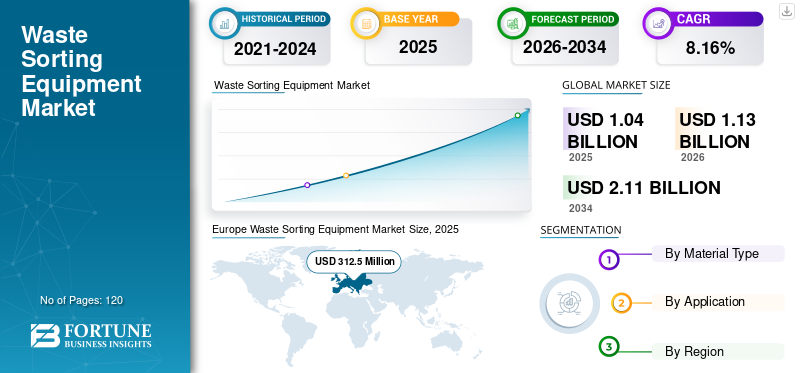
The global waste sorting equipment market size was valued at USD 1.04 billion in 2025. The market is projected to grow from USD 1.13 billion in 2026 to USD 2.11 billion by 2034, exhibiting a CAGR of 8.16% during the forecast period. Europe dominated the global market with a share of 42.62% in 2025. The waste sorting equipment market in the U.S. is projected to grow significantly, reaching an estimated value of USD 10.21 Bn by 2032, driven by the rapid growth in the smart building automation for residential and commercial sector.
The rising demand for municipal solid waste management owing to the increased waste generation from the urban population is expected to result in the increased demand for sorting equipment. The evolving stringent regulations by government to prevent environmental pollution is expected to drive the market.
Download Free sample to learn more about this report.
Waste Sorting Equipment Market Key Takeaways
 Global Market Size & Forecast
- 2025 Market Size: USD 1.04 billion
- 2026 Market Size: USD 1.13 billion
- 2034 Forecast Market Size: USD 2.11 billion
- CAGR: 8.16% from 2026–2034
 Market Share
- Europe dominated the waste sorting equipment market with a 42.62% share in 2025.
- Plastic waste recovery is driving strong demand for sorting equipment.
- Industrial waste accounted for a significant share of market demand.
 Key Regional Highlights
Europe
Europe led the market with USD 312.5 million in 2025, supported by strict recycling regulations.
Asia Pacific
Asia Pacific is expected to register the highest CAGR due to rising waste generation.
North America
North America is supported by advanced recycling systems and increasing waste generation.
U.S.
The market is driven by advanced recycling rates and rising waste management needs.
Japan
Rising waste generation and environmental concerns are supporting market adoption.
Read More

Waste Sorting Equipment Market Trends
Rising Global Waste Generation is Likely to Result in the Need of Waste Sorting Equipment
Increasing waste generation is resulting in the need for waste management equipment. For instance, according to The World Bank Group 2.01 billion tons of solid municipal waste is generated per year out of which 33% is impacting the environment owing to its waste handling and disposing of manner. Thus, the rising awareness regarding waste generation and disposal are boosting the waste sorting equipment market growth.
Download Free sample to learn more about this report.
Increasing Digitalization is Expected to Propel the Market Growth
Manufacturers are incorporating digital solutions including IoT and Big Data in their products to facilitate improved production efficiency. The companies are focused on developing sorting machines that can perform tasks with enhanced circuit duration, running status, and identification process. Thus digitization in sorting equipment is expected to improve the sorting accuracy and decision-making capabilities of the management.
DRIVING FACTORS
Automation and Technological Advancements is Expected to Drive the Market
The increasing demand for automation owing to labor and material shortages is likely to drive circuit automation in the industry. The surge in benefits of automation include improved separation of containers, metals, glass, and plastics based on their shape size and ballistic properties is resulting in high product penetration.
In addition, the improved front-end and back-end separating as well as the screening process resulted in increased material purity and has drastically reduced the need for manual sorters over the past few years. For instance, the recycling area sales manager of TOMRA Sorting and Recycling West North America stated that the Material Recovery Facility operators have witnessed more than 50% decrease in manual sorters over the past years through up-gradation of front-end and back-end as well as leveraging systems-thinking approach to the entire circuit. Thus, manufacturers are offering various automation solutions. For instance, Tomra has developed AUTOSORT LASER which offers high safety, efficiency, and recovery in the processing of commercial and household waste. The various features offered by it are independent background system, user-friendly operations through a touch screen, and synchronized single point detection for multiple applications.
Furthermore, the manufacturers are striving to develop machines with low maintenance and high energy efficiency through technological upgradation. For instance, TOMRA introduced FLUIDCOOL LED technology that enables maximum yield stability at varying ambient temperatures.
Evolving Stringent Government Regulations Regarding Waste Management is Resulting in the Market Growth
The increasing inclination towards environmental safety and prevention of waste generation in developed countries has resulted in the implementation of stringent policies which in turn are expected to benefit the market. For instance, in July 2018, the European countries have approved high recycling targets and new measures to prevent the generation of waste. The targets agreed are as follows, the EU countries by 2025 need to recycle a minimum of 55% of municipal waste, and at least 60% should be recycled by 2030. This is expected to drive the need for high accuracy sorting machines.
Furthermore, Germany has revised its commercial waste ordinance and packaging ordinance where the recycling rates of plastics are revised from 36% to 63% by 2022. This strict regulation has led to the construction of new sorting facilities to sort plastic in a more categorized way such as sheets of PE and PP. Thus manufacturers are focusing on the development of machines with high-end technologies for sorting facility operators to meet the stringent government requirements. For instance, the STEINERT group provides with sensor and magnet sorting machines to meet the recycling rates of German Packaging Ordinance.
RESTRAINING FACTORS
The Change in International Policies is Expected to Impact the Market Growth
The rising concerns regarding the quality of waste imported for recycling owing to the growing environmental issues is expected to significantly impact the market growth. For instance, China has restricted the import of recycled materials. In 2018, China introduced the National Sword Policy which stated stricter contamination limits of up to 0.05% for imports of recyclable materials which has momentarily impacted the global recyclable material market. However, it has opened new avenues for sorting equipment manufacturers to produce equipment of high accuracy to prevent contamination waste.
The Financing of the Solid Waste Management System Pose a Challenge to the Market Growth
The rising operational cost for developing countries is resulting in the slow adoption of products. This is attributed to the increased combined cost of collection, transportation, treatment, and disposal concerning the recovery cost. As waste recovery differs significantly across high and low-income countries. Thus, the operating cost of such solid waste management plants is expected to impact product penetration. However, the increased funding from the state and local governments is expected to drive the market growth of waste sorting equipment.
SEGMENTATION ANALYSIS
By Material Type Analysis
To know how our report can help streamline your business, Speak to Analyst
High Demand for Plastic Recovery is Expected to Drive the Market
Based on the material type, the market is segmented into metal, plastic, cardboard & paper, and others.
The waste composition is different across various countries. The World Bank Group stated that the high-income countries generate relatively less food and other organic waste in comparison to dry waste such as plastic, cardboard, metals, and paper. Cardboard and paper waste has significantly contributed to the amount of waste generated in the past few years. This is attributed to the increasing demand for paper from various industries including packaging, food and beverage, office supplies, and others.
The rise in demand for plastics from various applications including food packaging, consumer goods, semiconductors, healthcare devices, and products has greatly contributed to the increased generation of plastic waste. According to Plastics Europe (Association of Plastic Manufacturers), plastic waste collection and recycling has drastically increased by around 79% in Europe. This is attributed to the landfill bans which has resulted in high recycling rates. Moreover, the increase in world plastic production from 335 million tons in 2016 to more than 348 million tons in 2017 is resulting in the growth of plastic wastes. Thus, the increased plastic production and consumption is expected to contribute positively to plastic recycling which in turn is expected to drive the need for sorting machines. Besides, the increasing industrialization in the developing economies is resulting in a high generation of metal scrap which in turn is expected to positively contribute to the market growth. The other materials which contribute to the waste are wood, glass, organic material, textile, and rubber which is likely to drive product adoption owing to the increase in their respective recycling markets.
By Application Analysis
Industrial Waste has Significantly Contributed to the Market
Based on the application, the market is classified into Industrial and Municipal.
The growing urbanization in developing economies is resulting in high demand for municipal waste management. According to the UN, more than 70% of the earth’s population is likely to reside by 2050. Moreover, the megacities count is expected to increase to 40 according to the UN by 2030. This is expected to result in increased per capita municipal waste generation in the near future. Besides, the urban population is likely to produce increased inorganic waste such as plastic, and metals, which in turn is expected to drive the municipal waste management equipment such as sorting machines.
The surge in Industrial waste owing to the several end-markets such as construction, manufacturing, and textile sectors is expected to positively contribute to the market growth. The increasing demand for sorting equipment as a result of strict regulation and recycling requirements is driving the product penetration in the industrial application.
REGIONAL ANALYSIS
Europe Waste Sorting Equipment Market Size, 2025 (USD Million)
To get more information on the regional analysis of this market, Download Free sample
Europe Accounts for the Major Market Share Owing to the Stringent Government Regulations
Geographically, the global market for waste sorting equipment is categorized into five major regions, North America, Europe, Asia Pacific, the Middle East & Africa, and Latin America. They are further categorized into countries.
Asia Pacific
The World Bank Group forecasted global waste to reach more than 3.40 billion tons by 2050. This is attributed to the increasing disposable income of people. Asia Pacific market has the highest CAGR across all the regions. This is attributed to the surge in waste generation from East Asian countries such as China, Japan, and Korea. For instance, according to the association of plastics manufacturers in Europe, China accounts for a major share of the global plastic production market of around 29.4%. Furthermore, increasing environmental and waste management concerns are driving greater product adoption in Asian Countries. The increasing investments in Asia Pacific are likely to contribute to the growth of the market. For instance, in 2019, the World Bank approved USD 100 million loans for Indonesia in order to improve solid waste management services across the country.
Europe
Besides this, Europe waste sorting equipment market holds a major share of this global market. This is attributed to the strict government regulations and the improved recycling rate in the country which has contributed to the highest market revenue. Besides, Europe has a high waste collection rate of approximately 90%.
Middle East & Africa and Latin America
The growth in population and urbanization in the Middle East is further resulting in increased waste generation. Moreover, cities such as UAE, Qatar, Saudi Arabia, and Kuwait rank among the top 10 in the world for per capita waste generation. The increasing environmental concerns and high amount of waste generated in the Middle East & Africa are expected to drive product penetration in the region. According, to the UN environmental report Latin America recovers around 10% thus has a low product penetration.
North America
However, the waste generation of the region is expected to grow more than 25% by 2050 and is expected to contribute positively to the market. In addition, the advanced recycling rates in the U.S. are further expected to contribute to the North America market growth.
KEY INDUSTRY PLAYERS
Steinert is Focusing on New Product Development and Technological Up-gradation
The company is developing new products to provide customers with highly efficient sorting equipment coupled with enhanced technology. For instance, in January 2020, Steinert launched UniSort PR EVO 5.0 the next generation UniSort PR with improved performance and easy maintenance. This system is enabled with an AI-supported object detection system that isolates cartridges based on optically detectable characteristics. In addition, the group is focused on providing greater sorting reliability through hardware and software. In September 2019, Steinert introduced its black plastics recycling technology at the K2019 Trade fair in Germany. This technology is expected to help separate black plastic residue at a large-scale based on the raw material properties.
Players are Focusing on Product Portfolio Enhancement through Introduction of Innovative Products
Key players in this global market including Steinert and TOMRA are continuously striving towards developing products to meet the critical sorting requirements stated by the evolving stringent regulations in the waste management industry. They are increasingly focused on the development of products with high efficiency by incorporating advanced technologies.
List of Key Companies Profiled:
- STEINERT GmbH (Germany)
- TOMRA (Norway)
- MSS, Inc. (USA)
- Green Machine (USA)
- Beston (Henan) Machinery Co., Ltd. (China)
- CP Manufacturing, Inc. (USA)
- Kingtiger (Shanghai) Environmental Technology Co., Ltd. (China)
- REDWAVE (Parent: BT-Wolfgang Binder GmbH)(Austria)
- Buhler Group (Switzerland)
- Coparm Srl (Italy)
KEY INDUSTRY DEVELOPMENTS:
- March 2019: - TOMRA Sorting Recycling launched its INNOSORT FLAKE at Plastic Recycling show Europe. This flake sorting equipment is focused on various applications including PET flakes, PE/PP flakes, PO flakes, and others. The INNOSORT Flake combines material and color sorting through NIR technology to provide high accuracy.
- November 2019: - TOMRA Sorting and Recycling introduced GAIN a sorting technology, based on deep learning to increase the performance of its sensor-based sorting machines.
REPORT COVERAGE
The waste sorting equipment market research report provides detailed information regarding various insights into the industry. Some of them are key growth drivers, restraints, competitive landscape, regional markets analysis, and challenges. It further offers an analytical depiction of the market trends and estimations to illustrate the forthcoming investment pockets. The market is quantitatively analyzed from 2020 to 2027 to provide financial competency. The information gathered in the report has been taken from several primary and secondary sources.
Request for Customization to gain extensive market insights.
Report Scope and Segmentation
|
ATTRIBUTE |
DETAILS |
|
Study Period |
2021-2034 |
|
Base Year |
2025 |
|
Forecast Period |
2026-2034 |
|
Historical Period |
2021-2024 |
|
Unit |
Value (USD million) |
|
Segmentation |
By Material Type
|
|
By Application
|
|
|
By Region
|
Frequently Asked Questions
As per Fortune Business Insights, the market was worth USD 1.04 billion in 2025.
The market is expected to reach USD 2.11 bilion by 2034.
The market is projected to grow at a CAGR of 8.16% during the forecast period (2026-2034).
The cardboard & paper segment is expected to lead the market
Stringent government regulations and increasing automation along with technological advancements is driving product penetration.
TOMRA and STEINERT are among the top companies operating in the market.
Europe holds a major share of the market.
The change in policies and high operating cost is impacting the market.
The plastic segment holds the highest CAGR in the market.
Increasing shift towards digitalization is expected to result in the growth of the market.



- 2021-2034
- 2025
- 2021-2024
- 120
Get 30-60 hrs Free Customization
Expand Regional and Country Coverage, Segments Analysis, Company Profiles, Competitive Benchmarking, and End-user Insights.












Related Reports
-
US +1 833 909 2966 ( Toll Free )
-
Get In Touch With Us