Water Dispenser Market Size, Share & Industry Analysis, By Product (Bottled, Bottle-less), By Application (Residential, Commercial, Industrial), By Distribution Channel (Online, Retail Stores), By Region, and Regional Forecast, 2026-2034
 Download Free Sample
Water Dispenser Market Overview
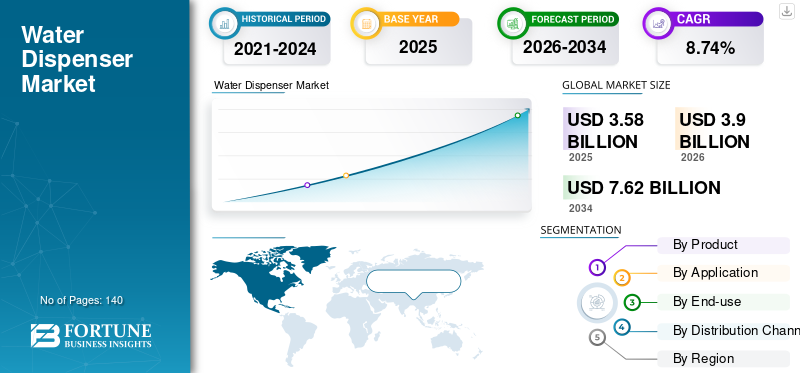
The water dispenser market size was valued at USD 3.66 billion in 2025. The market is projected to grow from USD 3.94 billion in 2026 to USD 7.20 billion by 2034, exhibiting a CAGR of 7.81% during the forecast period.

The Water Dispenser Market is evolving from a basic hydration-equipment category into a broader water-access and point-of-use appliance industry serving homes, offices, healthcare facilities, schools, hospitality venues, factories, and public spaces. Demand is being shaped by convenience, water-quality awareness, workplace hydration programs, and the replacement of conventional bottled delivery systems with connected or filtered dispensers. Product differentiation increasingly centers on cooling and heating performance, filtration, sanitation, dispensing speed, footprint, energy efficiency, and service support. The Water Dispenser Market Report therefore covers bottled and bottleless formats, applications, distribution channels, regional demand, competitive positioning, product innovation, investment priorities, and emerging Water Dispenser Market Opportunities.
The USA Water Dispenser Market is strongly connected to office hydration, residential convenience, healthcare, education, hospitality, and industrial workplaces. Bottleless systems are gaining attention where businesses want continuous filtered water without handling heavy refill containers, while bottled coolers remain relevant in locations where plumbing changes are difficult or temporary hydration is required. Commercial buyers increasingly evaluate sanitation features, capacity, service contracts, installation requirements, and operating efficiency rather than purchasing price alone.
The U.S. market also benefits from a mature replacement cycle for drinking-water equipment and broad availability of water-treatment services. Demand for touch-free dispensing, advanced filtration, hot-and-cold functions, countertop designs, and subscription-based maintenance is influencing purchasing decisions. For B2B buyers, the Water Dispenser Market Analysis increasingly focuses on operating convenience, employee experience, sustainability targets, maintenance response, and compatibility with existing facility infrastructure.
Download Free sample to learn more about this report.
Key Takeaways
Market Size & Growth
- Global market size 2025: USD 3.66 Billion
- Global market size 2034: USD 7.20 Billion
- CAGR (2025–2034): 7.81%
Market Share – Regionals
- North America: 34%
- Europe: 27%
- Asia-Pacific: 25%
- Rest of World: 14%
Country-Level Shares
- Germany:27% of Europe’s market
- United Kingdom: 19% of Europe’s market
- Japan: 24% of Asia-Pacific market
- China: 38% of Asia-Pacific market
Water Dispenser Market Latest Trends
Touchless dispensing is becoming a major design direction as workplaces, schools, healthcare environments, and public facilities seek more hygienic shared hydration points. Sensor activation, larger dispensing areas, antimicrobial surfaces, and UV-based sanitation are being combined with filtration to create higher-value systems. Another important Water Dispenser Market Trend is the movement toward bottleless point-of-use equipment because organizations can reduce dependence on delivered containers and simplify water access. Smart monitoring is also entering premium systems, allowing operators to track filter condition, usage patterns, temperature settings, and service requirements. Culligan and Waterlogic product platforms illustrate the industry's increasing emphasis on touchless dispensing, UV sanitation, filtration, and commercial-use functionality.
Manufacturers are additionally developing compact countertop products for apartments, small offices, hotel rooms, and flexible workplaces. Multi-temperature dispensing is becoming more common, with systems designed to deliver chilled, ambient, and hot water from one appliance. Sustainability is influencing materials, refrigeration components, packaging, and product life-cycle decisions. In commercial environments, buyers increasingly prefer modular systems that can be serviced quickly and scaled across multiple locations. These trends are broadening the Water Dispenser Market Size opportunity beyond traditional water coolers toward integrated hydration infrastructure.
Water Dispenser Market Dynamics
DRIVERS
Rising demand for convenient access to filtered drinking water.
Demand for convenient drinking-water access is a central driver of Water Dispenser Market Growth. Consumers and organizations increasingly want water that is immediately available at a controlled temperature without repeatedly purchasing individual containers. In offices, the dispenser has become part of employee amenities and workplace infrastructure, while schools, hospitals, factories, hotels, restaurants, and fitness centers require dependable hydration points that can support frequent daily use. The combination of cooling, heating, filtration, and easy dispensing gives modern equipment a wider role than the traditional water cooler.
Download Free sample to learn more about this report.
The expansion of water-quality awareness is strengthening this demand. Buyers increasingly consider filtration performance, maintenance schedules, sanitation, and source-water conditions when selecting equipment. Bottleless systems are particularly attractive to commercial users because they connect to a building water line and can support continuous access. Bottled systems remain valuable where portability and simple installation are priorities. This broad application base provides equipment manufacturers, filtration suppliers, service providers, and distributors with recurring opportunities across new installations and replacement demand. As organizations modernize facilities, the Water Dispenser Market Outlook is increasingly tied to practical hydration, employee convenience, hygiene expectations, and reliable service.
RESTRAINTS
Installation, maintenance, and replacement costs can limit adoption.
The Water Dispenser Market faces restraints from the combined cost of equipment ownership, installation, filtration components, sanitation, refrigeration maintenance, and replacement parts. A premium dispenser may require sophisticated filters, electronic controls, UV modules, sensors, or refrigeration components. For smaller businesses, schools, rental properties, and price-sensitive households, these features can make purchasing decisions more difficult. Bottleless units can also require suitable plumbing access, adequate installation space, electrical connections, and periodic filter servicing, which may not be convenient in older buildings.
Operational complexity can become another barrier. If filters are not replaced on schedule or internal components are not cleaned correctly, performance and user confidence can decline. Commercial customers may therefore prefer service contracts, but recurring service commitments can influence procurement decisions. Bottled dispensers avoid some plumbing requirements but introduce container handling, storage, delivery coordination, and lifting concerns. Competitive pressure from refrigerators with water filtration, under-sink systems, countertop filtration units, and packaged drinking water can also limit dispenser adoption. Vendors must demonstrate practical value through reliability, low maintenance, service responsiveness, and long-term operating efficiency.
MARKET OPPORTUNITIES
Expansion of smart, bottleless, and multifunctional hydration systems.
Smart and bottleless equipment represents a major Water Dispenser Market Opportunity because it combines hydration with filtration, sanitation, monitoring, and facility-management capabilities. Commercial customers can benefit from systems that indicate filter status, monitor consumption, automate temperature management, or provide service alerts. Connected features can be especially useful for organizations operating multiple offices or facilities because maintenance teams can prioritize equipment that requires attention rather than relying entirely on manual inspection.
Another opportunity is multifunctional dispensing. Manufacturers can combine chilled, ambient, hot, sparkling, or enhanced water functions in a single platform, creating differentiated solutions for hospitality, corporate campuses, premium residential settings, and food-service locations. Sustainability objectives can further support bottleless installations by reducing reliance on transported containers. Compact designs create opportunities in apartments and small offices, while high-capacity systems can target factories, warehouses, educational campuses, and healthcare facilities. The strongest Water Dispenser Market Insights point toward equipment that provides measurable operational benefits rather than simply adding more appliance features.
CHALLENGES
Maintaining hygiene, reliability, and performance across diverse operating environments.
Hygiene and consistent performance are major challenges because dispensers are shared-contact appliances exposed to frequent use. Nozzle areas, drip trays, buttons, touchscreens, and surrounding surfaces require regular cleaning, while filtration and sanitation components must operate according to manufacturer specifications. A system that provides attractive technology but is difficult to clean or service can create operational problems for facility managers. Commercial installations also face differences in water quality, user volume, ambient temperature, installation conditions, and available maintenance resources.
Manufacturers must balance performance with affordability and simplicity. Touchless controls, UV sanitation, antimicrobial materials, advanced filtration, and smart sensors can improve product differentiation, but every additional component can increase design, testing, servicing, and supply-chain requirements. Energy consumption is another consideration for units that continuously heat or cool water. B2B customers increasingly expect clear maintenance schedules, rapid service response, spare-parts availability, and reliable performance over extended operating periods. The challenge for suppliers is to develop dispensers that remain hygienic, efficient, intuitive, and durable without making ownership unnecessarily complicated.
Water Dispenser Market Segmentation
By Product
Bottled water dispensers remain an important part of the Water Dispenser Market because they offer straightforward deployment where direct plumbing is unavailable, impractical, or undesirable. These systems generally use replaceable water containers and can provide cold, ambient, and hot water depending on the model. They are suitable for homes, small offices, temporary work sites, retail locations, workshops, events, and facilities where users need a movable hydration solution. The segment benefits from simple installation, familiar operation, and compatibility with established water delivery networks. Bottled dispensers also remain useful during construction projects, emergency situations, and locations with changing layouts. Recent market research places bottled products at approximately 56% of global product demand, reflecting their broad installed base and convenience.
Product development within this segment is increasingly focused on bottom-loading designs, leak reduction, child-safety features, improved insulation, quieter compressors, and easier bottle handling. Bottom-loading units are particularly relevant for users who find top-loading containers difficult to lift. B2B purchasers evaluate bottle capacity, delivery frequency, sanitation procedures, heating and cooling performance, footprint, and service availability. The segment faces sustainability pressure because repeated container handling creates logistical and environmental considerations, but refillable large-format bottles can still offer a practical alternative to individual packaged bottles. Manufacturers are therefore working to make bottled systems more efficient and user-friendly while retaining installation flexibility. Bottled dispensers are expected to remain important in markets where delivery infrastructure is mature and plumbing access is limited.
To know how our report can help streamline your business, Speak to Analyst
Bottleless water dispensers, commonly described as point-of-use systems, connect directly to a building's water supply and use filtration or purification technologies before dispensing. Their strongest appeal is continuous access to treated water without storing or replacing large bottles. This makes the format especially suitable for offices, healthcare facilities, schools, manufacturing sites, hospitality properties, call centers, and other high-use environments. Commercial buyers can design installations around expected user volume, available plumbing, water quality, and filtration requirements. Bottleless equipment is also increasingly positioned as a workplace sustainability solution because it can reduce dependence on transported water containers. Recent industry analysis identifies bottleless adoption as an important structural shift in the category.
Modern bottleless systems can incorporate sediment and carbon filtration, reverse osmosis, UV treatment, antimicrobial dispensing areas, sensor activation, electronic temperature control, and usage monitoring. Some products provide cold, ambient, and hot water, while premium commercial platforms can add sparkling or enhanced-water options. The major purchasing consideration is whether the complete system can provide reliable water quality, hygiene, capacity, service, and predictable maintenance. Installation requirements can restrain adoption in older buildings, but professional installation and managed service models can reduce this barrier. For B2B customers seeking long-term hydration infrastructure, bottleless systems are increasingly central to Water Dispenser Market Opportunities.
By Application
Residential demand is supported by households seeking convenient access to chilled or hot drinking water without repeatedly purchasing individual bottles. Countertop and freestanding dispensers are common choices because they can be installed without major renovation, while bottleless systems appeal to homeowners who want integrated filtration and continuous supply. Families may prioritize child-safety functions, quiet operation, compact design, temperature control, filter replacement indicators, and easy cleaning. In apartments and smaller homes, countertop models are especially relevant because floor space is limited. The residential application is estimated to account for approximately 35% of global application demand.
Consumer preferences are also changing as smart-home concepts expand. Users increasingly expect appliances to have intuitive displays, maintenance reminders, energy-saving modes, and cleaner dispensing areas. However, residential customers remain more price-sensitive than large commercial buyers, making product simplicity important. Manufacturers can expand adoption by offering several capacity levels and filtration configurations rather than forcing households to purchase complex premium systems. Online retail is important for residential products because buyers can compare dimensions, features, filter costs, warranty terms, and user reviews before purchasing. The Water Dispenser Market Research Report therefore treats residential demand as a significant replacement and first-time adoption segment.
Commercial application represents the strongest demand center for modern dispensers because businesses need dependable hydration for employees, visitors, customers, and contractors. Offices, hotels, restaurants, schools, universities, healthcare facilities, retail stores, gyms, and public-facing workplaces can require multiple units with different capacities and functions. Commercial buyers typically evaluate user volume, water flow, installation complexity, sanitation, service response, operating cost, and equipment durability. Bottleless systems are especially attractive in high-traffic environments because they can provide continuous filtered water without storing heavy containers. Current market assessments indicate that commercial use represents approximately 48% of application demand.
Commercial purchasing is increasingly influenced by workplace experience and sustainability programs. A well-designed dispenser can support employee amenities while reducing dependence on packaged water. Touchless activation is gaining importance in shared spaces, while larger dispensing areas help users fill bottles and reusable containers quickly. Service-based procurement is also expanding because companies may prefer predictable maintenance and replacement support instead of managing filters and repairs internally. Vendors that can provide installation, scheduled servicing, sanitation guidance, and multi-site support have an advantage in enterprise accounts. The Water Dispenser Industry Report consequently places strong emphasis on commercial infrastructure, facility management, and recurring equipment-service relationships.
Industrial: Industrial demand covers factories, warehouses, logistics centers, construction operations, processing plants, workshops, and other environments where employees work for extended periods and hydration access is an operational requirement. These locations often need durable dispensers capable of handling high user traffic, variable ambient conditions, and continuous operation. Equipment may be installed in break rooms, production-support areas, administrative buildings, or controlled environments. Buyers commonly prioritize rugged construction, easy maintenance, rapid dispensing, temperature performance, and dependable service. Industrial applications represent an estimated 17% of global demand.
Industrial facilities also have distinctive installation requirements. Water lines may be located far from employee areas, electrical conditions may vary, and equipment can be exposed to dust, heat, vibration, or intensive daily use. High-capacity bottleless systems can be attractive where plumbing is available, while bottled units can serve remote work zones or temporary sites. Some industrial operators are integrating hydration equipment into employee-welfare and workplace-safety programs. For suppliers, the opportunity lies in designing durable equipment with accessible service points, robust sanitation features, and efficient operation. The Water Dispenser Market Outlook for industrial users is closely linked to manufacturing expansion, logistics infrastructure, workforce amenities, and facility modernization.
By Distribution Channel
Online distribution has become an important route for the Water Dispenser Market, particularly for residential buyers, small businesses, and offices looking for standardized products that can be purchased without extensive sales support. E-commerce platforms allow customers to compare dispenser capacity, filtration technology, temperature settings, loading configuration, dimensions, warranty coverage, and replacement-filter requirements before making a purchasing decision. This channel is especially suitable for countertop and compact freestanding dispensers because these products generally require less customization than large commercial systems. The online channel is estimated to represent approximately 38% of global water dispenser distribution demand.
For manufacturers, online sales provide access to geographically dispersed customers while reducing dependence on physical retail locations. Digital product demonstrations, installation videos, customer reviews, technical specifications, and comparison tools can influence purchasing decisions. Replacement filters, cartridges, sanitation accessories, and other consumable components can also be sold through recurring online purchases, creating opportunities beyond the initial equipment transaction.
B2B purchasing through digital channels is also expanding, although larger organizations frequently require additional technical evaluation. Office managers, hospitality operators, small clinics, educational facilities, and retail businesses may use online channels to identify suitable products before contacting suppliers for installation or servicing. Consequently, online distribution is increasingly becoming part of a hybrid purchasing process in the Water Dispenser Market Research Report. Manufacturers that provide clear specifications, transparent maintenance requirements, responsive customer support, and dependable delivery can strengthen online conversion.
Retail stores remain an important distribution channel because physical outlets allow buyers to examine dispenser size, loading configuration, dispensing mechanisms, build quality, noise levels, and user-interface features before purchasing. This is particularly valuable for residential customers who may be choosing between countertop, top-loading, bottom-loading, and bottleless models. Retail distribution is also relevant for customers who want immediate availability rather than waiting for online delivery. The retail-store channel accounts for approximately 34% of global distribution activity.
Large appliance retailers and specialized water-treatment dealers can provide additional assistance by explaining filtration technologies, installation requirements, maintenance schedules, and warranty terms. For higher-value bottleless systems, physical retail and specialist dealers can also arrange installation and after-sales service. These capabilities make retail distribution particularly useful when customers need help matching equipment with local water conditions or available plumbing.
Retail stores also support brand visibility and product demonstrations. Manufacturers can differentiate their products through interactive displays showing hot, cold, ambient, or filtered-water functions. Retail distribution is expected to remain relevant despite online expansion because water dispensers can involve technical considerations that are difficult to evaluate from product listings alone. The Water Dispenser Market Analysis therefore identifies a complementary relationship between digital commerce and physical retail, with online channels emphasizing convenience and product comparison while retail channels provide inspection, consultation, and immediate support.
By Region
North America represents one of the most established regional markets for water dispensers, supported by extensive use across offices, residential properties, healthcare facilities, schools, hospitality businesses, manufacturing locations, and other commercial environments. The region accounts for approximately 34% of the global Water Dispenser Market. The United States represents the largest national opportunity, while Canada contributes through residential water-treatment demand and commercial workplace applications.
Bottleless point-of-use systems are receiving strong attention among organizations seeking continuous access to filtered drinking water without managing large delivery containers. Commercial buyers increasingly evaluate touchless dispensing, filtration performance, sanitation, maintenance requirements, energy efficiency, and service availability. Bottled dispensers nevertheless remain relevant for small businesses, temporary locations, and facilities where plumbing modifications are impractical.
Water Dispenser Market Regional Outlook
North America
North America Water Dispenser Market Share, 2025 (%)
To get more information on the regional analysis of this market, Download Free sample
North America is the leading regional market, supported by strong adoption of drinking-water equipment in homes, offices, healthcare settings, hospitality venues, schools, and industrial facilities. Current market estimates place the region at approximately 34% of global demand. The United States represents the largest national opportunity within the region, while Canada provides additional demand through residential water treatment, commercial workplaces, hospitality properties, and institutional facilities. Buyers in mature North American markets generally place significant emphasis on convenience, product reliability, filtration, maintenance support, and total operating requirements.
The region is also an important center for bottleless innovation and managed hydration services. Businesses are increasingly interested in touchless dispensing, high-capacity equipment, UV sanitation, antimicrobial dispensing areas, and energy-saving operating modes. Large employers and multi-location organizations can benefit from standardized dispenser platforms and service agreements. Bottled systems remain relevant in residential and small-business settings where direct plumbing is unavailable or installation simplicity is more important. The North American Water Dispenser Market Forecast therefore reflects a balance between established bottled-water delivery models and newer point-of-use systems.
Europe
Europe has a mature but diverse Water Dispenser Market influenced by sustainability priorities, workplace standards, hospitality demand, and consumer interest in efficient water-treatment appliances. The region is estimated to represent approximately 27% of global demand. Western European countries have strong commercial applications, especially in offices, hotels, restaurants, public facilities, and healthcare environments. Buyers increasingly evaluate dispenser energy performance, filtration, maintenance requirements, recyclability, and the ability to reduce dependence on transported or packaged water.
European demand also favors compact and design-oriented products that can fit modern offices, kitchens, hospitality interiors, and premium residential spaces. Bottleless systems are gaining attention in organizations that want continuous access to filtered water while reducing container logistics. Manufacturers are responding with contactless controls, sanitation technologies, efficient refrigeration, and modular installation options. Regional regulations and differing building conditions mean suppliers must adapt products and service models to local requirements. The European Water Dispenser Market Outlook is consequently shaped by environmental objectives, commercial infrastructure modernization, consumer convenience, and demand for well-designed appliances.
Germany Water Dispenser Market
Germany is an important European market because of its large industrial base, office infrastructure, hospitality sector, and strong interest in efficient equipment. Germany is estimated to account for approximately 27% of Europe's Water Dispenser Market. Commercial demand is particularly relevant, with employers and facility managers seeking reliable hydration systems for offices, factories, educational institutions, healthcare environments, and visitor areas. Product selection commonly considers filtration, hygiene, operating efficiency, serviceability, footprint, and facility requirements.
German buyers are also attentive to sustainability and resource efficiency, which can support interest in bottleless point-of-use systems. However, bottled dispensers continue to have a role where flexible installation or established delivery arrangements are preferred. Manufacturers serving Germany can benefit from offering precise maintenance schedules, durable components, clear technical documentation, and service coverage. Premium systems with touchless dispensing, advanced filtration, and monitoring functions can address larger corporate facilities. The Germany Water Dispenser Industry Analysis indicates that demand is increasingly connected to professional workplace standards and sustainable facility management.
United Kingdom Water Dispenser Market
The United Kingdom Water Dispenser Market is supported by offices, hospitality properties, healthcare sites, education, retail environments, and residential consumers. The country is estimated to represent approximately 19% of Europe's market. Commercial users often seek managed hydration solutions that combine equipment, filtration, installation, servicing, and routine maintenance. Bottleless dispensers can be attractive for organizations looking to simplify water access and reduce dependence on delivered containers, while bottled equipment remains relevant for smaller sites and locations without convenient plumbing.
UK product demand is also being influenced by hygiene expectations and the preference for easy-to-maintain equipment. Touchless activation, antimicrobial dispensing areas, UV sanitation, and larger fill zones are increasingly valuable in shared environments. Compact countertop products can address small offices and residential kitchens, while higher-capacity systems target corporate campuses and hospitality properties. Suppliers that combine reliable equipment with responsive service can strengthen B2B relationships. The United Kingdom Water Dispenser Market Insights therefore emphasize workplace hydration, sustainability, service-based purchasing, and product designs suitable for diverse commercial premises.
Asia-Pacific
Asia-Pacific is a high-potential Water Dispenser Market because of urbanization, expanding commercial infrastructure, large populations, rising household appliance adoption, and growing attention to drinking-water quality. The region is estimated to contribute approximately 25% of global demand. China, Japan, India, South Korea, and Southeast Asian markets contain diverse customer needs ranging from affordable bottled dispensers to premium filtration and smart dispensing platforms. Residential adoption is important in dense urban areas, while commercial demand is supported by offices, retail centers, schools, healthcare facilities, hotels, and manufacturing plants.
Manufacturers in Asia-Pacific are competing through compact designs, integrated filtration, multiple temperature settings, energy efficiency, digital controls, and increasingly connected appliances. Local manufacturing capabilities also support product variety and competitive pricing. Bottleless systems have room for expansion where building water infrastructure can support point-of-use installation, although bottled models remain useful in areas with different plumbing conditions or established water-delivery practices. The Asia-Pacific Water Dispenser Market Forecast is therefore shaped by both premiumization and broadening access to hydration equipment.
Japan Water Dispenser Market
Japan represents a technologically sophisticated Water Dispenser Market characterized by demand for compact appliances, reliability, hygiene, energy efficiency, and advanced household functionality. Japan is estimated to account for approximately 24% of Asia-Pacific demand. Residential consumers can favor space-efficient units that provide hot and cold water with filtration, while commercial buyers seek dependable equipment for offices, hospitality properties, healthcare facilities, and public environments.
Product development in Japan often emphasizes quiet operation, intuitive controls, compact footprints, and efficient resource use. Smart functions can add maintenance alerts and operating information without making the appliance difficult to use. The country's mature consumer-appliance environment also creates a strong replacement opportunity as older systems are upgraded with more efficient and hygienic designs. For B2B suppliers, reliability and after-sales support remain essential because equipment is expected to operate consistently in demanding institutional settings.
China Water Dispenser Market
China is one of the largest country-level opportunities within Asia-Pacific because of its substantial urban population, extensive manufacturing base, expanding middle-class consumption, and broad use of water-treatment appliances. China is estimated to account for approximately 38% of the Asia-Pacific Water Dispenser Market. Demand spans residential kitchens, offices, schools, factories, hotels, retail facilities, and public institutions, creating opportunities for both entry-level and premium equipment.
Chinese manufacturers are increasingly competing on integrated filtration, multiple temperature settings, smart controls, compact construction, and attractive designs. The commercial market is also developing as businesses modernize employee facilities and seek more convenient drinking-water systems. Online purchasing plays an important role in consumer appliance discovery, while commercial projects rely more heavily on distributors, installers, and service providers. The China Water Dispenser Market Research Report therefore highlights product diversification, electronics integration, filtration technology, and competitive pricing.
Rest of World
Rest of World includes Latin America, the Middle East, and Africa, where water dispenser demand is influenced by climate, urban development, hospitality activity, workplace infrastructure, and local water-quality conditions. Together these markets are estimated to account for approximately 14% of global demand. Adoption patterns vary considerably. In some cities, bottled dispensers are favored because they can be deployed without complex plumbing, while bottleless systems are attractive where treated municipal or building water is readily available and customers want continuous access.
Commercial opportunities are particularly visible in hotels, restaurants, offices, healthcare facilities, educational institutions, industrial sites, and public buildings. High temperatures in parts of the Middle East and Africa can strengthen demand for chilled drinking water, while Latin American urban centers provide opportunities for residential and commercial water-treatment appliances. Suppliers need flexible pricing, durable equipment, accessible replacement parts, and local service capability. The Rest of World Water Dispenser Market Opportunities are particularly relevant for distributors and manufacturers able to adapt equipment to local water conditions and infrastructure.
List of Top Water Dispenser Companies
- Whirlpool Corporation
- Brio Water Technology, Inc.
- Primo Water Corporation
- Honeywell International Inc.
- Culligan International Company
- Clover Co. Ltd.
- Waterlogic Holdings Limited
- Midea Group Co. Ltd.
- O. Smith Corporation
- Edgar’s Water
Top two companies with the highest market share
- 16% — Primo Water Corporation
- 13% — Culligan International Company
Investment Analysis and Opportunities
Investment activity in the Water Dispenser Market is increasingly moving toward technologies that create recurring customer value rather than basic hardware differentiation. Bottleless platforms, filtration systems, touchless controls, sanitation modules, smart monitoring, and managed-service models offer opportunities for manufacturers, component suppliers, installers, and water-treatment companies. Commercial customers can be especially attractive because large facilities may require multiple machines, scheduled maintenance, replacement filters, and ongoing technical support.
Investors can also consider opportunities in emerging urban markets, workplace hydration programs, hospitality infrastructure, and premium residential appliances. Manufacturing investments focused on modular designs and common components can help suppliers serve multiple product categories while simplifying spare-parts management. Sustainability-oriented products may gain additional traction as businesses evaluate packaging and transportation requirements. Strategic partnerships with facility-management companies and distributors can also expand market reach without requiring manufacturers to build every local service capability themselves.
New Product Development
New product development is centered on making dispensers cleaner, smarter, smaller, quieter, and more efficient. Touchless sensors reduce the need for users to physically press buttons, while UV-based purification and antimicrobial treatment are being integrated into selected commercial systems. Manufacturers are also improving dispensing areas so users can fill tall reusable bottles and containers without awkward positioning. These changes are especially relevant in offices, schools, healthcare facilities, gyms, and other shared environments.
Another innovation direction is multifunctional equipment that combines chilled, ambient, and hot water with advanced filtration and optional sparkling or enhanced-water capabilities. Connected systems can provide filter alerts, usage information, temperature controls, and service notifications. Countertop units are being redesigned for compact urban kitchens and small workplaces, while larger commercial systems emphasize high throughput and easy servicing. In 2025, Midea introduced OneTouch AutoFill technology for a refrigerator dispenser that automatically detects container size and dispenses water or ice hands-free, illustrating the wider movement toward automated dispensing.
Five Recent Developments (2023-2025)
- Primo Water Corporation: Continued expansion of its dispenser portfolio, including bottom-loading and smart-touch formats, strengthening its position across residential and commercial hydration applications.
- Culligan International Company: Expanded commercial bottleless solutions featuring touchless dispensing, UV sanitation options, high-capacity configurations, and managed hydration services.
- Waterlogic Holdings Limited: Continued advancing hygienic dispensing through filtration, UV purification, contactless dispensing, and antimicrobial surface technologies.
- Midea Group Co. Ltd.: Introduced OneTouch AutoFill technology in 2025, adding automatic container detection and hands-free ice-and-water dispensing to its appliance portfolio.
- Primo Water Corporation and BlueTriton: Completed their combination in 2024 to create Primo Brands, strengthening the broader North American hydration platform and its water-delivery ecosystem.
Report Coverage of Water Dispenser Market
The Water Dispenser Market Report covers the structure, competitive environment, product categories, applications, distribution channels, regional demand, country-level opportunities, market dynamics, and technology developments shaping the industry. The analysis focuses on bottled and bottleless products and examines how residential, commercial, and industrial customers differ in purchasing requirements. It also considers online retail, physical retail, direct sales, distributors, installation partners, and service-based models.
Request for Customization to gain extensive market insights.
The report further assesses regional conditions across North America, Europe, Asia-Pacific, and Rest of World, with focused analysis of the United States, Germany, the United Kingdom, Japan, and China. Key Water Dispenser Market Insights include the transition toward bottleless systems, touchless dispensing, advanced filtration, sanitation technologies, energy efficiency, smart monitoring, and multifunctional appliances. The competitive review includes major manufacturers and water-service providers, while the investment section evaluates opportunities associated with product innovation, commercial infrastructure, sustainability, and recurring service models. The Water Dispenser Industry Report is designed for manufacturers, investors, distributors, technology suppliers, facility managers, procurement teams, and other B2B stakeholders seeking practical market intelligence.
Frequently Asked Questions
Fortune Business Insights says that the global market value stood at USD 3.66 billion in 2025 and is projected to reach USD 7.20 billion by 2034.
The market is expected to exhibit a CAGR of 7.81% during the forecast period of 2026-2034.
Bottled water dispensers were the leading product segment, accounting for nearly 56% of the market, supported by their convenience, mobility, and minimal installation requirements.
Key players include Whirlpool Corporation, Brio Water Technology, Inc., Primo Water Corporation, Honeywell International Inc., Culligan International Company, and Clover Co. Ltd.
Major trends include rapid adoption of touchless and sensor-based dispensers and growing preference for eco-friendly, bottle-less systems with integrated purification technologies. North America leads regionally with a 34% market share.



- 2021-2034
- 2025
- 2021-2024
- 140
-

(Offer valid till 30th Sep 2026)
Get 30-60 hrs Free Customization
Expand Regional and Country Coverage, Segments Analysis, Company Profiles, Competitive Benchmarking, and End-user Insights.













-
US +1 833 909 2966 ( Toll Free )
-
Get In Touch With Us