Wax Market Size, Share & Trends Analysis, By Product Type (Petroleum, Synthetic, Mineral and Animal & Plant), By Application (Candles, Packaging, Coating & Polishes, Hot-melt Adhesives, Cosmetic & Toiletries, Plastic & Rubber and Others) and Regional Forecast, 2026-2034
 Download Free Sample
Wax Market Size and Industry Overview
 Listen to Audio Version
The global wax market size was valued at USD 11.68 billion in 2025 and is projected to grow from USD 12.35 billion in 2026 to USD 19.24 billion by 2034, exhibiting a CAGR of 5.70% during the forecast period. Asia Pacific dominated the global market with a share of 32.75% in 2025. Moreover, the U.S. wax market is projected to reach USD 1,992.4 million by 2034, driven by demand in cosmetics, packaging, and industrial processing.
Wax consists of a variety of organic substances. Generally, it is solid at room temperature and melts at higher temperatures. These products can be derived from petroleum and bio-based resources. Petroleum products are generally derived from crude oil refining. Physical and chemical characteristics of these materials are highly dependent upon their molecular weight, degree of carbon branching, and distribution of individual components.
Paraffin consists of saturated hydrocarbons ranging from C18 to C60. Microcrystalline type contains naphthenic & branched hydrocarbons with normal alkanes. Synthetic types are derived from the polymerization of carbon monoxide under high-pressure conditions. Mineral types are produced from the fractional distillation of lignite, coal, or shale oil. Plant types are derived from palm trees, soy, or candelilla shrubs. Animal type contains long-chain fatty alcohols & carboxylic acids and is commonly obtained with the help of insects.
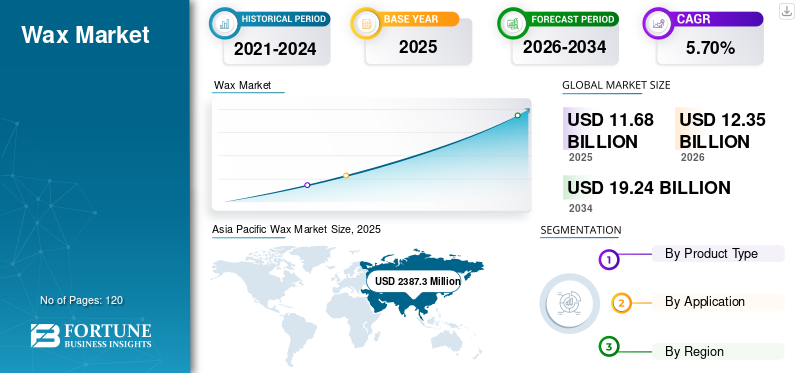
Download Free sample to learn more about this report.
Wax Market Key Takeaways
 Global Market Size & Forecast
- 2025 Market Size: USD 11.68 billion
- 2026 Market Size: USD 12.35 billion
- 2034 Forecast Market Size: USD 19.24 billion
- CAGR: 5.70% from 2026–2034
 Market Share
- Asia Pacific dominated the wax market with a 32.75% share in 2025.
- The petroleum segment held the largest market share of 63.5%.
- The cosmetic & toiletries segment is projected to be the fastest-growing segment.
 Key Regional Highlights
North America
North America accounted for the third-largest share of 26.6% in the global market.
Asia Pacific
Asia Pacific dominated the global wax market.
Europe
Europe held the second-largest share of the global market.
U.S.
The U.S. is expected to witness steady growth during the forecast period.
Japan
Japan is anticipated to experience stable market growth during the forecast period.
Read More

Wax Market Trends
Thermotherapy Using Molten Paraffin Bath Is Increasing Demand for Paraffin
Paraffin possesses excellent heat absorbing and retaining capacity. As paraffin has a low melting point, it can be easily applied to the skin without any burns. Therefore, paraffin bath is one of the most effective methods used to improve blood circulation & reduce joint pains. Muscle stiffness or pains caused due to arthritis are relieved with the help of paraffin heat treatment. The heat is transferred to the affected area when paraffin undergoes a phase change from liquid to solid.
- Asia Pacific witnessed a growth from USD 2316.5 Million in 2018 to USD 2387.5 Million in 2019.
In addition to therapeutic benefits, the paraffin bath has cosmetic benefits too. Paraffin is a natural emollient. It opens skin pores and softens the skin by improving blood circulation. Moreover, it helps to rehydrate dry or cracked skin due to cold conditions or stress. It removes layers of dead skin and helps to improve the skin tone.
Download Free sample to learn more about this report.
Wax Market Growth Factor
Multiple Uses across Variety of Industrial Application is Boosting Growth of the Market
Wax coatings provide protection to packaged goods and higher gloss improves the appearance of the same. Smooth coating allows the consumers to better control the opening of the packages. Soft & gentle packaging products are highly valued across the world. Excellent barrier properties against moisture make them suitable for packaging applications in food & other industries. The non-sticky nature plays an important role to offer reliable & cost-effective solutions for packing sticky products.
Moreover, properties such as anti-blocking, water repellency, slip, lubricity, abrasion resistance, low viscosity, excellent chemical resistance, high compatibility, and thermal stability are highly recommended in applications such as candle manufacturing, coatings, polishes, adhesives, cosmetics, as well as plastic & rubber additives.
Growth of End-use Industries in Developing Economies is Projected to Boost Market Growth
In developing countries of Asia Pacific, Africa, and Latin America, the growth of end-use industries such as candles, packaging, cosmetics, plastic, rubber and others is high as compared to the developed countries in America & Europe. Therefore, rapid industrialization in such countries is expected to create opportunities for the wax market growth in these regions.
Paraffin wax is highly adopted in corrugated packaging which is used to pack food, furniture, and other goods. Therefore, the healthy growth of the packaging sector across these developing economies is fuelling the growth of the market. For instance, according to the Packaging Industry Association of India, the packaging is the fifth largest sector and one of the highest growth sectors in India with an annual growth rate of 22% to 25%. In Latin America, Mexico is the key packaging market. According to the Packaging Machinery Manufacturers Institute, the packaging manufacturing companies in Mexico produce over 8.1 million tons of packaging products per year.
Restraining Factor
High Cost of Animal & Plant-Based Waxes Is Key Restraining Factor for Market Growth
As compared to petroleum type, the manufacturing cost of animal & plant-based wax is high, due to their high cost, adulteration with other cheaper material. Animal fat, paraffin, plant oils and other materials are mixed to gain more profit. However, the emergence of methods to detect adulteration such as liquid chromatography is expected to lower the impact of this restraint during the forecast period.
Animal & plant-based products start to degrade after a period of time. Therefore, sustainability, as compared to the other types, is also a key challenge for the growth of this segment. Moreover, improper handling of natural resources due to lack of quality standards & regulations, as well as authentic sourcing of raw material represents a major restraint for manufacturers. Improperly treated products may contain chemicals used for insect keeping and hence, will lead to very low product quality.
Market Growth Opportunities
Increasing Oil Exploration Activities across the World Is Creating Potential Opportunities for Market Growth
Refining is an important separation process in petroleum plants. Two commercial processes are used for this purpose i.e. solvent-based physical process and catalytic based chemical process. The products obtained from petroleum refining are marketable by-products and important to gain the overall plant operation revenue. As wax is manufactured during such processes, favorable growth of oil exploration activities globally is expected to create new opportunities for production during the forecast period. For instance, in 2019, Total S.A. planned to drill wells at different locations including South Africa, Brazil, Mauritania, and Guyana. In 2020, the Brazilian oil firm, Petrobras identified the presence of oil in the Campos basin, Brazil.
Segmentation Analysis
By Product Type Analysis
Petroleum Segment Dominated the Global Wax Market in 2019
On the basis of product type, the global market for wax is segmented as petroleum, synthetic, mineral, and animal & plant.
Petroleum products mainly include paraffin, petrolatum, and micro-crystalline type. Among these, paraffin is highly consumed and produced across the world. Less reactive nature and high versatility make these products suitable for numerous industrial applications. Moreover, paraffin is cheaper than the other types which make them the economically prime option. Despite high cost, owing to the increasing demand for bio-based non-toxic & non-carcinogenic products, the animal & plant segment is projected to be the fastest-growing segment during the forecast period, both in terms of value and volume.
- The petroleum segment is expected to hold a 63.5% share in 2019.
To know how our report can help streamline your business, Speak to Analyst
The synthetic segment accounted for the second-largest share among product type in 2019 and is expected to grow at a higher CAGR than the petroleum segment during the forecast period. Synthetic type mainly includes products derived from polyolefin and the Fischer-Tropsch process. The oil content in synthetic type is low and these products can be used in numerous applications such as candles, coatings, inks, adhesives, lubricants, textiles, and polishes.
By Application Analysis
Candles Segment Held the Largest Revenue Share in the Global Wax Market
On the basis of application, the global market is segmented as candles, packaging, coating & polishes, hot-melt adhesives, cosmetic & toiletries, plastic & rubber, and others.
In 2019, the candles segment dominated the global market and the trend is projected to remain the same throughout the forecast period. Increasing demand for scented candles for home décor and aromatherapy is boosting the growth of this segment. Candles are available in a wide variety of choices such as scent, size, shape, and cost. Moreover, they are considered as the most appropriate gift on different occasions such as Christmas, birthdays, house warming parties, and others. According to the National Candle Association, most of the American candle consumer use purchased candles within a week.
The cosmetic & toiletries segment is projected to be the fastest growing segment in the global market throughout the forecast period. In cosmetic manufacturing, these waxes are used as structuring or thickening agents, waterproofing or wear enhancing agents, and SPF booster. They are mainly used in the manufacturing of lipsticks, lip balms, sunscreens, foundations, and mascara.
Regional Analysis
Asia Pacific
Asia Pacific Wax Market Size, 2025 (USD Million)
To get more information on the regional analysis of this market, Download Free sample
Asia Pacific dominated the global market in 2019. Countries such as China, India, and Japan are the key markets in this region. The bulk availability of raw materials, along with the favourable growth of end-use industries in the region is projected to drive the growth of the market in the near future.
For many years, China is one of the largest producers, consumers, and importers in the world. India is one of the largest producers of beeswax in the world. According to the Economic Advisory Council Beekeeping Development Report 2019, India has the potential to keep 200 million bee colonies which can produce over 15 kilo tons of this product and an organized collection can add an additional 10 kilo tons.
Europe
Europe held the second-largest share of this global market in 2019. Owing to the higher presence of leading manufacturers, the region is a well-established market. In Europe, Germany accounted for the highest revenue share, followed by the U.K. and is expected to grow at the fastest CAGR over the forecast period.
North America
North America accounted for the third-largest share of 26.6% in the global market in 2019. The demand in this region is expected to grow at a CAGR of 2.6% over the forecast period. The United States is the largest consumer and importer in the world. Among applications, the candles segment accounted for the largest revenue share in this region in 2019. Owing to the increasing demand for high-quality petroleum and bio-based candles, the segment is expected to lead the market during the forecast period.
List of Key Companies Profiled in the Wax Market:
- Sasol Limited (South Africa)
- Sinopec (China)
- Royal Dutch Shell PLC (Netherlands)
- Exxon Mobil Corporation (USA)
- The International Group Inc. (Canada)
- Petróleo Brasileiro S.A. (Brazil)
- The PJSC Lukoil Oil Company (Russia)
- PDVSA (Petróleos de Venezuela, S.A.) (Venezuela)
- Kerax Limited (UK)
- DEUREX AG (Germany)
- NIPPON SEIRO CO. LTD. (Japan)
- Numaligarh Refinery Limited (India)
- Strahl & Pitsch, Inc. (USA)
- CALWAX (USA)
- Poth Hille & Co Ltd. (UK)
- Cargill, Inc. (USA)
- Samin Chemical (Iran)
KEY INDUSTRY DEVELOPMENTS:
- May 2019: Exxon Mobil Corporation invested USD 2 billion to expand its chemical plant located in Baytown, Texas. The expansion enabled the company to enter into the linear alpha olefin material market. The new unit will produce 400 kilo tons of Vistamaxx performance polymer per year.
- February 2018: Sasol Limited successfully commissioned its Fisher-Tropsch Wax Expansion Plant (FTWEP) in Sasolburg, South Africa. With completion of this project worth USD 1 billion, South Africa became one of the largest producers globally. The company invested as a part of its commitment towards industrial development into South Africa.
- February 2017: Kerax Limited launched new soy candle wax named KeraSoy in the United Kingdom. The product was designed to produce premium quality candles with superior glass adhesion and excellent scent.
REPORT COVERAGE
Request for Customization to gain extensive market insights.
The wax market report provides both qualitative & quantitative insights across the world. Quantitative insights include market sizing in terms of value (USD million) & volume (Kilo Tons) across each segment, sub-segment, and region profiled in the scope of study. Also, it provides market share analysis and growth rates of the segment, sub-segments, and key counties across each region. Qualitative insight covers an elaborative analysis of the market drivers, restraints, growth opportunities, and key trends related to the market.
Moreover, the competitive landscape section provides detailed company profiling of key players operating in the market covering their business overview, key management, key geographic operations, business strategies, and SWOT analysis.
REPORT SCOPE & SEGMENTATION
|
ATTRIBUTE |
DETAILS |
|
Study Period |
2021-2034 |
|
Base Year |
2025 |
|
Forecast Period |
2026-2034 |
|
Historical Period |
2021-2024 |
|
Unit |
Value (USD Million) Volume (Kilo Tons) |
|
Segmentation |
By Product Type
|
|
By Application
|
|
|
By Geography
|
Frequently Asked Questions
According to Fortune Business Insights, the global wax market was valued at USD 12.35 billion in 2026, projected to reach USD 19.24 billion by 2034 at a CAGR of 5.70% during 2026–2034.
The Market is projected to grow at a CAGR of 5.70% over the forecast period.
The wax market includes several types such as petroleum-based wax (paraffin, microcrystalline), synthetic wax (polyolefin, Fischer-Tropsch), mineral wax, and animal & plant-based waxes. Petroleum wax, especially paraffin, dominates due to its low cost and versatility.
The candle industry is the largest consumer of wax globally. It accounted for the highest market share in 2025 due to the rising demand for scented, decorative, and aromatherapy candles, especially in North America and Europe.
Growth is driven by the expanding use of wax in packaging, cosmetics, hot-melt adhesives, and coatings. Additionally, increasing demand from developing economies and rising oil exploration activities are creating new production opportunities.
A major restraint is the high cost and limited availability of animal & plant-based waxes. These waxes also face issues like adulteration, sustainability challenges, and inconsistent raw material sourcing due to poor quality control standards.
Asia Pacific held the largest share in 2025 (32.75%) due to strong industrial growth in countries like China and India, large-scale production, and increasing demand from packaging, cosmetics, and candle industries.
Notable trends include the rising use of paraffin wax in thermotherapy treatments, demand for bio-based and natural waxes, and increased R&D in wax formulations for cosmetic and packaging applications.



- 2021-2034
- 2025
- 2021-2024
- 120
Get 30-60 hrs Free Customization
Expand Regional and Country Coverage, Segments Analysis, Company Profiles, Competitive Benchmarking, and End-user Insights.


















Related Reports
-
US +1 833 909 2966 ( Toll Free )
-
Get In Touch With Us