Weight Management Market Size, Share & Industry Analysis, By Function (Diet, Fitness Equipment, Surgical Equipment, Services), and Regional Forecast, 2026-2034
 Download Free Sample
Weight Management Market Size & Industry Overview
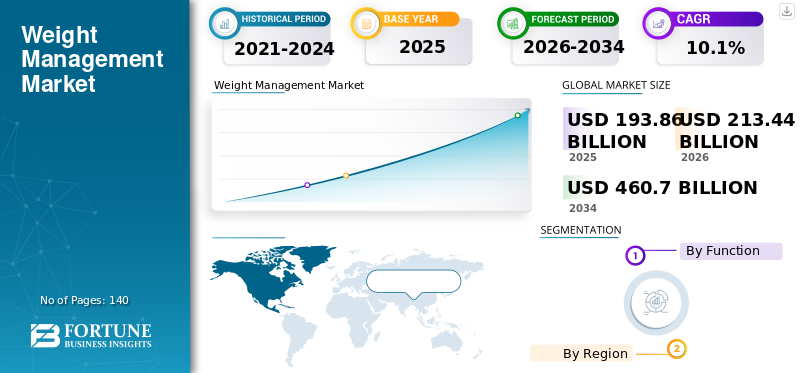
The global weight management market size was valued at USD 193.86 billion in 2025. The market is projected to grow from USD 213.44 billion in 2026 to USD 460.70 billion by 2034, exhibiting a CAGR of 10.10% during the forecast period.

The weight management market is witnessing substantial expansion due to increasing awareness regarding healthy lifestyles, preventive healthcare, and obesity management. Consumers across various age groups are actively seeking solutions that help maintain healthy body weight while improving overall wellness. The market encompasses a broad range of products and services, including dietary programs, fitness equipment, surgical interventions, nutritional supplements, and professional weight management services. Rising incidences of obesity-related disorders such as diabetes, cardiovascular diseases, and metabolic conditions are encouraging individuals to adopt structured weight management strategies. The integration of digital health technologies, personalized nutrition programs, and connected fitness solutions continues to reshape the competitive landscape of the weight management market.
The United States represents one of the most developed weight management markets globally. Growing public awareness regarding obesity-related health risks, combined with strong consumer spending on wellness products and services, continues to drive market demand. Americans are increasingly adopting personalized nutrition plans, fitness programs, digital health applications, and medically supervised weight loss solutions. The country benefits from advanced healthcare infrastructure, widespread fitness culture, and continuous innovation in nutrition and wellness technologies. Corporate wellness programs, health insurance initiatives, and preventive healthcare campaigns further support market expansion. The presence of leading manufacturers and service providers strengthens the overall competitiveness of the U.S. weight management industry.
Download Free sample to learn more about this report.
Weight Management Market Key Takeaways
 Global Market Size & Forecast
- 2025 Market Size: USD 193.86 Billion
- 2026 Market Size: USD 213.44 Billion
- 2034 Forecast Market Size: USD 460.70 Billion
- CAGR: 10.10% from 2026–2034
 Market Share
- The market in North America dominated with a revenue share of 38% in 2025.
- Diet held a 38% market share by function.
- Fitness Equipment accounted for a 29% market share by function.
 Key Regional Highlights
North America
North America led the market with a 38% share in 2025.
Europe
Europe accounted for 29% of the global market, supported by increasing demand for weight management solutions.
Asia-Pacific
Asia-Pacific held a 24% market share, driven by rising health awareness and wellness adoption.
U.S
The U.S. is witnessing strong demand for diet, fitness, surgical, and professional weight management solutions.
Japan
Japan accounted for 7% of the Asia-Pacific market, supported by growing interest in preventive health and weight management.
Read More

Weight Management Market Latest Trends
The weight management market trends reflect a significant shift toward personalized and technology-driven health solutions. Consumers increasingly prefer customized nutrition programs that align with their unique health goals, dietary preferences, and metabolic profiles. Artificial intelligence and data analytics are playing a growing role in creating individualized weight management plans that improve adherence and long-term success rates.
Download Free sample to learn more about this report.
Digital health platforms continue to transform the industry by providing remote coaching, virtual consultations, fitness tracking, and nutritional monitoring capabilities. Mobile applications integrated with wearable devices enable users to track calorie intake, physical activity, sleep quality, and overall wellness metrics in real time. These technologies help consumers make informed decisions and maintain accountability throughout their weight management journeys. Additionally, medical weight management solutions are gaining traction as healthcare providers increasingly address obesity as a chronic health condition. Integrated approaches that combine dietary interventions, behavioral counseling, fitness programs, and medical supervision are becoming standard practice. These developments continue to strengthen the weight management market outlook and create new opportunities for industry participants.
Weight Management Market Dynamics
DRIVER
Rising Prevalence of Obesity and Lifestyle Disorders
The increasing prevalence of obesity and lifestyle-related health disorders remains the primary driver of weight management market growth. Sedentary lifestyles, unhealthy dietary habits, and reduced physical activity levels have contributed to rising obesity rates across both developed and developing economies. Obesity is closely associated with chronic conditions such as diabetes, hypertension, cardiovascular disease, and joint disorders, encouraging individuals to adopt weight management strategies.
Healthcare organizations and government agencies are actively promoting preventive healthcare initiatives focused on healthy living and weight control. Public awareness campaigns have increased consumer understanding of the long-term health risks associated with excessive weight gain. As a result, demand for dietary programs, fitness solutions, weight management services, and medical interventions continues to expand. The growing popularity of wellness culture further supports market growth. Consumers increasingly prioritize physical fitness, nutritional balance, and overall well-being. Social media influence, fitness communities, and health-focused lifestyles have created a strong demand for innovative weight management products and services. These factors collectively contribute to sustained growth within the weight management market.
RESTRAINT
High Cost of Comprehensive Weight Management Programs
One of the key restraints affecting the weight management market is the relatively high cost associated with comprehensive weight management programs. Effective weight management often requires a combination of nutritional counseling, fitness training, dietary supplements products, behavioral support, and medical supervision. These services can create financial barriers for many consumers.
Advanced fitness equipment, personalized meal programs, and medically supervised weight loss treatments often involve significant expenses. In some regions, insurance coverage for weight management interventions remains limited, further increasing out-of-pocket costs for consumers. As a result, adoption rates may be constrained among lower-income populations. Another challenge relates to consumer adherence. Weight management requires long-term lifestyle changes and consistent commitment. Many individuals struggle to maintain dietary restrictions and exercise routines over extended periods. High dropout rates from weight management programs can impact overall market effectiveness and consumer satisfaction. These factors continue to influence market dynamics despite growing awareness regarding obesity prevention and wellness.
OPPORTUNITY
Growth of Personalized Nutrition and Digital Health Solutions
Personalized nutrition and digital health technologies present substantial opportunities within the weight management market. Advances in artificial intelligence, genetic testing, and health analytics are enabling providers to develop highly customized weight management solutions tailored to individual needs. Personalized approaches improve engagement, effectiveness, and long-term adherence compared to traditional one-size-fits-all programs.
Digital health platforms offer convenient access to nutrition coaching, fitness tracking, behavioral support, and progress monitoring. Consumers increasingly prefer virtual health solutions that provide flexibility and accessibility. Mobile applications and wearable technologies allow users to monitor health metrics continuously, creating opportunities for proactive weight management. Emerging markets also present significant growth potential due to increasing health awareness and expanding digital infrastructure. Rising disposable incomes and growing interest in preventive healthcare are encouraging adoption of wellness solutions across developing regions. Companies that invest in personalized nutrition, telehealth services, and connected fitness ecosystems are well positioned to capitalize on these opportunities.
CHALLENGE
Consumer Retention and Long-Term Behavioral Change
Maintaining consumer engagement and promoting long-term behavioral change remain major challenges within the weight management market. Many individuals begin weight management programs with strong motivation but struggle to sustain healthy habits over time. Weight loss plateaus, lifestyle constraints, and psychological factors can reduce adherence and affect outcomes.
Weight management providers must develop strategies that encourage continuous participation and support lasting behavior modification. Personalized coaching, motivational tools, progress tracking, and community support mechanisms are increasingly important for improving retention rates. The challenge lies in creating sustainable programs that deliver measurable results while maintaining user engagement. Additionally, misinformation regarding weight loss methods and unrealistic consumer expectations can complicate market dynamics. Providers must emphasize evidence-based approaches and realistic goal setting to build trust and improve program effectiveness. Addressing these challenges will remain critical for long-term market success.
Weight Management Market Segmentation
By Function
The Diet segment holds approximately 38% of the weight management market share and remains the leading category due to growing consumer preference for nutrition-based weight control solutions. This segment includes meal replacement products, dietary supplements, calorie-controlled meal plans, personalized nutrition programs, and functional foods designed to support healthy weight management. Increasing awareness of obesity-related health risks and preventive healthcare practices is driving demand for scientifically developed dietary solutions. Consumers are increasingly adopting sustainable eating habits rather than short-term dieting approaches. The expansion of personalized nutrition technologies and professional dietary counseling services continues to strengthen the position of the diet segment within the weight management market.
The Fitness Equipment segment accounts for approximately 29% of the weight management market and continues to benefit from rising interest in physical fitness and active lifestyles. This segment includes treadmills, stationary bicycles, strength training machines, rowing equipment, and connected fitness devices. Growing demand for home-based workout solutions has significantly increased equipment adoption among consumers seeking convenient weight management methods. Technological advancements such as virtual coaching, performance tracking, and smart connectivity features are enhancing user experiences and encouraging regular exercise participation. The increasing focus on preventive health and physical wellness is expected to support continued growth in the fitness equipment segment.
Surgical Equipment represents approximately 15% of the weight management market and primarily serves individuals requiring medical intervention for obesity management. This segment includes devices used in bariatric procedures, minimally invasive surgeries, and other weight-loss treatments performed in healthcare facilities. Growing awareness regarding obesity-related complications such as diabetes, cardiovascular disease, and hypertension has increased acceptance of surgical solutions among eligible patients. Continuous advancements in surgical technologies have improved procedural safety, reduced recovery times, and enhanced long-term outcomes. As healthcare providers increasingly recognize obesity as a serious medical condition, demand for innovative surgical equipment continues to expand within the market.
The Services segment accounts for approximately 18% of the weight management market and includes weight loss clinics, nutritional counseling, fitness coaching, behavioral therapy, and wellness management programs. Consumers increasingly seek professional guidance to achieve sustainable weight management goals and improve overall health outcomes. Personalized coaching services provide accountability, motivation, and customized support that enhance long-term success rates. Digital health platforms and telehealth consultations are expanding access to professional weight management expertise, allowing providers to serve broader populations. Growing demand for comprehensive wellness solutions that combine nutrition, exercise, and behavioral support continues to drive expansion within the services segment.
Weight Management Market Regional Outlook
North America
North America holds approximately 38% of the weight management market share and remains the leading regional market due to high health awareness, widespread obesity management initiatives, and strong adoption of wellness technologies. The region benefits from advanced healthcare infrastructure, a well-established fitness industry, and increasing consumer expenditure on health and wellness products. Consumers actively utilize dietary supplements, meal replacement programs, fitness equipment, mobile health applications, and professional weight management services to maintain healthy lifestyles and prevent chronic diseases.
The growing prevalence of obesity and associated health conditions continues to encourage demand for comprehensive weight management solutions across the United States and Canada. Healthcare providers are increasingly integrating weight management programs into preventive healthcare strategies. Corporate wellness initiatives are also gaining momentum as employers seek to improve workforce health and productivity. Additionally, technological advancements in wearable fitness devices, artificial intelligence-powered nutrition platforms, and virtual coaching services are creating new opportunities for market expansion. The strong presence of leading manufacturers, wellness service providers, and healthcare organizations further strengthens North America's position within the global weight management market.
Europe
Europe accounts for approximately 29% of the global weight management market share and continues to demonstrate strong demand for health-focused products and services. Increasing awareness regarding obesity prevention, healthy nutrition, and active lifestyles has significantly contributed to market growth throughout the region. Governments and healthcare organizations are actively promoting public health campaigns that encourage healthy eating habits and regular physical activity. These initiatives have created favorable conditions for the adoption of weight management solutions.
The European market is characterized by strong demand for nutritional products, fitness programs, wellness services, and medically supervised weight loss treatments. Consumers increasingly seek personalized health solutions that combine dietary guidance, exercise planning, and behavioral support. The growing popularity of organic foods, plant-based diets, and functional nutrition products further supports market expansion. Digital health technologies and online wellness platforms are also transforming the industry by providing convenient access to professional weight management services. Countries such as Germany, the United Kingdom, France, Italy, and Spain continue to play significant roles in regional market development. Ongoing innovation and increasing investment in preventive healthcare solutions contribute to the positive outlook for the European weight management industry.
Germany Weight Management Market
Germany represents approximately 24% of the European weight management market and serves as one of the region's most influential markets. The country benefits from strong healthcare infrastructure, high consumer awareness regarding preventive health, and increasing demand for wellness-focused products and services. German consumers are increasingly adopting healthy lifestyle practices that include balanced nutrition, regular exercise, and professional weight management support. This trend has created substantial demand for dietary supplements, fitness equipment, and personalized wellness programs.
Healthcare providers across Germany actively promote obesity prevention and chronic disease management initiatives. Weight management clinics, nutrition counseling centers, and fitness organizations continue to expand their service offerings to meet growing consumer demand. Digital health technologies are also becoming increasingly popular, enabling consumers to access personalized nutrition guidance, fitness tracking, and virtual health coaching. The country's strong emphasis on healthcare quality and innovation supports continued market development. Corporate wellness programs and employer-sponsored health initiatives further contribute to demand for weight management solutions. Germany remains a key growth center within the European weight management market outlook due to its focus on health promotion and wellness innovation.
United Kingdom Weight Management Market
The United Kingdom accounts for approximately 18% of Europe's weight management market and continues to experience strong demand for weight control solutions. Rising awareness regarding obesity-related health risks and increasing focus on preventive healthcare have encouraged consumers to seek professional weight management support. The country has witnessed growing adoption of dietary programs, fitness memberships, nutritional supplements, and digital wellness applications designed to promote healthier lifestyles.
Healthcare organizations and public health authorities actively support initiatives aimed at reducing obesity prevalence and improving overall population health. Consumers are increasingly embracing personalized nutrition strategies, home fitness solutions, and technology-driven wellness programs. The expansion of virtual health services has improved access to weight management resources, enabling individuals to receive professional guidance remotely. The United Kingdom also benefits from a highly developed fitness industry and strong consumer interest in health optimization. As wellness becomes an increasingly important priority among individuals and employers, the market continues to create opportunities for providers offering innovative and evidence-based weight management solutions.
Asia-Pacific
Asia-Pacific represents approximately 24% of the global weight management market share and is emerging as one of the fastest-developing regional markets. Rapid urbanization, changing dietary habits, and increasing health awareness have significantly influenced consumer demand for weight management products and services. As sedentary lifestyles become more common across many countries in the region, concerns regarding obesity and lifestyle-related diseases are driving greater interest in health and wellness solutions.
Governments and healthcare organizations throughout Asia-Pacific are implementing initiatives focused on nutrition education, physical activity promotion, and chronic disease prevention. Rising disposable incomes have enabled consumers to spend more on dietary supplements, fitness memberships, wellness programs, and health technologies. Digital health platforms are particularly influential within the region due to widespread smartphone adoption and growing internet connectivity. Countries such as China, Japan, India, South Korea, and Australia continue to play important roles in market expansion. Increasing investment in healthcare infrastructure and growing demand for personalized wellness solutions are expected to support sustained growth across the Asia-Pacific weight management industry. The region's large population base provides substantial long-term opportunities for manufacturers and service providers.
Japan Weight Management Market
Japan accounts for approximately 7% of the Asia-Pacific weight management market and remains a significant contributor to regional demand. The country's strong emphasis on preventive healthcare, balanced nutrition, and active lifestyles supports widespread adoption of weight management solutions. Japanese consumers are highly health-conscious and often seek scientifically supported approaches to maintaining healthy body weight and overall wellness.
The market benefits from advanced healthcare infrastructure and strong consumer interest in nutrition-focused products. Functional foods, dietary supplements, and health monitoring technologies are particularly popular among Japanese consumers. Fitness centers, wellness programs, and digital health applications also contribute to market growth. Aging demographics have further increased demand for weight management solutions that support healthy aging and disease prevention. Healthcare providers frequently incorporate weight management strategies into broader wellness initiatives aimed at improving quality of life. Japan's focus on innovation and preventive health continues to create opportunities for market participants seeking to develop advanced weight management products and services.
China Weight Management Market
China represents approximately 35% of the Asia-Pacific weight management market and remains the largest country-level market within the region. Rapid economic development, urbanization, and changing consumer lifestyles have significantly influenced dietary patterns and physical activity levels. As awareness regarding obesity-related health risks continues to grow, consumers are increasingly adopting weight management strategies to improve overall health and wellness.
The Chinese market has witnessed strong demand for nutritional supplements, fitness equipment, weight management programs, and digital health platforms. Online wellness services and mobile health applications have become particularly popular due to widespread smartphone usage and digital connectivity. Government initiatives promoting healthy lifestyles and disease prevention are encouraging consumers to adopt healthier habits. The country's expanding middle-class population is also contributing to increased spending on health and wellness products. Continuous innovation in digital health technologies and personalized nutrition solutions further supports market growth. China remains a critical market for companies seeking long-term opportunities within the global weight management industry.
Rest of World
The Rest of World region accounts for approximately 9% of the weight management market share and includes Latin America, the Middle East, and Africa. Although market development varies significantly across these regions, increasing health awareness and growing concerns regarding obesity are supporting demand for weight management products and services. Governments and healthcare organizations are investing in initiatives designed to improve nutrition education and encourage healthier lifestyles.
Consumers throughout these regions are gradually adopting dietary supplements, fitness programs, and wellness services as awareness regarding preventive healthcare increases. Urbanization and changing dietary habits have contributed to rising rates of obesity and lifestyle-related diseases, creating demand for effective weight management solutions. Improvements in healthcare infrastructure and growing access to digital technologies are helping expand market reach. International companies are increasingly targeting these regions through partnerships, localized product offerings, and educational campaigns. As economic development continues and healthcare access improves, the Rest of World market is expected to generate additional opportunities for industry participants operating within the global weight management market.
List of Top Weight Management Companies
- Herbalife International, Inc.
- NutriSystem, Inc.
- Weight Watchers International, Inc.
- Glanbia PLC
- Atkins Nutritionals, Inc.
- Technogym
- Now Health Group, Inc.
- Johnson Health Tech
- The Kellogg Company
- Nestle SA
- Abbott Laboratories
- Amer Sports
- GNC Holdings, Inc.
- Alticor Corporation
Top Two Companies with Highest Market Share
- Herbalife International, Inc. – 12%
- Nestle SA – 10%
Investment Analysis and Opportunities
The weight management market continues to attract substantial investments from healthcare companies, nutrition manufacturers, fitness technology providers, and private equity firms. Rising awareness regarding obesity prevention and healthy living has encouraged investors to focus on companies offering innovative solutions across dietary products, digital wellness platforms, fitness technologies, and clinical weight management services. Investment activity is particularly strong in personalized nutrition, artificial intelligence-powered health coaching, wearable fitness devices, and telehealth-enabled wellness programs.
Growing consumer demand for holistic health management has created opportunities for businesses offering integrated solutions that combine nutrition, fitness, behavioral coaching, and health monitoring. Investors are increasingly targeting companies capable of delivering long-term customer engagement through subscription-based wellness services and digital ecosystems. Emerging economies also present significant opportunities due to increasing disposable incomes, urbanization, and rising health awareness. Expansion of online health platforms and direct-to-consumer business models continues to attract capital across the industry.
New Product Development
Innovation remains a critical success factor within the weight management market. Manufacturers are continuously developing advanced products designed to improve effectiveness, convenience, and consumer engagement. Personalized nutrition solutions represent one of the most significant innovation areas, with companies utilizing artificial intelligence and health analytics to create customized dietary recommendations based on individual health profiles, activity levels, and wellness objectives.
Digital health platforms continue to expand their capabilities by incorporating behavioral coaching, remote monitoring, virtual consultations, and predictive health analytics. Companies are increasingly integrating multiple wellness functions into unified ecosystems that support long-term weight management and overall health improvement. These innovations are transforming consumer experiences and strengthening competitive differentiation throughout the weight management industry.
Five Recent Developments (2023-2025)
- Expanded its personalized nutrition portfolio with enhanced digital wellness tools and individualized dietary support programs.
- Introduced advanced digital coaching solutions and expanded its integrated health management platform offerings.
- Launched new functional nutrition products focused on healthy weight maintenance and metabolic wellness support.
- Developed next-generation connected fitness equipment featuring artificial intelligence-driven workout personalization and performance tracking.
- Expanded nutritional product offerings designed to support healthy weight management and active lifestyle goals across multiple consumer segments.
Report Coverage of Weight Management Market
The weight management market Report provides comprehensive analysis of industry developments, market dynamics, competitive landscape, segmentation trends, regional performance, investment activities, and technological advancements influencing market growth. The report evaluates the impact of changing consumer lifestyles, rising health awareness, obesity management initiatives, and digital health transformation on industry development. It offers detailed insights into the factors driving adoption of weight management products and services across global markets.
Request for Customization to gain extensive market insights.
Additionally, the report provides detailed competitive analysis of leading industry participants, emerging business models, innovation strategies, and investment trends. It examines the role of personalized nutrition, connected fitness technologies, digital health platforms, and preventive healthcare initiatives in shaping future market developments. The weight management industry Analysis serves as a valuable resource for manufacturers, investors, healthcare organizations, distributors, and strategic decision-makers seeking actionable market intelligence and long-term business opportunities.
Frequently Asked Questions
Fortune Business Insights says that the global market value stood at USD 193.86 billion in 2025 and is projected to reach USD 460.69 billion by 2034.
The market is expected to exhibit a CAGR of 10.1% during the forecast period of 2026-2034.
The Diet segment was the leading function segment, accounting for approximately 38% of the market, driven by growing consumer preference for nutrition-based weight control solutions.
Key players include Herbalife International, Inc., NutriSystem, Inc., Weight Watchers International, Inc., Glanbia PLC, Atkins Nutritionals, Inc., and Technogym.
Major trends include growing adoption of personalized nutrition and AI-driven weight management solutions, along with expanding digital health platforms, wearable devices, and virtual coaching. North America leads regionally with a 38% market share.



- 2021-2034
- 2025
- 2021-2024
- 140
-

(Offer valid till 30th Sep 2026)
Get 30-60 hrs Free Customization
Expand Regional and Country Coverage, Segments Analysis, Company Profiles, Competitive Benchmarking, and End-user Insights.













.webp)






-
US +1 833 909 2966 ( Toll Free )
-
Get In Touch With Us