Wetsuits Market Size, Share & Industry Analysis, By Product (Wind Sports, Surfing, Scuba Diving, Triathlon) and Regional Forecast, 2026-2034
 Download Free Sample
Wetsuits Market Overview
The wetsuit market size was valued at USD 1.64 billion in 2025. The market is projected to grow from USD 1.74 billion in 2026 to USD 2.75 billion by 2034, exhibiting a CAGR of 5.89% during the forecast period. The market in North America dominated with a revenue share of 31% in 2025.

The wetsuits market is experiencing consistent expansion due to rising participation in water sports, recreational marine activities, professional diving, and adventure tourism worldwide. Wetsuits are increasingly used in surfing, scuba diving, wind sports, triathlons, paddle boarding, and rescue operations because they provide thermal insulation, buoyancy, flexibility, and protection against harsh water conditions. Manufacturers are focusing on lightweight neoprene alternatives, eco-friendly materials, and performance-enhancing suit designs to attract both professional athletes and recreational consumers. The wetsuits market growth is also supported by increasing awareness regarding water safety and rising investments in coastal tourism infrastructure. Premium product innovation and customization remain key competitive factors.
The USA wetsuits market remains highly influential due to strong participation in surfing, scuba diving, triathlons, and recreational water sports across coastal regions including California, Florida, and Hawaii. Consumer demand for high-performance wetsuits is increasing among professional athletes, adventure tourists, and fitness-focused buyers. Domestic brands are introducing sustainable wetsuit materials, including limestone-based neoprene and recycled fabrics, to align with environmental preferences. The country accounts for approximately 27% of the North American wetsuit market Share because of advanced retail networks, sports sponsorships, and high spending on outdoor recreational equipment. The wetsuits market Report for the United States also highlights rising online sales and increasing demand for customized thermal protection suits.
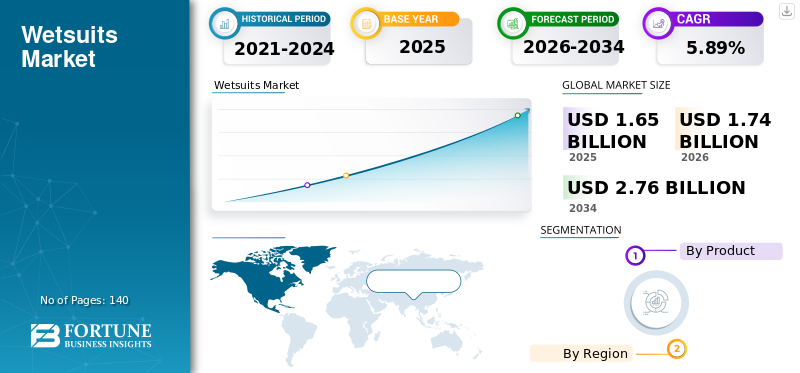
Download Free sample to learn more about this report.
Wetsuits Market Key Takeaways
 Global Market Size & Forecast
- 2025 Market Size: USD 1.64 Billion
- 2026 Market Size: USD 1.74 Billion
- 2034 Forecast Market Size: USD 2.75 Billion
- CAGR: 5.89% from 2026–2034
 Market Share
- The market in North America dominated with a revenue share of 31% in 2025.
- Surfing wetsuits held a 39% market share by product.
- Scuba diving wetsuits accounted for a 28% market share by product.
 Key Regional Highlights
North America
North America held 31%, driven by strong water sports participation.
Europe
Europe accounted for 29% of the global market, supported by strong participation in water sports.
Asia-Pacific
Asia-Pacific held a 27% market share, driven by growing marine tourism and recreational diving.
U.S
The U.S. is witnessing strong demand for surfing, wind sports, and diving wetsuits.
Japan
Japan accounted for 19% of the Asia-Pacific market, supported by growing participation in marine sports and water-based recreation.
Read More

Wetsuits Market Latest Trends
The wetsuits market Trends indicate strong movement toward sustainable manufacturing, lightweight insulation technologies, and performance-oriented product development. Manufacturers are increasingly replacing petroleum-based neoprene with eco-friendly materials derived from natural rubber, recycled polyester, and limestone compounds. This transition is being driven by environmental concerns among consumers and stricter sustainability standards within outdoor sports industries. Premium wetsuit brands are also focusing on ergonomic panel construction and seam-sealing innovations that improve flexibility, comfort, and thermal retention.
Download Free sample to learn more about this report.
Another major trend identified in the wetsuits market Analysis is the growing popularity of specialized wetsuits designed for niche sports such as kiteboarding, open-water swimming, foil surfing, and underwater photography. Athletes are seeking suits tailored to specific water temperatures and performance conditions, encouraging manufacturers to expand their product portfolios. Smart wetsuits integrated with body-temperature monitoring and GPS tracking device technologies are also gaining attention among professional sports communities. In addition, direct-to-consumer sales channels and digital customization platforms are reshaping purchasing behavior. Companies are increasingly using advanced body-scanning technology to provide personalized wetsuit fitting solutions and improve customer satisfaction.
Wetsuits Market Dynamics
DRIVER
Rising Global Participation in Water Sports and Marine Recreation
The increasing popularity of water sports and marine recreational activities is one of the most significant drivers fueling the wetsuits market Growth. Surfing, scuba diving, snorkeling, triathlons, paddle boarding, and windsurfing are attracting larger participant bases across both developed and emerging economies. Coastal tourism expansion and adventure travel packages are also contributing to higher demand for professional-grade and recreational wetsuits. Governments and tourism authorities are investing in marine sports infrastructure, beaches, diving schools, and water sports equipment & training centers, creating strong market demand for wetsuit equipment.
The wetsuits market Research Report also highlights growing interest in fitness-oriented outdoor activities, particularly open-water swimming and endurance sports. Professional athletes and recreational users increasingly prioritize thermal protection and flexibility while participating in cold-water sports. The rise of social media-driven adventure culture has further encouraged younger consumers to invest in premium sportswear and specialized wetsuits. Manufacturers are responding with advanced products that offer durability, stretch performance, and lightweight insulation. The increasing number of surfing competitions, diving events, and triathlon championships globally is expected to continue strengthening market demand over the coming years.
RESTRAINT
High Product Costs and Seasonal Demand Fluctuations
The wetsuits market faces restraints associated with premium pricing structures and seasonal purchasing patterns. High-performance wetsuits often involve advanced materials, thermal lining technologies, and precision manufacturing processes, resulting in elevated retail costs. Professional-grade wetsuits designed for extreme water conditions are particularly expensive, limiting affordability among budget-conscious consumers and entry-level participants. This pricing challenge is more noticeable in emerging markets where disposable income levels remain relatively lower.
The Wetsuits Industry Analysis also identifies seasonal demand variability as a major operational limitation for manufacturers and retailers. Sales volumes are heavily influenced by weather conditions, tourism cycles, and regional sports seasons. During off-season periods, inventory turnover can slow significantly, creating financial pressure on suppliers and distributors. Smaller manufacturers may struggle to maintain stable production schedules due to inconsistent purchasing patterns. In addition, raw material costs associated with neoprene and sustainable alternatives continue to fluctuate, impacting profit margins and long-term pricing strategies. These factors collectively create challenges for consistent revenue generation and supply chain planning within the industry.
OPPORTUNITY
Expansion of Eco-Friendly and Sustainable Wetsuit Technologies
The growing demand for sustainable sportswear is creating significant opportunities within the wetsuits market. Consumers are increasingly seeking environmentally responsible products made from recycled materials, natural rubber, and low-impact manufacturing processes. Brands that prioritize sustainability are gaining competitive advantages among environmentally conscious surfers, divers, and outdoor athletes. This shift is encouraging companies to invest heavily in biodegradable packaging, water-based adhesives, and neoprene-free wetsuit technologies.
The wetsuits market Opportunities are also expanding through innovations in thermal insulation and lightweight design. Manufacturers are developing advanced materials that improve flexibility while reducing overall suit weight and environmental impact. Partnerships between sportswear companies and material science firms are accelerating research into plant-based foam alternatives and recyclable wetsuit components. E-commerce growth and direct-to-consumer channels are enabling emerging brands to reach global audiences more effectively. Additionally, the increasing popularity of women-specific and youth-focused wetsuit collections is opening new customer segments. Sustainable innovation and product diversification are expected to remain central growth opportunities for the industry.
CHALLENGE
Intense Competition and Counterfeit Product Availability
One of the primary challenges affecting the wetsuits market is intense competition among global and regional manufacturers. The industry includes established premium brands as well as low-cost producers competing across recreational and professional product categories. Price-based competition can reduce profit margins and create pressure on companies investing heavily in innovation and sustainable materials. Smaller brands often struggle to differentiate themselves in highly saturated online retail environments.
The wetsuits market Forecast also highlights the growing issue of counterfeit and low-quality products entering global distribution channels. Imitation wetsuits manufactured using inferior materials can negatively impact consumer trust and damage brand reputation. Online marketplaces have increased the availability of unverified products that fail to meet performance and safety standards. In addition, manufacturers must continuously adapt to changing consumer preferences related to fit, thermal protection, and sports-specific functionality. Maintaining supply chain transparency, investing in research and development, and protecting intellectual property rights remain major challenges for companies operating within the competitive wetsuits industry.
Wetsuits Market Segmentation
By Product
Wind sports wetsuits account for approximately 24% of the global wetsuit market Share due to rising participation in kiteboarding, windsurfing, and wing foiling activities. These wetsuits are designed to provide high flexibility, wind resistance, and thermal insulation during extended exposure to cold and windy marine environments. Athletes participating in competitive wind sports require lightweight materials and advanced mobility features to improve performance and comfort. Manufacturers are focusing on stretchable neoprene alternatives and reinforced seam technology to enhance durability under extreme movement conditions. The wetsuits market Report indicates increasing demand for wind sports wetsuits in Europe and North America where coastal sports tourism is highly developed. Premium products featuring quick-dry linings, aerodynamic panel construction, and water-resistant zippers are becoming increasingly popular among professional athletes and recreational users. Companies are also introducing gender-specific and youth-oriented designs to expand customer reach. The rising popularity of adventure sports events and marine sports schools is expected to further strengthen demand for wind sports wetsuits worldwide.
Surfing wetsuits dominate the wetsuits market Size with approximately 39% share because surfing remains one of the most commercially influential water sports globally. Demand is particularly strong in regions with active surf culture including North America, Australia, Europe, and parts of Asia-Pacific. Surfing wetsuits are designed to balance thermal insulation, flexibility, and lightweight performance for varying ocean temperatures. Manufacturers are introducing advanced chest-zip systems, seamless paneling, and eco-friendly materials to improve athlete mobility and reduce water entry. The Wetsuits Industry Report highlights growing consumer preference for sustainable surfing products made from recycled fabrics and neoprene alternatives. Surf tourism and professional surfing competitions are also contributing significantly to product demand. Social media exposure and celebrity athlete endorsements have increased consumer interest in premium surf apparel and equipment. Companies are increasingly using direct-to-consumer platforms and custom sizing technologies to strengthen brand engagement and improve customer loyalty. Innovation in thermal retention and stretch performance remains central to competition within this segment.
Scuba Diving: Scuba diving wetsuits account for nearly 28% of the global wetsuits market and continue to benefit from increasing participation in recreational diving and underwater tourism. Diving wetsuits are designed with thicker insulation, abrasion resistance, and enhanced buoyancy support to protect divers in deep-water environments. Professional diving instructors, underwater photographers, rescue teams, and marine researchers represent key customer segments driving demand for high-performance diving suits. The wetsuits market Insights show rising investments in diving tourism infrastructure across Southeast Asia, the Caribbean, and the Mediterranean region. Manufacturers are focusing on integrated thermal lining systems, reinforced knee panels, and ergonomic fit designs to improve underwater comfort and safety. Technical diving and cold-water exploration activities are also supporting demand for premium wetsuits with advanced thermal protection capabilities. In addition, increasing awareness regarding underwater safety standards is encouraging both recreational and professional divers to upgrade to higher-quality equipment.
Triathlon wetsuits represent approximately 9% of the wetsuits market Share and are gaining popularity due to rising participation in endurance sports and open-water swimming competitions. These wetsuits are specifically engineered for speed, buoyancy, and hydrodynamic efficiency during competitive swimming events. Athletes prioritize lightweight materials, shoulder flexibility, and reduced drag when selecting triathlon wetsuits, encouraging manufacturers to invest heavily in performance-driven innovation. The wetsuits market Analysis highlights increasing demand from fitness enthusiasts and amateur athletes participating in regional and international triathlon events. Premium triathlon wetsuits often incorporate advanced compression technology and quick-transition features to improve race performance. Online fitness communities and sports sponsorships are also driving awareness and product adoption among younger consumers. As endurance sports continue to expand globally, triathlon wetsuits are expected to remain an important niche segment within the broader market.
Wetsuits Market Regional Outlook
North America
North America remains one of the leading regional markets, accounting for approximately 31% of global wetsuit demand. The region benefits from strong participation in surfing, triathlons, diving, paddleboarding, and recreational marine sports. The United States drives most regional sales due to established surfing communities, premium sports retailers, and increasing consumer spending on outdoor recreation equipment. Canada also contributes to demand through cold-water diving and seasonal water sports activities.
The wetsuits market Insights for North America highlight rising demand for eco-friendly wetsuits featuring natural rubber and recycled fabric construction. Manufacturers are expanding premium product lines that offer superior flexibility, quick-dry functionality, and thermal insulation for varying water temperatures. Direct-to-consumer online platforms and athlete sponsorship campaigns are further strengthening market expansion. Increased awareness regarding marine safety and water fitness activities is expected to continue driving long-term regional growth.
Europe
Europe represents approximately 29% of the global wetsuits market Share due to extensive participation in surfing, sailing, wind sports, and scuba diving. Countries including France, Spain, Portugal, Germany, and the United Kingdom contribute significantly to regional consumption. The region’s strong marine tourism industry and growing number of professional water sports competitions support consistent demand for high-performance wetsuits.
The wetsuits market Analysis for Europe indicates increasing preference for sustainable manufacturing and environmentally responsible materials. Consumers are actively seeking neoprene-free alternatives and recyclable sportswear products. European brands are investing heavily in innovation related to seam technology, thermal efficiency, and ergonomic fit. Retail expansion, sports sponsorships, and tourism-related demand continue to strengthen the market outlook across the region.
Germany Wetsuits Market
Germany accounts for approximately 18% of the European wetsuits market due to rising participation in diving, open-water swimming, and wind sports activities. German consumers prioritize premium-quality sportswear and technologically advanced wetsuits designed for durability and thermal protection. The country’s strong sporting culture and increasing focus on outdoor recreation continue to support market demand.
The Germany wetsuits market Report highlights growing consumer interest in sustainable sports apparel and eco-friendly wetsuit materials. Domestic distributors and international brands are expanding online sales channels and specialty retail partnerships to improve product accessibility. Germany also serves as an important market for triathlon wetsuits due to increasing participation in endurance sports events. Product innovation related to lightweight insulation and ergonomic design remains a key competitive factor.
United Kingdom Wetsuits Market
The United Kingdom contributes approximately 15% of the European wetsuits market Share due to strong surfing culture, diving tourism, and recreational water sports participation. Coastal regions in Cornwall, Wales, and Scotland remain major demand centers for wetsuits designed for cold-water conditions. The country’s expanding adventure tourism sector continues to support purchases of premium marine sports equipment.
The wetsuits market Forecast for the United Kingdom indicates increasing demand for flexible and thermally efficient wetsuits among both professional athletes and recreational consumers. Sustainability trends are also influencing product development as brands introduce recycled materials and low-impact production methods. Online retail expansion and sports influencer marketing campaigns are strengthening consumer engagement and boosting product visibility across the market.
Asia-Pacific
Asia-Pacific accounts for approximately 27% of the global wetsuits market and remains one of the fastest-growing regions due to increasing disposable income and expanding marine tourism. Countries such as Australia, Japan, China, Indonesia, and Thailand are experiencing growing participation in surfing, scuba diving, and recreational water sports. The region also benefits from rising investments in beach tourism infrastructure and international sporting events.
The wetsuits market Growth in Asia-Pacific is further supported by expanding e-commerce penetration and increasing popularity of fitness-oriented outdoor activities. Regional manufacturers are developing affordable product categories while also investing in premium wetsuit technologies for export markets. Demand for eco-friendly sportswear and customized wetsuit designs is also increasing among younger consumers and professional athletes.
Japan Wetsuits Market
Japan accounts for approximately 19% of the Asia-Pacific wetsuits market due to growing interest in diving, surfing, and triathlon competitions. Japanese consumers prioritize technologically advanced sportswear products that provide superior fit, comfort, and thermal efficiency. The country’s strong focus on innovation has encouraged manufacturers to invest in lightweight materials and advanced seam construction technologies.
The wetsuits market Research Report for Japan highlights rising demand for premium wetsuits among professional athletes and recreational users. Coastal tourism and marine sports events continue to strengthen product demand, while sustainable manufacturing practices are gaining attention among environmentally conscious consumers. Domestic brands are also expanding into export markets through high-quality product positioning and advanced material development.
China Wetsuits Market
China contributes approximately 36% of the Asia-Pacific wetsuits market Share because of expanding recreational sports participation and rapid growth in marine tourism. Surfing, diving, and water fitness activities are becoming increasingly popular among younger consumers, particularly in coastal cities and tourism destinations. Domestic manufacturing capabilities and large-scale production infrastructure also support regional market leadership.
The Wetsuits Industry Report for China indicates growing investments in sportswear manufacturing technology and international brand partnerships. Local companies are improving product quality and expanding premium product offerings to compete in global markets. Rising disposable income and increasing awareness regarding outdoor fitness activities continue to drive long-term demand for wetsuits and related marine sports apparel.
Rest of World
The Rest of World region accounts for approximately 13% of the global wetsuits market and includes Latin America, the Middle East, and Africa. Coastal tourism expansion and increasing participation in recreational marine activities are supporting steady demand growth across these regions. Brazil, South Africa, and the United Arab Emirates are among the key emerging markets contributing to industry expansion.
The wetsuits market Opportunities in Rest of World regions are linked to growing investment in diving tourism, surfing schools, and luxury marine resorts. International brands are increasingly targeting these markets through local partnerships and online distribution strategies. Lightweight wetsuits designed for warm-water conditions are particularly popular in tropical tourism destinations. Continued tourism development and increasing sports participation are expected to create new commercial opportunities for manufacturers.
List of Top Wetsuit Companies
- Arena S.p.A
- Aqua Lung
- Billabong
- Body Glove
- BOZ Todos los derechos reservados
- Buell Wetsuits & Surf
- Carapace Wetsuits
- C-Skins
- HELLY HANSEN
- Hyperflex Wetsuits
- Isurus, Inc.
- JMJ Manufacture, Inc.
- Lunasurf
- Musto Limited
- O'Neill
- Patagonia, Inc.
- Boardriders
- RIP CURL
- Johnson Outdoors Inc.
- SHEICO Group
- Speedo International
- Xcel Wetsuits
Top two companies with the highest market share
- O'Neill – 16% market share
- RIP CURL – 13% market share
Investment Analysis and Opportunities
The wetsuits market is witnessing increased investment activity due to rising consumer participation in marine sports and growing demand for sustainable sportswear products. Manufacturers are expanding production facilities, upgrading material technologies, and improving direct-to-consumer distribution channels to strengthen market competitiveness. Significant investments are being directed toward eco-friendly neoprene alternatives, recycled fabric integration, and lightweight insulation systems designed for professional athletes and recreational users.
The wetsuits market Opportunities are particularly strong in Asia-Pacific and North America where coastal tourism and water sports participation continue to rise. Venture capital firms and sportswear investors are supporting startups focused on sustainable marine apparel and digital customization platforms. Companies are also investing in advanced body-scanning technologies to improve wetsuit fitting accuracy and customer experience. Expansion of women-specific, youth-oriented, and sports-specialized wetsuit collections is creating additional growth opportunities. Increasing sponsorship of surfing competitions, diving events, and triathlon championships is expected to strengthen brand visibility and attract long-term investment interest across the industry.
New Product Development
Innovation within the wetsuits market is increasingly centered on sustainable materials, smart technologies, and enhanced athletic performance. Manufacturers are introducing neoprene-free wetsuits made from natural rubber and recycled ocean plastics to align with environmental sustainability goals. Advanced thermal lining systems and seamless construction methods are improving flexibility, comfort, and insulation efficiency for professional and recreational users.
The wetsuits market Trends also highlight development of smart wetsuits integrated with biometric sensors, GPS tracking, and body-temperature monitoring systems. These products are gaining attention among professional divers, endurance athletes, and marine rescue organizations. Brands are also introducing ultra-lightweight triathlon suits designed to reduce drag and improve swimming efficiency during competitions. In addition, customization technologies using digital body measurements are helping companies produce better-fitting wetsuits tailored to individual performance requirements. Product innovation remains a critical strategy for strengthening brand differentiation and long-term customer loyalty.
Five Recent Developments (2023-2025)
- O'Neill launched a new sustainable wetsuit collection using recycled yarns and natural rubber materials in 2024.
- RIP CURL introduced advanced thermal lining technology designed for extreme cold-water surfing conditions in 2023.
- Patagonia, Inc. expanded eco-friendly wetsuit manufacturing operations focused on neoprene-free product development in 2025.
- SHEICO Group invested in automated wetsuit production technology to improve manufacturing efficiency and product consistency in 2024.
- Aqua Lung released a premium diving wetsuit series featuring enhanced buoyancy support and reinforced underwater protection in 2025.
Report Coverage of the Wetsuits Market
The wetsuits market Report provides detailed analysis of product innovation, competitive positioning, consumer demand patterns, and regional industry developments across the global marine sports apparel sector. The report evaluates major product categories including surfing wetsuits, scuba diving wetsuits, triathlon wetsuits, and wind sports wetsuits. It also analyzes technological advancements related to thermal insulation, sustainable materials, ergonomic fit, and lightweight construction.
Request for Customization to gain extensive market insights.
The wetsuits market Research Report further examines regional demand across North America, Europe, Asia-Pacific, Latin America, and the Middle East & Africa. Country-level analysis for Germany, the United Kingdom, Japan, and China is also included to provide deeper market insights for B2B stakeholders. The report covers manufacturing strategies, distribution channels, sustainability initiatives, investment trends, and recent product developments shaping industry competition. In addition, the analysis highlights opportunities associated with marine tourism expansion, water sports participation, and eco-friendly sportswear innovation. The report supports manufacturers, distributors, retailers, investors, and industry participants seeking strategic insights into evolving market conditions.
Frequently Asked Questions
Fortune Business Insights says that the global market value stood at USD 1.64 billion in 2025 and is projected to reach USD 2.75 billion by 2034.
The market is expected to exhibit a CAGR of 5.89% during the forecast period of 2026-2034.
Surfing wetsuits were the leading product segment, accounting for approximately 39% of the market, supported by the strong global popularity of surfing and demand for thermal insulation and flexibility.
Key players include O'Neill, RIP CURL, Patagonia, Inc., Aqua Lung, Billabong, and Body Glove.
Major trends include the shift toward sustainable materials and lightweight insulation and rising demand for specialized and smart wetsuits with customization technologies. North America leads regionally with a 31% market share.



- 2021-2034
- 2025
- 2021-2024
- 140
-

(Offer valid till 30th Sep 2026)
Get 30-60 hrs Free Customization
Expand Regional and Country Coverage, Segments Analysis, Company Profiles, Competitive Benchmarking, and End-user Insights.



















-
US +1 833 909 2966 ( Toll Free )
-
Get In Touch With Us