Wind Turbine Rotor Blade Market Size, Share & Industry Analysis, By Material (Glass Fiber, Carbon Composite), By Application (Onshore, Offshore) and Regional Forecast, 2026-2034
 Download Free Sample
Wind Turbine Rotor Blade Market Size & Overview
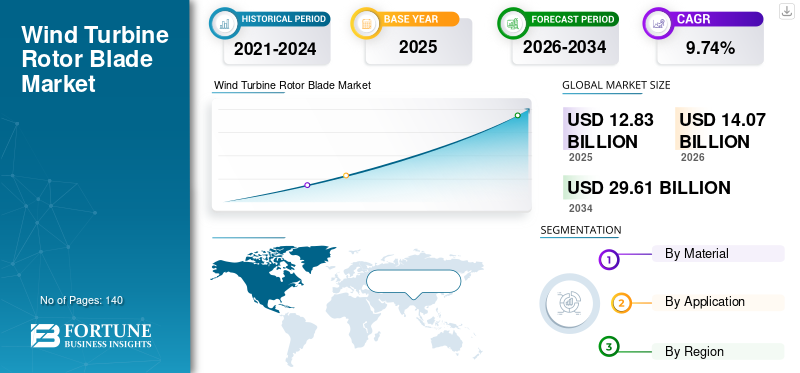
The wind turbine rotor blade market size was valued at USD 12.82 billion in 2025. The market is projected to grow from USD 14.07 billion in 2026 to USD 29.60 billion by 2034, exhibiting a CAGR of 9.74% during the forecast period.

The wind turbine rotor blade market is expanding rapidly due to increasing global investment in renewable energy infrastructure and large-scale wind power installations. Rotor blades are critical components in wind turbines, responsible for converting wind energy into mechanical power with high operational efficiency. wind turbine rotor blade market analysis highlights rising demand for lightweight composite materials, longer blade designs, and aerodynamic engineering solutions that improve power generation efficiency. Increasing offshore wind farm development and government clean energy targets are accelerating wind turbine rotor blade market growth globally. Manufacturers are focusing on advanced blade materials, recyclable composites, and predictive maintenance technologies to strengthen wind turbine rotor blade market share across renewable energy projects.
The USA wind turbine rotor blade market is witnessing strong growth due to rising onshore wind installations, federal renewable energy initiatives, and expansion of domestic manufacturing capacity. Wind energy developers across Texas, Iowa, Oklahoma, and Kansas are increasingly investing in larger rotor blades to improve turbine output and operational performance. wind turbine rotor blade market research report findings indicate that more than 54% of newly installed wind turbines in the United States now utilize blades exceeding 60 meters in length. Increasing focus on energy independence, carbon reduction, and offshore wind development along the East Coast continues to strengthen wind turbine rotor blade market opportunities throughout the country.
Download Free sample to learn more about this report.
wind turbine rotor blade Market Key Takeaways
 Global Market size & Forecast
- 2025 Market size: USD 12.82 Billion
- 2026 Market size: USD 14.07 Billion
- 2034 Forecast Market size: USD 29.60 Billion
- CAGR: 9.74% from 2026–2034
 Market share
- The market in Europe dominated with a revenue share of 33% in 2025.
- Glass fiber rotor blades held a 68% market share by material.
- Onshore applications accounted for a 72% market share.
 Key Regional Highlights
Europe
Europe held 33%, driven by strong wind energy deployment.
Asia-Pacific
Asia-Pacific held 32%, supported by expanding renewable energy projects.
North America
North America held 29%, driven by onshore wind development.
U.S
Strong demand from expanding onshore wind projects.
Japan
19% of Asia-Pacific, supported by offshore wind investments.
Read More

wind turbine rotor blade Market: Latest Trends
The wind turbine rotor blade market trends are increasingly focused on larger blade dimensions, lightweight composite materials, and advanced aerodynamic optimization. Manufacturers are developing ultra-long rotor blades capable of capturing higher wind energy output while reducing the overall cost of energy generation. wind turbine rotor blade market Insights reveal growing adoption of carbon composite reinforcement technologies that improve structural strength and reduce blade weight. Advanced digital simulation and AI-assisted blade design are also becoming important tools for improving turbine efficiency and operational reliability.
Download Free sample to learn more about this report.
Another major wind turbine rotor blade industry trend is the increasing emphasis on recyclable and sustainable blade materials. Wind turbine manufacturers are investing in thermoplastic resins and recyclable composite systems to address blade disposal and environmental sustainability concerns. Offshore wind projects are significantly influencing wind turbine rotor blade market growth as larger offshore turbines require longer and more durable rotor blades capable of operating under harsh marine conditions. Smart sensors and predictive maintenance technologies integrated into rotor blades are also improving operational efficiency and reducing maintenance costs. Automated manufacturing systems and robotic blade inspection technologies continue to reshape the global wind turbine rotor blade market outlook.
wind turbine rotor blade Market Dynamics
DRIVER
Rising Global Investment in Renewable Energy and Offshore Wind Projects
The wind turbine rotor blade market is primarily driven by increasing global investment in renewable energy generation and expansion of wind power infrastructure. Governments worldwide are implementing clean energy policies, carbon reduction strategies, and renewable electricity targets, significantly accelerating demand for wind turbines and rotor blades. wind turbine rotor blade market analysis indicates that offshore wind capacity additions are increasing rapidly due to higher energy generation efficiency and favorable marine wind conditions.
Wind farm developers are increasingly adopting larger turbines equipped with advanced rotor blades to maximize electricity output and reduce operational costs. wind turbine rotor blade market growth is also supported by rising electricity demand, industrial decarbonization initiatives, and increasing focus on sustainable energy security. Offshore wind projects in Europe, North America, and Asia-Pacific are creating strong demand for high-performance composite rotor blades capable of withstanding extreme weather conditions. Manufacturers are investing heavily in blade engineering, lightweight materials, and digital monitoring systems to strengthen competitiveness within the wind turbine rotor blade industry report landscape.
RESTRAINT
High Manufacturing and Transportation Costs of Large Rotor Blades
One of the major restraints in the wind turbine rotor blade market is the high manufacturing and logistics cost associated with producing and transporting large-scale rotor blades. Advanced composite materials such as carbon fiber and reinforced polymers significantly increase production expenses. wind turbine rotor blade market research report findings reveal that transportation of oversized rotor blades often requires specialized logistics infrastructure, route planning, and custom transportation equipment.
Large rotor blades are difficult to transport through urban areas, mountainous regions, and narrow road networks, creating operational challenges for wind project developers. wind turbine rotor blade market Forecast studies also indicate that fluctuations in raw material prices and supply chain disruptions can affect production schedules and profitability. Additionally, blade maintenance and replacement activities require highly skilled technicians and specialized repair equipment. Environmental concerns regarding disposal of non-recyclable composite blades also create long-term sustainability challenges for the wind turbine rotor blade industry analysis ecosystem.
OPPORTUNITY
Development of Recyclable Blade Materials and Offshore Wind Expansion
The increasing focus on sustainable renewable energy infrastructure presents major opportunities for the wind turbine rotor blade market. Manufacturers are developing recyclable blade materials and thermoplastic composite technologies to address environmental concerns related to blade disposal. wind turbine rotor blade market opportunities are especially strong in offshore wind projects where larger rotor blades significantly improve energy generation efficiency.
Offshore wind farms across Europe, the United States, China, and Japan are rapidly expanding, creating substantial demand for next-generation rotor blades with enhanced durability and corrosion resistance. wind turbine rotor blade market Insights reveal increasing investment in smart blade technologies equipped with sensors for predictive maintenance and structural monitoring. Automation and robotics are also creating opportunities for improving manufacturing efficiency and reducing production defects. Emerging economies are increasingly adopting wind energy projects to reduce dependence on fossil fuels, further strengthening long-term wind turbine rotor blade market outlook globally.
CHALLENGE
Blade Recycling Complexity and Operational Durability Concerns
The wind turbine rotor blade market faces major challenges related to blade recycling complexity and long-term operational durability. Most traditional rotor blades are manufactured using thermoset composite materials that are difficult to recycle efficiently. wind turbine rotor blade market analysis indicates growing regulatory and environmental pressure on manufacturers to develop sustainable end-of-life blade management solutions.
Rotor blades operating in offshore environments face severe weather conditions, saltwater exposure, and mechanical stress, increasing the risk of structural fatigue and erosion damage. wind turbine rotor blade market industry report findings reveal that maintenance and repair activities for offshore rotor blades remain expensive and technically challenging. Manufacturers must continuously improve blade durability while reducing weight and maintaining aerodynamic performance. In addition, skilled workforce shortages and increasing demand for advanced composite engineering expertise continue to create operational challenges across the wind turbine rotor blade market.
wind turbine rotor blade Market Segmentation
By Material
Glass fiber rotor blades account for approximately 68% of the wind turbine rotor blade market share because of their cost-effectiveness, durability, and widespread usage in onshore wind turbine applications. Glass fiber composites provide a strong balance between structural performance and manufacturing affordability, making them highly suitable for utility-scale wind projects. wind turbine rotor blade market analysis indicates strong demand for fiberglass blades in emerging wind energy markets where cost optimization remains a major priority. Manufacturers are increasingly improving glass fiber blade performance through enhanced resin systems, aerodynamic optimization, and automated manufacturing processes. Glass fiber rotor blades are widely utilized in medium-capacity and large-capacity onshore turbines due to their mechanical stability and operational reliability. wind turbine rotor blade market trends also reveal increasing integration of advanced coatings and lightning protection systems to improve blade lifespan. Expansion of renewable energy infrastructure across Asia-Pacific and North America continues to strengthen demand for glass fiber rotor blades globally.
Carbon composite rotor blades represent nearly 32% of the wind turbine rotor blade market size and are gaining strong popularity in offshore and high-capacity wind turbine applications. Carbon composites provide superior strength-to-weight ratio, allowing manufacturers to produce longer rotor blades without significantly increasing structural weight. wind turbine rotor blade market Insights indicate growing adoption of carbon composite blades in offshore wind farms where maximizing energy capture is essential. Manufacturers are heavily investing in carbon fiber reinforcement technologies and hybrid composite structures to improve blade stiffness and aerodynamic efficiency. Carbon composite blades are particularly important for next-generation offshore turbines exceeding 10 MW capacity. wind turbine rotor blade market Forecast studies reveal rising demand for lightweight blades capable of operating under harsh marine conditions and variable wind environments. Although carbon composites involve higher manufacturing costs, their long-term performance advantages continue to support strong market expansion.
By Application
Onshore applications account for approximately 72% of the wind turbine rotor blade market share due to widespread deployment of land-based wind farms across developed and emerging economies. Onshore wind energy projects remain highly attractive because of lower installation costs and easier infrastructure accessibility compared to offshore installations. wind turbine rotor blade market research report findings reveal increasing adoption of larger rotor blades in onshore turbines to improve electricity generation efficiency and reduce energy costs. Manufacturers are developing highly durable and lightweight rotor blades optimized for varying terrain conditions and wind patterns. Onshore wind farms in the United States, China, India, and Europe continue to drive substantial demand for advanced blade technologies. wind turbine rotor blade market growth within this segment is further supported by government renewable energy targets and corporate sustainability initiatives. Automated blade inspection systems and predictive maintenance technologies are also improving operational reliability in onshore wind projects.
Offshore applications hold approximately 28% of the wind turbine rotor blade market share and represent one of the fastest-growing segments in the renewable energy industry. Offshore wind turbines require exceptionally long and durable rotor blades capable of maximizing energy production under high-wind marine environments. wind turbine rotor blade market analysis indicates strong investment in offshore wind farms across Europe, China, Japan, and the United States. Manufacturers are increasingly utilizing carbon composite materials and advanced aerodynamic designs to improve offshore blade performance and structural integrity. Offshore wind projects require blades with enhanced corrosion resistance, fatigue durability, and predictive maintenance capabilities. wind turbine rotor blade market opportunities continue to expand due to growing government support for offshore renewable energy and rising electricity demand from coastal industrial regions. Floating offshore wind technologies are also creating new opportunities for advanced rotor blade engineering and manufacturing innovation.
wind turbine rotor blade Market Regional outlook
North America
North America accounts for approximately 29% of the wind turbine rotor blade market share due to strong renewable energy investments and extensive onshore wind installations across the United States and Canada. Wind energy developers in the region are increasingly investing in high-capacity turbines equipped with longer rotor blades to improve electricity generation efficiency. wind turbine rotor blade market trends in North America include growing adoption of carbon composite blades and smart monitoring technologies.
Federal clean energy policies and state-level renewable electricity targets continue to support wind turbine rotor blade market growth across the region. Offshore wind projects along the Atlantic Coast are also creating increasing demand for large-scale rotor blades with advanced marine durability features. Manufacturers are expanding domestic production capacity and investing in automated blade manufacturing technologies to strengthen regional competitiveness.
Europe
Europe represents nearly 33% of the wind turbine rotor blade market share due to extensive offshore wind development and strong renewable energy policies. Countries such as Germany, the United Kingdom, Denmark, and Spain are major contributors to wind turbine technology innovation and offshore wind deployment. wind turbine rotor blade market Insights indicate rising demand for ultra-long rotor blades designed for high-capacity offshore turbines.
European manufacturers are focusing heavily on recyclable composite materials, automated blade inspection systems, and sustainable manufacturing practices. wind turbine rotor blade market Forecast studies reveal increasing investment in floating offshore wind projects and next-generation turbine platforms throughout Europe. research institutions and renewable energy companies continue to collaborate on advanced blade aerodynamics and material engineering solutions.
Germany wind turbine rotor blade Market
Germany accounts for approximately 31% of Europe’s wind turbine rotor blade market due to strong renewable energy infrastructure and advanced wind turbine manufacturing capabilities. German wind energy developers are increasingly adopting high-performance rotor blades optimized for both onshore and offshore applications. wind turbine rotor blade market analysis highlights growing investment in recyclable composite materials and lightweight blade engineering technologies within Germany.
Manufacturers and research organizations are focusing on aerodynamic optimization, blade durability improvement, and automated production systems. Offshore wind expansion in the North Sea continues to strengthen demand for large-scale rotor blades with enhanced operational reliability. wind turbine rotor blade market trends in Germany also include increasing integration of predictive maintenance sensors and digital monitoring platforms across wind turbine fleets.
United Kingdom wind turbine rotor blade Market
The United Kingdom contributes approximately 27% of Europe’s wind turbine rotor blade market and remains one of the leading offshore wind markets globally. British renewable energy projects increasingly utilize ultra-long rotor blades designed for offshore wind farms operating in high-wind marine environments. wind turbine rotor blade market research report findings indicate rising investment in floating offshore wind technology and advanced composite blade systems throughout the UK market.
Manufacturers are expanding offshore blade production facilities and investing in corrosion-resistant materials to improve operational efficiency. wind turbine rotor blade market opportunities continue to grow due to strong government support for renewable energy and carbon neutrality initiatives. The United Kingdom also demonstrates increasing adoption of AI-driven blade monitoring technologies and automated inspection systems.
Asia-Pacific
Asia-Pacific holds approximately 32% of the wind turbine rotor blade market share and represents one of the fastest-growing renewable energy markets globally. China, India, Japan, and South Korea are significantly increasing investment in onshore and offshore wind infrastructure. wind turbine rotor blade market growth in the region is driven by rising electricity demand, industrial decarbonization goals, and large-scale renewable energy projects.
Manufacturers across Asia-Pacific are investing heavily in blade manufacturing automation, composite material innovation, and offshore wind engineering capabilities. wind turbine rotor blade market Insights indicate strong demand for cost-efficient fiberglass blades and high-performance carbon composite blades throughout the region. Government incentives and renewable energy targets continue to strengthen long-term market expansion opportunities across Asia-Pacific.
Japan wind turbine rotor blade Market
Japan contributes approximately 19% of the Asia-Pacific wind turbine rotor blade market and demonstrates increasing investment in offshore wind energy development. Japanese energy companies are focusing on floating offshore wind technologies to address limited land availability and rising electricity demand. wind turbine rotor blade market trends in Japan include increasing adoption of lightweight carbon composite blades and advanced corrosion-resistant coatings.
Manufacturers are investing in typhoon-resistant rotor blade engineering and smart monitoring technologies to improve offshore operational reliability. wind turbine rotor blade market Forecast studies reveal strong government support for renewable energy diversification and marine wind infrastructure expansion. research institutions and industrial companies continue to collaborate on advanced aerodynamic blade design and sustainable material innovation.
China wind turbine rotor blade Market
China accounts for approximately 46% of the Asia-Pacific wind turbine rotor blade market and remains the world’s largest wind energy manufacturing and deployment hub. Chinese wind turbine manufacturers are rapidly expanding production of large-scale rotor blades for both domestic and international wind projects. wind turbine rotor blade market analysis indicates strong investment in offshore wind farms, automated manufacturing facilities, and advanced composite material technologies across China.
Government renewable energy targets and large-scale infrastructure projects continue to support strong wind turbine rotor blade market growth throughout the country. Chinese manufacturers are increasingly developing ultra-long blades exceeding 100 meters in length for next-generation offshore turbines. The country also plays a major role in global supply chains for fiberglass materials, carbon composites, and wind turbine manufacturing equipment.
Rest of the World
The Rest of World region accounts for approximately 6% of the wind turbine rotor blade market share and includes Latin America, the Middle East, and Africa. Growing renewable energy investments and rising electricity demand are supporting wind energy infrastructure development across these regions. wind turbine rotor blade market outlook remains positive due to increasing adoption of utility-scale wind projects and clean energy initiatives.
Countries in Latin America and the Middle East are increasingly investing in onshore wind farms to diversify energy generation portfolios and reduce fossil fuel dependence. wind turbine rotor blade market industry report findings reveal rising demand for durable and cost-efficient rotor blade technologies suitable for harsh environmental conditions. Manufacturers are expanding regional partnerships and logistics capabilities to improve blade supply and maintenance services across emerging markets.
List of Top wind turbine rotor blade Companies
- Acciona S.A.
- Aeris Energy
- EnBW
- Enercon GmbH
- Gamesa Corporation Technology
- Hitachi Power Solutions
- MFG Wind
- Siemens AG
- Suzlon Energy Limited
- Vestas Wind Systems AS
Top Two Companies by Market share
- Vestas Wind Systems AS – 18%
- Siemens AG – 15%
Investment analysis and opportunities
The wind turbine rotor blade market is attracting major investments due to increasing renewable energy deployment and expansion of offshore wind projects worldwide. Manufacturers are investing heavily in lightweight composite materials, automated blade manufacturing systems, and recyclable rotor blade technologies to improve operational efficiency and sustainability. wind turbine rotor blade market opportunities are particularly strong in offshore wind infrastructure and next-generation high-capacity turbine motor development.
Governments and private investors are increasing funding for clean energy projects, offshore transmission infrastructure, and advanced wind turbine technologies. wind turbine rotor blade market analysis indicates growing investment in AI-driven blade monitoring systems, predictive maintenance platforms, and robotic inspection technologies. Emerging economies are also rapidly expanding wind energy capacity, creating long-term opportunities for rotor blade manufacturers and composite material suppliers. Strategic collaborations between energy developers, engineering firms, and blade manufacturers continue to accelerate innovation within the wind turbine rotor blade industry report landscape.
New Product Development
Manufacturers in the wind turbine rotor blade market are continuously developing innovative blade technologies designed to improve energy capture, durability, and environmental sustainability. New-generation rotor blades feature advanced aerodynamic structures, carbon composite reinforcement, and integrated smart sensors for real-time performance monitoring. wind turbine rotor blade market trends indicate increasing development of recyclable thermoplastic blade materials and modular blade construction systems.
Companies are also introducing ultra-long offshore rotor blades capable of supporting turbines exceeding 15 MW capacity. wind turbine rotor blade market Insights reveal rising adoption of automated manufacturing processes and robotic quality inspection technologies to improve production precision. Manufacturers are additionally focusing on erosion-resistant coatings, lightning protection systems, and adaptive blade control technologies to improve operational lifespan and efficiency across both onshore and offshore wind installations.
Five Recent Developments (2023-2025)
- Siemens AG introduced next-generation recyclable rotor blade technology for offshore wind turbines in 2024.
- Vestas Wind Systems AS expanded production capacity for ultra-long offshore rotor blades during 2025.
- Suzlon Energy Limited launched advanced lightweight rotor blade platforms optimized for low-wind onshore environments in 2023.
- Gamesa Corporation Technology developed enhanced aerodynamic blade designs for high-capacity offshore turbines in 2024.
- Enercon GmbH integrated AI-based blade monitoring systems into large-scale wind turbine platforms in 2025.
report Coverage of the wind turbine rotor blade Market
The wind turbine rotor blade market report provides comprehensive analysis of market trends, technological advancements, competitive landscape, and regional renewable energy developments influencing the global rotor blade industry. The report evaluates changing material technologies, offshore wind expansion, and increasing adoption of recyclable composite systems. wind turbine rotor blade market growth drivers, restraints, opportunities, and challenges are thoroughly examined to provide strategic industry insights.
Request for Customization to gain extensive market insights.
The wind turbine rotor blade industry report also includes detailed segmentation by material type, application, regional outlook, and key manufacturer analysis. wind turbine rotor blade market Forecast assessments examine aerodynamic engineering innovations, smart blade monitoring technologies, and offshore wind infrastructure developments shaping future market expansion. The report further analyzes investment patterns, manufacturing automation, and renewable energy policy frameworks affecting global wind turbine rotor blade market dynamics.
Frequently Asked Questions
Fortune Business Insights says that the global market value stood at USD 12.82 billion in 2025 and is projected to reach USD 29.60 billion by 2034.
The market is expected to exhibit a CAGR of 9.74% during the forecast period of 2026-2034.
Glass fiber was the leading material segment, accounting for approximately 68% of the market, owing to its cost-effectiveness, durability, and widespread use in onshore wind turbines.
Key players include Vestas Wind Systems AS, Siemens AG, Suzlon Energy Limited, Enercon GmbH, Gamesa Corporation Technology, and Acciona S.A.
Major trends include the development of larger, lightweight rotor blades and advanced aerodynamic designs, along with growing adoption of recyclable materials, AI-assisted design, and predictive maintenance technologies. Europe leads regionally with a 33% market share.


- 2021-2034
- 2025
- 2021-2024
- 140
-

(Offer valid till 30th Sep 2026)
Get 30-60 hrs Free Customization
Expand Regional and Country Coverage, Segments Analysis, Company Profiles, Competitive Benchmarking, and End-user Insights.


















-
US +1 833 909 2966 ( Toll Free )
-
Get In Touch With Us