Diaper Market Size, Share & Industry Analysis, By End-User (Babies and Adults), By Material (Conventional and Organic), By Type (Disposable and Reusable), By Price Range (Economy, Mid-range, and Premium), By Distribution Channel (Hypermarkets & Supermarkets, Specialty Stores, Pharmacy Stores, Online Channels, and Others), and Regional Forecast, 2026-2034
 Download Free Sample
(Offer valid till 30th Sep 2026)

Diaper Market Size and Future Outlook
 Listen to Audio Version
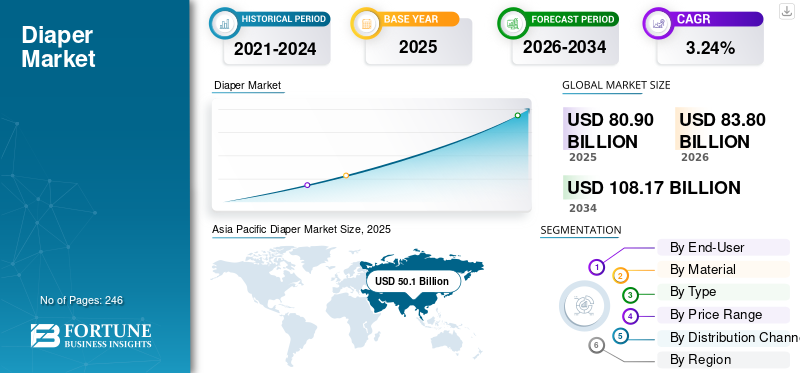
The global diaper market size was valued at USD 80.90 billion in 2025. The market is projected to grow from USD 83.80 billion in 2026 to USD 108.17 billion by 2034, exhibiting a CAGR of 3.24% during the forecast period. Asia Pacific dominated the diaper market with a market share of 61.92% in 2025.
The global market is undergoing a structural transformation shaped by demographic shifts, product innovation, and evolving consumer preferences. The rising prevalence of adult incontinence, increasing urbanization rates, and improving hygiene awareness across emerging markets are driving demand for high-quality nappies. Manufacturers emphasize product innovation, including the adoption of biodegradable and skin-friendly materials and smart absorption technologies, in product designs to enhance user comfort and sustainability. The increasing demand for sustainable, premium-based products is driving market growth.
Key players operating in the global market include The Procter & Gamble Company, Kimberly-Clark Corporation, Unicharm Corporation, Essity AB, and Ontex International. These companies collectively drive market innovation through diverse product portfolios that span both baby and adult incontinence care, responding to rising global demand and evolving hygiene standards.
DIAPER MARKET Key Takeways
 Market Size & Forecast
- 2025 Market Size: USD 80.90 Billion
- 2026 Market Size: USD 83.80 Billion
- 2034 Forecast Market Size: USD 108.17 Billion
- CAGR: 3.24% from 2026–2034
 Market Share
- Asia Pacific dominated the diaper market with a 61.92% share, generating USD 50.01 billion in 2025.
- The babies segment held the largest market share of 64.52% in 2025.
- The disposable segment accounted for the highest market share of 86.99% in 2025.
 Key Regional Highlights
Asia Pacific
Asia Pacific generated USD 50.01 billion in 2025 and is projected to reach USD 52.06 billion in 2026.
Europe
Europe held the second-largest market share in 2025, supported by strong demand for sustainable.
North America
North America maintained the third-largest market share in 2025, driven by high consumer awareness.
U.S.
The diaper market reached USD 7.86 billion in 2025, supported by strong demand for premium, eco-friendly, and adult incontinence products.
Japan
Demand for incontinence, hygiene, and premium baby care products drives growth.
Read More

DIAPER MARKET TRENDS
Growing Preference for Convenience in Baby Pads Purchasing Decisions to Favor Market Growth
Convenience-driven purchasing behavior reflects a major shift in consumer priorities within the global market, where buyers increasingly value ease of access, time efficiency, and product practicality over brand loyalty or price alone. Parents and caregivers with busy lifestyles prefer disposable, easy-to-use, and travel-friendly nappy options that reduce daily effort. This trend is also supported by the rise of online retail channels and subscription-based delivery services, which enable consumers to receive regular nappy supplies at home without the need for repeated store visits. The emphasis on hassle-free shopping and consistent availability has become a key factor shaping purchasing decisions in both baby and adult nappy categories.
Download Free sample to learn more about this report.
Download Free sample to learn more about this report.
MARKET DYNAMICS
MARKET DRIVERS
Rising Prevalence of Adult Incontinence to Drive Product Adoption
The rising prevalence of adult incontinence is a major global driver of nappy demand, supported by increasing life expectancy and greater medical awareness. As the aging population grows, more adults are experiencing mild to chronic incontinence, prompting higher adoption of disposable hygiene products. Increasing social acceptance and public health education are helping normalize the use of incontinence care products. Continuous innovation in discreet, comfortable, and high-performance designs is further accelerating the global market expansion. According to the NCBI (National Centre for Biotechnology Information), as of August 2024, approximately 423 million individuals worldwide aged 20 years and above are affected by some form of urinary incontinence.
MARKET RESTRAINTS
Environmental Concern and Disposable Issues of Disposable Diapers to Restrain Market Growth
Environmental concerns and waste disposal issues pose a significant restraint on the global nappies industry. Disposable nappies are primarily made from plastic-based materials, such as polyethylene, polypropylene, and superabsorbent polymers, which are non-biodegradable and can take up to hundreds of years to decompose in landfills. With billions of nappies discarded worldwide each year, the sector contributes substantially to solid waste accumulation and greenhouse gas emissions from waste degradation. Increasing regulatory pressure on product sales is expected to restrain the global diaper market growth.
MARKET OPPORTUNITIES
Advancements in the Development of Nappies of Sensor-based Technologies to Augment Market Growth
Continuous advancements in nappies design and materials are reshaping product performance, comfort, and user convenience. Manufacturers are increasingly incorporating sensor-based features that detect moisture or pH changes, helping caregivers manage hygiene more effectively and prevent skin irritation. At the same time, innovations in superabsorbent polymers, breathable fabrics, and biodegradable materials are enhancing product functionality and sustainability. These developments support the growing demand for premium, health-oriented, and eco-friendly hygiene solutions, positioning technology integration as a key competitive advantage in the market.
MARKET CHALLENGES
Volatility in Raw Material Costs to Challenge Key Players’ Business Revenue Growth
Fluctuating prices of essential raw materials such as fluff pulp, superabsorbent polymers, and nonwoven fabrics directly affect manufacturing costs and profit margins. These materials are heavily influenced by the dynamics of the petroleum and chemical markets, making price predictability challenging. As a result, nappy manufacturers often face pressure to balance cost efficiency with product quality and pricing stability.
Segmentation Analysis
By End-User
High Demand for Infant Hygiene Products Led the Babies Segment to Hold a Leading Market Share
Based on end-user, the market is bifurcated into babies and adults.
The babies segment held a leading diaper market share of 64.52% in 2025. The growth of this segment is driven by consistently high demand for infant hygiene products, rising global birth rates, and parental focus on convenience and hygiene. Despite declining fertility rates in some regions, the absolute number of newborns, particularly in developing countries, remains substantial, sustaining demand. Moreover, rising disposable incomes, urbanization, and increased awareness about baby health and sanitation have further strengthened this segment’s market share.
To know how our report can help streamline your business, Speak to Analyst
The adult segment is projected to grow at the fastest rate of 5.22% during the forecast period. This growth is primarily driven by the increasing prevalence of urinary incontinence and the aging population worldwide. Increasing awareness of adult hygiene products and the growing importance of incontinence care have encouraged their adoption among both elderly and younger adults. Additionally, innovations such as discreet, comfortable, and gender-specific designs have made adult nappies more acceptable and accessible, further accelerating segment growth.
By Material
Affordability and Wide Availability of Conventional Products Led the Conventional Segment to Hold a Dominant Market Share
Based on material, the market is bifurcated into conventional and organic.
The conventional segment held a leading global market share of 87.67% in 2025. This growth is driven by its affordability, wide range, and established manufacturing base. Conventional nappies, typically made from synthetic materials such as superabsorbent polymers and polyethylene, offer high absorption efficiency and cost-effectiveness, making them the preferred choice among consumers, especially in developing regions. Moreover, the strong presence of leading manufacturers focused on optimizing conventional product performance and production efficiency continues to reinforce the dominance of this segment.
The organic segment is projected to grow at the fastest rate of 5.87% during the forecast period. The growth of this segment is driven by rising consumer awareness regarding skin health and environmental sustainability. Parents are increasingly opting for nappies made from natural, biodegradable materials such as bamboo fiber and organic cotton, which are free from harmful chemicals and fragrances. Additionally, growing concerns over the ecological footprint of conventional nappies and the expansion of eco-friendly product portfolios by leading brands are accelerating the adoption of organic nappies across both baby and adult categories.
By Type
Dominance of Disposable Nappies Driven by Convenience and Hygiene Advantages
By type, the market is bifurcated into disposable and reusable.
The disposable segment held a leading global market share of 86.99% in 2025. The growth of this segment is primarily due to its superior convenience, hygiene, and ease of use. These nappies offer high absorbency, leak protection, and odor control, making them the preferred choice for both parents and caregivers. The increasing availability of advanced disposable products, featuring wetness indicators and breathable materials, has further strengthened their demand. Moreover, busy lifestyles and rising urbanization have reduced the preference for time-intensive reusable alternatives, reinforcing the dominance of disposable nappies in the global market.
The reusable segment is slated to grow at the fastest CAGR of 5.16% during the forecast period. The segment is experiencing notable growth as consumers become increasingly aware of environmental sustainability and the long-term cost efficiency benefits. Reusable personal care products, often made from organic cotton, bamboo, or microfiber, appeal to eco-conscious parents who seek to reduce waste and minimize their reliance on single-use plastics. Advances in product design, such as adjustable fittings, improved absorbent layers, and easy-to-clean materials, have enhanced their practicality and comfort. Additionally, the growing popularity of sustainable parenting practices and government initiatives promoting eco-friendly baby care products are accelerating the adoption of reusable nappies worldwide.
By Price Range
Affordability and Wide Acceptability of Economic Products Led to the Dominance of the Economy Segment
Based on price range, the market is segmented into economy, mid-range, and premium.
The economy segment held a leading market share of 41.91% in 2025. This segment’s growth is driven by the affordability and accessibility of nappies across a wide consumer base. Many households, particularly in developing regions, prioritize cost-effective nappy options that offer reliable performance at a lower price point. Manufacturers have also improved the quality and comfort of economy-range nappies, narrowing the gap between budget and premium offerings. Additionally, bulk purchasing options and strong distribution networks, facilitated through supermarkets and local retail stores, have further supported the widespread adoption of economy nappies.
The premium segment is slated to grow at the fastest CAGR of 3.47% during the forecast period. The segment is expanding rapidly as consumers increasingly seek high-quality, skin-friendly, and technologically advanced nappy products. Rising disposable incomes, particularly in urban areas, have encouraged parents and caregivers to invest in nappies offering superior comfort, breathability, and advanced absorbent technology. Premium nappies often feature innovations such as organic materials, wetness indicators, and ultra-soft textures, catering to growing preferences for enhanced hygiene and convenience. Furthermore, the influence of premiumization trends and brand differentiation strategies by leading manufacturers is driving the growth of this segment.
By Distribution Channel
Diverse Portfolio and Widespread Retail Presence Led Hypermarkets & Supermarkets to Dominate the Market
Based on distribution channels, the market is segmented into hypermarkets & supermarkets, specialty stores, pharmacy stores, online channels, and others.
The hypermarkets & supermarkets segment held a dominant market share of 47.49% in 2025. The growth of this segment is driven by its extensive product variety, strong brand visibility, and attractive promotional offers. These retail formats enable consumers to physically assess nappies’ quality, compare brands, and take advantage of bulk purchase discounts. Their widespread presence in both developed and emerging economies enhances product accessibility and trust among buyers. Additionally, the convenience of one-stop shopping and frequent in-store promotions by leading nappy manufacturers further strengthen the dominance of hypermarkets & supermarkets in nappy sales.
The online channels segment is projected to grow at the fastest rate of 5.74% from 2026 to 2034. The segment is growing swiftly as consumers increasingly prefer the convenience of home delivery, subscription models, and easy price comparisons. The expansion of e-commerce platforms and digital marketing by major incontinence product brands is further driving global online sales growth.
Diaper Market Regional Outlook
By geography, the market is categorized into North America, Europe, Asia Pacific, South America, and Middle East & Africa.
Asia Pacific
The Asia Pacific region held the dominant share in 2025, valued at USD 50.01 billion, and is expected to maintain its leading position in 2026, with a value of USD 52.06 billion. The region is projected to grow at the fastest rate during the forecast period. Asia Pacific’s market growth is driven by its substantial infant population and increasing awareness of hygiene and baby care. Rapid urbanization, rising disposable incomes, and growing participation of women in the workforce have fueled demand for convenient diapering solutions. Countries such as China, India, and Japan are key contributors, with strong domestic manufacturing and expanding retail infrastructure. Moreover, the growing adoption of premium and eco-friendly products reflects the region’s evolving consumer preferences and improving living standards.
Asia Pacific Diaper Market Size, 2025 (USD Billion)
To get more information on the regional analysis of this market, Download Free sample
China Diaper Market
The Chinese market size reached USD 19.17 billion in 2025. China dominates the Asia Pacific market, driven by its large population, rising income levels, and strong consumer awareness of hygiene and baby care. The shift toward premium and ultra-soft nappies has accelerated as parents prioritize comfort and skin protection for infants. Additionally, the aging population and increasing prevalence of adult incontinence are boosting demand for adult incontinence products. The market is further supported by local production expansion, government encouragement of elderly care products, and the growing popularity of e-commerce platforms such as JD.com and Tmall for nappy purchases.
India Diaper Market
The Indian market in 2025 was valued at USD 7.20 billion, accounting for roughly 8.90% of global market revenues.
North America
The North America region held the third-largest global market share in 2025 and is expected to maintain its position over the forecast period. The market in this region is well-established, driven by high consumer awareness, strong purchasing power, and widespread availability of advanced hygiene products. The region benefits from a mature retail infrastructure, with leading brands continuously innovating in absorbent technology, comfort, and eco-friendly materials. The rising adoption of adult incontinence products, particularly among the aging population, has also contributed to market expansion. Moreover, the growing popularity of subscription-based online purchases and demand for sustainable nappy alternatives are reshaping consumer preferences across the U.S. and Canada.
U.S. Diaper Market
The U.S. market size reached USD 7.86 billion in 2025. High disposable incomes and strong brand presence support the market. Growing demand for premium, eco-friendly, and adult incontinence products continues to drive innovation and market expansion.
Europe
The European region held second place in global market during the forecast period. Europe represents a mature yet steadily evolving market characterized by high product penetration, strong brand loyalty, and an increasing preference for sustainable, eco-friendly options. Consumers in the region are shifting toward organic and biodegradable nappies, driven by environmental awareness and stringent regulatory standards on waste management. Additionally, the growing elderly population has increased demand for adult incontinence products, particularly in countries such as Germany, France, and the U.K. Continuous innovation by leading brands in skin-friendly, compostable materials further supports the region’s market growth.
U.K. Diaper Market
The U.K. market in 2025 was valued at USD 1.47 billion, representing approximately 1.82% of global product revenues.
Germany Diaper Market
Germany’s market reached a valuation of USD 2.28 billion in 2025, equivalent to around 2.82% of global product sales.
South America and Middle East & Africa
The South America market in 2025 reached a valuation of USD 5.30 billion. The regional market is experiencing steady growth, driven by improving economic conditions, rising hygiene awareness, and expanding access to affordable nappy products. Brazil and Argentina are the key contributors, supported by growing urban populations and increasing participation of women in the workforce. The availability of cost-effective disposable nappies through supermarkets and local retail channels enhances market penetration. Additionally, the gradual adoption of eco-friendly and premium nappy variants reflects a shifting consumer preference toward higher-quality hygiene solutions.
The Middle East & Africa market is witnessing gradual growth, supported by rising birth rates, increasing urbanization, and improved access to modern retail infrastructure. The expanding middle-class population and greater awareness of hygiene and infant care primarily drive demand. Countries such as the UAE and South Africa are leading markets due to higher income levels and the strong presence of international underwear brands. Furthermore, growing acceptance of adult incontinence products and the emergence of affordable local manufacturing are fostering market development across the region. In the Middle East & African market, South Africa reached a market value of USD 1.78 billion in 2025.
UAE Diaper Market
The UAE market reached approximately USD 0.44 billion in 2025, accounting for roughly 0.54% of the global market revenues.
COMPETITIVE LANDSCAPE
Key Industry Players
Product Innovation and Strong Global Footprint to Help Key Players Maintain Competitive Market Position
The leading players, including The Procter & Gamble Company, Kimberly-Clark Corporation, Unicharm Corporation, Essity AB, and Ontex International, consolidate the global market. Procter & Gamble and Kimberly-Clark dominate North America with their Pampers and Huggies brands, innovating continuously in absorbency, comfort, and skin protection, features that are highly sought after by consumers. Unicharm and Essity have extensive international footprints, particularly in the Asia Pacific and Europe, focusing on affordability and product accessibility through local production and healthcare collaborations. Ontex and Essity also push sustainability, exemplified by the launch of eco-friendly technologies that reduce plastic usage and environmental impact. Overall, intense competition, frequent product launches, and investments in both premium and eco-friendly segments ensure ongoing growth and a diverse product offering globally, while regional players and private labels increase affordability and access across markets.
LIST OF KEY DIAPER COMPANIES PROFILED
- The Procter & Gamble Company (U.S.)
- Kimberly-Clark Corporation (U.S.)
- Unicharm Corporation (Japan)
- Essity AB (Sweden)
- Ontex International N.V. (Belgium)
- Hengan International Group (China)
- Kao Corporation (Japan)
- Domtar Corporation (U.S.)
- Daio Paper Corporation (Japan)
- First Quality Enterprises (U.S.)
KEY INDUSTRY DEVELOPMENTS
- July 2025: Ontex International developed bio-based Superabsorbent Polymers (bioSAP) for use in nappies. The developed polymer enabled the company to replace virgin fossil-based plastic SAP in nappies, delivering similar absorbance performance.
- June 2025: Kimberly‑Clark Corporation entered into a strategic joint‑venture agreement with Suzano S.A. (Brazilian pulp and fiber company) covering Kimberly‑Clark’s International Family Care & Professional business. The move is part of Kimberly-Clark’s portfolio optimization and refocus on higher-growth hygiene segments.
- May 2025: Ontex International launched the 360° Anti-Leak barrier system for baby diapers, targeting the U.S. and other premium markets. This design is equipped with front-to-back leak protection for the baby’s comfort.
- January 2025: Neo Asset Management invested USD 20 million in Nobel Hygiene Pvt. Ltd.’s adult & kid nappies business to expand its product portfolio.
- October 2024: Softys S.A. (a subsidiary of CMPC) acquired Brazil‑based diaper manufacturer Falcon Distribuição Armazenamento e Transporte S.A. for approximately USD 123 million. This deal strengthens CMPC’s footprint in baby and adult incontinence products in the Brazilian market.
- September 2024: DOMS Industries Ltd. invested USD 7.3 million to acquire Uniclan Healthcare Pvt. Ltd., a wipe and nappy manufacturer, to expand its business in the baby hygiene products category.
- March 2024: First Quality announced a major expansion of its baby pads and training‑pant manufacturing capacity by 50% with a new facility, new nappy lines, and a state‑of‑the‑art automated warehouse in Macon, Georgia, U.S.
REPORT COVERAGE
The global baby diapers market analysis provides an in-depth study of market insights, size, and forecast for all the market segments included in the report. In addition, the report outlooks market dynamics and trends expected to drive the market over the forecast period. It offers information on the technological advancements, new product launches, key industry developments, and details on partnerships, mergers, and acquisitions. The market research report also encompasses a detailed competitive landscape with information on the market share and profiles of key operating players.
Request for Customization to gain extensive market insights.
Report Scope & Segmentation
| ATTRIBUTE | DETAILS |
| Study Period | 2021-2034 |
| Base Year | 2025 |
| Forecast Period | 2026-2034 |
| Historical Period | 2021-2024 |
| Growth Rate | CAGR of 3.24% from 2026-2034 |
| Unit | Value (USD Billion) |
| Segmentation | By End-User, Material, Type, Price Range, Distribution Channel, and Region |
| By End-User |
|
| By Material |
|
| By Type |
|
| By Price Range |
|
| By Distribution Channel |
|
| By Geography |
|
Frequently Asked Questions
Fortune Business Insights says that the global market value stood at USD 80.90 billion in 2025 and is projected to reach USD 108.17 billion by 2034.
In 2025, the Asia Pacific’s market value stood at USD 50.01 billion.
The market is expected to exhibit a CAGR of 3.24% during the forecast period.
Based on end-user, the babies segment led the market in 2025.
The rising prevalence of adult incontinence is the key factor driving the market.
The Procter & Gamble Company, Kimberly-Clark Corporation, Unicharm Corporation, Essity AB, and Ontex International are some of the prominent players in the market.
Asia Pacific dominated the market in 2025 with the largest share.
The advancements in the development of sensor-based diapers and premium materials are expected to favor the adoption rate of this product.



- 2021-2034
- 2025
- 2021-2024
- 246
-
(Offer valid till 30th Sep 2026)
Get 30-60 hrs Free Customization
Expand Regional and Country Coverage, Segments Analysis, Company Profiles, Competitive Benchmarking, and End-user Insights.



















Related Reports
-
US +1 833 909 2966 ( Toll Free )
-
Get In Touch With Us