Wine Cooler Market Size, Share & Industry Analysis, By Product (Free-standing, Countertop, Built-in), By Application (Residential, Commercial), and Regional Forecast, 2026-2034
 Download Free Sample
Wine Cooler Market Overview
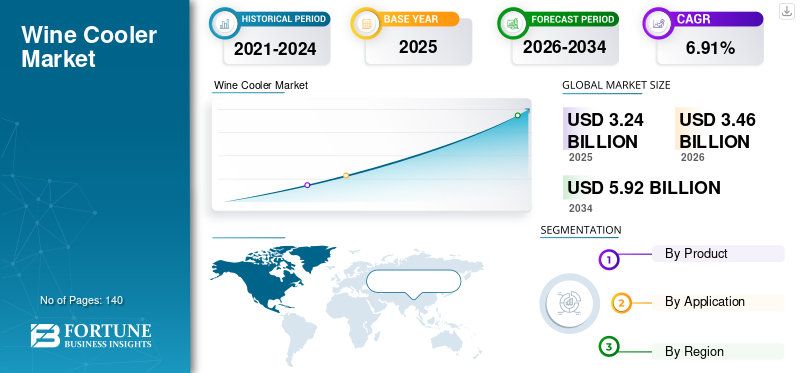
The global wine cooler market size was valued at USD 3.24 billion in 2025. The market is projected to grow from USD 3.46 billion in 2026 to USD 5.92 billion by 2034, exhibiting a CAGR of 6.91% during the forecast period.

The wine cooler market is expanding steadily due to increasing consumer preference for premium beverage storage solutions in residential and commercial environments. Demand for wine coolers is growing among urban households, restaurants, hotels, wine bars, and luxury real estate developers seeking advanced temperature-controlled storage systems. The market is witnessing higher adoption of dual-zone wine coolers, smart connectivity features, energy-efficient compressor technology, and aesthetically integrated appliances. Manufacturers are focusing on silent cooling systems, UV-resistant glass doors, humidity management, and customizable shelving to attract premium buyers. The wine cooler market report highlights increasing penetration of compact and built-in units across modern kitchens, hospitality spaces, and entertainment lounges globally.
The United States wine cooler market is experiencing strong product demand driven by expanding wine consumption culture, growth in luxury home remodeling projects, and rising interest in home entertainment appliances. Consumers in metropolitan areas increasingly prefer premium wine preservation systems equipped with digital controls and smart monitoring technology. Commercial establishments including wine bars, fine-dining restaurants, and boutique hotels are also investing heavily in high-capacity wine coolers to improve beverage storage standards. The USA market benefits from strong distribution networks, rising online appliance sales, and increasing preference for energy-efficient refrigeration appliances. Growing consumer awareness regarding proper wine aging and storage conditions is further supporting wine cooler market growth in the country.
Download Free sample to learn more about this report.
Wine Cooler Market Key Takeaways
 Global Market Size & Forecast
- 2025 Market Size: USD 3.24 Billion
- 2026 Market Size: USD 3.46 Billion
- 2034 forecast Market Size: USD 5.92 Billion
- CAGR: 6.91% from 2026–2034
 Market Share
- The market in North America dominated with a revenue share of 38% in 2025.
- Free-standing wine coolers held a 41% market share by product.
- Residential applications accounted for a 63% market share.
 Key Regional Highlights
North America
North America held 38%, driven by strong residential and commercial demand.
Europe
Europe held 31%, supported by premium wine storage and hospitality demand.
Asia-Pacific
Asia-Pacific held 23%, driven by urbanization and rising disposable incomes.
U.S
Strong demand for premium residential and commercial wine coolers.
Japan
19% of Asia-Pacific, supported by compact and advanced wine cooling solutions.
Read More

Wine Cooler Market Latest trends
The wine cooler market trends indicate a major shift toward smart and connected cooling appliances designed for modern residential and commercial applications. Manufacturers are introducing Wi-Fi-enabled wine coolers with smartphone control systems, automatic temperature adjustments, inventory tracking, and energy optimization capabilities. Consumers are increasingly demanding dual-zone and triple-zone wine coolers that can store multiple wine varieties simultaneously under different cooling conditions. Premium stainless steel finishes, frameless glass doors, ambient LED lighting, and low-noise compressor technologies are becoming standard features across the Wine Cooler industry report landscape.
Download Free sample to learn more about this report.
Another major trend influencing the wine cooler market analysis is the growing demand for built-in and under-counter wine coolers in luxury kitchens and compact apartments. Space-efficient product designs are gaining popularity among urban consumers seeking modern integrated appliances. Sustainable manufacturing practices and energy-efficient refrigerants are also becoming key product differentiation factors. Commercial sectors including restaurants, wine retailers, and hospitality chains are increasingly adopting large-capacity wine storage cabinets with advanced humidity control systems. Online retail platforms are further accelerating product visibility and customer accessibility, supporting global wine cooler market opportunities for both established brands and emerging manufacturers.
Wine Cooler Market Dynamics
DRIVER
Rising Consumer Demand for Premium Wine Storage Appliances
The primary growth driver in the wine cooler market is the increasing global consumption of wine combined with rising awareness regarding proper wine preservation. Consumers are becoming more knowledgeable about maintaining optimal temperature and humidity conditions for wine quality retention, leading to greater demand for dedicated wine cooling appliances. Urban households with rising disposable incomes are investing in luxury kitchen appliances and home entertainment systems, significantly contributing to wine cooler market growth.
The hospitality sector is also fueling demand for wine coolers across restaurants, hotels, lounges, and bars. Commercial establishments require specialized wine storage systems to maintain product quality and improve customer experience. Growing popularity of wine tourism, premium dining culture, and home wine collections is encouraging purchases of technologically advanced wine coolers. Manufacturers are responding by introducing stylish, compact, and energy-efficient models suitable for modern residential and commercial environments. The increasing availability of smart appliances through online retail channels is further accelerating wine cooler market Expansion worldwide.
RESTRAINT
High Product Costs and Maintenance Expenses
One of the major restraints affecting the wine cooler market is the relatively high purchase cost associated with premium wine storage appliances. Advanced models equipped with dual-zone cooling, smart monitoring systems, UV protection, and humidity control often carry higher price tags, limiting adoption among middle-income consumers. In developing economies, consumers frequently prioritize essential household appliances over specialized refrigeration systems, reducing potential market penetration.
Maintenance and operational costs also present challenges for end users. Compressor repairs, cooling component replacements, and energy consumption concerns may discourage long-term investment in premium wine coolers. Commercial users operating multiple storage units face increased electricity and servicing expenditures, especially in regions with unstable power infrastructure. Additionally, counterfeit and low-quality products available through unorganized retail channels negatively impact consumer trust and brand reputation. These factors collectively create barriers for consistent wine cooler market share growth across price-sensitive markets.
OPPORTUNITY
Expansion of Smart Home and Luxury Kitchen Infrastructure
The rapid expansion of smart home ecosystems and luxury residential developments presents major opportunities for the wine cooler market forecast. Consumers increasingly seek integrated appliances that align with modern interior aesthetics and connected home environments. Smart wine coolers equipped with mobile applications, voice assistant compatibility, and automated climate management systems are gaining strong traction among premium buyers.
Luxury real estate developers are incorporating built-in wine coolers into modular kitchens and entertainment spaces, supporting sustained demand growth. Commercial opportunities are also emerging within boutique hotels, wine cellars, private clubs, and fine-dining establishments that require advanced beverage storage systems. Emerging economies in Asia-Pacific and the Middle East are witnessing rising demand for imported wines and premium refrigeration appliances, creating new revenue streams for manufacturers. Expansion of e-commerce platforms and direct-to-consumer appliance sales channels is further improving accessibility, supporting long-term wine cooler market opportunities globally.
CHALLENGE
Intense Competition and Product Commoditization
The wine cooler market faces substantial challenges due to intense competition among international appliance manufacturers and regional suppliers. Numerous companies are competing through aggressive pricing strategies, product innovation, and rapid feature upgrades. This competitive environment often pressures manufacturers to reduce profit margins while continuously investing in research and development activities.
Another major challenge involves product commoditization in lower and mid-range market segments. Consumers increasingly compare products based primarily on price rather than technological differentiation, making it difficult for premium brands to maintain strong brand loyalty. Supply chain disruptions, fluctuating raw material prices, and rising transportation costs further impact manufacturing efficiency. Additionally, maintaining energy efficiency compliance and environmental refrigeration standards requires continuous technological upgrades and regulatory adaptation. These challenges influence the overall Wine Cooler industry analysis and create operational complexities for manufacturers operating in highly competitive global markets.
Wine Cooler Market Segmentation
By Product
Free-standing wine coolers account for nearly 41% of the global wine cooler market share due to their flexibility, larger storage capacities, and ease of installation. These units are widely used in residential homes, restaurants, and hospitality venues where mobility and accessibility are important considerations. Consumers prefer free-standing wine coolers because they can be placed in dining rooms, entertainment areas, kitchens, or wine cellars without requiring structural modifications. Manufacturers are introducing advanced free-standing models with dual-zone cooling systems, anti-vibration compressors, and touch-screen temperature controls to enhance product appeal. Commercial users increasingly adopt high-capacity free-standing wine coolers for restaurants, bars, and hotels where organized wine display and storage are critical. Premium designs featuring stainless steel exteriors, panoramic glass doors, and customizable shelving systems are becoming popular among luxury buyers.
Countertop wine coolers represent approximately 24% of the wine cooler market Size due to increasing demand for compact beverage storage solutions among urban consumers. These appliances are designed for small apartments, office spaces, studio kitchens, and personal entertainment areas where space optimization is essential. Countertop units are particularly popular among young professionals and casual wine consumers seeking affordable and portable cooling appliances. Manufacturers are focusing on lightweight designs, thermoelectric cooling systems, and stylish finishes to strengthen product competitiveness in this category. Compact countertop wine coolers equipped with digital displays, LED lighting, and adjustable temperature settings are gaining significant traction across online retail channels.
Built-in wine coolers hold nearly 35% of the global wine cooler market share and are witnessing strong demand in luxury residential and premium commercial environments. These appliances are integrated directly into cabinetry, kitchen islands, or entertainment walls, offering seamless aesthetic integration with modern interiors. Built-in models are increasingly preferred in high-end real estate projects and modular kitchen installations due to their sophisticated appearance and space-saving advantages. The commercial sector also utilizes built-in wine coolers extensively in hotels, restaurants, and private clubs where elegant presentation and premium ambiance are important. Manufacturers are introducing advanced built-in models featuring smart connectivity, humidity stabilization, and multi-zone cooling systems to meet evolving consumer expectations. The wine cooler market outlook suggests increasing investments in luxury residential infrastructure will continue driving demand for built-in wine cooling solutions globally.
By Application
The residential segment contributes nearly 63% of the global wine cooler market share due to growing consumer interest in home wine storage and premium kitchen appliances. Rising disposable income levels, urbanization, and increasing adoption of smart home technologies are encouraging households to invest in dedicated wine cooling systems. Homeowners are increasingly incorporating wine coolers into kitchen renovations, entertainment rooms, and luxury living spaces. Consumers prefer residential wine coolers with silent operation, compact dimensions, energy efficiency, and advanced digital controls. Built-in and dual-zone wine coolers are especially popular among premium residential buyers seeking aesthetic integration and specialized wine preservation. Online appliance retailers are significantly improving product accessibility and customer awareness within the residential segment.
The commercial segment accounts for approximately 37% of the wine cooler market Size and remains essential for restaurants, hotels, wine bars, retailers, and hospitality chains. Commercial establishments require reliable wine storage systems capable of maintaining stable temperatures and humidity levels for premium beverage preservation. Demand is particularly strong among fine-dining restaurants and luxury hospitality venues seeking advanced wine presentation capabilities. Commercial wine coolers are increasingly equipped with high-capacity shelving, anti-vibration technology, UV-resistant glass, and multi-zone cooling systems to support operational efficiency. Wine retailers and specialty beverage stores are also investing in display-oriented wine coolers that improve product visibility and customer engagement. The Wine Cooler industry analysis indicates growing tourism, hospitality expansion, and premium dining trends are creating substantial opportunities within the commercial application segment.
Wine Cooler Market Regional outlook
North America
North America holds nearly 38% of the global wine cooler market share due to rising consumer interest in premium wine preservation appliances and strong demand from hospitality businesses. The region benefits from high wine consumption rates, advanced retail infrastructure, and increasing adoption of smart kitchen appliances. Residential consumers across the United States and Canada are increasingly investing in luxury kitchen remodeling projects that include built-in and dual-zone wine coolers. Demand is also growing among affluent households seeking organized wine storage systems for personal collections and entertainment spaces. The wine cooler market report highlights growing awareness regarding ideal wine temperature maintenance as a key factor supporting appliance adoption throughout the region.
Commercial establishments including restaurants, hotels, wine bars, and luxury resorts are further contributing to regional market expansion. Hospitality operators increasingly install large-capacity wine coolers to improve beverage storage quality and customer satisfaction. Manufacturers are focusing on energy-efficient refrigeration systems, low-noise compressors, and customizable shelving designs to meet evolving consumer preferences. E-commerce platforms and specialty appliance retailers are improving product accessibility across metropolitan and suburban areas. Smart wine coolers integrated with mobile applications and digital controls are becoming increasingly popular among technology-oriented buyers. Continued innovation in premium appliance aesthetics and advanced cooling technologies remains a major driver of wine cooler market growth in North America.
Europe
Europe accounts for approximately 31% of the global wine cooler market share due to its strong wine culture, developed hospitality sector, and widespread consumer preference for premium beverage storage systems. Countries such as France, Italy, Germany, Spain, and the United Kingdom represent major markets for residential and commercial wine coolers. European consumers place significant importance on preserving wine quality, encouraging steady adoption of advanced cooling appliances equipped with humidity control, UV-resistant glass, and silent compressor technology. The wine cooler market analysis indicates rising demand for integrated wine coolers within luxury residential kitchens and modern hospitality environments throughout the region.
The commercial sector remains a major contributor to regional growth as restaurants, wine retailers, hotels, and private clubs increasingly require reliable wine preservation systems. Manufacturers operating in Europe emphasize energy-efficient cooling technologies and sustainable refrigerants to comply with strict environmental regulations. Built-in wine coolers with sleek aesthetics and customizable shelving systems are particularly popular among urban consumers seeking space-efficient solutions. Growing investment in luxury real estate developments and high-end hospitality infrastructure continues supporting regional wine cooler market Expansion. Online appliance retail platforms and premium home appliance showrooms are also strengthening product visibility and consumer accessibility across European countries.
Germany Wine Cooler Market
Germany contributes nearly 27% of Europe’s wine cooler market share due to strong demand for technologically advanced refrigeration appliances and increasing interest in premium home entertainment systems. German consumers prioritize durability, energy efficiency, and high-performance cooling systems when selecting wine coolers for residential and commercial use. Built-in wine coolers are gaining popularity among luxury homeowners and modular kitchen developers seeking integrated storage appliances that complement modern interior aesthetics. The Germany wine cooler market report highlights growing demand for dual-zone and multi-zone cooling systems capable of storing different wine varieties under ideal temperature conditions.
Commercial establishments including upscale restaurants, hotels, wine boutiques, and entertainment venues are investing heavily in advanced wine preservation systems. Demand for silent compressor technology and vibration-free cooling systems remains particularly strong among professional users concerned with maintaining wine quality over long periods. Manufacturers are increasingly introducing smart wine coolers featuring digital touch controls, Wi-Fi connectivity, and energy-saving technologies tailored to German consumer preferences. Expansion of online appliance retail platforms and premium kitchen showrooms is further improving market accessibility. Rising interest in imported wines and premium beverage experiences continues supporting long-term wine cooler market growth throughout Germany.
United Kingdom Wine Cooler Market
The United Kingdom represents around 22% of Europe’s wine cooler market share due to increasing wine consumption trends and rising demand for premium residential appliances. Consumers across the country are increasingly incorporating wine coolers into luxury kitchens, entertainment spaces, and modern apartments as part of evolving lifestyle preferences. Compact built-in and countertop wine coolers are particularly popular among urban households where space optimization is essential. The United Kingdom wine cooler market analysis highlights rising consumer interest in smart appliances equipped with digital temperature controls, LED lighting, and stylish stainless-steel finishes.
Commercial demand is also expanding steadily across restaurants, boutique hotels, wine bars, and hospitality venues seeking improved beverage storage solutions. Businesses are investing in high-capacity wine coolers with multi-zone cooling systems to maintain wine quality and presentation standards. Manufacturers are introducing energy-efficient and low-noise cooling technologies to meet growing consumer expectations regarding sustainability and convenience. Online appliance retailers continue strengthening product availability across the country, allowing consumers to compare premium models and customized storage options. Increasing awareness regarding proper wine aging and preservation techniques is further contributing to the expansion of the wine cooler market outlook in the United Kingdom.
Asia-Pacific
Asia-Pacific holds approximately 23% of the global wine cooler market share and remains one of the fastest-growing regional markets due to rising disposable incomes and changing consumer lifestyles. Growing wine consumption across China, Japan, South Korea, and Australia is increasing demand for specialized refrigeration appliances capable of preserving beverage quality. Urban consumers are increasingly investing in compact and stylish wine coolers that align with modern apartment living and luxury kitchen designs. The wine cooler market research report highlights strong growth opportunities associated with premium residential infrastructure development and rising awareness regarding wine preservation standards throughout the region.
Commercial sectors including hotels, fine-dining restaurants, wine retailers, and entertainment lounges are also driving market demand. Hospitality operators increasingly require advanced wine storage systems equipped with humidity stabilization, UV protection, and dual-zone cooling capabilities. Regional manufacturers are introducing affordable and energy-efficient wine cooler models tailored to local consumer preferences and compact living environments. E-commerce expansion and growing penetration of smart home technologies are further accelerating regional market development. Increased consumer exposure to international wine brands and premium lifestyle products continues supporting long-term wine cooler market opportunities across Asia-Pacific countries.
Japan Wine Cooler Market
Japan contributes nearly 19% of the Asia-Pacific wine cooler market share due to strong demand for compact premium appliances and advanced refrigeration technologies. Japanese consumers value minimalistic design, energy efficiency, and silent appliance operation, making compact built-in and countertop wine coolers highly popular in urban residential environments. Space-saving wine storage systems integrated into modern kitchens are increasingly preferred among apartment owners and luxury homeowners. The Japan wine cooler market report indicates growing interest in smart refrigeration appliances equipped with digital temperature controls and humidity management systems.
Commercial establishments including luxury hotels, fine-dining restaurants, and premium wine retailers are also increasing investments in advanced wine cooling systems to improve beverage quality and customer satisfaction. Manufacturers are focusing on sleek aesthetics, low-vibration cooling systems, and environmentally sustainable refrigerants tailored to Japanese market preferences. Online retail channels and specialty appliance stores continue improving accessibility to premium wine cooler products throughout the country. Rising wine appreciation culture and growing interest in imported wines are encouraging consumers to adopt dedicated wine preservation systems. These factors continue supporting wine cooler market growth across Japan’s residential and commercial sectors.
China Wine Cooler Market
China accounts for approximately 16% of the Asia-Pacific wine cooler market share due to rapid urbanization, rising disposable incomes, and increasing popularity of wine consumption among middle-class consumers. Premium residential developments across major cities are driving demand for built-in and free-standing wine coolers designed for luxury apartments and modern kitchens. Chinese consumers increasingly view wine coolers as premium lifestyle appliances associated with status, sophistication, and modern living standards. The wine cooler market forecast highlights strong growth potential resulting from increasing smart home adoption and rising demand for imported wine products.
Commercial demand is also expanding significantly among hotels, restaurants, private clubs, and wine retailers seeking advanced beverage storage systems. Domestic and international manufacturers are aggressively competing through affordable pricing strategies, innovative product designs, and advanced cooling technologies. Smart wine coolers equipped with mobile connectivity and energy-efficient compressor systems are gaining popularity among younger consumers. E-commerce platforms play a major role in strengthening nationwide product accessibility and consumer awareness. Continued investment in luxury hospitality infrastructure and premium residential construction projects remains a major factor driving wine cooler market Expansion throughout China.
Rest of World
The Rest of World region accounts for nearly 8% of the global wine cooler market share and includes Latin America, the Middle East, and Africa. These regions are witnessing gradual market expansion due to increasing urbanization, rising disposable incomes, and growing adoption of luxury lifestyle products. Wine consumption trends are strengthening among affluent consumers, encouraging demand for advanced wine preservation systems in residential and commercial environments. The wine cooler market analysis indicates increasing interest in compact and built-in wine coolers across premium housing developments and upscale urban apartments.
Commercial establishments including luxury hotels, fine-dining restaurants, resorts, and entertainment venues are also supporting regional market development. Hospitality businesses increasingly require specialized refrigeration systems capable of maintaining ideal wine storage conditions while enhancing beverage presentation quality. Manufacturers are targeting emerging markets through affordable product offerings, compact appliance designs, and expanding retail distribution networks. growth in tourism and luxury real estate infrastructure continues creating additional opportunities for wine cooler manufacturers operating across the Rest of World region. Increasing awareness regarding premium beverage preservation and modern kitchen appliance integration remains an important factor contributing to long-term wine cooler market growth.
List of Top Wine Cooler Companies
- Allavino Company
- Avanti Products, Inc.
- Electrolux AB
- Danby Appliances Inc.
- AGA Marvel
- Viking Range, LLC
- Donlert Electrical Co Ltd.
- Newari Company
- LG Electronics
- General Electric Company
Top Two Companies by Market share
- Electrolux AB – 16% market share
- LG Electronics – 13% market share
Investment analysis and opportunities
The wine cooler market is attracting substantial investments due to rising demand for premium refrigeration appliances and smart kitchen technologies. Manufacturers are increasing research and development spending to introduce energy-efficient cooling systems, intelligent temperature management, and environmentally sustainable refrigerants. Investments in luxury residential infrastructure and hospitality expansion are creating significant growth opportunities for wine cooler manufacturers globally.
E-commerce expansion is also opening new investment channels by improving direct-to-consumer appliance sales and product accessibility. Emerging markets in Asia-Pacific and the Middle East offer strong long-term opportunities due to urbanization and increasing disposable incomes. Investors are particularly focusing on smart built-in wine coolers, compact countertop models, and commercial-grade storage systems designed for hospitality applications. Partnerships between appliance brands and luxury real estate developers are further supporting market expansion. Growing consumer demand for premium home entertainment products and modular kitchen appliances continues strengthening the global wine cooler market outlook.
New Product Development
Product innovation remains a major competitive factor within the wine cooler market. Manufacturers are introducing advanced cooling technologies designed to improve temperature stability, humidity management, and energy efficiency. Smart wine coolers equipped with Wi-Fi connectivity, touchscreen controls, and mobile application integration are gaining increasing popularity among technology-oriented consumers.
Recent product developments also focus on aesthetic enhancements including frameless glass doors, customizable shelving systems, ambient LED lighting, and premium stainless steel finishes. Compact built-in wine coolers designed for modern apartments and modular kitchens are expanding rapidly. Manufacturers are additionally incorporating low-vibration compressors and UV-resistant glass to improve wine preservation quality. Commercial-grade wine coolers with larger capacities and multi-zone cooling systems are also being developed to meet hospitality industry requirements. The wine cooler market trends indicate continued innovation in sustainable refrigeration systems and intelligent appliance connectivity features.
Five Recent Developments (2023-2025)
- Electrolux AB introduced a new smart dual-zone wine cooler series with mobile application temperature monitoring in 2024.
- LG Electronics launched energy-efficient built-in wine coolers featuring inverter compressor technology in 2023.
- Danby Appliances Inc. expanded its compact countertop wine cooler portfolio for urban residential consumers in 2025.
- Viking Range, LLC introduced luxury integrated wine storage systems with customizable shelving and humidity control in 2024.
- Avanti Products, Inc. launched commercial-grade wine coolers targeting hospitality and restaurant sectors in 2025.
report Coverage of the Wine Cooler Market
The wine cooler market report provides comprehensive analysis of industry structure, product innovation, competitive landscape, regional performance, and application trends across residential and commercial sectors. The report examines evolving consumer preferences related to smart refrigeration appliances, luxury kitchen integration, and premium beverage preservation systems. Detailed segmentation analysis covers free-standing, countertop, and built-in wine coolers alongside residential and commercial applications.
Request for Customization to gain extensive market insights.
Regional insights evaluate market dynamics across North America, Europe, Asia-Pacific, and Rest of World markets, highlighting emerging growth opportunities and technological developments. The report also profiles leading manufacturers, product innovation strategies, and investment trends shaping industry competition. analysis includes distribution channel developments, online appliance retail expansion, and increasing demand for energy-efficient refrigeration technologies. The wine cooler market research report further examines commercial hospitality adoption trends and the growing role of smart connected appliances in modern residential infrastructure.
Frequently Asked Questions
Fortune Business Insights says that the global market value stood at USD 3.24 billion in 2025 and is projected to reach USD 5.92 billion by 2034.
The market is expected to exhibit a CAGR of 6.91% during the forecast period of 2026-2034.
The freestanding wine cooler segment was the leading type segment, driven by its portability, flexible placement, and suitability for residential and commercial spaces.
Key players include Haier Inc., Electrolux AB, Whirlpool Corporation, LG Electronics Inc., Samsung Electronics Co., Ltd., and Robert Bosch GmbH.
Major trends include rising demand for smart and connected wine coolers and growing preference for energy-efficient models with advanced temperature-control technologies. North America is a major regional market, supported by premium wine consumption and home entertainment trends.



- 2021-2034
- 2025
- 2021-2024
- 140
-

(Offer valid till 30th Sep 2026)
Get 30-60 hrs Free Customization
Expand Regional and Country Coverage, Segments Analysis, Company Profiles, Competitive Benchmarking, and End-user Insights.




















-
US +1 833 909 2966 ( Toll Free )
-
Get In Touch With Us